

STRAIT OF HORMUZ — A ship anchored off the United Arab Emirates was seized and steered toward Iran on Thursday while a second vessel — an Indian-flagged cargo ship near Oman — sank after an attack sparked a fire aboard, as the Persian Gulf lurched into fresh turmoil and Iran’s foreign minister declared his country had no trust in the United States and would only negotiate if Washington proved it was serious.
The back-to-back maritime incidents unfolded as U.S. President Donald Trump sat with Chinese President Xi Jinping in Beijing and both governments agreed publicly that the Strait of Hormuz must stay open — a statement of shared principle that had no visible effect on what was happening in the waters it described.
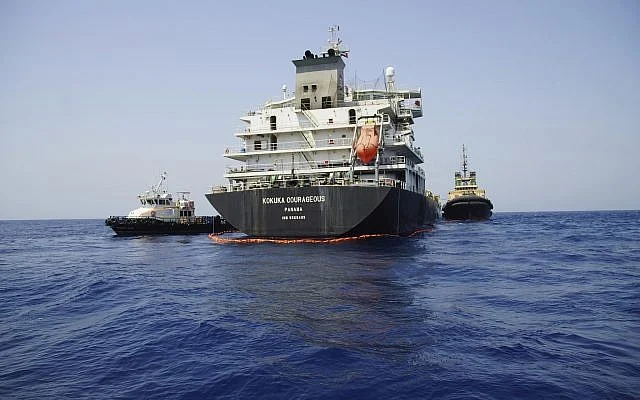
Britain’s Maritime Trade Operations center confirmed the seizure, saying unauthorized personnel boarded and took control of a vessel anchored 38 nautical miles northeast of the UAE port of Fujairah — an oil export terminal that has been struck repeatedly during the Iran war. The British military said the ship was heading toward Iranian waters. The center did not identify the vessel and said an investigation was underway.
The sinking involved the cargo ship Haji Ali, which was traveling from Somalia to the UAE port of Sharjah when it was attacked Wednesday. A fire broke out aboard the vessel, which subsequently went down. All 14 Indian crew members were rescued by Oman’s coast guard and confirmed safe, Mukesh Mangal, a senior official in India’s shipping ministry, confirmed Thursday. India’s foreign ministry called the attack “unacceptable” and condemned ongoing assaults on commercial shipping and civilian mariners without identifying a perpetrator.
Neither incident was immediately attributed to a specific actor, but both occurred in waters Iran has claimed authority over and as Iranian officials were reiterating in public their assertion that the strait belongs to Tehran.
Iran’s Conditions and Its Claims
Iranian Senior Vice President Mohammadreza Aref left no room for ambiguity Thursday. The Strait of Hormuz belongs to Iran, he said on state television, and Tehran would not surrender that claim “at any price.” “It has always been our property,” Aref said.
Iran’s judiciary spokesperson Asghar Jahangir added a legal dimension to that territorial assertion, telling the state-owned Iran Daily that Iran holds the legal and judicial right to seize oil tankers in the strait connected to the United States, on the grounds that Washington had violated international maritime law and committed what Tehran characterizes as piracy with its naval blockade of Iranian ports. Jahangir did not directly reference the ship seized Thursday.
Iran’s semiofficial Fars news agency, citing an informed source, said Tehran would not enter further negotiations with the United States unless five conditions were satisfied — including war reparations from Washington and formal American acceptance of Iranian sovereignty over the strait. Those demands, if accepted, would effectively ratify Iran’s wartime seizure of the waterway as a permanent legal reality, a position the White House has shown no willingness to entertain.
Iran also claimed that Chinese vessels began transiting the strait Wednesday night under newly established Iranian protocols, after China’s foreign minister and Beijing’s ambassador to Iran requested facilitation of their passage. The ships moved through as Trump landed in China — a detail Iranian officials did not appear to consider coincidental.
No Trust, Difficult Talks
Iranian Foreign Minister Abbas Araqchi put the diplomatic situation in stark terms Friday while speaking to reporters in New Delhi, where he was attending a BRICS foreign ministers’ meeting. Tehran has no trust in the United States, he said, and would only engage in talks if Washington demonstrated genuine seriousness rather than what he characterized as contradictory messaging.
“Contradictory messages had raised Iranian doubts about the Americans’ real intentions,” Araqchi said, adding that Pakistani-mediated negotiations had not formally collapsed but were in “difficulty.”
The ceasefire between the U.S. and Iran that took effect last month has held in a narrow technical sense while producing no progress toward a lasting agreement. Washington and Tehran each rejected the other’s most recent proposals, and the Pakistani mediation channel has been suspended since. The United States and Israel have launched two previous rounds of air strikes on Iran in the past 13 months, cutting short both prior diplomatic openings — a history that informs Tehran’s publicly stated skepticism about American intentions.
Araqchi said Iran was trying to preserve the current ceasefire to give diplomacy space to work but was prepared to resume full fighting if negotiations failed. He said all vessels except those “at war” with Iran could pass through the strait if they coordinated with the Iranian navy — a condition that the United States, whose blockade of Iranian ports Tehran considers an act of war, cannot practically meet.
Hours before Araqchi spoke, Trump said his patience with Iran was running out. On Chinese mediation, Araqchi said Beijing’s involvement would be welcomed. “We have very good relations with China. We are strategic partners, and we know that the Chinese have good intentions. So, anything they can do to help diplomacy would be welcomed,” he said.
What the U.S. Military Says
The top U.S. commander in the Middle East, Admiral Brad Cooper, told lawmakers in Congress Thursday that Iran’s military capabilities had been “dramatically degraded” by the strikes of the past several months. But he added a qualification that explained why the degradation has not translated into open shipping lanes: Iran does not need functioning military hardware to disrupt global commerce.
“Their voice is very loud, and the threats are clearly heard by the merchant industry and the insurance industry,” Cooper said. The combination of Iranian rhetoric, occasional seizures, and sporadic attacks has been sufficient to keep most commercial operators out of the strait regardless of what the U.S. Navy can and cannot intercept.
Cooper said the United States had the military capability to permanently reopen the strait and escort ships through it. He deferred to policymakers on the question of whether to do so, citing the sensitivity of ongoing negotiations.
That deference captures the central tension driving American strategy in the Gulf. The military says it can reopen the strait. The diplomats say doing so might collapse the talks. The result is a waterway that remains effectively closed while both governments insist they want it open.
Last week, U.S. forces fired on and disabled Iranian oil tankers attempting to breach the American blockade of Iranian ports. Iran seized the tanker identified as the Ocean Koi, which the U.S. had sanctioned in February as part of what Washington calls a shadow fleet transporting Iranian oil, saying the vessel was attempting to disrupt Iranian oil exports when it was taken to Iran’s southern coast, the official IRNA news agency confirmed.
Netanyahu’s UAE Visit and Its Fallout
Thursday’s maritime tensions unfolded hours after Israeli Prime Minister Benjamin Netanyahu disclosed that he had quietly visited the UAE during the war — a revelation the UAE promptly denied. The Gulf nation normalized relations with Israel in 2020, but the Gaza war and its civilian death toll have complicated that relationship considerably.
Yoel Guzansky, a senior researcher at Israel’s Institute of National Security Studies, said Netanyahu’s decision to publicize the sensitive visit was likely driven by domestic political calculation — an effort to project strength and alliance-building ahead of Israeli elections where his coalition has been struggling.
“It’s amazing, it’s the deepest cooperation we’ve ever had — that during a war, Israel is defending an Arab state against Iran,” Guzansky said. “It shows how complicated the Middle East is.”
He added that the UAE was working to distinguish between security cooperation with Israel broadly and association with Netanyahu’s specific government. “They’re trying to differentiate between security cooperation and cooperating with this government,” Guzansky said, noting that sentiment within the UAE against Israeli policies in Gaza ran deep.
A Strait That Controls Everything
The Strait of Hormuz has become the fulcrum on which the entire U.S.-Iran conflict rests, and Thursday’s events showed why resolving the standoff is so difficult. Before the war began in February, roughly one-fifth of the world’s seaborne oil and gas supply moved through those narrow waters every day. That flow has been reduced to a trickle. The economic consequences ripple through fuel prices, inflation, and industrial costs in countries that have no involvement in the conflict and no ability to influence its outcome.
Iran understands this leverage intimately. Araqchi’s statement that the strait situation was “very complicated” understated what Tehran has actually achieved: it has converted physical geography into strategic power in a way that gives it a negotiating position disproportionate to its degraded military capabilities. Admiral Cooper’s own testimony — that Iran can disrupt shipping with rhetoric alone — is an unintentional acknowledgment of how thoroughly Tehran has won the psychological dimension of this maritime standoff.
The seizure of a ship and the sinking of another on the same day that Trump and Xi were publicly agreeing the strait must stay open illustrates the gap between declaratory policy and operational reality. Two of the world’s most powerful governments can agree in Beijing that something must happen. The boats in the Gulf will not stop being seized because of that agreement.
What changes the dynamic is not statements but incentives. Iran is asking for war reparations, sanctions relief, sovereignty recognition, and release of frozen assets — a package that amounts to winning the war at the negotiating table after losing it militarily. Washington is offering an end to active hostilities in exchange for nuclear concessions and open shipping lanes — a package Tehran reads as defeat with extra steps.
China sits between these positions with the most leverage of any external actor. Iranian crude moves to China. Beijing has economic relationships with both sides. If Xi chooses to apply pressure on Tehran rather than simply facilitate the optics of Trump’s Beijing visit, the calculation inside Iran changes. If Beijing plays both sides or prioritizes its own energy supply over American diplomatic goals, the stalemate continues indefinitely.
The ships in the Gulf will keep being seized until one of those larger calculations shifts.
AP/Reuters





