

MAIDUGURI, Nigeria — Armed militants stormed a school in northeastern Nigeria on Friday morning and snatched dozens of students while classes were in session, and in a separate coordinated assault hundreds of miles south in Oyo State, gunmen raided three schools simultaneously, killing two people and abducting pupils, students, and a vice principal before setting a car ablaze and vanishing into nearby forest.
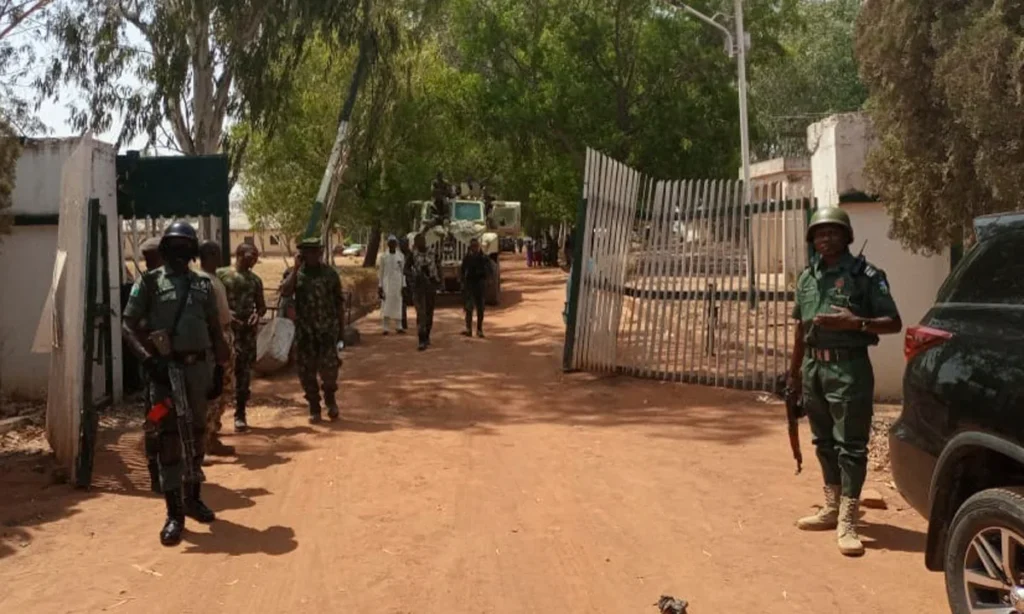
The twin attacks on the same day, in states separated by geography but connected by Nigeria’s deepening security failure, pushed the country’s school kidnapping crisis to a new threshold of geographic reach.
In Borno State, the assault on Mussa Primary and Junior Secondary School in Askira-Uba Local Government Area began around 9 a.m. when motorcycle-riding gunmen rode onto the school grounds and began seizing students. Ubaidallah Hasaan, a resident who lives near the school, confirmed the attack to Reuters. A teacher at the school said some students managed to flee into surrounding bush but many were taken. Parents and local villagers put the number seized at between 35 and 43 children.
“Despite some students escaping to the bushes, I can tell you many were taken away,” the teacher told Reuters.
No organization immediately claimed responsibility. The attack bore characteristics consistent with the Islamist militant group Boko Haram, which has maintained a foothold in the Sambisa Forest, a long-standing insurgent stronghold near the Mussa community. Nigeria’s military and police did not respond to requests for comment.
Local lawmaker Midala Usman Balami called the attack “heartbreaking” and demanded swift action from security authorities.
The last comparable school abduction in Borno State was in 2014, when Boko Haram seized more than 270 girls from a school in Chibok, an event that drew global condemnation and launched an international advocacy campaign. Friday’s attack marks the return of mass school kidnapping to a state that had been spared such an assault for more than a decade.
Oyo State: Three Schools, Two Dead, Multiple Abducted
The southern attacks were more complex. Armed men on motorcycles hit Baptist Nursery and Primary School in Yawota, near Alawusa, as well as Community Grammar School and L.A. Primary School in Esiele, all within Oriire Local Government Area in the Ogbomoso axis of Oyo State. The raids appeared coordinated, with attackers striking multiple locations in the same window before withdrawing toward a forest road.
An assistant headmaster identified as Mr. Adesiyan was killed during the assault. A motorcycle taxi operator was shot dead after he resisted the gunmen’s attempt to seize his bike. The vice principal of Community Grammar School, Mrs. Alamu Folawe, was among those abducted along with pupils and other staff members. The attackers took her Toyota Corolla vehicle and later set it on fire along the road leading into the forest.
Oyo State Police Command spokesperson Deputy Superintendent Ayanlade Olayinka confirmed the attacks in a statement Friday. “Preliminary investigations showed that the assailants carried out simultaneous attacks on the schools and surrounding communities, abducting pupils, students and members of staff,” Olayinka said. He confirmed no pupil or student had been killed as of the statement’s release, though the two adult deaths were confirmed.
Oyo State Commissioner of Police Abimbola Olugbenga traveled personally to the affected communities to assess the scene and coordinate the security response. Tactical teams, intelligence assets, and operational units were deployed to the area. Schools in Oriire Local Government Area were ordered closed while the manhunt continued.
“The Command assures residents that intensive operations are ongoing and urges members of the public to remain calm, vigilant and supportive by providing timely and credible information that could aid the investigation and rescue efforts,” Olayinka said.
Oyo’s Widening Security Problem
Friday’s school attacks did not emerge in isolation in Oyo State. The state has seen a pattern of escalating violence that security analysts have connected to armed bandit networks operating across state boundaries in southwestern Nigeria.
In January, five officers of the National Park Service were killed in a bandit attack on the National Park Office in Oloka Village, also in Orire Local Government Area. Governor Seyi Makinde said at the time that preliminary investigations indicated the attack was cross-border in nature, carried out by armed bandits from neighboring regions. Friday’s school raids in the same local government area suggest those networks have not been dismantled and may be expanding their targeting to include educational institutions.
Attacks on travelers along the Ibadan-Ijebu road have also been reported in recent months, building a picture of a state where armed groups are testing the limits of security coverage across rural and semi-rural areas.

A National Pattern With No Regional Boundary
Nigeria’s school kidnapping crisis has historically been associated with the northeast, where Boko Haram’s 2014 Chibok abduction first brought international attention to the tactic. But the geographic spread of Friday’s attacks tells a more current story. The northeast remains dangerous, as Borno State demonstrated. But the expansion of similar tactics into the southwest, a region that has been less associated with mass school abductions, signals that the methods pioneered by jihadist groups in the north have been adopted by criminal bandit networks operating in entirely different parts of the country with entirely different motivations.
In the northwest, banditry-driven school kidnappings for ransom have become routine. In the northcentral states, herder-farmer conflicts and criminal networks have targeted communities with increasing boldness. Friday added Oyo to the list of states where children sitting in classrooms are no longer safe from armed men on motorcycles.
Reuters confirmed the Borno attack through local sources. Premium Times and Punch Nigeria independently verified the Oyo State details through police statements and community contacts.
Schools as the Softest Target in a Failing System
Nigeria’s security establishment has been aware for years that armed groups across the country regard schools as strategically valuable targets. The reasons are straightforward. Schools concentrate large numbers of children in predictable locations at predictable times. They are typically in rural or semi-rural areas where police response times are measured in hours rather than minutes. The abduction of children generates immediate emotional and media impact, which amplifies the political pressure on governments to negotiate or pay. And in communities where poverty is widespread, ransom payments from desperate families represent reliable income for criminal networks operating at low risk.
The Borno attack is particularly significant because it breaks a decade-long pattern. After the international spotlight that followed the 2014 Chibok abduction, security deployments in Borno State were substantially increased and school kidnappings in the state had not recurred at mass scale. Friday’s assault suggests either that those security arrangements have deteriorated or that the militant networks operating near the Sambisa Forest have found new openings in rural areas that remain beyond consistent military reach.
The Oyo attack raises a different set of concerns. This is not insurgency territory. Oyo is a commercially active southwestern state, home to the ancient city of Ibadan and one of Nigeria’s most densely populated regions. If armed groups can execute coordinated simultaneous raids on three schools in Oyo’s Oriire Local Government Area, kill two people, abduct a vice principal, and withdraw into forest cover before security forces respond, the geographic reach of the school kidnapping threat has expanded in ways that no state government in Nigeria can treat as someone else’s problem.
Nigeria’s federal government has not issued a statement on Friday’s attacks as of this writing. The silence is itself part of the pattern. Attacks happen. Communities mourn. Local officials demand action. Security forces deploy. And then another set of motorcycle-riding gunmen rides onto another school compound, and the cycle continues.
Until the underlying economics of kidnapping change through consistent prosecution, dismantling of ransom payment networks, and security coverage that reaches rural schools before the attackers do, the children inside those classrooms will remain the most accessible targets in a country that has not yet found a way to protect them.
Punchng/Reuters/Tribune/PremiumTimes





