

French naval commandos rappelled from helicopters onto a sanctioned oil tanker in the Atlantic Ocean on Sunday, seizing the vessel more than 400 nautical miles west of France in international waters and ordering it escorted to the French mainland, as President Emmanuel Macron posted video of the boarding operation and Russia called the action illegal piracy.
The tanker, identified as the Tagor, had traveled from Russia’s Arctic port of Murmansk and was flying what French authorities said was a false flag. Vessel tracking data from MarineTraffic showed the 252-meter ship sailing under a Madagascar flag. French maritime authorities said inspection of the vessel’s papers confirmed the flag irregularity. The Russian captain refused to comply with the French navy’s orders, and a Brest prosecutor confirmed that forcibly taking control of the vessel became necessary. A criminal investigation was opened on charges of failure to prove a vessel’s nationality, absence of a legitimate flag, and refusal to comply with naval instructions.
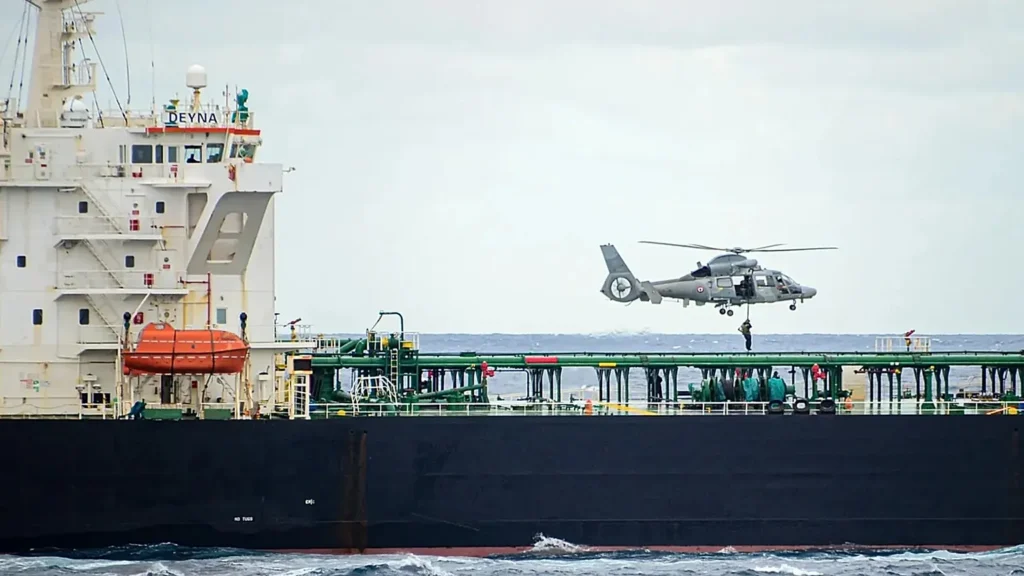
The operation was carried out with support from the United Kingdom, Macron confirmed in a post on X Monday showing commandos descending onto the ship’s deck from a hovering helicopter.
“It is unacceptable for ships to circumvent international sanctions, violate the law of the sea, and fund the war that Russia has been waging against Ukraine for more than four years,” Macron wrote. “These ships, that don’t respect the most elementary rules of maritime navigation, are also a threat to the environment and everyone’s security.”
By Monday, the Tagor was steaming under naval escort toward an anchorage off northwestern France for further inspection.
Russia’s Response
The Kremlin reacted with immediate condemnation. Spokesman Dmitry Peskov told reporters Monday that Russia considered the interception illegal and that it bordered on piracy. “We absolutely disagree that they are being carried out in full compliance with international law,” Peskov said.
Russia previously deployed a naval frigate in April to escort two sanctioned vessels through the English Channel after similar interception operations, and the Kremlin said at that time Moscow reserved the right to defend against what it characterized as piracy. Estonia subsequently announced it would stop detaining Russian shadow fleet tankers, citing concern that such actions risked provoking a Russian military response.
Peskov said Monday that Russia would take measures to ensure the safety of its shipping cargo in response to the latest seizure.
The Fourth French Interception
The Tagor is the fourth sanctioned tanker France has boarded since September. French forces seized the Benin-flagged tanker Boracay off the Atlantic coast in October, and Macron later said a probe was examining whether the vessel had been used as a launch platform for a drone incursion into Danish airspace that forced the closure of airports in Denmark. The Grinch was intercepted in the Mediterranean in January and released in February after paying a multimillion-euro penalty. The Deyna was boarded in the Mediterranean in March, and its owners paid an undisclosed fine to secure its release in April.
The pattern of seizure, penalty, and release has drawn criticism from sanctions advocates who argue the fines have not been large enough to meaningfully deter the use of shadow fleet vessels. Russia has assembled what Western intelligence assessments estimate to be a flotilla of nearly 600 vessels under EU sanctions, typically old tankers of deliberately opaque ownership, carrying Russian oil to buyers including India and China at discounted prices that still generate substantial revenue for Moscow.
The Economics Behind the Fleet
Oil revenue is a structural pillar of Russia’s war financing. The income from petroleum exports allows the Kremlin to continue funding military operations without forcing the kind of domestic austerity that would generate political pressure on Putin’s government. The EU has now issued 19 successive packages of sanctions against Russia since the February 2022 invasion, but Moscow has adapted to most measures and continues to move millions of barrels of oil to non-Western markets.
The current moment offers Russia an additional incentive to keep its shadow fleet moving. The Iran war has pushed global oil prices sharply higher, meaning the premium on any barrel that reaches an international buyer has increased. The combination of discounted Russian crude and elevated global prices has made shadow fleet operations particularly profitable, even accounting for the higher insurance and operational costs that come with vessels of uncertain status.
Reuters noted that the greatest practical disruption to Russian oil exports has come not from European naval interceptions but from Ukrainian drone and missile strikes on Russian oil production and refining facilities, which have reduced Moscow’s capacity to capitalize on the price spike.
British Prime Minister Keir Starmer said in March that he had authorized the British military to board shadow fleet vessels. Shipping data shows that dozens of sanctioned tankers have continued to cross British waters since that authorization, suggesting enforcement has been selective rather than comprehensive.
Interceptions as Signal, Not Solution
France’s fourth shadow fleet seizure in eight months, executed with helicopter-deployed commandos and posted to social media with the unmistakable quality of a political statement, is more accurately understood as a message than as a meaningful constraint on Russian oil exports.
The shadow fleet comprises hundreds of vessels. Four interceptions, however operationally impressive, do not dent a network of that scale. The vessels that have been seized and fined have generally been released after financial penalties that their operators have demonstrated willingness to absorb as a cost of doing business. The Grinch paid a multimillion-euro fine and returned to operation. The Deyna’s owners paid and recovered their ship. The economic logic of shadow fleet operations, particularly at current oil prices, can withstand a fine at the end of each voyage more easily than the vessels can be permanently removed from service.
The interceptions do serve genuine purposes beyond the individual vessels involved. Each seizure creates uncertainty for shadow fleet operators about which routes and which national enforcement zones carry elevated risk. Each one generates diplomatic pressure on the countries whose flags these vessels fly falsely, since the Madagascar and Benin flag links in recent cases create conversations with those governments about how their maritime registries are being exploited. And each one forces Russia to spend political and diplomatic capital defending operations that it publicly characterizes as legitimate commercial activity.
What the interceptions have not done is stop Russian oil from reaching its buyers. India and China are purchasing Russian crude at scale, and neither country has shown any indication of accepting Western pressure to curtail those purchases. Until either the buyers change their behavior or the sanctions enforcement is applied at a scale that genuinely disrupts the shadow fleet’s economics rather than penalizing its occasional participants, the Tagor’s successors will keep sailing.
AP/Reuters/Euronews




