

A powerful offshore earthquake measuring 7.8 in magnitude struck the southern Philippines early Monday, killing at least 32 people, injuring more than 200 others and damaging buildings across Mindanao as authorities rushed to rescue survivors and assess widespread destruction.
Officials said the tremor, centered off the coast of Sarangani province, sent strong shaking across the island and triggered tsunami alerts in several countries before the warnings were lifted hours later.
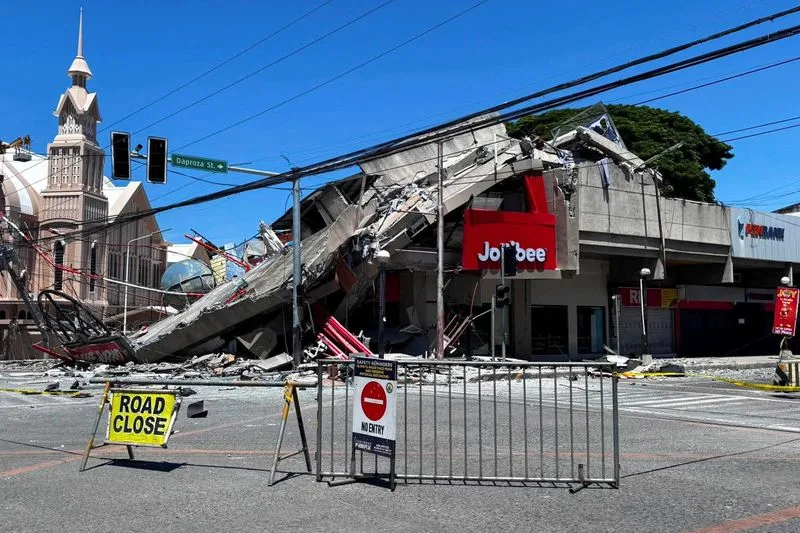
Emergency teams deployed by the government and military fanned out across affected areas, where collapsed structures, landslides and debris caused most of the casualties.
KEY DEVELOPMENTS
- At least 32 people confirmed dead, with more than 200 injured across Mindanao
- Around 12 people initially listed as missing as rescue efforts continued
- Buildings collapsed in General Santos and surrounding areas, prompting evacuations
- Tsunami waves reached nearby coasts before alerts were lifted
- More than 200 aftershocks recorded, including several strong tremors
Authorities confirmed fatalities both at the scene and in hospitals, with many victims struck by falling debris or caught in landslides. Civil defense officials indicated that a number of injured survivors suffered severe trauma and burns, while others remained in critical condition.
The hardest hit areas included General Santos, a key port city, where several structures were reduced to rubble. Video released by local authorities showed a building collapse that sent clouds of dust into the air as residents fled.
The Associated Press confirmed that at least 32 people were killed and more than 200 injured, with damage reported to infrastructure and homes. Waves measuring about one meter were recorded along parts of the coast, causing additional concern in low lying communities.
President Ferdinand Marcos Jr. ordered an immediate nationwide response, directing agencies to mobilize relief supplies, open evacuation centers and assist in rescue operations.
“The national government is moving and we will not leave Mindanao behind,” Marcos said in a statement, emphasizing ongoing coordination with local officials.
Classes were suspended in affected regions, impacting millions of students as authorities prioritized safety inspections of schools and public buildings.
The Civil Aviation Authority temporarily halted operations at General Santos Airport before reopening it for humanitarian and emergency flights.
Search and rescue teams continued to comb through debris for survivors as aftershocks rattled the region. More than 200 aftershocks were recorded, including several strong tremors felt widely across Mindanao.
The Office of Civil Defense and local emergency units worked alongside military personnel to reach remote communities cut off by damaged roads and landslides.
Humanitarian agencies, including the United Nations children agency, signaled readiness to support relief efforts with emergency supplies and services for displaced families.
The quake triggered tsunami warnings across parts of Southeast Asia, including Indonesia and Malaysia. Residents in coastal areas were advised to move to higher ground before authorities later declared the threat had largely passed.
Small tsunami waves were detected in neighboring regions, while minor damage was reported in parts of Indonesia.
Mindanao lies along a complex network of tectonic boundaries within the Pacific Ring of Fire, making it highly vulnerable to earthquakes. The Philippine Institute of Volcanology and Seismology indicated the quake struck at a moderate depth, increasing its destructive potential.
Reuters noted that the Philippines experiences frequent seismic activity, with previous deadly quakes striking the region in recent years.
This disaster underscores the persistent vulnerability of densely populated regions in the Philippines to large scale seismic events. While building standards have improved in urban centers, the extent of structural collapse suggests uneven enforcement and aging infrastructure remain serious risks.
The timing of the quake, coinciding with the reopening of schools, magnified its social impact, exposing millions of students and teachers to immediate danger. The widespread suspension of classes reflects both caution and the scale of disruption to daily life.
The rapid lifting of tsunami warnings may ease immediate fears, but the psychological impact of such alerts across multiple countries highlights how interconnected disaster risks have become in the region.
Longer term, the event is likely to renew debate over disaster preparedness, urban planning and emergency response coordination in one of the world’s most disaster prone nations.
Credits: Reuters, The Associated Press, Rappler.com





