

A train driver was killed and at least 89 people were injured Friday afternoon when two passenger trains traveling in the same direction collided outside the town of Bedford, north of London, in one of the most serious rail accidents in Britain in recent years.
British Transport Police declared a major incident at the scene, deploying more than 20 ambulances, six air ambulances, and specialist hazardous area response teams as emergency services worked to treat the injured and clear the tracks.
What We Know So Far
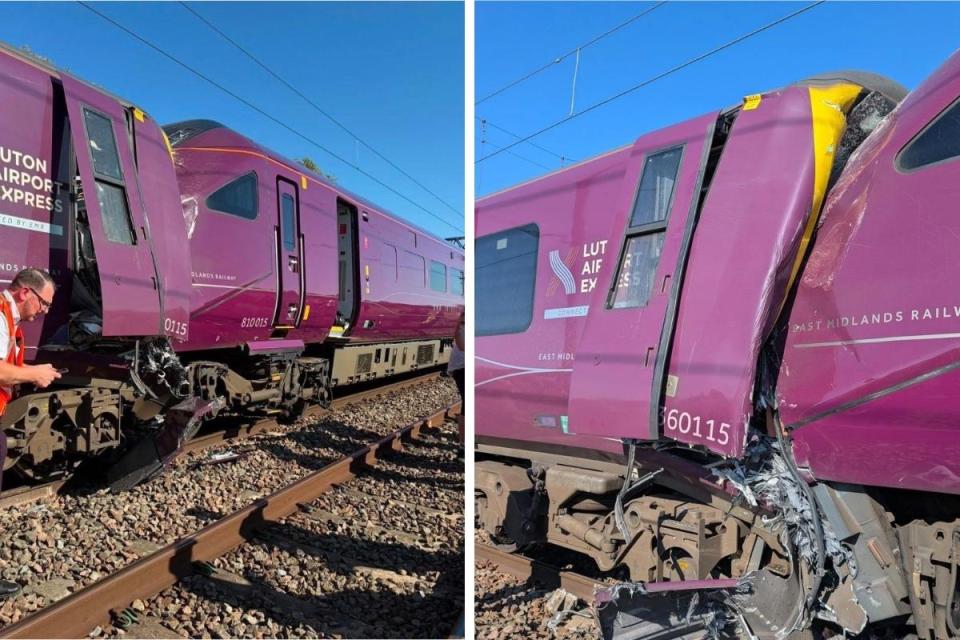
The collision occurred around 5:15 p.m. when the 4:40 p.m. East Midlands Railway service from Corby to London St. Pancras ran into the back of the 3:50 p.m. Nottingham to St. Pancras service, which had stopped on the same southbound track, according to East Midlands Railway and rail tracking data.
The East of England Ambulance Service confirmed that 11 people sustained very serious injuries, 22 were seriously injured, and 56 suffered minor injuries. All patients with the most critical injuries were transported from the scene to hospital, a spokesperson said.
Eddie Dempsey, general secretary of the National Union of Rail, Maritime and Transport Workers, confirmed the person killed was a train driver.
British Transport Police Deputy Chief Constable Stuart Cundy said officers were working to establish exactly what had happened. “We have declared a major incident and a significant emergency service response is ongoing,” Cundy said. “We are working at pace to establish exactly what happened and will provide further information as soon as we are able.”
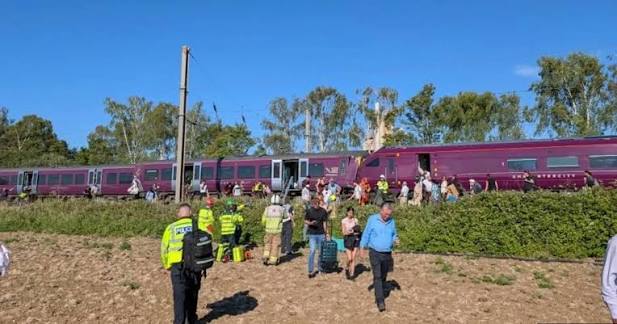
Passenger Peter Knapp, who was traveling in the rear train, described the moment of impact to reporters. “There was a moment of being flung into the chair in front, and then I saw smoke,” he said. “People were crying, screaming. People were so scared and confused. I got up and I saw a lot of people who were unable to speak, had broken legs. And then I managed to get out of the train and because I am quite thin I was able to squeeze out through the gap in the doors.”
Photos and videos shared on social media showed dozens of passengers, some with bandages and head injuries, standing alongside emergency vehicles parked on a road running parallel to the tracks.
East Midlands Railway canceled all services to and from St. Pancras for the remainder of Friday and said it could not confirm its Saturday schedule. National Rail suspended Thameslink services between Luton and Bedford and advised passengers not to travel on affected routes.
A fitness center on the outskirts of Bedford was converted into a triage and reception point for passengers with minor injuries. Volunteers from organizations including React Disaster Response provided food, water, and seating as passengers waited for onward travel arrangements. By late Friday evening, most passengers had been processed and the center was beginning to wind down, Sky News correspondent Barnaby Papadopulos reported from the scene.
Accident and emergency departments at Bedfordshire Hospitals NHS Foundation Trust and Cambridge University Hospitals NHS both issued public appeals asking people to keep their facilities clear for the most seriously injured.
What Authorities And Experts Are Saying
Travel expert Simon Calder told Sky News he believed the lead train had stopped on the track after encountering a problem with its automatic warning system, a safety mechanism designed to alert drivers to red signals ahead. While the driver of the stationary train was attempting to address that issue, the following service caught up and struck it from behind, Calder said.
Rail expert Tony Miles told Sky News the physical damage to both trains appeared relatively limited, suggesting the rolling stock had performed well under the impact. He said both trains were traveling in the same direction on the same track, and that the most likely explanation was a rear-end collision with the leading train stationary at the time of impact. “The question has to be, how did that train in the rear get into contact with the train it was following?” Miles said, noting the cause could involve a signal fault or driver error.
Rail expert Philip Haigh said the crash had taken him completely by surprise. “We have on the railways here signalling systems that are designed to keep trains apart and prevent this sort of thing happening,” he told Sky News. He described rail travel in Britain as “incredibly safe” and crashes of this nature as “exceedingly rare.”
The RMT union said it was monitoring the situation and expressed concern over reports of serious injuries sustained by both train staff and passengers.
Why This Matters
Britain’s rail network has one of the strongest safety records in the world and rear-end collisions between passenger trains on the same track are exceptionally uncommon in the modern era of automated signaling and driver safety systems. The last major collision of this nature on the British network occurred at Potters Bar in 2002 and at Ladbroke Grove in 1999, both of which led to significant overhauls in safety protocols and technology.
Friday’s accident raises immediate questions about whether the automatic warning system failure that may have caused the leading train to stop was communicated in time to the following service, and whether the signaling infrastructure in place between Bedford and London provided adequate protection once the first train halted unexpectedly.
The fact that the collision occurred on a warm afternoon when trains were carrying significant passenger loads heading into London for the weekend contributed to the scale of the casualty figures. Haigh noted that with overhead power switched off to allow emergency access to the tracks, conditions aboard trains held in place further along the line would have been uncomfortable in the heat.
The economic disruption to one of Britain’s busiest commuter corridors connecting the East Midlands to London is also significant. The St. Pancras route serves hundreds of thousands of commuters and intercity travelers daily, and the full suspension of services on a Friday evening during peak travel hours affected a large number of passengers beyond those directly involved in the crash.
What Happens Next
Britain’s Rail Accident Investigation Branch is expected to launch a formal inquiry into the collision, as it does with all serious rail incidents. Investigators will examine the condition of the signaling system, the automatic warning mechanism on the stationary train, the response of the following driver, and whether communications between train operators and control centers followed established protocols.
East Midlands Railway is expected to publish further information about its Saturday timetable as the situation on the Bedford to St. Pancras line becomes clearer. National Rail has advised passengers on affected routes to seek alternative travel arrangements until further notice.
The identity of the driver killed in the collision has not yet been released publicly. British Transport Police said formal identification procedures were ongoing.
For the 11 passengers and crew members described as having very serious injuries, the coming days will determine the longer-term consequences of a collision that shattered what had been, until Friday afternoon, a routine commute into London.
Skynews/AP





