

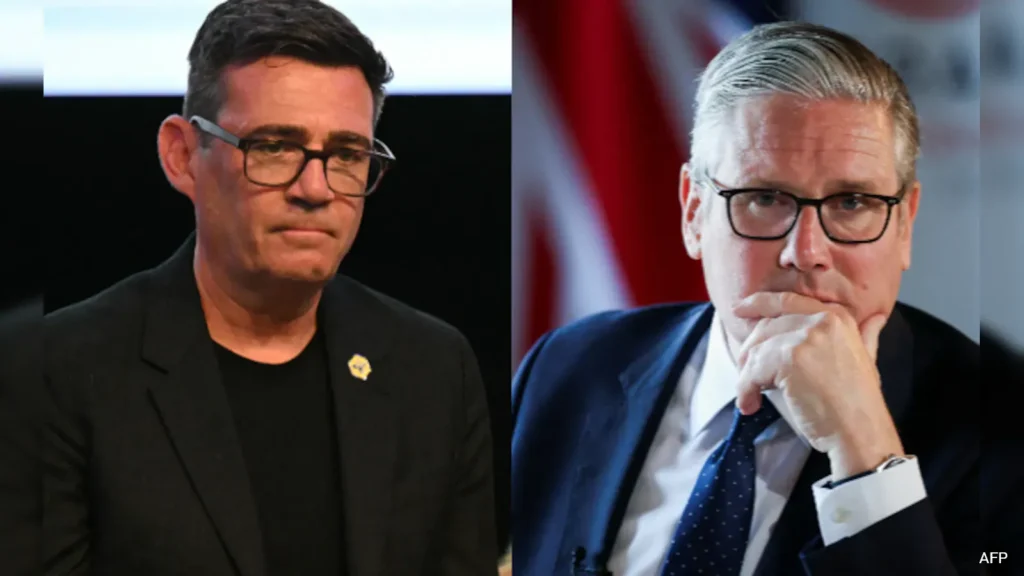
British Prime Minister Keir Starmer is expected to announce his resignation as early as Monday and set out a timetable for his departure from Downing Street, according to The Observer, as pressure from within his own party reached a tipping point following rival Andy Burnham’s decisive parliamentary victory and months of mounting political failure.
The situation remained fluid Sunday, with no official confirmation from Starmer or his office. But the signs of an imminent leadership transition were multiplying rapidly.
What We Know So Far
The Observer reported Saturday that Starmer had concluded his position was no longer tenable after consulting senior Cabinet ministers, political advisers, party donors, and trade union leaders. Those conversations reinforced concerns about his ability to maintain authority within the Labour Party and across government.
Starmer spent the weekend at Chequers, the prime minister’s country residence, with his family. He gave no public indication of his decision but posted a Father’s Day message on X. “Being a dad is my greatest joy. Today, I’m thinking about my dad, and the father I am to my children because of him,” he wrote.
A source with knowledge of the matter told Reuters that Starmer was spending the weekend considering his position and discussing it with his family, and that an expected conversation with Burnham would help clarify the path forward. “Keir likes to think about things,” the source said.
A senior Labour figure told The Observer that the prime minister had run out of road. “Keir has realised the game is up and it has got to be a graceful exit,” the figure said. “What he rightly wants to avoid is humiliation, but the worst humiliation for Keir personally would be if he stands in a leadership election and is heavily beaten.”
Sky News reported that Foreign Minister Yvette Cooper had privately called on Starmer to stand down in a conversation over the weekend. Her spokesperson did not immediately respond to a request for comment. Her apparent appeal, alongside pressure from dozens of lawmakers and other ministers, reinforced the sense that the question had shifted from whether Starmer would leave to when.
Business minister Peter Kyle, who spoke to Starmer on Friday, described a leader in genuine distress. “I found a man who was questioning what the country expected of him,” Kyle told LBC radio. “I am not going to deny the political challenges that he faces in this moment, but what I am also not going to do is say there is ever anything inevitable about the days ahead.”
A senior government figure separately told Reuters that Starmer remained focused on his job and was not going anywhere. That account stood in direct tension with the chorus of senior figures calling for his departure.
Starmer had insisted publicly only days earlier that he would contest any formal Labour leadership challenge. “I will run, I will stand,” he said. “I have said repeatedly I am not going to walk away from that.”
But senior Labour peer Charlie Falconer told the BBC that Starmer had “absolutely no authority” left. “There should be an agreed transition process in which Andy and Keir cooperate as to when the handover should take place,” Falconer said.
What Triggered The Crisis
The immediate catalyst was Burnham’s landslide victory Thursday in the Makerfield seat in northwestern England, where he took nearly 55 percent of votes cast, more than 9,000 ahead of the Reform UK runner-up, Reuters confirmed. The scale of the win cleared the final hurdle to Burnham entering parliament and formally positioning himself to challenge Starmer for the Labour leadership.
“Everyone knows that politics isn’t working,” Burnham said during his victory speech. “Everyone can feel that the country isn’t where it should be. Tonight could, just could, be the turning point.”
Burnham, 56, served as mayor of Greater Manchester from 2017 to 2026. He has made two previous bids for the Labour leadership and now presents himself as a left-wing populist with a direct, street-level communication style. Sources told The Observer that Burnham had the support of more than half of Labour members of parliament for a leadership challenge. The two men were expected to meet the following week.
The Makerfield result followed devastating local election losses in May that saw Labour shed more than 1,100 council seats across England while Nigel Farage’s Reform UK gained more than 1,450, the Associated Press noted. Those results prompted more than 80 Labour lawmakers to call on Starmer to stand down.
What Authorities And Politicians Are Saying
Former minister Jess Phillips, a supporter of Health Secretary Wes Streeting, who resigned from the Cabinet last month to protest Starmer’s leadership, told the BBC that the end had arrived. “It feels like we have come to the end of the road,” she said, adding that it would be best for Starmer’s departure to be “as dignified as possible.”
Streeting has confirmed he will stand in any formal leadership contest that emerges, setting up a potential three-way race if Starmer steps aside and Burnham is not given a clear path.
U.S. President Donald Trump added his voice to the commentary before any official announcement had been made. “Keir Starmer will resign as Prime Minister of the United Kingdom,” Trump posted on Truth Social. “He failed badly on two very important subjects, immigration and energy. Open North Sea oil! I wish him well.”
Trump had clashed repeatedly with Starmer over the course of the year, most notably over Starmer’s refusal to allow American military aircraft to launch strikes on Iran from the joint U.S.-U.K. base at Diego Garcia. Starmer ultimately permitted access to the base but only after prolonged tension. “We were not involved in the initial strikes against Iran, and we will not join offensive action now,” Starmer said in March.
Trump responded at the time by saying he was “not happy with the UK” and that Starmer was “not Winston Churchill.”
Why This Matters
If Starmer resigns, he will become the sixth British prime minister to leave office in ten years, a turnover rate that reflects the extraordinary political instability gripping one of the world’s leading democracies, the Associated Press observed.
Starmer came to power in July 2024 with a landslide election victory that was supposed to mark a generational shift in British politics after years of Conservative turmoil. That mandate has eroded rapidly. He has struggled to deliver economic growth, failed to repair crumbling public services, and has watched living standards remain stagnant for a population already exhausted by years of austerity, Brexit, the pandemic, and the cost-of-living crisis.
Professor Anand Menon of King’s College London told Newsweek in May that the British economy had barely grown since 2008 and had absorbed a succession of body blows that left it in a structurally weakened position. “We are in a difficult situation. There is no doubt about that,” Menon said.
Starmer compounded his political difficulties with a series of missteps, most notably his decision to appoint Peter Mandelson, a figure associated with scandal and a friendship with convicted sex offender Jeffrey Epstein, as the United Kingdom’s ambassador to the United States. Starmer fired Mandelson in September and has never been accused of any personal wrongdoing, but the episode damaged his standing further.
The broader political landscape has also shifted against him. Labour is losing liberal voters to the growing Green Party on one flank while Reform UK, led by Farage and running on an anti-immigration platform, leads consistently in nationwide opinion polls. The squeeze from both directions has left Starmer’s coalition of 2024 supporters visibly fraying.
What Happens Next
Burnham is expected to travel to London to be sworn in as a member of parliament as soon as Monday, placing him inside the House of Commons and formally in a position to seek the Labour leadership.
Labour’s internal rules require a formal leadership contest rather than an appointed succession, though the timeline can be adjusted depending on internal party decisions and political urgency. In the short term, a senior Cabinet minister could be asked to serve in an acting capacity while a contest is organized.
Starmer’s team has argued that his 2024 election mandate gives him the right to remain in office until 2029. That argument has found fewer and fewer takers within the party as the week has progressed.
Whether Starmer steps aside gracefully, as senior Labour figures are urging, or contests a leadership election against Burnham and potentially Streeting, will determine whether the transition is managed or convulsive. Either way, the outcome will carry significant implications for British foreign policy, the country’s relationship with Washington, and the government’s ability to address the domestic economic challenges that have defined and doomed Starmer’s tenure.
AP/Reuters/NewsWeek/NewYorkTimes





