

Russia launched an hours-long barrage of missiles and drones at Kyiv and the surrounding region overnight into Thursday, killing at least 15 people and damaging a children’s hospital, a kindergarten and dozens of residential buildings, officials said.
Casualty figures shifted somewhat across reports as the day went on. Kyiv Mayor Vitali Klitschko and the Kyiv Independent both cited at least 15 deaths in the capital, while separate reporting put the total at 16, and Reuters cited a toll of 17 killed across Kyiv and the surrounding region. At least one additional person died in the wider Kyiv region beyond the city itself. President Volodymyr Zelenskyy said about 40 people were injured, while Klitschko said at least 14 of the wounded were hospitalized.
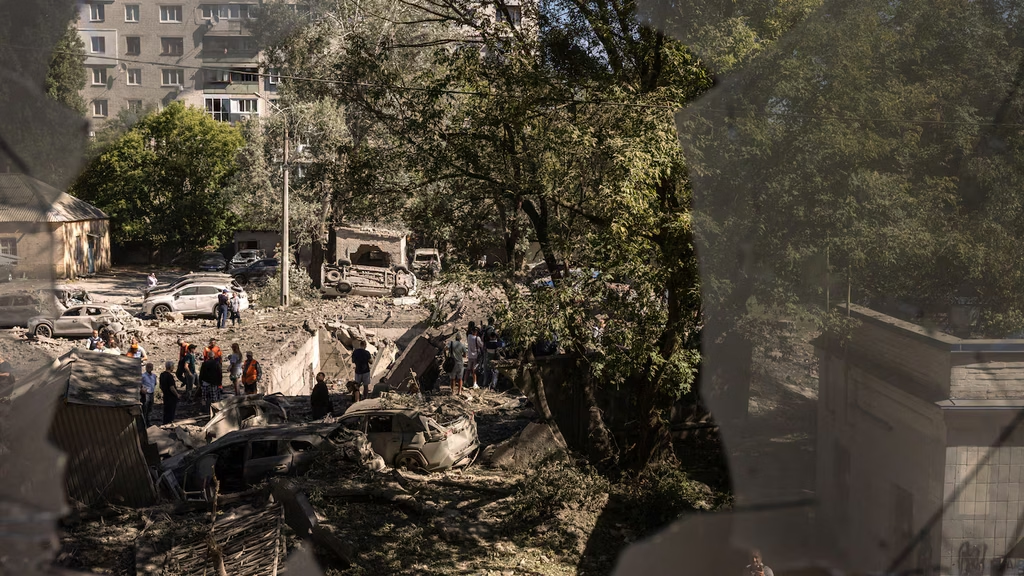
Ukraine’s air force said Russia launched 44 cruise missiles, two Banderol missiles and 168 Shahed type drones during the attack, striking 28 locations. The air force said it intercepted 39 of the cruise missiles, both Banderol missiles and 145 of the drones, though it did not disclose how many ballistic or hypersonic missiles were launched or intercepted, citing a recent policy shift against releasing that information.
What We Know So Far
Explosions began shortly after midnight and continued intermittently for hours, with a brief all-clear around 8:36 a.m. followed by renewed alerts roughly 30 minutes later as officials warned of additional missiles approaching the capital. Sporadic drone activity and explosions continued into the afternoon and evening.
The heaviest damage occurred in Kyiv’s Solomianskyi district, where Reuters reported at least eight deaths after the upper floors of a nine-story residential building were destroyed. Klitschko said debris from the strikes blew out windows and sparked fires at a five-story building in the same district, with another building damaged between its eighth and ninth floors.
Resident Larysa Bondaruk, 60, said a rocket struck the roof of her building with a deafening blast, sending out debris and smoke as screams and cries filled the air. She said her neighbor’s grandson died after being trapped in the rubble, though she credited rescuers with responding quickly. Another resident, Galina Morozova, described two nearly simultaneous explosions unlike anything she had heard before, saying she was covered in glass and debris while sheltering under a blanket but was not injured.
A children’s hospital in the Darnytskyi district was damaged, with windows blown out and vehicles burning on the hospital grounds. Overall, Zelenskyy said strikes damaged 30 residential buildings, a school, a children’s hospital and a kindergarten across Kyiv and the surrounding areas. Klitschko said Russia also targeted critical infrastructure in the capital for the first time in months, disrupting hot water service in two districts.
In Brovary, a community in Kyiv Oblast, one person was killed and eight others injured, according to Ukraine’s State Emergency Service, with earlier reports citing damage to an unspecified industrial facility in the area. Ukrainian Prime Minister Serhii Koretskyi said food warehouses and Red Cross facilities near Kyiv were also damaged in the attack, which he said lasted nearly nine hours. Several warehouses supplying grocery chains were hit, including facilities belonging to EKO Market and Fora, both of which said their employees were evacuated safely beforehand. The strikes reflect a tactic Russia began using in early August, targeting food storage facilities with ballistic missiles and disrupting supplies of staples including vegetables, dairy and meat in parts of Kyiv.
Kyiv’s transit operator said more than 38,000 people, including over 2,000 children, sheltered overnight in the city’s subway stations. Klitschko declared August 21 a day of mourning in the capital.
Russia’s Overnight Toll and Ukraine’s Counter Strikes
Russia’s Defense Ministry said its forces struck a Kyiv industrial site manufacturing components for Flamingo cruise missiles, along with sites tied to drone production and storage, an ammunition depot and a logistics center.
Ukraine’s military said it struck the Nizhnekamsk oil refinery in Russia’s Tatarstan region and the Tamanneftegaz oil terminal in Volna, in Russia’s Krasnodar region, sparking fires at both sites as part of Ukraine’s continuing campaign against Russian oil infrastructure. Tatarstan leader Rustam Minnikhanov confirmed a massive attack on the region, according to Russian state news agency Tass, saying drones targeted Nizhnekamsk’s Zakamsk economic area and disrupted industrial production while damaging residential buildings. Russia’s Defense Ministry said its air defenses shot down 726 drones overnight across several Russian regions, occupied Crimea, and the Black and Azov seas, describing it as one of Ukraine’s largest aerial attacks of the war.
Ukrainian intelligence told the outlet Ukrainska Pravda that Russia is capable of producing more than 200 cruise and ballistic missiles per month and has stockpiled over 1,100 cruise missiles and roughly 130 Iskander-M ballistic missiles, among other missile types. That claim could not be independently verified, and Russian officials do not routinely discuss the country’s weapons stockpiles publicly.
Neighboring Countries on Alert
Poland’s Armed Forces Operational Command activated military aviation operations, ground based air defense systems and radar reconnaissance during the attack, with Polish and other NATO aircraft deployed to monitor Polish airspace, according to Polish news agency PAP.
Romania’s Defense Ministry said an unidentified drone crashed and burned in an uninhabited area near the Ukrainian border, prompting two Spanish F-18 jets on a NATO policing mission in Romania to scramble and monitor a group of aerial targets near the border. Romania’s acting Defense Minister Radu Miruta said two Romanian F-16 jets were separately deployed to destroy a naval drone spotted near a major Black Sea gas project. Moldova’s Defense Ministry said its airspace was also breached by at least one drone, a claim Moldovan President Maia Sandu separately confirmed.
Ukrainian Foreign Minister Andrii Sybiha said Russia is increasingly testing the resolve of NATO and its partners by violating the sovereignty of neighboring states and expanding the risks of its war beyond Ukraine’s borders. European Commission President Ursula von der Leyen said an escalating campaign of threats is underway that is unsettling European citizens and seeking to divide the European Union, adding that she is working with member states to provide Ukraine with anti-ballistic missile capabilities as an urgent priority.
What Authorities Are Saying
Zelenskyy called the attack massive, saying Russia had prepared it over a long period by combining different types of ballistic missiles, cruise missiles and drones specifically to maximize damage to civilian infrastructure. He separately described it as one of the most cynical, calculated and large-scale strikes of the four-and-a-half-year war, and said the failure of Ukraine’s allies to replenish its stock of Patriot interceptor missiles is costing lives.
“Each additional missile saves the lives of our people,” Zelenskyy said, adding that Ukraine had not received promised replacement missiles and that the world’s response to such attacks has not always been adequate.
Postoyuk, who lost her previous home to a Russian missile strike in May, said the sky felt calmer and safer during periods when interceptor missiles were available, arguing that this kind of warfare belongs on the front line rather than in the heart of Ukraine.
Why This Matters
Thursday’s attack extends a pattern of intensifying large-scale Russian strikes on Kyiv this summer, following an attack roughly two weeks earlier that killed 17 people in the city and region, and a separate strike two days before that which killed nine. The United Nations reported that Kyiv was among the hardest hit cities in Ukraine in July, with at least 54 civilians killed and 202 injured that month alone.
The attack coincides with a deepening crisis in Ukraine’s air defense capacity, since the Patriot system remains the only weapon in Kyiv’s arsenal capable of reliably intercepting ballistic and hypersonic missiles. Other Western supplied systems, including the Franco-Italian SAMP/T, cannot engage ballistic missiles, according to Ukrainian Air Force Communications Department head Colonel Yurii Ihnat. Ukraine is working to develop its own indigenous anti-ballistic system, called Freya, through the defense firm Fire Point, though it remains unclear when such a system might become operational.
The targeting of food storage facilities represents a notable shift in Russian tactics, with strikes on grocery chain warehouses beginning in early August contributing to intermittent shortages of fresh produce in some Kyiv supermarkets, a tactic that extends the war’s economic impact directly into everyday civilian consumption patterns. Russian strikes near Odesa targeting a border crossing with Moldova have similarly disrupted Ukraine’s agricultural exports through Black Sea ports, adding pressure to global food prices.
The drone incursions into Romanian and Moldovan territory underscore how the conflict continues to spill beyond Ukraine’s borders, straining NATO’s eastern flank monitoring capacity and prompting repeated rapid response deployments from alliance members.
What Happens Next
Zelenskyy has said Ukraine submitted peace proposals to U.S. negotiators Steve Witkoff and Jared Kushner earlier this month, though the Kremlin said Thursday it had no information yet on a possible visit by the two envoys to Moscow. Witkoff and Kushner were last in Moscow in January and have not yet visited Kyiv, and no date has been confirmed for a proposed visit to Ukraine, according to a source familiar with the discussions.
Zelenskyy has warned that Russia will not seriously pursue peace negotiations as long as Ukraine lacks adequate missile defenses, framing continued Western military support as a precondition for any meaningful diplomatic progress. With interceptor stockpiles low amid simultaneous demands from the conflict involving Iran, the pace at which allies can resupply Ukraine’s Patriot systems is likely to remain a central factor shaping both the war’s trajectory and any renewed diplomatic efforts in the weeks ahead.
Reporting drawn from the Associated Press, Reuters and the Kyiv Independent





