

Thousands of demonstrators marched through South Africa’s major cities Tuesday as a deadline set by anti-immigration groups for undocumented migrants to leave the country took effect, triggering the largest wave of migration-related protests since deadly anti-foreigner violence swept the country in 2008, with at least four people killed and widespread reports of looting, vandalism, and forced evictions.
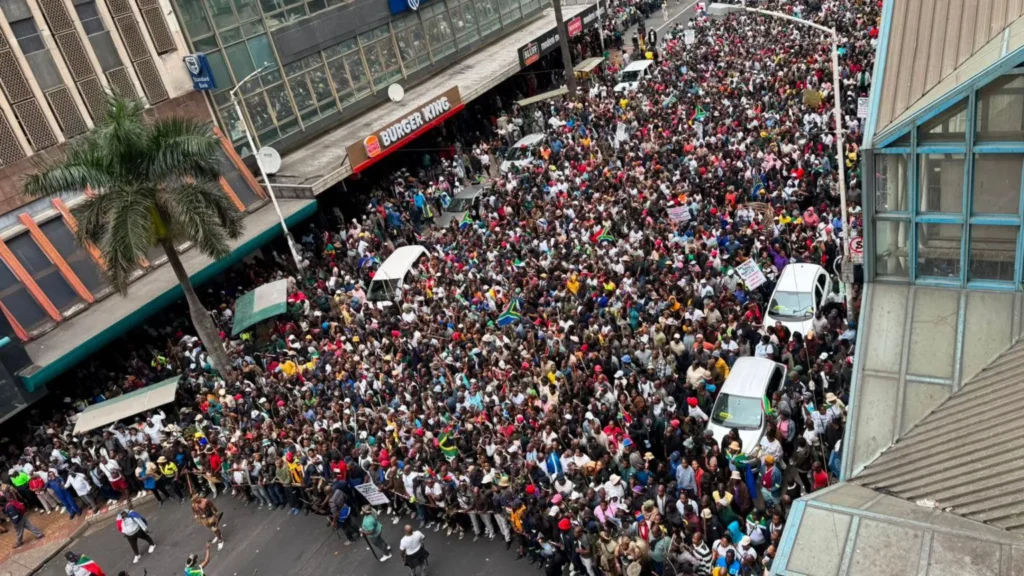
Police, backed by private security firms, deployed in large numbers across Johannesburg, Durban, and other cities amid fears that the protests, organized around a self-declared June 30 deadline that the South African government has explicitly rejected as unenforceable, could descend further into violence.
What We Know So Far
South African police confirmed that approximately 25,000 undocumented migrants, the majority from other African countries, have already been repatriated in the lead-up to Tuesday’s deadline, the BBC confirmed. Police separately said roughly 50,000 migrants have been arrested since January for being in the country without proper documentation.
The Ministry of Police described the demonstrations as largely peaceful nationwide, though it acknowledged isolated incidents of looting and attempted looting. In Johannesburg, the country’s financial capital, shops in the city center closed in anticipation of unrest, and police maintained a heavy visible presence on major thoroughfares.
Violence did break out in several areas. In Thembisa, a northern suburb of Johannesburg, rioters threw stones at police and at people suspected of being migrants, while sporadic gunfire was reported near the central business district, Reuters confirmed.
In Benoni, in eastern Johannesburg, police deployed tactical vehicles and fired shots after facing a crowd of roughly 500 protesters, according to the Daily Maverick. In Soweto, the country’s largest township, protesters looted shacks belonging to foreign nationals, national broadcaster SABC reported, while police fired rubber bullets to disperse marches in Pietermaritzburg near Durban.
In Yeoville, a Johannesburg suburb home to many African migrants, some protesters threw bricks and broke windows of residential homes. In a Germiston neighborhood roughly 15 kilometers from Johannesburg, demonstrators reportedly went door to door, evicting residents suspected of being foreign nationals and handing them to police to have their documentation checked, according to local media accounts cited by the BBC.
Police confirmed five arrests connected to the alleged looting of a foreign-owned shop in Soweto, roughly ten additional arrests for looting in KwaZulu-Natal province, and separate arrests of a woman for assaulting a police officer and a man for intimidation following reports that a foreign national had been beaten.
Deputy National Commissioner for Policing Tebello Mosikili said 103 criminal cases had been opened against anti-foreigner vigilantes since March, Reuters confirmed, indicating that law enforcement has been actively pursuing cases against organized harassment campaigns predating Tuesday’s marches.
What Authorities And Protest Leaders Are Saying
President Cyril Ramaphosa met with leaders of several anti-migrant groups Monday night in an effort to defuse tensions ahead of the marches, urging peaceful demonstration while also acknowledging the legitimacy of public frustration over immigration enforcement.
“South Africans’ deep concerns about illegal immigration are real and they deserve to be heard,” Ramaphosa said in a statement Monday. “But the right to protest and freedom of expression does not allow people to threaten or intimidate others, or to engage in acts of vandalism or violence.”
In his weekly newsletter, Ramaphosa also defended the rights of foreign nationals living in South Africa legally. “Some foreign nationals who live in South Africa are here lawfully,” he wrote. “They work, study, raise families, invest in our economy and contribute positively to our society. They too are entitled to the protection of our laws and our Constitution.”
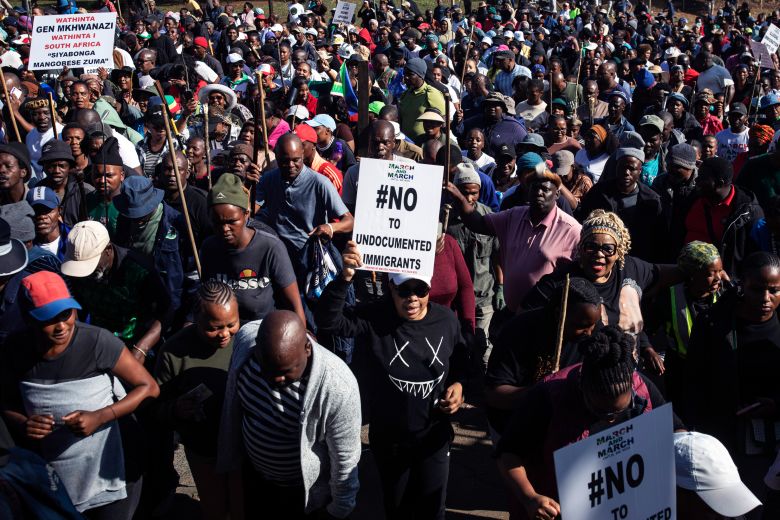
Jacinta Ngobese-Zuma, leader of the anti-migrant group March and March, confirmed the movement intends to continue its campaign indefinitely. “For the next six months, we are asking for our national resources to be used to take the illegal immigrants out of this country. From building to building, they must go,” she said in Durban, according to Reuters. Ngobese-Zuma has previously declined to accept responsibility for sporadic violence connected to the marches, telling Reuters in an earlier interview that the organization “cannot be in every single community telling them how to behave.”
Ngizwe Mchunu, another protest leader, told the Associated Press that illegal immigration was responsible for a proliferation of illicit drugs in the country and argued that informal neighborhood shops currently run by African immigrants should be owned exclusively by South Africans. “It is time for our government to put South Africa first,” Mchunu said.
Protester Bongani Cindi rejected the characterization of the movement as xenophobic. “Our country has got a lot of problems. We have an influx of illegal immigrants who are committing crimes that we can’t even take anymore. So we need them to leave us in peace, so we can sort our house. We are not fighting anyone,” he said.
A demonstrator affiliated with Operation Dudula, another prominent anti-migrant group, told the BBC that protesters intended to “push the police to do their job” if undocumented migrants did not leave voluntarily.
Why This Matters
The protests have exposed deep and unresolved tensions in post-apartheid South Africa, a country that built its modern political identity partly on Nelson Mandela’s vision of pan-African solidarity and human rights, but that now faces persistent unemployment exceeding 30 percent and rising public anger directed disproportionately at foreign nationals.
Social scientists have repeatedly found that claims linking immigrants to job losses, rising crime, and strained public services lack strong empirical support, even as those claims continue to drive political mobilization. South Africa’s documented foreign national population stands at approximately three million people, or roughly four percent of the total population, a relatively modest share by international standards. The precise number of undocumented migrants in the country remains unknown, a gap that protest organizers have specifically cited as central to their grievances.
Reuters noted that politicians across the spectrum have been accused of amplifying anti-migrant sentiment ahead of local elections expected by November, raising concerns that electoral incentives are reinforcing rather than restraining xenophobic rhetoric at a moment when restraint is most needed.
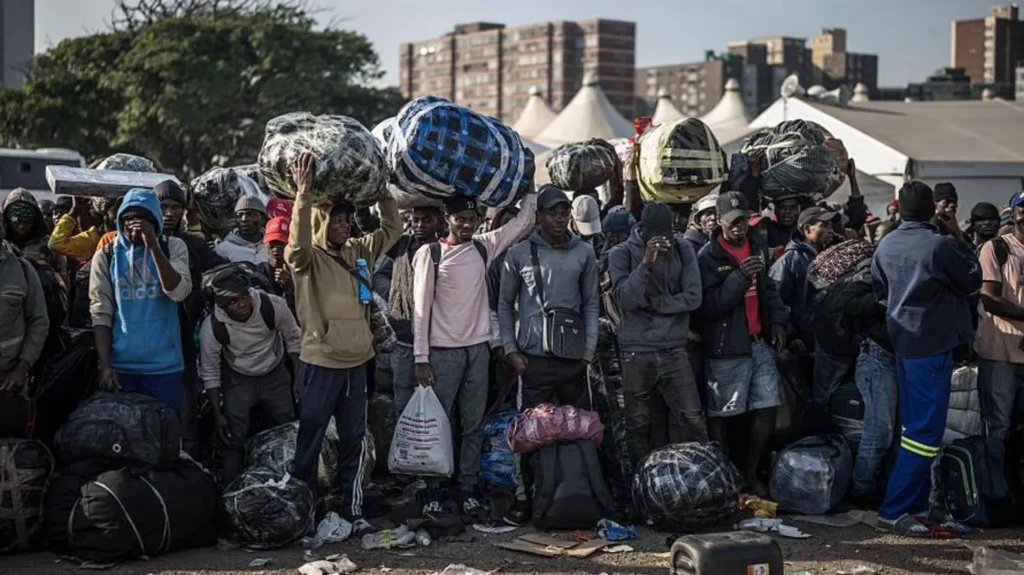
The human cost of the unrest has extended well beyond South Africa’s borders. The exodus of migrants fleeing the protests and the broader climate of intimidation has triggered a wave of repatriation efforts across the African continent. Nigeria has evacuated approximately 632 of more than a thousand citizens who registered for voluntary return, with additional flights expected in the coming days, according to Nigerian officials. Ghana, Malawi, Mozambique, and Zimbabwe have similarly organized repatriation efforts by air and bus. Approximately 7,000 Malawians have already returned home, according to Malawian media.
Emmanuella Akagbosun, a Nigerian woman who had lived in South Africa since 2017, described fleeing for her safety after the shop she shared with her sister was ransacked and looted by anti-migrant protesters. “We are not safe, so we had to leave,” she said after arriving in Lagos.
In Durban, where some of the largest protests took place, approximately 100 Congolese migrants were reported sleeping on the streets after being forced from their housing, with their community leader saying they had been chased out by landlords acting preemptively out of fear that their buildings would be targeted for vandalism.
The African Centre for Migration and Society’s Xenowatch tracker has recorded two deaths from xenophobic violence so far this year, a figure that predates Tuesday’s protests and the additional fatalities reported during the demonstrations themselves. The current unrest follows the catastrophic 2008 wave of anti-foreigner rioting, in which more than 60 people were killed nationwide, establishing the grim historical benchmark against which Tuesday’s protests are now being measured.
South African officials have noted that comparable immigration tensions exist in Western nations, often fueled by similarly divisive political rhetoric and misinformation, framing South Africa’s crisis as part of a broader global pattern rather than an isolated phenomenon.
What Happens Next
March and March has announced plans to continue weekly demonstrations for the next six months until its demands are met, signaling that Tuesday’s protests represent the opening phase of a sustained campaign rather than a single event.
Thousands of police remained deployed across affected cities, with the military placed on standby, a military spokesperson confirmed. Whether law enforcement can contain further violence as the weekly marches continue will be a critical test of the government’s capacity to balance the right to protest against the safety of foreign nationals who remain in the country.
Transit camps housing migrants awaiting repatriation continued winding down operations in Durban, where white tents primarily housing Malawian nationals were being dismantled as authorities worked to process remaining cases. Additional evacuation flights from Nigeria, Ghana, Malawi, Mozambique, and Zimbabwe are expected in the coming days as the exodus continues.
For migrants like Nelson Mbewe, a Malawian who described being targeted with the xenophobic slur “makwerekwere,” the practical reality has become one of resignation rather than resistance. “It’s their country, so what can we do? That’s why we have accepted that we just have to unwillingly go back home,” he told the BBC.
Others expressed hope that the current crisis would not permanently fracture relationships across the continent. Hassan Phiri, a Malawian still awaiting processing for repatriation, offered a different message entirely. “All I want to say to South Africans is that we are all one. Africa can’t be Africa without South Africa, without Malawi, without anywhere. So whatever will happen, we must love each other and stick together as Africa,” he told the BBC.
Whether that sentiment can withstand six more months of organized weekly demonstrations, continuing repatriation flights, and an electoral calendar that gives politicians incentive to harden rather than soften their rhetoric, remains the central question hanging over South Africa as Tuesday’s deadline passes into a longer and more uncertain chapter.
Reuters/AP/BBC




