

The U.S. Supreme Court ruled Tuesday that children born on American soil are citizens at birth regardless of their parents’ immigration status, delivering a decisive six to three defeat to President Donald Trump’s effort to reinterpret one of the Constitution’s most settled provisions and ending, for now, his administration’s attempt to restrict birthright citizenship through executive order.
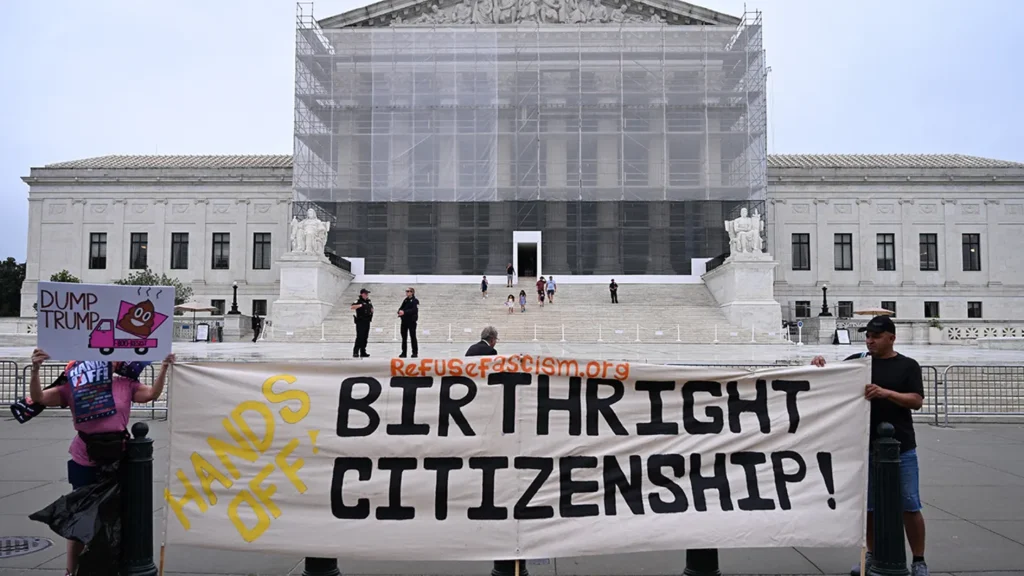
The ruling marked the second time this year the court has struck down a major Trump initiative, following its February decision invalidating his sweeping global tariffs.
What We Know So Far
Writing for the majority, Chief Justice John Roberts grounded the decision in more than a century of settled constitutional interpretation, anchored by the court’s 1898 ruling in United States v. Wong Kim Ark, which recognized that a man born in San Francisco to Chinese national parents was a U.S. citizen under the Fourteenth Amendment, the Associated Press confirmed.
“Not surprisingly, then, in the 128 years since, we have repeatedly understood the rule of Wong Kim Ark to guarantee citizenship to all children born in the United States and subject to its power,” Roberts wrote. “We see no reason to depart from that view today.”
Roberts was direct in dismissing the administration’s central legal argument. He said there was scant evidence supporting what he called the Trump administration’s dramatically revisionist interpretation of the citizenship clause. “If Congress intended to limit American citizenship to the children of those domiciled in the United States, nothing in the succinct language of the Citizenship Clause conveyed that design,” he wrote, according to Reuters.
The chief justice closed the opinion with language that framed the ruling in broader civic terms. “Citizenship, then and now, was the right to have rights, to freely participate in our political community. The Framers of the Fourteenth Amendment extended that promise to every free-born person in this land. We keep that promise today.”
Three conservative justices dissented and would have allowed Trump’s restrictions to take effect, though the order itself had never actually been implemented anywhere in the country, having been blocked by multiple lower courts since shortly after Trump signed it.
The case, formally captioned Trump v. Barbara, arose from a challenge filed in New Hampshire, where the American Civil Liberties Union represented individual plaintiffs, including infants who would have been directly affected by the executive order, NBC confirmed.
Trump signed the order on his first day back in office, January 20, 2025, as part of a broader immigration enforcement agenda. The order stipulated that, beginning 30 days after its effective date, children born in the United States would not be entitled to citizenship documents if their parents had entered the country illegally or were undocumented.
The restrictions also extended to children of parents legally present on a temporary basis, including students and applicants for green card status, meaning the policy’s reach went well beyond Trump’s typical rhetorical focus on illegal immigration.
Multiple federal district court judges ruled the order unconstitutional in the months following its signing, and two federal appellate circuit courts separately upheld injunctions blocking it from taking effect, CNBC confirmed. Every court that examined the order ruled against the administration.
Trump attended the oral arguments in April in person, becoming the first sitting president in American history to appear at Supreme Court arguments for a case directly challenging his own executive action.
What Authorities Are Saying
The Fourteenth Amendment’s citizenship clause, ratified in 1868 in the aftermath of the Civil War, was adopted specifically to guarantee citizenship to formerly enslaved Black Americans, though its text was written in broader and more universal terms. The clause states: “All persons born or naturalized in the United States, and subject to the jurisdiction thereof, are citizens of the United States and of the State wherein they reside.”
The Trump administration’s legal position rested on a narrow reading of the phrase “subject to the jurisdiction thereof,” arguing that children born to noncitizen parents, particularly those present illegally or temporarily, did not meet that jurisdictional threshold and were therefore excluded from automatic citizenship. The Supreme Court rejected that interpretation outright, affirming the position taken by every lower court that had previously reviewed the order.
Trump reacted to the ruling with the same sharp personal criticism he has directed at the court following other adverse decisions this year. He had previewed his frustration in advance on Truth Social, criticizing what he called “dumb judges and justices” and specifically targeting wealthy pregnant women traveling from China and elsewhere to give birth in the United States in order to secure American citizenship for their children.
Following the court’s February ruling striking down his global tariffs, Trump said he was “ashamed” of the justices who ruled against him and described them as unpatriotic, language that set the tone for how he has responded to judicial setbacks throughout his second term, even from a court whose conservative majority has ruled in his favor on most other major disputes.
Why This Matters
The scale of the policy that was struck down was substantial. Research from the Migration Policy Institute and Pennsylvania State University’s Population Research Institute estimated that more than a quarter of a million babies born in the United States each year would have been directly affected by Trump’s order had it taken effect, a population spanning children of undocumented immigrants, visa holders, international students, and green card applicants alike.
The ruling represents a meaningful boundary on a presidency that has otherwise pushed executive authority further than most of its predecessors, often with judicial backing. The Supreme Court’s conservative majority, including three justices appointed by Trump himself, has generally taken an expansive view of presidential power and has ruled in Trump’s favor in the majority of cases testing that authority during his second term.
Birthright citizenship and the February tariffs ruling stand as the two clearest exceptions, both involving attempts to use executive authority to override constitutional text or congressional statute rather than to reorganize existing executive branch functions.
That distinction matters for understanding the court’s reasoning. The justices have shown a consistent willingness to expand presidential control over agencies, personnel, and administrative functions.
They have shown far less tolerance for executive attempts to unilaterally reinterpret constitutional guarantees or override clear statutory text, areas where the court appears to view its own institutional role as the final word.
The ruling also reaffirms the durability of Wong Kim Ark as binding precedent. That 1898 decision has anchored American citizenship law for more than 125 years, and Tuesday’s ruling makes clear that any future effort to restrict birthright citizenship through executive action alone will face the same constitutional barrier.
Altering the scope of the Fourteenth Amendment’s citizenship clause would require either a constitutional amendment or, at minimum, a Supreme Court willing to overturn more than a century of settled precedent, a path the current court explicitly declined to take.
For the families directly affected, particularly immigrant communities living with uncertainty about their children’s legal status, the ruling provides definitive legal clarity. Children born in the United States remain citizens at birth regardless of their parents’ immigration status, with the narrow historical exceptions of children born to foreign diplomats and those born to members of an occupying foreign force remaining intact.
What Happens Next
Tuesday’s ruling closes the legal chapter on this particular executive order. With the Supreme Court having affirmed the lower court injunctions and definitively rejected the administration’s constitutional argument, there is no further judicial avenue for the administration to pursue the order as written.
Whether the Trump administration attempts to pursue birthright citizenship restrictions through legislative means, by seeking a constitutional amendment, or by introducing narrower administrative changes that do not directly contradict Tuesday’s ruling, remains to be seen. Any legislative path would require congressional action that has shown no clear signs of having sufficient support to proceed.
The ruling also serves as a marker for how the current Supreme Court approaches the broader pattern of executive power claims that have characterized Trump’s second term.
With birthright citizenship and the global tariffs case now both resolved against the administration, attention turns to how the court will handle the remaining body of litigation testing the limits of presidential authority over immigration, federal employment, and other areas where Trump has moved aggressively since returning to office in January 2025.
For now, the constitutional guarantee that has applied to nearly everyone born on American soil since 1868 remains exactly as it was before Trump’s order was ever signed.
AP/Reuters/NBC




