

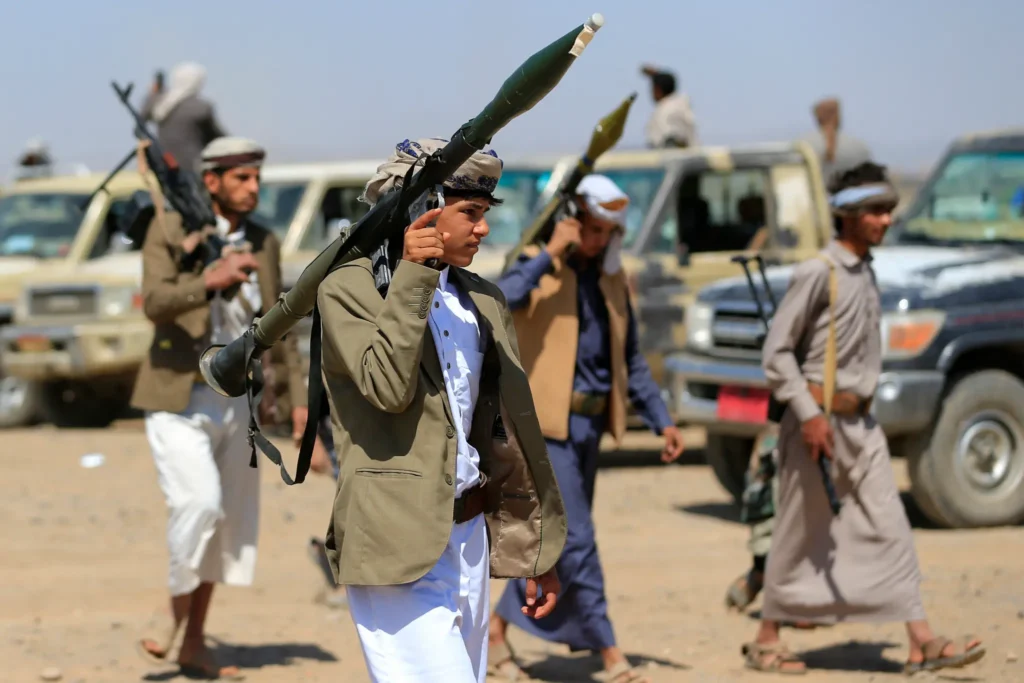
Yemen’s Houthi movement launched ballistic missiles and drones at Saudi Arabia’s Abha International Airport on Monday, ending four years of relative calm between the two adversaries and threatening to drag the Arabian Peninsula into a fresh cycle of violence, after Yemen’s internationally recognized government struck the runway at Sanaa International Airport to prevent an Iranian aircraft from landing.
The exchange of fire marked the most significant escalation between the Houthis and Saudi Arabia since an informal truce took effect in March 2022 and raised immediate alarm at the United Nations, which warned that Yemen and the wider region could not afford another war.
What We Know So Far
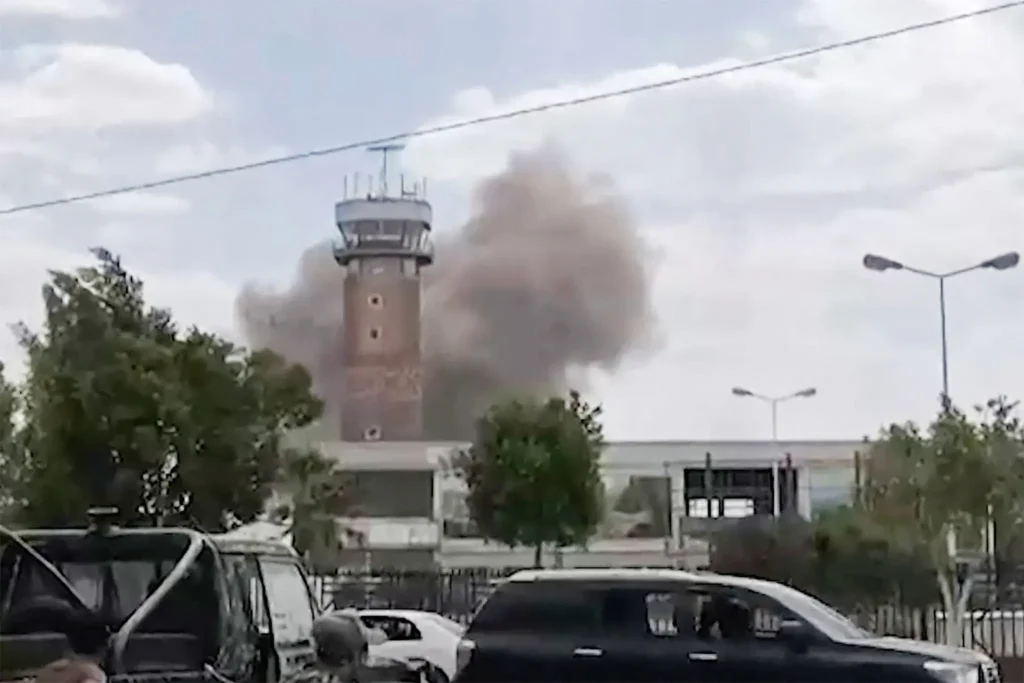
The crisis began when Yemen’s Saudi-backed government bombed the runway at Sanaa International Airport on Monday to stop an Iranian aircraft carrying a Houthi delegation returning from the funeral of Iran’s Supreme Leader Ayatollah Ali Khamenei in Tehran, the Associated Press confirmed. The government said it had exhausted diplomatic efforts to prevent what it described as Iranian violations of Yemeni airspace.
Yemen’s Defense Minister General Taher al-Aqili announced the strike in a video statement released shortly beforehand. “At this moment, we say that our patience has run out. Accordingly, we will respond appropriately to this treacherous and brutal act, and we will confront and deal with the hostile aircraft violating Yemeni airspace and sovereignty by all available means,” he said.
The Iranian plane was diverted and eventually landed at Hodeida Airport, the Houthi-controlled port city on Yemen’s western Red Sea coast, the Associated Press confirmed. Houthi broadcaster al-Masirah quoted the group’s transport minister as saying the aircraft had carried medical patients, stranded citizens, and an official delegation.
Hours later, the Houthis retaliated. Houthi military spokesman Brigadier General Yahya Saree confirmed in a Telegram video statement that the group had struck Abha International Airport, the capital of a mountainous southern Saudi region bordering Yemen, with ballistic missiles and drones.
Saudi Arabia’s coalition spokesperson confirmed on X that air defenses had intercepted ballistic missiles fired by the Houthis toward the southern region, though no details were provided on casualties or damage. No fatalities were reported on either side, the Associated Press confirmed.
Saree warned all airlines against flying through Saudi airspace until what he described as the blockade on Sanaa International Airport was lifted. He said the warnings should be taken “seriously.” The Houthis separately declared all airports in Yemen closed until further notice.
The Yemen government additionally accused the Houthis of detaining an aircraft belonging to the International Committee of the Red Cross at Sanaa airport and holding its pilot and co-pilot, Yemen Information Minister Moammar bin Mutahar Al-Eryan said.
Adding to the maritime dimension of the crisis, the United Kingdom Maritime Trade Operations center warned of suspicious activity off the coast of Yemen on Monday, with at least six small boats approaching a tanker sailing in the Gulf of Aden.
The ship fired warning shots as the boats continued to trail the vessel, the New York Post confirmed. The incident remained under investigation.
What Authorities Are Saying
The United Nations Security Council convened an emergency meeting on the developments Monday afternoon. U.N. Assistant Secretary-General for Political Affairs Khaled Khiari addressed the 15-member council directly. “Yemen and the wider region cannot afford another cycle of escalation. We call on all actors to constructively engage in negotiations under UN auspices,” Khiari said, the Associated Press confirmed.
U.N. Special Envoy for Yemen Hans Grundberg issued a parallel warning, saying his office was in contact with all parties and urging them to step back. “We are urging them to de-escalate and refrain from any actions that would risk a new cycle of violence in Yemen,” Grundberg said.
Iran condemned the Sanaa airport strike. Foreign Ministry spokesman Esmaeil Baghaei described the attack as a “clear violation of international law and the United Nations Charter, as well as an affront to Yemen’s national sovereignty and territorial integrity,” Iranian state news agency IRNA confirmed.
Rashad al-Alimi, who leads Yemen’s Presidential Leadership Council, confirmed that Iran had formally requested permission to operate a flight by Iranian airline Mahan Air from Tehran to Sanaa to return the Houthi delegation.
The council denied the request, saying the Houthis had insisted on receiving the Iranian flight “outside the legal and sovereign frameworks governing civil aviation.”
Saudi Arabia’s government communication office did not immediately respond to media requests for comment on the strikes in Yemen, Reuters noted.
Why This Matters
Monday’s events represent a convergence of multiple active conflicts that had previously been treated as separate theaters but are now becoming visibly interconnected.
The Houthi-Saudi truce that began in March 2022 had survived years of regional turbulence, including the broader U.S.-Iran war that began in February and the episodic maritime attacks that the Houthis carried out against Red Sea shipping in 2024.
That the truce has now broken down, triggered by a dispute over an Iranian aircraft carrying delegates back from Khamenei’s funeral, illustrates how the death of the Iranian supreme leader and the dynamics of the broader U.S.-Iran conflict are reshaping security arrangements across the entire region simultaneously.
The maritime threat attached to any renewed Houthi-Saudi confrontation is particularly acute at this moment. Saudi Arabia has been rerouting its oil exports through the Red Sea and its pipeline to the western coast precisely because the Strait of Hormuz has been disrupted by the U.S.-Iran war. Any Houthi campaign against shipping in the Bab al-Mandab Strait, the 20-mile-wide chokepoint connecting the Red Sea and the Gulf of Aden through which roughly one trillion dollars in goods passes annually, would directly threaten that alternative export route, the New York Post noted.
The Houthis demonstrated in 2024 that they have both the willingness and the capability to disrupt Red Sea shipping on a significant scale. Their attacks during that period sowed chaos in global shipping markets and forced major carriers to reroute around Africa.
A renewed campaign, launched in the context of an already disrupted global energy supply chain, would add additional pressure to markets that are already under stress from the Strait of Hormuz crisis.
Yemen’s civil war began in 2014 when the Houthis seized Sanaa and much of northern Yemen. A Saudi-led coalition, including the United Arab Emirates, intervened the following year.
The resulting conflict produced one of the world’s most severe humanitarian crises, with widespread displacement, damage, and famine affecting millions of Yemenis.
The UAE has since withdrawn from the coalition, weakening the military partnership that underpinned the Saudi intervention. That fracture in the coalition comes at a moment when the Houthis appear emboldened and Saudi Arabia faces renewed pressure on its southern border, Reuters noted.
What Happens Next
The immediate diplomatic priority is preventing Monday’s exchange of strikes from hardening into a sustained resumption of hostilities.
The U.N. Security Council meeting and Grundberg’s direct outreach to all parties reflect the urgency with which international mediators are treating the situation.
Whether Saudi Arabia responds militarily to the Houthi missile attack, or whether it opts to absorb the strike and pursue a diplomatic de-escalation, will be the decisive variable in the coming hours.
A Saudi military response against Houthi-controlled territory would almost certainly end the truce formally and reopen the full conflict.
The Houthis’ warning to international airlines and their declaration that all Yemeni airports are closed signal an intention to sustain pressure rather than stand down.
Their demand, that the Sanaa airport blockade be lifted before they end the threat to Saudi airspace, creates a negotiating condition that will require third-party mediation to resolve.
For Saudi Arabia, the timing is particularly uncomfortable. The kingdom has spent years trying to extract itself from the Yemen conflict, which has been costly in both blood and international reputation, while managing its own exposure to the broader U.S.-Iran war that has repeatedly struck its territory.
A renewed Houthi front, combined with a potentially active maritime threat in the Bab al-Mandab, confronts Riyadh with a multi-directional security challenge at a moment when regional stability remains exceptionally fragile.
Sources: Reuters, The Associated Press, Al Jazeera, New York Post




