

The United States carried out its third consecutive night of military strikes against Iran on Monday, hitting dozens of targets across multiple locations along Iran’s Persian Gulf coast as President Donald Trump reinstated a naval blockade of Iranian ports, proposed charging a 20 percent tariff on ships passing through the Strait of Hormuz, and declared that Washington intends to run the waterway itself, escalating a conflict that has already killed thousands and sent global energy markets into renewed turmoil.
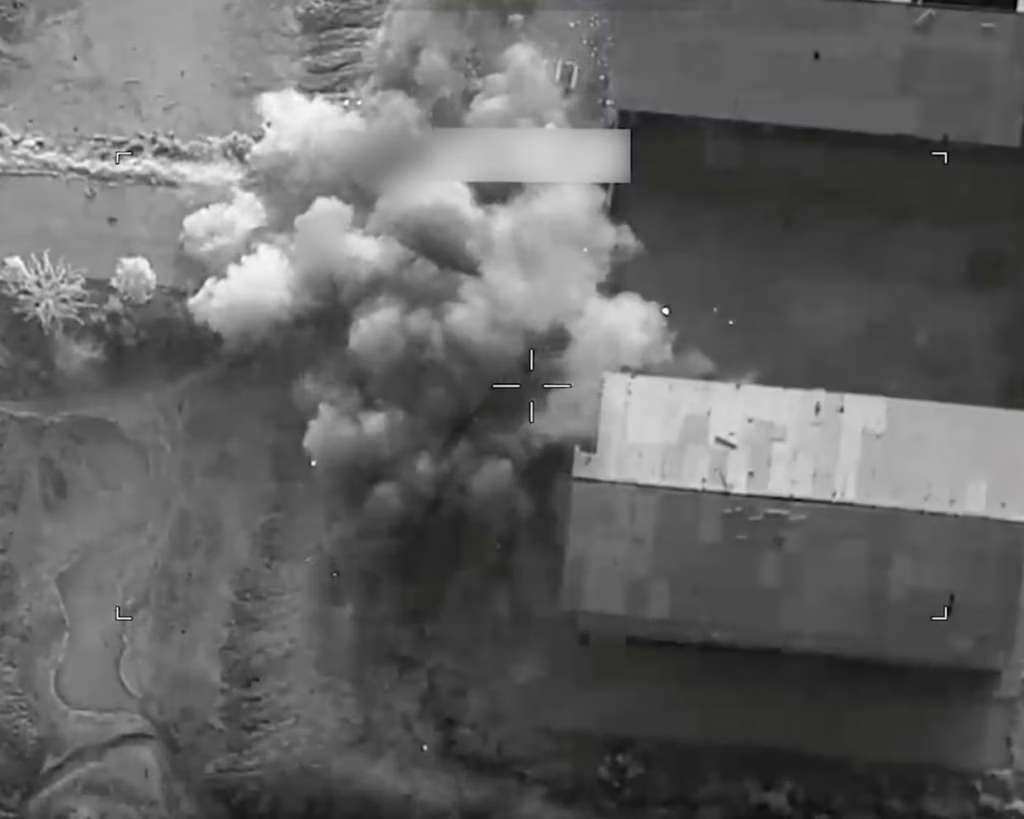
U.S. Central Command confirmed the strikes were completed at 10:15 p.m. Eastern time after a five-hour mission that struck targets in Bushehr, Chah Bahar, Jask, Konarak, Abu Musa, and Bandar Abbas, CNN confirmed.
What We Know So Far
Central Command announced the third night of strikes began at 4:45 p.m. Eastern time at Trump’s direct order. The mission targeted Iranian coastal defense systems, missile and drone sites, and maritime capabilities using fighter planes, naval vessels, one-way attack aerial drones, and for the first time, one-way attack sea drones, the New York Post confirmed.
“These strikes will continue imposing a heavy cost on Iranian forces and degrade their ability to attack innocent civilians and commercial shipping in the Strait of Hormuz,” CENTCOM said in its statement on X.
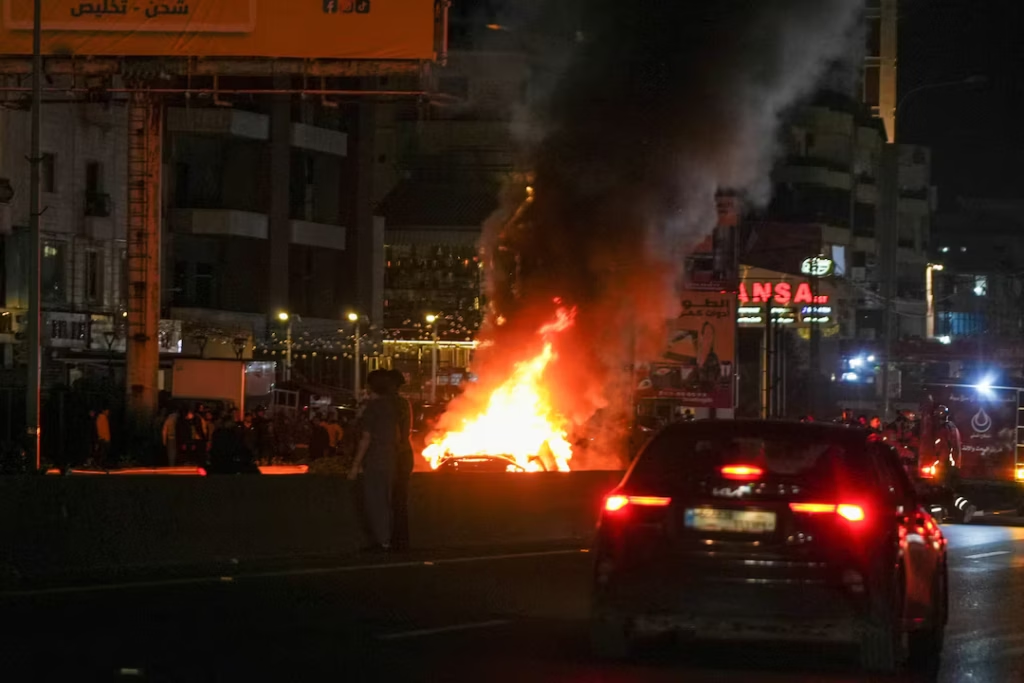
Explosions were reported across several cities along Iran’s Persian Gulf coast, including Jam, Konarak, Bushehr, Bandar Abbas, and Bandar Kangan, according to Iranian state media and unconfirmed social media accounts. Targets on the islands of Kish, Qeshm, and Abu Musa were also believed to have been struck. Iranian state media reported at least one person killed and several wounded. Semi-official Fars News Agency confirmed explosions in Bushehr and Choghadak. Iran’s official IRNA news agency, citing a provincial official, reported four areas of Bushehr city were hit by American projectiles.
The Sunday night mission that preceded Monday’s strikes hit approximately 140 Iranian military sites in an overnight aerial assault, Central Command confirmed. Sunday’s operation also employed the new one-way attack sea drones for the first time in the conflict.
Iran’s Revolutionary Guard responded by launching strikes toward U.S. bases across the region. The Guard separately accused the United States of endangering global oil and gas supplies by interfering in the strait, with spokesperson Hossein Mohebi saying Washington had “seriously endangered the security of the world’s oil and gas supply and must be held accountable” and adding that Tehran would “continue to exercise sovereignty over and management of the strait of Hormuz.”
The United Arab Emirates, which had not been targeted since early May, confirmed its air defenses engaged Iranian missiles and drones. The UAE also disclosed that two of its national tankers were struck by Iranian cruise missiles in the southern lane of the strait in Omani territorial waters, killing one Indian crew member and wounding eight others, including four seriously, the Guardian confirmed.
Iran’s strikes on Sunday extended to Qatar, a ceasefire mediator that had not been attacked since April, the Guardian noted. Brent crude oil rose 7.8 percent to $81.92 a barrel Monday, reflecting the market’s sharpening anxiety about energy supply disruptions.
The U.S. Navy-led Joint Maritime Information Center announced Monday evening that the blockade of Iran would resume enforcement Tuesday night at 4 p.m. Eastern time, covering all Iranian ports, oil terminals, and coastal areas. “Any vessel suspected of entering or departing the blockaded area without authorization is subject to interception, diversion and capture. Noncompliant vessels may be legally compelled with force,” the center said, adding that neutral transit through the strait to non-Iranian destinations would not be impeded.
What Trump And U.S. Officials Are Saying
Trump was direct and expansive in describing Monday’s operations and his intentions. Speaking to reporters in the Oval Office shortly after Central Command announced the strikes, the president said: “We’re hitting them very heavily tonight.
We have tremendous amounts of ammunition. We have numbers that we haven’t had in years, and we’re hitting them very hard and it’ll continue. We’re knocking out all of their offensive capability, and we’re controlling the straits.”
Earlier in the day, Trump told conservative radio host Hugh Hewitt: “We’re going to hit them very hard tonight and we’re going to hit them hard tomorrow, and there’s not a damn thing they can do about it. They have nothing going, other than they have big mouths.”
Trump also raised the prospect of striking what he called Pickaxe Mountain, a facility he described as a hidden fortress potentially housing Iranian uranium stockpiles. “We’re going to take out Pickaxe Mountain. Tell the Iranians to be ready,” he told Hewitt. “We’ll probably give Pickaxe a shot relatively soon.”
The president proposed on Truth Social that the United States should be recognized as the “guardian of the strait of Hormuz” and said Washington intended to charge a 20 percent tariff on all cargoes passing through the waterway. In a subsequent Fox News phone interview, he went further. “We’re going to keep the strait, and we’ll probably run it,” Trump said.
The tariff proposal represents a significant and legally contested policy shift. Until Monday, the United States had insisted no country had the right to charge fees for transit through a strait used for international navigation, a position Secretary of State Marco Rubio articulated as recently as last month. “No country is allowed to charge tolls or fees on an international waterway. That’s existing international law,” Rubio had said. Trump’s tariff announcement appeared to directly contradict that position.
Trump also disclosed that he had formally notified Congress on Friday that the United States resumed conducting what he described as limited and measured kinetic strikes in Iran on July 7, a notification his administration characterized as opening a new 60-day window to conduct military operations without congressional approval under the War Powers Act.
Democrats and some Republican opponents of the war accused the administration of misinterpreting the law, the Guardian confirmed.
What Iran And Others Are Saying
Iran’s top negotiator and parliamentary speaker Mohammad Bagher Ghalibaf posted on social media Sunday with a message directed at Washington. “The era of one-sided deals is over. We told you: keep your word or pay the price. Reality is knocking,” Ghalibaf wrote.
The International Maritime Organization, the United Nations agency overseeing international shipping safety, pushed back firmly against Trump’s tariff proposal. “IMO stands firmly against charging fees for passage through straits used for international navigation. There is no legal basis through which to introduce mandatory tolls simply to transit through a strait,” the organization said in a statement, the Guardian confirmed.
Iran’s Revolutionary Guard framed its ongoing strikes as a defense of sovereignty rather than aggression, characterizing U.S. interference in the strait as a threat to the global economy that Washington would be held accountable for.
Why This Matters
Monday’s developments represent a qualitative shift in the character of the U.S.-Iran confrontation that goes beyond military exchange.
Trump’s claim that the United States intends to “run” the Strait of Hormuz and charge a 20 percent tariff on cargo passing through it amounts to a unilateral assertion of American control over one of the world’s most consequential waterways, a claim with no precedent in modern international law and one that contradicts the legal framework Washington itself has cited repeatedly in condemning Iran’s attempts to do precisely the same thing.
The Strait of Hormuz is not simply a strategic chokepoint. It is the passage through which roughly 20 percent of globally traded oil and natural gas normally flows. If the United States imposes a tariff on that traffic, it would represent a tax on energy supplies reaching Asia, Europe, and developing nations alike, generating diplomatic friction far beyond the immediate conflict zone.
Countries that have supported or tolerated the American military campaign against Iran on the basis of its stated commitment to free navigation will face a far more complicated calculation if Washington begins collecting fees in the same waterway it entered to protect.
The use of one-way attack sea drones for the first time also signals a continuing expansion of the military tools being deployed, suggesting that the operational capacity of U.S. forces in the region remains substantial and that the Pentagon has not yet exhausted its tactical options.
The formal notification to Congress, framing July 7 as the restart date for hostilities, suggests the administration is positioning itself for a sustained military campaign rather than a series of limited retaliatory strikes. A new 60-day window, if that framing holds legally, would extend American military authority in the region through early September.
The economic dimensions are worsening. Oil prices rose nearly eight percent on Monday despite remaining well below their wartime peak. Global inflation, already elevated by months of energy supply disruption, faces further pressure each day the conflict continues without a genuine diplomatic resolution.
Iran’s strikes extending to Qatar, which has served as a key mediator throughout the conflict, and renewed targeting of the UAE, are particularly destabilizing. Both countries have played constructive roles in the negotiations and their targeting reduces the diplomatic space available for the back-channel conversations that any eventual settlement will require.
What Happens Next
Central Command confirmed that more than 50,000 U.S. service members remain deployed across the Middle East, described as vigilant and ready for further operations.
Trump said a negotiated settlement with Iran remained possible despite the current intensity of exchanges. He claimed Washington had reached a deal with Tehran two days earlier but that Iran backed out, a characterization Iranian officials did not immediately address.
The reimposition of the naval blockade from Tuesday evening will be the next immediate flashpoint. Iran has threatened to contest any U.S. moves in the strait, and the practical challenge of enforcing a blockade while simultaneously conducting airstrikes and protecting commercial shipping will test the operational bandwidth of U.S. forces in the region.
Iran and the United States are nominally still within the 60-day window established by last month’s interim memorandum of understanding, though the Guardian noted that in reality the deal has devolved into a series of attacks over the strait of Hormuz resulting in the near-total collapse of the ceasefire.
Whether any negotiating framework survives Monday’s developments will depend on whether third-party mediators, particularly Pakistan and Qatar, can find a formula acceptable to both sides before the military exchanges foreclose the diplomatic space entirely.
For the world beyond the conflict zone, the question is how much longer a global economy already absorbing the costs of months of disrupted energy supply can sustain an escalating military confrontation in the waterway through which so much of that supply must pass.
Sources: CNN, Reuters, The Guardian, The Associated Press, The New York Post





