

Russia unleashed one of its largest ballistic missile attacks of the war on Kyiv early Sunday, killing at least one person and injuring 16 others, while Ukraine answered with coordinated long range strikes targeting Russian oil depots, fuel infrastructure and vessels linked to Moscow’s energy network.
The exchange marked another significant escalation in the conflict as both countries intensified attacks far beyond the front lines, targeting infrastructure considered critical to sustaining military operations.
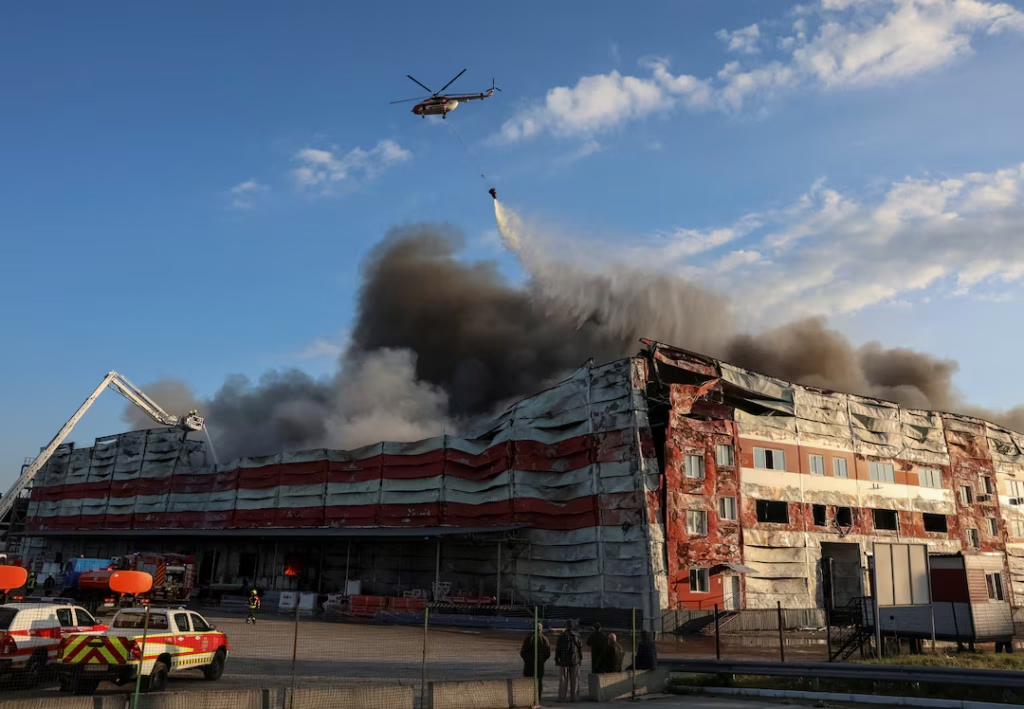
President Volodymyr Zelensky said Ukrainian forces struck three oil depots in Russia’s Stavropol region, another fuel storage facility and three tankers connected to Russia’s shadow fleet operating in the Black Sea.
“We continue to respond to Russian strikes in a fully justified and accurate manner,” Zelensky said in a statement posted on X.
His remarks came only hours after Russia launched what Ukrainian officials described as the largest ballistic missile assault on Kyiv since the full scale invasion began.
What we know so far
Russian missiles and drones struck multiple districts across the Ukrainian capital before dawn, igniting fires in residential neighborhoods, office buildings, industrial facilities, student housing and parked vehicles.
Ukraine’s Air Force said Russia launched 41 missiles and 125 drones overnight. Air defense units intercepted 18 missiles and destroyed 108 drones before they reached their intended targets.
Emergency crews rescued residents trapped inside burning apartment buildings while firefighters battled blazes across five districts of Kyiv.
Authorities confirmed that one person was killed and at least 16 others were injured. Several victims remained in serious condition.
Reuters reported that powerful explosions echoed across the capital as rescue workers searched damaged buildings and extinguished fires. The news agency said additional Russian strikes in the Kharkiv region killed three more people and wounded at least 16 others.
The Associated Press reported that rescue teams pulled residents from burning buildings while emergency crews responded to fires across the Sviatoshynskyi, Shevchenkivskyi, Solomyanskyi, Desnianskyi and Dnipro districts.
Residents described hours of continuous explosions.
Viktoria Shejko said she sheltered in the hallway of her apartment with her husband and seven children after missile alerts sounded across the city.
“When the alarm started, we checked that there were ballistic missiles, then went into the corridor. Then it started exploding one missile after another,” she told The Associated Press.
What authorities are saying
Ukraine’s Foreign Minister Andrii Sybiha said Russia fired roughly four dozen ballistic missiles during the overnight attack, making it the largest ballistic missile barrage against Kyiv since the war began.
Mayor Vitali Klitschko said residential buildings, warehouses, supermarkets and student accommodation suffered extensive damage.
Russia’s Defense Ministry maintained that the strikes targeted military related facilities, including factories producing drones, missile components and electronic warfare equipment.
Meanwhile, Zelensky announced that Ukraine’s Security Service and Armed Forces conducted coordinated strikes against Russian energy infrastructure.
According to the Ukrainian president, direct hits were recorded at three oil depots in Stavropol, another fuel storage facility and three tankers connected to Russia’s shadow fleet in the Black Sea.
Ukraine’s General Staff also said military forces struck a fuel depot in Noginsk that supplies Russian troops, damaged additional vessels operating in the Black and Azov seas and targeted military logistics infrastructure inside occupied territory.
Why this matters
The latest attacks illustrate how the war has increasingly evolved into a campaign against strategic infrastructure rather than solely conventional battlefield positions.
Russia continues to rely heavily on ballistic missiles and long range drones to pressure Ukrainian cities while attempting to overwhelm Kyiv’s limited air defense systems.
Ukraine, meanwhile, has expanded its long range strike capability, focusing on oil facilities, fuel depots and maritime assets that generate revenue and logistical support for Russia’s military campaign.
Energy infrastructure has become one of the most strategically valuable targets for both countries. Ukrainian officials argue that disrupting Russia’s fuel supply reduces Moscow’s ability to sustain prolonged military operations while also limiting export revenues that finance the war.
At the same time, repeated attacks on Kyiv demonstrate Ukraine’s continuing dependence on advanced air defense systems, particularly Patriot missile batteries, to intercept Russian ballistic missiles.
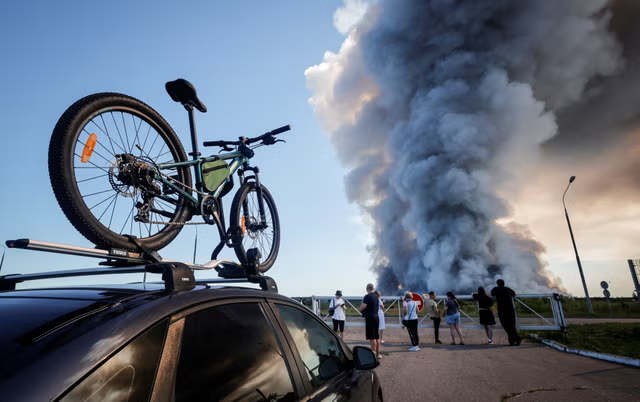
What happens next
Ukraine’s latest long range strikes indicate that Kyiv intends to sustain pressure on Russia’s military logistics and energy infrastructure even as Moscow intensifies missile attacks on Ukrainian cities.
Russian authorities are expected to assess damage to the targeted fuel depots and maritime facilities while strengthening air defenses around strategic energy assets. Although Moscow rarely acknowledges the full impact of Ukrainian strikes, repeated attacks on oil storage facilities have forced temporary shutdowns and emergency repairs in several regions over the past year.
Ukraine, meanwhile, continues to urge Western allies to accelerate deliveries of advanced air defense systems. President Zelensky has repeatedly stressed that additional Patriot missile batteries and interceptor missiles are essential as Russia increases the scale and frequency of ballistic missile attacks.
Last week, Zelensky said Ukraine and the United States had reached a political agreement that could eventually allow licensed production of Patriot interceptor missiles inside Ukraine. However, officials have yet to announce when such production could begin or how quickly it could strengthen Ukraine’s defenses.
The latest exchange also comes as fighting expands beyond traditional battlefields. Military analysts increasingly view the conflict as a contest over logistics, fuel supplies and industrial production as much as territorial control. Both sides are attempting to weaken the other’s ability to sustain prolonged combat by striking critical infrastructure hundreds of miles from the front line.
Ukraine’s continued targeting of Russia’s oil industry reflects a broader strategy aimed at reducing the revenue Moscow earns from energy exports while disrupting fuel supplies used by Russian forces. Russia, in turn, has intensified attacks on Ukrainian cities in an apparent effort to overwhelm air defenses, damage industrial capacity and erode civilian morale.
The Black Sea has emerged once again as a critical theater in the conflict. Ukrainian officials said the latest operation struck tankers linked to Russia’s shadow fleet, vessels that have become increasingly important in transporting oil despite international sanctions. Although independent verification of the damage remains limited, repeated attacks on shipping and port infrastructure have heightened risks for commercial maritime traffic throughout the region.
The Associated Press also noted that operations at the Caspian Pipeline Consortium terminal on Russia’s Black Sea coast were temporarily suspended after two oil tankers were struck. The consortium said a fire aboard one vessel was extinguished without casualties or oil spills, although loading operations were halted as officials assessed the damage.
The latest developments highlight a significant evolution in the nearly five year conflict. Rather than concentrating solely on battlefield gains, both countries are investing heavily in long range precision strikes designed to disrupt economic capacity, military logistics and public confidence.
Russia continues to leverage its larger missile arsenal to target major Ukrainian population centers, while Ukraine increasingly relies on drones and precision weapons to attack facilities that support Russia’s military economy. This reciprocal strategy suggests the conflict is becoming a prolonged campaign of strategic attrition in which infrastructure carries nearly as much military value as territory.
The growing emphasis on oil depots, fuel storage facilities, logistics hubs and shipping networks also reflects the broader importance of energy in sustaining modern warfare. Every successful strike against fuel supplies has the potential to affect troop mobility, military production and government revenues, even if immediate battlefield effects are not always visible.
Another emerging trend is the increasing pressure on Western governments to expand military assistance. Russia’s growing use of ballistic missiles reinforces Ukraine’s demand for more advanced air defense systems, while Ukraine’s expanding long range strike capability may encourage allies to provide additional intelligence, surveillance and precision weapons.
As both nations continue to adapt their military strategies, civilian infrastructure and economic assets are likely to remain frequent targets, increasing humanitarian concerns and complicating diplomatic efforts to end the conflict.
The coming weeks will reveal whether the latest wave of strikes alters operational momentum or simply marks another phase in a prolonged war that continues to escalate across multiple domains.
Sources: The Independent, Reuters and The Associated Press





