

The United States is banning imports of most Canadian dairy products, most alcoholic beverages and motorcycles, the White House said Tuesday, deepening a trade war that shows little sign of cooling after Canada’s own retaliatory tariffs took effect earlier the same day.
The ban is set to take effect in roughly three weeks, with the Associated Press citing a specific effective date of September 29. It follows Canada’s imposition of retaliatory tariffs on $20 billion worth of U.S. imports Tuesday, itself a response to tariff moves President Donald Trump made after trade talks between the two countries collapsed last month.
Trump also directed the U.S. General Services Administration to declare Canadian products ineligible for large, long-term U.S. government contracts until Canada offers what the administration called full and fair reciprocity for American products.
What We Know So Far
The new import ban targets Canadian wines and spirits, some motorcycles and mopeds, dairy products including whey, and various types of molasses. The measure came in direct response to several Canadian provinces banning the sale of U.S. alcoholic products, a policy Washington cited as the trigger for Tuesday’s retaliatory ban.
Canada’s own tariffs, which took effect Tuesday, hit hundreds of American products including steel, aluminum, cheese, appliances, clothing, cosmetics and farm equipment, at rates of 15, 25 or 50 percent. The measures cover roughly $20 billion in American goods, about 6 percent of the $333.6 billion the United States exported to Canada last year.
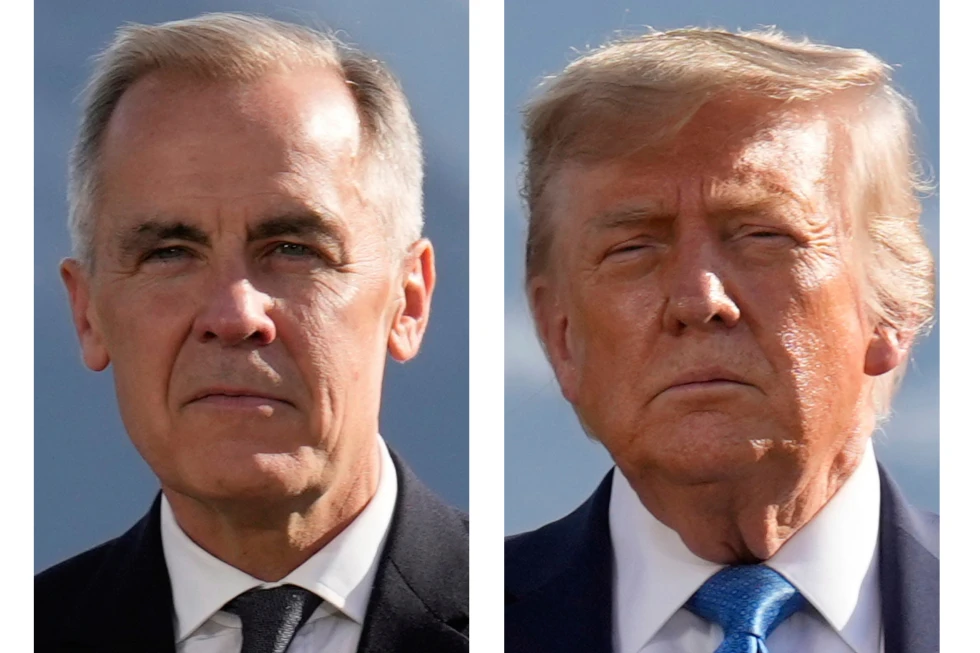
Canadian Prime Minister Mark Carney defended the retaliation, saying Canada could not allow American goods to enter tariff free while Canadian companies faced U.S. tariffs. He said Canada was not seeking to escalate the confrontation but viewed the tariffs as necessary to protect Canadian workers. Carney said the deeper problem stemmed from what Washington had sought during the failed negotiations. “The most fundamental issue is that the cumulative U.S. demands revealed that they wanted us to become even more reliant on them, not less,” Carney said, adding that Washington sought limits on French language and cultural protections, influence over future trade deals, and terms that would have weakened Canada’s auto, steel and forestry sectors.
A Canadian official said Tuesday that Ottawa did not intend to change its course regardless of how Washington responded, even describing a scenario in which Trump might issue what the official called a nuclear response. The official said Canada’s strategy remains focused on building domestic capacity and diversifying trade abroad.
Canada Looks Beyond the US
Carney said Canada’s broader strategy is about becoming more independent. “It’s about ensuring that no country can hold us hostage. And that we can live how we want to live,” he said, acknowledging the trade actions would cause short term pain but arguing they would accelerate Canadian investment, infrastructure development and trade diversification. “It was easy business, but it meant we relied too much on one economic partner,” Carney said. “That time is over.” More than 70 percent of Canadian exports still go to the United States, underscoring the scale of the diversification Carney is pursuing, though he said Canada’s exports to other countries are rising sharply and are on track to double over the next decade.
A Canadian official familiar with the matter said Canada is exploring deeper ties with the European Union that could stop short of formal membership, potentially through expanding existing agreements, negotiating a new treaty, or other forms of cooperation. The official said Canada is already consulting provinces, territories and labor groups about what a closer EU relationship might look like, though no specific model has been chosen. Carney is scheduled to travel to Strasbourg, France, next week, where he will attend European Commission President Ursula von der Leyen’s State of the European Union address on September 16 and address the European Parliament the following day.
British Columbia Premier David Eby said the province will install new signage at U.S. border crossings declaring British Columbia strong, proud and never willing to become the 51st state, a reference to Trump’s repeated suggestions that Canada join the United States. “While our kindness is one of our greatest strengths, you should never, ever mistake that kindness for weakness,” Eby said. Canadians have also sharply cut travel to the United States and boycotted American goods, actions Carney has praised as signs of national resolve.
Neither Side Is Rushing Back to the Table
Canadian Trade Minister Dominic LeBlanc said the government was assessing the latest U.S. tariff measures and remained in contact with U.S. Trade Representative Jamieson Greer, adding that Canada was ready to engage whenever Washington was. A senior Trump administration official told reporters on a White House arranged conference call Tuesday evening that U.S. and Canadian trade representatives had held constructive conversations and would speak again in the coming days to determine whether a path forward exists.
Wendy Cutler, a former U.S. trade official, said Carney’s public approval rating, now above 70 percent, gives him little political incentive to restart talks. “Clearly, at this point each side does not want to look too anxious to reengage in fear of looking weak,” Cutler said.
Why This Matters
The dispute has upended one of the world’s closest bilateral relationships, a rupture that traces back to the U.S. imposing 50 percent tariffs on about 5 percent of Canadian imports on August 22, following accusations that Canada had unfairly treated American dairy, alcoholic beverage and auto industries. The U.S. and Canada have long sparred over trade issues, particularly Canada’s protected dairy market and softwood lumber subsidies, but the relationship had historically remained one of close friendship and alliance despite those disputes.
Trump’s repeated suggestions that Canada become the 51st U.S. state have fueled anger across the country and contributed to Carney’s political rise, since he came to power in a come from behind victory last year built partly on a promise to stand up to Trump. The government contract ban targeting Canadian products adds a new dimension to the dispute beyond tariffs, extending the conflict into public procurement policy and signaling a more comprehensive approach to economic pressure from Washington.
How the trade war ultimately resolves could carry implications well beyond the two countries directly involved, testing whether a smaller U.S. ally can resist sustained American economic pressure without being forced into concessions, a dynamic other countries navigating similar disputes with Washington are likely watching closely.
What Happens Next
The new U.S. import ban is scheduled to take effect around September 29, giving both governments several weeks during which further negotiation or escalation remains possible. Carney’s planned trip to Strasbourg next week, including his address to the European Parliament, will offer an early indication of how seriously Canada intends to pursue deeper European ties as an alternative to its historical reliance on U.S. trade.
Given both sides’ stated reluctance to appear eager to return to the negotiating table, and the Trump administration’s own description of only “constructive conversations” rather than concrete progress, a near term resolution appears unlikely. The outcome of Canada’s broader diversification push, including its EU discussions and efforts to double non-U.S. exports over the next decade, will likely shape how much leverage each side retains in any eventual renewed negotiations.
Reporting drawn from the Associated Press and The Independent





