

The United States struck multiple Iranian tankers Tuesday in response to renewed attempted missile attacks on a Navy warship, while Yemen’s Iran backed Houthi rebels separately attacked four cities in southern Saudi Arabia, wounding more than 70 people in what appeared to be a major expansion of the six month old Middle East war.
A U.S. official, speaking on condition of anonymity to discuss sensitive military operations, confirmed the tanker strikes came in response to Iranian attempts to hit a U.S. Navy warship, marking a resumption of American attacks on Iran after a two-day pause. Iranian state media reported that a U.S. missile struck a tanker about four miles from the Kharg Island oil hub, while a second tanker was attacked near Jask on the Gulf of Oman. State television said the crews of both vessels near Jask were evacuating by lifeboat toward the coast, and that the crew of the Kharg Island tanker was safely evacuated shortly after that strike.
Iran’s Revolutionary Guard Navy warned oil tanker crews near ports in Kuwait and Bahrain to immediately evacuate their vessels, saying the ships could be targeted in retaliation for the U.S. strikes and accusing both countries of hosting U.S. forces that assisted in the attacks.
Houthi Attacks Strike Deep Into Saudi Arabia
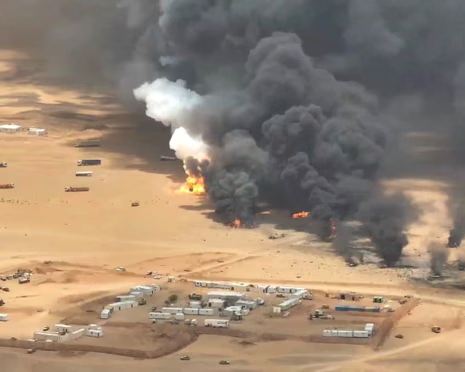
Separately Tuesday, Houthi forces, which control most of Yemen’s populated areas including the capital, said they launched a broad operation using drones and missiles deep into Saudi territory, striking a Saudi air base in the southern city of Khamis Mushait along with Saudi state oil company assets in Abha, Najran and Jazan. NASA satellite images showed a thick cloud of black smoke over the Jazan refinery and white smoke rising from an oil distribution center in Abha. Saudi authorities said 73 people were wounded, including women and children, describing fires burning at the targeted sites. The scale of injuries suggested the attack ranked among the largest carried out against Saudi Arabia since the U.S. and Israeli war against Iran began in February. No confirmed images from the ground were available, and witnesses could not be reached given tight media controls within Saudi Arabia.
Houthi spokesperson Yahya Saree accused Saudi Arabia of escalating the war by launching airstrikes on Yemen and said the Houthis would respond further. Saudi Arabia has led an Arab coalition fighting the Houthis in Yemen for more than a decade in a conflict that had calmed in recent years before its ceasefire broke down. Saudi backed Yemeni forces aligned with a government based in southern Yemen have recently launched a multipronged offensive on Houthi held areas, following Houthi attempts to advance on government positions, with the government, driven from the capital by the Houthis 12 years ago, saying it now aims to recapture all Houthi controlled territory.
Disputed Claim Over a US Underwater Drone
Iran’s Revolutionary Guard said it had captured a U.S. submersible near the Strait of Hormuz. A U.S. official told Reuters that an underwater military drone had malfunctioned more than a day earlier, adding that it carried no classified sonar or radar equipment, a characterization that directly contradicts Iran’s claim of a capture and remained unresolved as of the latest reporting.
Economic and Military Escalation
Tuesday’s strikes came three days after the U.S. military said Saturday it had struck three Iranian oil tankers following ballistic missile attacks on Navy warships, warning it would, if necessary, destroy Iran’s limited and exposed oil fleet. Iran said in response that it planned to announce a new exclusion zone near the Strait of Hormuz targeting vessels attempting to transit, with Tehran saying Tuesday that details of a maritime exclusion zone extending from the edge of the U.S. blockade through the strait and into the Gulf would soon be unveiled.
The Trump administration also imposed new sanctions Tuesday targeting more than two dozen commercial and private Iranian airlines, along with foreign cargo service providers, as part of a continued push to isolate Iran from its remaining trading partners. The U.S. Treasury said the aviation related sanctions were aimed at grounding Iran’s airlines.
Both the U.S. and Iran continue seeking control over the Strait of Hormuz, through which about a fifth of the world’s oil passed before the war began. The U.S. has maintained a blockade on Iranian ports that has significantly limited the country’s oil exports, while American forces have helped guide a limited number of ships through a route near Oman. Iran wants ships to instead follow a route of its own choosing through the strait, which was widely considered an international waterway before the conflict began.
Oil prices climbed as fighting resumed after a relatively calm August. Brent crude briefly reached as high as $99.46 a barrel Tuesday, with both Brent and U.S. West Texas Intermediate closing at their highest levels since July 23 and June 4, respectively. Diesel fuel in the United States reached a record average retail price amid the renewed fighting, adding political pressure on President Trump and Republicans ahead of November’s midterm elections.
Why This Matters
The near simultaneous escalation on two fronts, the direct U.S.-Iran naval exchange and the Houthi assault on Saudi Arabia, illustrates how the six month conflict has increasingly drawn in actors and territory well beyond its original combatants. The Houthi attacks in particular threaten to disrupt Middle East energy supplies through channels beyond the already blockaded Strait of Hormuz, compounding the war’s global economic impact at a moment when oil and fuel prices are already climbing toward levels last seen at the conflict’s peak.
The dispute over the alleged captured U.S. submersible reflects the broader pattern of competing, difficult to verify claims that has characterized the conflict’s military dimension, with both sides offering accounts calibrated to project strength. Iran’s continued ability to threaten shipping and strike U.S. linked assets despite months of American strikes degrading its conventional military capacity suggests neither side has yet achieved a decisive advantage, reinforcing the sense that the war has become a test of economic endurance as much as military strength.
The political stakes for the Trump administration are mounting domestically as fuel prices rise ahead of the midterm elections, a dynamic that may shape how aggressively the U.S. continues pursuing its dual military and economic pressure campaign against Iran in the weeks ahead.
What Happens Next
Iran is expected to unveil further details of its planned maritime exclusion zone in the Strait of Hormuz in the coming days, a move likely to further complicate international shipping already constrained by the U.S. blockade. Whether Iran’s threatened retaliation against tankers near Kuwait and Bahrain materializes remains to be seen, and would represent a further significant escalation given the two countries’ hosting of U.S. forces.
The Houthi threat of further retaliation against Saudi Arabia, combined with the ongoing Saudi backed offensive against Houthi held territory in Yemen, suggests continued violence on that front is likely regardless of how the separate U.S.-Iran naval confrontation develops. Given the mounting economic pressure on both sides and the domestic political stakes for the Trump administration, near term de-escalation appears unlikely absent a significant shift in either government’s position.
Reporting drawn from the Associated Press and Reuters





