

U.S. forces struck three Iranian oil tankers Saturday after Iran’s Islamic Revolutionary Guard Corps launched ballistic missiles toward two U.S. Navy warships, the American military said, marking a sharp escalation after Iran’s earlier attacks at sea had targeted commercial shipping rather than U.S. military assets directly.
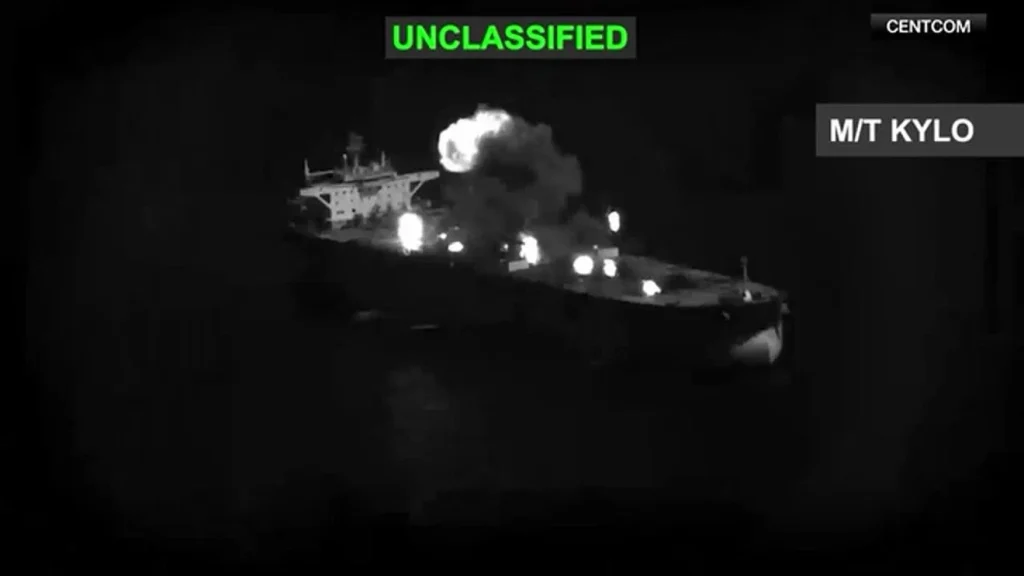
U.S. Central Command said an American aircraft carrier and a guided missile destroyer evaded multiple unprovoked Iranian attacks while patrolling the region, with no U.S. personnel hurt. It was not immediately clear when the Iranian missiles were launched. In response, U.S. forces permanently disabled two Iranian tankers, identified as the M/T Downy off Kharg Island and the M/T Stark 1 near Jask, east of the Strait of Hormuz, and completely destroyed a third, unladen tanker, the M/T Kylo, in the Gulf of Oman, whose crew was directed to abandon ship. CENTCOM said the tankers were part of a shadow network helping fund Iran’s Revolutionary Guard and its regional armed proxies.
Adm. Brad Cooper, head of U.S. Central Command, said the message to Iran’s Revolutionary Guard should be clear. “If you shoot at two of our ships, we will impose an even higher economic cost, taking out three of yours,” Cooper said, adding that the U.S. would not hesitate to defend American forces and would, if necessary, destroy Iran’s limited and exposed oil fleet.
Iran’s Response and Competing Claims
Iran’s state broadcaster said Saturday that Iran had struck back at three oil tankers and three American vessels in response to the U.S. strikes, a claim that could not be immediately confirmed. Iranian state television separately said four U.S. missiles had struck a tanker about six miles from Kharg Island, the terminal through which Iran exports most of its oil and a site repeatedly targeted throughout the war, including in U.S. strikes on military facilities there in March.
The Revolutionary Guard later aired its own video showing what it described as explosives laden projectiles striking multiple ships in the Strait of Hormuz, and said separately it had fired several ballistic missiles at the U.S. aircraft carrier and a second warship involved in the blockade of Iran’s southern ports. The Guard claimed both vessels sustained damage and fled the area, a direct contradiction of CENTCOM’s account that the attacks were fully evaded with no damage or casualties. That conflict between the two militaries’ versions of events remained unresolved as of the latest reporting. The Guard also said a U.S. built sea drone was struck while attempting to enter Iranian waters in the strait.
Danny Citrinowicz, an Iran expert at Israel’s Institute for National Security Studies, said Iran’s willingness to target a U.S. aircraft carrier directly with a ballistic missile signals that Tehran has become increasingly willing to accept risks it previously avoided, including threatening some of the most significant U.S. military assets in the region.
Iran’s parliament speaker and chief U.S. negotiator, Mohammad Bagher Ghalibaf, told a private parliamentary meeting that Iran had delivered significant blows to U.S. bases across the region and warned that the era of proportionate Iranian responses had ended, saying any further attacks on Iranian interests would be met with faster, heavier and more painful strikes. Iran’s Foreign Ministry called the U.S. strikes on its ships illegal and a war crime that violates the United Nations Charter.
Casualties From Earlier Strikes on Southern Iran
The tanker strikes came nearly a week after the U.S. and Iran resumed attacks following roughly a month of relative calm, with fighting again concentrated around the Strait of Hormuz and Iranian communities along it. At least five people were killed earlier in the week during a U.S. bombardment of southern Iran, including in a strike that hit a wedding celebration.
Masoumeh Zarei, 13, was wounded in that strike and spoke to the Associated Press from a hospital while being treated for abdominal injuries. She said she was on her way to the celebration, which had already begun, when a nearby telecommunications tower was struck, knocking her unconscious; her next memory was waking up in the hospital. “The party had just started, and we wanted to go there,” Zarei said. “I had made my nails really pretty for the party, but everything changed.”
Her friend, 14-year-old Kiana Karimi, was also wounded and remained in intensive care. She told the AP she heard five explosions, with the first three near the telecommunications tower knocking people to the ground before she got up to help her brothers, followed by two more explosions after which she recalled nothing further.
Economic Pressure Campaign
The Trump administration has pursued a dual approach to the conflict, responding militarily to attacks in the strait while separately targeting foreign financial institutions that handle Iranian money. Vice President JD Vance said Thursday there was no prospect of renewed talks as long as Iran continues targeting ships, while noting that major military operations had effectively ended in July, a characterization the past week’s renewed strikes have now complicated. President Trump had separately described the conflict as “small potatoes” a day before the tanker strikes and suggested he might strike Iran’s Pickaxe Mountain nuclear site amid rising tensions.
Iran’s elected government under President Masoud Pezeshkian has said it favors a negotiated end to the war, even as the country’s hardline senior leadership has signaled a willingness to continue enduring pressure after decades of sanctions. Negotiations over Iran’s nuclear program, the issue that helped trigger the war, collapsed shortly after the U.S. and Iran signed a memorandum of understanding in mid-June, and diplomats say the U.S., Britain, France and Germany are now pursuing a referral of Iran to the U.N. Security Council over noncompliance with nuclear nonproliferation obligations.
U.S. and Iranian officials offered starkly different accounts of the blockade’s effectiveness. The Trump administration says vessel traffic through the Strait of Hormuz has increased under U.S. guidance in recent weeks, approaching pre-war levels on some days, while Iranian authorities maintain the strait remains effectively closed. The U.S. military said about 90 commercial vessels have been redirected as part of the blockade, with several more disabled or boarded.
According to maritime intelligence firm TankerTrackers, Middle East crude oil exports in August were down 39 percent from the January and February baseline of 18.5 million barrels per day, with the current shortfall at 7.2 million barrels per day, improved from a 12.4 million barrel deficit in May. The firm said Iran’s baseline exports of 1.68 million barrels per day may remain near zero for the foreseeable future depending on whether a deal is reached. Iranian officials have confirmed they have been unable to move crude oil past the U.S. warships enforcing the blockade, though Pezeshkian said late last month that up to 90 million barrels were exported during the brief period the June memorandum of understanding remained in effect, with some oil held in floating storage outside the blockade and sold at a discount to China despite U.S. sanctions.
Treasury Secretary Scott Bessent told Fox News that only about 30 million barrels of Iranian crude remain available for China to purchase, predicting that supply would run out soon with no readily available replacement product. Bessent again touted what the administration calls Operation Economic Outcast, describing the combined blockade and sanctions campaign as a one-two punch aimed at isolating Iran’s roughly 90 million residents economically. Iran’s Economy Ministry established what it called an economic war headquarters Sunday to counter the pressure amid high inflation, unemployment and broader economic strain. Revolutionary Guard spokesperson Hossein Mohebbi argued the U.S. is absorbing significantly greater economic damage from the conflict than Iran, citing depleted U.S. strategic energy reserves and reduced regional aluminum exports as evidence.
Why This Matters
The direct targeting of U.S. Navy vessels marks a notable shift from the pattern of the past six months, in which Iran’s attacks at sea had primarily focused on commercial shipping rather than U.S. military assets themselves. Whether this represents a sustained shift in Iranian strategy or an isolated escalation remains unclear, though experts like Citrinowicz suggest it reflects a broader Iranian willingness to accept higher risks as economic pressure mounts.
The competing narratives over both the blockade’s effectiveness and the outcome of Saturday’s naval exchange illustrate how difficult it has become to assess the war’s actual trajectory from public statements alone, with both governments offering accounts calibrated to project strength and minimize acknowledged vulnerability. The casualties from the wedding strike, including two teenage girls now recovering from serious injuries, underscore the continued civilian toll of the conflict even as both sides frame the war primarily in terms of military and economic strategy.
What Happens Next
With diplomats reportedly pursuing a Security Council referral over Iran’s nuclear program and Vance ruling out talks while Iranian attacks on shipping continue, prospects for near term negotiations appear limited. Bessent’s prediction that Iran’s available oil reserves for sale to China will soon be exhausted suggests the Trump administration is betting on economic exhaustion to eventually force Iranian concessions, though Iran’s new economic war headquarters signals Tehran’s intent to continue resisting that pressure.
Continued naval confrontations in the Strait of Hormuz appear likely given both sides’ recent escalatory actions and rhetoric, with Ghalibaf’s warning of heavier future strikes and Cooper’s threat to target Iran’s remaining oil fleet suggesting neither side is currently inclined toward de-escalation.
Reporting drawn from the Associated Press, The Sun and Al Jazeera





