Home Blog Page 178

American Chess Grandmaster Daniel Naroditsky dies at 29

0

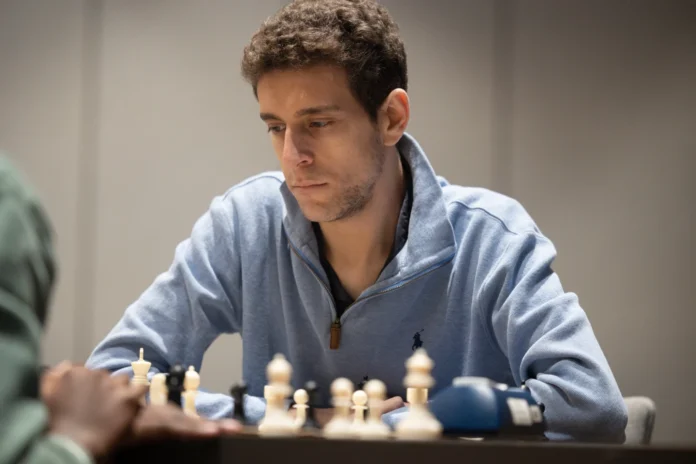
Daniel Naroditsky, a chess grandmaster who started as a child prodigy and quickly became one of the most influential American voices in the sport, died Monday. He was twenty-nine.

The Charlotte Chess Center in North Carolina, where Naroditsky trained and worked as a coach, announced his death on social media, calling him “a talented chess player, educator, and beloved member of the chess community.”

“Let us remember Daniel for his passion and love for the game of chess, and for the joy and inspiration he brought to us all every day,” his family said in a statement shared by the center.

The cause of death was not immediately known.

Naroditsky became a grandmaster, the highest title in chess aside from World Chess Champion, at the age of eighteen. Years earlier, the California-born player won the Under 12 world championship and spent his teenage years writing chess strategy books as he climbed the world rankings.

He was consistently ranked in the top two hundred worldwide for traditional chess and also excelled at a fast-paced style called blitz chess, maintaining a top twenty-five ranking throughout his adult career. Most recently Naroditsky, known to many as Danya, won the U.S. National Blitz Championship in August.

Fellow grandmasters credited Naroditsky with introducing the sport to a wider audience by livestreaming many of his matches and sharing live commentary on others. Thousands of people regularly tuned in on YouTube and the interactive streaming platform Twitch to watch Naroditsky play.

“He loved streaming, and he loved trying to be educational. The chess world is very grateful,” Hikaru Nakamura, an American grandmaster, said on a livestream Monday.

In a final video posted to his YouTube channel Friday titled “You Thought I Was Gone!?” Naroditsky tells viewers he’s “back, better than ever” after taking a creative break from streaming. He talks viewers through his moves as he plays live chess matches on the computer from a cozy home studio.

Other elite chess players from around the globe took to social media to express their shock and sadness.

Dutch chess grandmaster Benjamin Bok reflected on his lifelong friendship with Naroditsky, whom he said he has known since the Under 12 world championship that Naroditsky won in 2007.

“I still can’t believe it and don’t want to believe it,” Bok said on X. “It was always a privilege to play, train, and commentate with Danya, but above all, to call him my friend.”

Naroditsky was the son of Jewish immigrants to the United States from Ukraine and Azerbaijan. He was born and raised in San Mateo County, California, and was described by his parents as a very serious child with an impressive attention span and memory. He went on to study history at Stanford University, earning a bachelor’s degree in 2019 after taking a year off to play in chess tournaments.

After college, he moved to Charlotte, North Carolina, where he coached the area’s top junior chess players.

Naroditsky’s impact on chess extended far beyond his competitive achievements. His educational approach to streaming made complex chess concepts accessible to players of all skill levels, helping to democratize chess instruction and inspire a new generation of players.

His livestreams typically featured detailed explanations of strategic thinking and tactical patterns, delivered in an engaging and patient teaching style. This approach earned him a devoted following among both serious students of the game and casual fans.

The timing of his death, just days after posting an enthusiastic return to streaming, shocked the chess community. Many had watched his final video without any indication that he was facing health challenges.

Naroditsky’s contributions to chess literature also left a lasting mark on the sport. His strategy books, written during his teenage years, demonstrated both his deep understanding of chess and his ability to communicate complex ideas clearly.

The chess community has lost one of its most effective ambassadors to the broader public. Naroditsky’s combination of elite playing strength, teaching ability and media savvy made him uniquely positioned to grow the game’s popularity in the digital age.

His success in blitz chess, which requires players to make moves within seconds, showcased not only his tactical brilliance but also his ability to perform under intense time pressure. His August victory in the U.S. National Blitz Championship represented one of the highlights of his competitive career.

Memorial tributes continued to pour in from players, coaches and fans around the world who credited Naroditsky with inspiring their love of chess or helping them improve their game through his educational content.

AP
Japan’s parliament elects Sanae Takaichi as nation’s first female prime minister

0

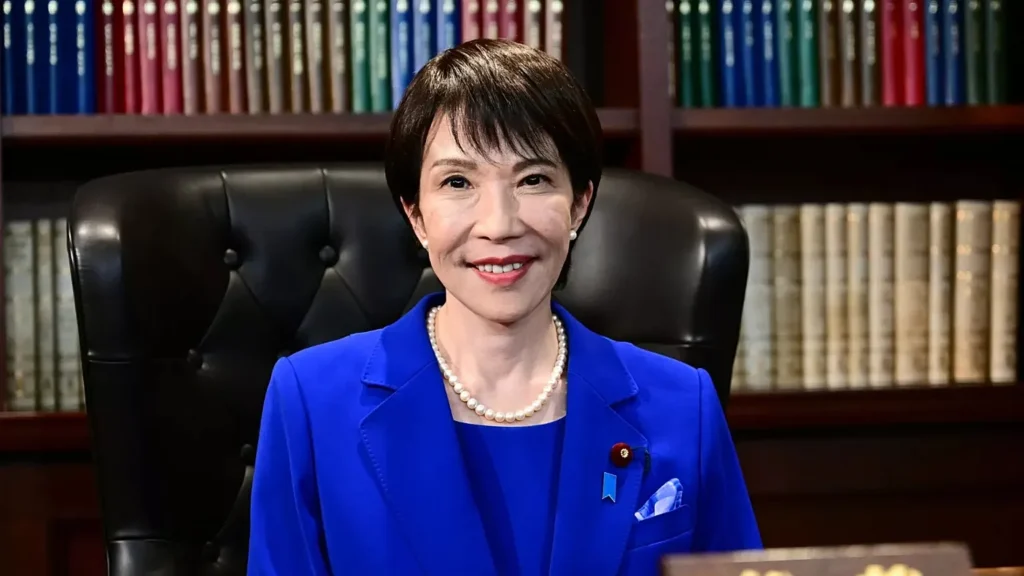
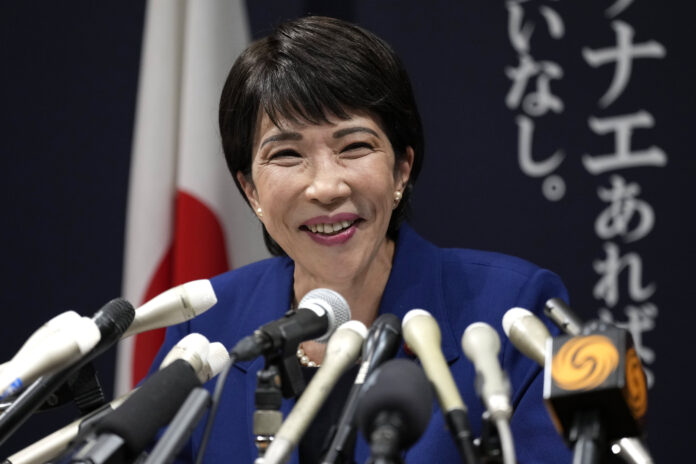
TOKYO (BN24) — Japan’s parliament on Tuesday elected ultraconservative Sanae Takaichi as the country’s first female prime minister, a historic appointment that concludes months of political turmoil following the Liberal Democratic Party’s (LDP) consecutive election defeats. At 64 years old, Takaichi, head of the struggling ruling party, succeeds Shigeru Ishiba, who resigned along with his Cabinet after only one year in office, triggered by the party’s poor electoral performance in July.

Takaichi’s rise to power comes on the heels of a last-minute coalition agreement forged between the LDP and the Osaka-based Japan Innovation Party (JIP), also known as Ishin no Kai. This alliance, while crucial in securing her premiership, falls short of an outright majority in both houses of Japan’s bicameral legislature. As a result, her governing bloc must seek support from other opposition parties to pass any significant legislation, raising concerns about the durability and stability of her administration.

At the coalition signing ceremony on Monday, held in Tokyo, Takaichi and JIP leader and Osaka Governor Hirofumi Yoshimura underscored the urgency of political stability. Takaichi declared, “Political stability is essential right now. Without stability, we cannot push measures for a strong economy or diplomacy.” This statement reflects her administration’s immediate priorities: to address economic challenges and navigate delicate foreign relations amid a shifting global environment.

The coalition deal signals a clear rightward tilt in Japanese politics. It comes just ten days after Komeito, the Buddhist-backed centrist party that had been a steady coalition partner of the LDP for decades, withdrew from the government. Komeito’s departure stemmed from frustrations with the LDP’s inadequate response to recent political scandals involving illicit slush funds, which contributed to the party’s electoral setbacks. Additionally, Komeito expressed deep unease with Takaichi’s nationalist views and actions, particularly her revisionist interpretation of Japan’s wartime past and her controversial visits to the Yasukuni Shrine—a shrine dedicated to Japan’s war dead, including convicted war criminals. These visits have drawn sharp rebukes from neighboring China and South Korea, who view them as a failure to acknowledge Japan’s wartime aggression.

Takaichi’s Cabinet is expected to include several close allies of Taro Aso, a prominent and influential figure within the LDP, as well as supporters who backed her during the party leadership contest. However, Yoshimura clarified that the Japan Innovation Party will not immediately accept ministerial posts in Takaichi’s Cabinet, opting instead to observe the stability of the coalition before fully committing to governance roles.

The new prime minister faces a pressing timeline. Within days, she is scheduled to deliver a major policy speech outlining her government’s agenda. She is also expected to hold discussions with U.S. President Donald Trump and participate in critical regional summits. Addressing Japan’s rising inflation and economic stagnation will be urgent priorities, with the government aiming to implement effective stimulus measures by late December in response to growing public dissatisfaction over living costs.

While Takaichi’s appointment marks a significant milestone as Japan’s first female prime minister, she is not seen as an advocate for progressive gender policies. Throughout her career, she has resisted initiatives aimed at advancing women’s rights and gender equality in Japan. She opposes reforms to the imperial succession laws that would allow women to ascend the throne, as well as efforts to legalize same-sex marriage or permit married couples to retain separate surnames. These positions highlight the conservative and traditionalist values she espouses, setting her apart from global trends toward greater inclusion and diversity.

A longtime protege of the late former Prime Minister Shinzo Abe, Takaichi is expected to continue Abe’s policy agenda. This includes efforts to strengthen Japan’s military capabilities, reinvigorate the economy, and pursue constitutional revision—particularly regarding Article 9, which renounces war. However, with a tenuous parliamentary majority and a coalition fraught with uncertainty, the extent to which Takaichi will be able to realize these ambitions remains unclear.

Takaichi’s nationalist rhetoric and controversial stances have exacerbated political divisions domestically and complicated Japan’s relations with its neighbors. Her visits to the Yasukuni Shrine have been a source of diplomatic tension, though she recently moderated her approach by sending a religious ornament in lieu of personally visiting the shrine, signaling a cautious attempt to ease frictions.

Moreover, Takaichi’s recent xenophobic remarks have further alienated moderate and centrist forces in Japanese politics, contributing to the fracturing of the governing coalition. As she steps into office, she must balance the competing demands of a divided parliament, an unsettled electorate, and complex regional dynamics that include tensions with China and North Korea. In this critical moment, Takaichi’s government will be closely watched for its ability to restore political stability, revitalize Japan’s economy, and navigate the country’s evolving geopolitical landscape.

Nicolas Sarkozy begins prison sentence amid final family farewell

0

PARIS (BN24) — Former French President Nicolas Sarkozy arrived at La Santé prison in Paris this morning to begin serving his five‑year sentence, following a dramatic and emotional departure from his private residence in the city’s 16th arrondissement. Accompanied by his wife, Carla Bruni, and surrounded by family members and supporters chanting his name, he left his home in a moment fraught with both personal and political significance.

Before the public farewell, his two sons made impassioned pleas: one urged supporters to gather outside the residence, and the other asked for messages of “nothing else but love, please.” Outside the prison, over a hundred people had congregated early, waving hopes of solidarity even as the former president moved toward incarceration.

As he stepped into the car that would convey him to La Santé, voices echoed from windows behind bars at the prison: “Welcome, Sarkozy!” and “Sarkozy’s here.” Once inside, officials say, he is expected to be held under heightened security in isolation, likely in a nine‑square‑metre cell in the prison’s high‑profile secure wing, permitted only limited access to outdoor exercise and activity rooms, always alone. Prison authorities described his arrangements as consistent with protocols for “vulnerable” inmates who must be separated from the general population.

The sentence stems from the court’s conclusion that Sarkozy had authorised close associates to solicit funds from the Libyan regime of the late Muammar Gaddafi to help finance his victorious 2007 presidential campaign. Although the judges found insufficient proof that the funds were ever delivered or directly received by Sarkozy, they determined the criminal association charge carried sufficient weight to justify a custodial sentence. He was acquitted on several other counts, including passive corruption and direct illegal campaign financing. Meanwhile, prosecutors had earlier sought a seven‑year term and a large fine.

In his farewell message posted on social media just hours before his arrival, Sarkozy reiterated his innocence, accusing the justice system of vengeance. “It is not a former President of the Republic who is being locked up this morning, it is an innocent person,” he wrote. He expressed “deep sorrow for France,” which he said had become humiliated by what he described as “hatred taken to an unprecedented level.” He vowed that “the truth will triumph,” though he acknowledged the “price to pay will have been crushing.”

His legal team said he had brought practical items for his confinement: pullovers to contend with the cold and earplugs to guard against the racket of cell life. He also reportedly packed three books for his first week behind bars, including Alexandre Dumas’ The Count of Monte Cristo, the classic tale of innocence, imprisonment, and revenge, a symbolic choice, many observers noted.

Before his transfer, Sarkozy had a private meeting with President Emmanuel Macron at the Élysée Palace, which Macron later characterized as a human gesture toward a predecessor facing extreme circumstances. Macron also reiterated his respect for the independence of the judiciary, even as he conveyed what he called “a basic human courtesy.”

The case represents the highest point in a series of legal battles that have shadowed Sarkozy since leaving office in 2012. He had already been convicted in previous cases involving corruption and campaign financing, but had avoided actual jail time until now. With his arrival at prison today, he became the first French president in the modern era to serve a custodial sentence, a development that has sent ripples across French politics, raising questions about accountability at the highest level.

As the nation watches, the path ahead for Sarkozy remains uncertain. Though incarcerated, he retains the right to appeal the conviction; his legal team is expected to seek provisional release and to continue fighting his case. Meanwhile, his departure today marks a watershed moment for France’s judicial and political institutions.

10 South Koreans arrested in Cambodia scam crackdown

0

PHNOM PENH, Cambodia (BN24) — Ten South Korean nationals have been arrested in Cambodia as part of an ongoing transnational crackdown on organized cyber scam operations that have entrapped thousands of victims across Asia. The announcement was made Monday by South Korean Foreign Minister Cho Hyun, underscoring growing regional cooperation to combat increasingly sophisticated fraud syndicates operating from Southeast Asia.

The arrests occurred last Thursday, days after Cambodian authorities deported 64 other South Koreans who had been implicated in large-scale online fraud schemes. Known widely as “pig butchering” scams, these operations involve scammers who cultivate trust with unsuspecting victims through fake romantic relationships, investment offers, or job opportunities only to defraud them of their savings once emotional or financial dependency is established.

Cho confirmed that the ten arrested individuals are currently in Cambodian custody and will be repatriated to South Korea later this week. He also revealed that two additional South Korean nationals were rescued during the operation. The Foreign Ministry continues efforts to locate and repatriate approximately 80 more South Koreans who remain unaccounted for in Cambodia and may be held against their will in scam compounds.

Authorities in Seoul estimate that roughly 1,000 South Koreans may currently be working either voluntarily or under duress in Cambodia’s underground scam industry, which reportedly employs over 200,000 people, many trafficked or coerced through deceptive job offers. Since early last year, more than 550 South Korean nationals have been reported missing or held involuntarily in Cambodia after being lured into scam operations under false pretenses.

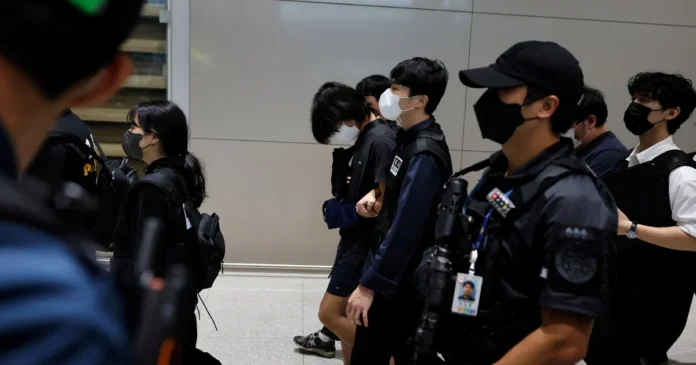
The repatriation of the 64 suspects over the weekend marked a dramatic turn in South Korea’s response. Upon landing at Incheon International Airport, the individuals were met by South Korean police and taken into custody. Many were handcuffed and escorted off the plane in full view of waiting media. South Korea’s National Police Agency stated that it is seeking arrest warrants for 59 of the 64 repatriated individuals, citing their alleged involvement in a range of cyber-enabled crimes including voice phishing, fraudulent cryptocurrency investment schemes, romance scams, and “no-show” job frauds.

Park Sung-joo, Commissioner General of the National Office of Investigation, said authorities had gathered extensive digital and testimonial evidence linking the suspects to organized scam rings based in Cambodia’s urban and rural areas. According to Park, some of the arrested individuals were identified through tip-offs from rescued victims, while others were caught through international coordination between South Korean and Cambodian law enforcement agencies.

National Security Adviser Wi Sung-lac added that not all individuals returned to South Korea were willing participants in the scams. “Among the deportees are victims who were lured with the promise of legitimate employment and then trapped inside compounds under threat of violence,” Wi told reporters. “We must distinguish between perpetrators and those coerced into illegal activity.”

The crackdown has gained political urgency following the murder of a South Korean university student earlier this year in Cambodia. The student was reportedly killed by members of a scam organization after responding to a fake job listing. His death triggered public outrage in South Korea and prompted Seoul to ramp up diplomatic pressure on Phnom Penh.

In the months that followed, South Korean officials held multiple meetings with Cambodia’s Prime Minister Hun Manet and senior Cambodian police officials, demanding stronger oversight of suspected scam compounds, many of which are believed to be operated by international criminal syndicates across border regions with Myanmar, Laos, and Thailand.

Efforts to dismantle these scam hubs have also involved cooperation with Interpol and ASEAN member states, as regional governments confront a growing crisis involving the trafficking of skilled workers into cybercrime.

Human rights organizations have documented testimonies from victims who report being locked inside guarded facilities, denied access to communication with the outside world, and physically assaulted when attempting to escape. Some compounds are disguised as legitimate tech startups or call centers, adding further complexity to law enforcement operations.

South Korea’s Foreign Ministry reiterated its commitment to continuing rescue operations and providing legal and psychological support to returning nationals, whether they are identified as suspects or victims. The government is also launching a nationwide awareness campaign warning young citizens against overseas job scams, particularly in Southeast Asia.

The situation remains fluid as investigations continue in both countries. Cambodian officials have pledged to expand joint operations to uncover more trafficking rings and prosecute foreign nationals involved in illegal online fraud activities.

Blast kills 3 police officers during eviction of siblings at farmhouse in northern Italy

0

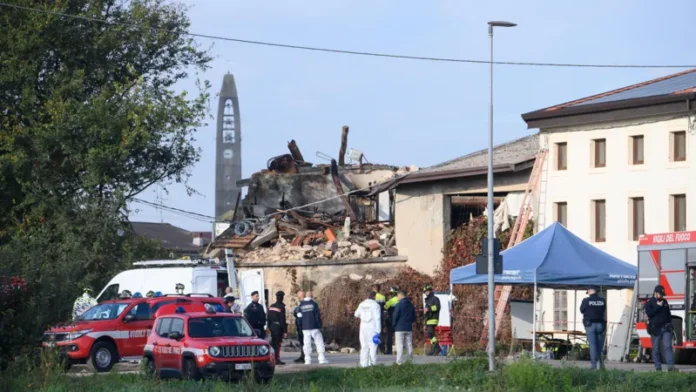
VERONA, Italy (BN24)— A devastating explosion at a farmhouse near Verona, Italy, has claimed the lives of three Carabinieri officers and injured at least 15 others, including fellow police officers and firefighters, as authorities attempted to evict three siblings from the property early Sunday morning.

The blast, believed to have been deliberately triggered by the occupants, occurred around 3 a.m. local time when police and emergency personnel entered the rural farmhouse to enforce an eviction order. The order targeted two brothers and a sister, aged in their late 50s and mid-60s, who had accumulated substantial debts linked to the dilapidated property. The explosion was so powerful it was audible up to 5 kilometers (approximately 3 miles) away, leaving the building reduced to rubble and creating a scene of utter destruction.

Authorities confirmed the three deceased victims were members of Italy’s Carabinieri, the country’s military police force. In addition to the fatalities, the blast caused injuries to 11 other Carabinieri officers, three members of the state police, and one firefighter, highlighting the dangerous and chaotic nature of the eviction operation.

Two suspects—a man and a woman—were immediately arrested at the scene following the explosion. A third individual, a man who initially fled the site, was apprehended shortly after. All three suspects were hospitalized for treatment and are currently under investigation.

Veneto regional governor Luca Zaia stated that the eviction was carried out due to mounting debts the siblings owed, emphasizing the farmhouse’s precarious condition. Prosecutor Raffaele Tito described the building as “derelict” with no electricity, underscoring the neglected state of the property.

Interior Minister Matteo Piantedosi expressed sorrow over the tragic loss of life and noted that previous eviction attempts had been made. “It was clear we were dealing with people who would resist in some way,” he said, explaining that mediators had been sent to negotiate with the siblings, who had barricaded themselves inside the farmhouse in a prolonged standoff.

Claudio Papagno, provincial police commander, detailed the horrific scene. Speaking to the Ansa news agency, he said officers encountered “an act of absolute madness” as they entered the home. Investigations revealed that a gas cylinder had been ignited to cause the blast, and petrol bombs were also discovered on the premises, indicating the siblings were prepared to violently resist eviction.

The prosecutor confirmed the blast was a “premeditated and voluntary homicide,” noting that officers heard the sound of gas cylinders being opened moments before the explosion. Neighbors recounted that the siblings had previously threatened to “blow themselves up” rather than surrender the property.

The incident has sparked widespread mourning across Italy. Defense Minister Guido Crosetto and other political leaders paid tribute to the fallen officers, describing their deaths as a heartbreaking sacrifice made in the line of duty.

Authorities have launched a thorough investigation into the circumstances leading up to the explosion and are working to provide support to those injured in the blast. The tragic event has reignited debates on the handling of forced evictions and the risks faced by law enforcement during such operations.

Saudi Arabia allows Nigerians to own property in Makkah

0

RIYADH (BN24)— Saudi Arabia has officially opened the door for Nigerians to own property in the holy city of Makkah, marking a significant step in its strategy to attract global investment and advance urban development in the region. This development accompanies the launch of the King Salman Gate project, a landmark urban transformation initiative announced by Crown Prince Mohammed bin Salman.

Prince Mohammed bin Salman, who also serves as Prime Minister and Chairman of RUA Al Haram Al Makki Company, unveiled the project as part of Saudi Arabia’s broader vision to modernize Makkah’s infrastructure while preserving its religious and cultural heritage.

The King Salman Gate project will span approximately 12 million square meters of gross floor area adjacent to Al-Masjid Al-Haram, Islam’s holiest mosque. The development is designed to position Makkah as a global benchmark for modern urban planning and hospitality.

According to the Crown Prince’s statement, the project aims to improve pilgrims’ experiences by enhancing accessibility to Al-Masjid Al-Haram and upgrading service quality throughout the area. The mixed-use complex will feature residential, hospitality, commercial, and cultural facilities, offering space for approximately 900,000 indoor and outdoor worshippers.

Strategically located with seamless access to public transportation, King Salman Gate will blend Makkah’s rich architectural heritage with world-class modern living. The project includes restoration and development of around 19,000 square meters of heritage sites, underscoring Saudi Arabia’s commitment to preserving Makkah’s cultural legacy.

The initiative is expected to contribute significantly to Saudi Vision 2030 by generating over 300,000 jobs by 2036 and transforming the local economy through sustainable urban development.

RUA Al Haram Al Makki Company, a Public Investment Fund (PIF) affiliate responsible for the project’s execution, focuses on innovative, sustainable resource management. The company is dedicated to providing exceptional real estate experiences while supporting PIF’s goal of establishing Makkah as a global hub for investment and pilgrimage.

This move to allow Nigerians and other international investors to own property in Makkah aligns with Saudi Arabia’s broader efforts to diversify its economy, boost foreign investment, and enhance the city’s capacity to accommodate growing numbers of pilgrims.

President Ruto awards Raila Odinga Kenya’s highest honor as Uhuru Kenyatta returns to gravesite day after burial

0

NAIROBI, Kenya (BN24) — The late former Prime Minister Raila Odinga has been awarded the Chief of the Order of the Golden Heart, Kenya’s highest honor, as President William Ruto recognized his contributions to democracy and nation-building on Mashujaa Day.

The honor was conferred by Ruto on Monday, a day after Odinga was buried at his family home in Bondo, Siaya County. A gazette notice dated October 20, 2025, confirmed the conferment of the First Class CGH honor to Odinga, recognizing him for exemplified courage, endurance, dedication, an unwavering commitment to the ideals of democracy and good governance, sacrifice, Pan-Africanism and faithful service to all of humanity.

In his address to Kenyans at Ithookwe Stadium in Kitui, Ruto recognized Odinga for his contribution to nation-building and enduring legacy. “The Government and people of Kenya inscribe Hon Raila Odinga’s name among the foremost of our heroes, under the public seal of the Republic,” Ruto said.

The head of state further described the former prime minister as a towering patriot and hero for the ages. “But if we, the people he so deeply loved and served, choose to live by the lessons he taught us; to love Kenya more than we love ourselves; to put unity above division; to aspire for greater, and to serve with courage and conviction, then we can become a great nation of 50 million heroes,” the president said.

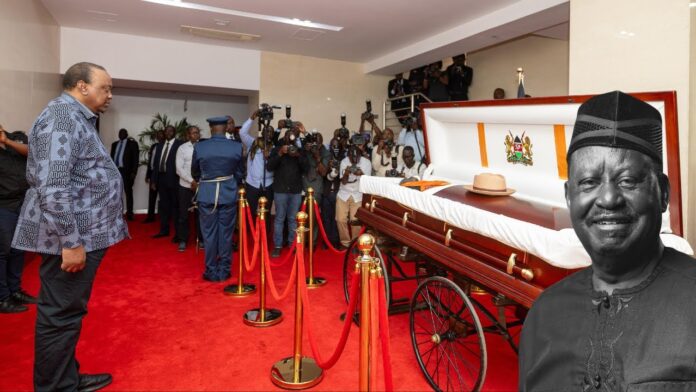
Meanwhile, former President Uhuru Kenyatta on Monday returned to Kang’o ka Jaramogi at Odinga’s family home in Bondo to honor the memory of the late former prime minister, who was buried there Sunday.

In the quiet visit, Kenyatta was accompanied by Odinga’s elder brother and Siaya Senator Oburu Oginga. He stood solemnly at the graveside, lingering in silence as if sharing a private moment with the departed statesman.

The former president appeared deeply contemplative, his gaze fixed on the grave. He at one point raised his right hand toward Odinga’s grave for a few seconds.

After a brief prayer alongside Senator Oginga, Kenyatta chose not to speak to the media, quietly departing the site without comment.

According to an evening statement from his office, the former head of state condoled with the Odinga family and “paid tribute to the life and legacy of his longtime friend and compatriot.” “Kenyatta also visited the Jaramogi Oginga Odinga Mausoleum to honour the memory of the Odinga family’s enduring contribution to Kenya’s history and democracy,” it added.

Odinga, who died Wednesday after collapsing in India, was buried Sunday afternoon next to his father, Jaramogi Oginga Odinga, and his mother, Mary Ajuma. The private ceremony, during which he was accorded state honors and a seventeen-gun salute, was attended only by members of his family, top government dignitaries and guests from the burial ceremony earlier in the day.

Kenyatta was among those present Sunday and laid a wreath by Odinga’s grave. He has eulogized him as a “brother, friend and patriot” whose passing has left a deep void in the nation, saying Kenya has lost a leader whose voice of conviction and courage helped shape the country’s political history.

Last week, Kenyatta reflected on his long and complex relationship with the longtime opposition leader, describing the Orange Democratic Movement party leader as a “defining part” of his own political journey.

The two were political rivals in several elections before joining forces in the historic 2018 “Handshake” after Odinga unsuccessfully challenged Kenyatta in the 2017 polls, quelling the political storm that followed the disputed election.

“Raila and I were navigators on opposing currents, charting different courses for the nation we both loved. At some point, we became political opponents and often, the weight of that competition felt immense,” the former president said. “Baba, as we fondly referred to him, was a man who made you sharpen your own ideas, compelling you to defend your positions with rigor and passion.”

Kenyatta said their eventual partnership through the Handshake defined Odinga as a leader guided not by personal ambition but by a genuine desire to unite the country. “I saw first-hand his unwavering passion for this country, his deep-seated belief in justice, and his incredible capacity to think beyond personal ambition for the sake of national peace,” he said.

The former president said he would remember Odinga for his strength of conviction, intellect and commitment to the ideals of democracy and justice. “I have lost a friend and a brother. I will miss our conversations – sometimes challenging, always insightful – and the fire of belief that never left his eyes,” he added.

Odinga died October 15, 2025, while receiving treatment at Devamatha Hospital in Kerala, India. The remains of the former prime minister were flown to Kenya on Thursday, October 16, and he was accorded a state funeral.

The conferment of Kenya’s highest honor on Odinga represents official recognition of his decades-long struggle for democratic reforms and social justice. Though he never succeeded in five campaigns for president, Odinga entered into political agreements with three of Kenya’s five presidents when tensions rose after elections.

The awarding of the CGH honor came during Mashujaa Day celebrations, Kenya’s annual holiday honoring national heroes. The timing underscored the government’s effort to memorialize Odinga’s contributions to the nation’s democratic development.

Odinga’s funeral week was marked by both celebration of his legacy and tragedy, with at least five people killed and hundreds injured in stampedes during public viewings as massive crowds overwhelmed security measures.

Trump warns Hamas will be eradicated if Gaza ceasefire fails, says group must honor truce deal

0

WASHINGTON (BN24) — President Donald Trump said Monday that he would give Hamas a chance to honor the Gaza truce deal with Israel but warned the group would be “eradicated” if it fails to do so.

“We made a deal with Hamas that they’re going to be very good, they’re going to behave, they’re going to be nice,” Trump told reporters at the White House as he hosted Australian Prime Minister Anthony Albanese. “And if they’re not, we’re going to go and we’re going to eradicate them, if we have to. They’ll be eradicated, and they know that.”

Trump’s comments came as two of his top envoys met Israeli Prime Minister Benjamin Netanyahu after weekend violence threatened to wreck the fragile ceasefire the U.S. president brokered nearly two weeks ago.

Trump insisted that American forces would not be involved against Hamas, saying dozens of countries that have agreed to join an international stabilization force for Gaza would “love to go in.”

“In addition, you have Israel would go in in two minutes, if I asked them to go in,” Trump said. “But right now, we haven’t said that. We’re going to give it a little chance, and hopefully there will be a little less violence. But right now, you know, they’re violent people.”

Trump said Hamas was now far weaker, especially given that regional backer Iran was now unlikely to step in on its behalf following U.S. and Israeli strikes earlier this year.

The president’s warning came amid growing concerns about the stability of the ceasefire agreement, which has faced challenges including disputes over hostage releases and the return of remains. Weekend violence in Gaza raised questions about whether both sides would continue to honor the terms of the truce.

The United States deployed approximately two hundred troops to Israel to help establish a civil-military coordination center for facilitating humanitarian aid into Gaza and monitoring the ceasefire. U.S. officials have emphasized that no American troops will be deployed inside Gaza.

Trump has portrayed the Gaza ceasefire as a major diplomatic achievement and the first step toward broader reconciliation in the Middle East. His special envoy Steve Witkoff and son-in-law Jared Kushner have been involved in negotiations and implementation efforts.

The ceasefire agreement’s first phase called for the release of all living hostages held by Hamas, exchange of Palestinian prisoners and a partial withdrawal of Israeli forces from Gaza. All twenty living hostages were released earlier this month, though complications have arisen regarding the return of remains of deceased hostages.

Israeli Prime Minister Benjamin Netanyahu has said Israel will not compromise on demands that Hamas fulfill ceasefire requirements, particularly regarding the return of hostages’ bodies. Three former senior managers at hospitals where hostage remains were handled are being investigated following confusion over body identifications.

Trump’s threat to “eradicate” Hamas if the group violates the ceasefire echoes similar warnings he has made regarding other adversaries. The president has previously authorized CIA covert operations inside Venezuela and threatened massive tariffs against China over trade disputes.

The international stabilization force for Gaza that Trump referenced would include participation from Egypt, Qatar, Turkey and other nations. Western and Arab countries met in Paris to discuss peacekeeping arrangements and reconstruction assistance for Gaza once fighting stops.

Hamas has been militarily decimated by Israel’s assault on Gaza but remains organizationally intact and could potentially rebuild if there is an extended period of calm. The group has indicated it handed over all hostage remains it had access to, though Israeli officials dispute this claim.

More than sixty-seven thousand Palestinians have been killed in Israel’s assault on Gaza, launched after Hamas-led militants stormed through Israeli towns and a music festival on October 7, 2023, killing twelve hundred people and capturing two hundred fifty-one hostages.

The ceasefire represents the most significant diplomatic breakthrough since the war began, though substantial challenges remain regarding Gaza’s postwar governance, the territory’s reconstruction and Israel’s demand that Hamas disarm completely.

Trump’s approach to the Middle East has included aggressive rhetoric combined with diplomatic initiatives. He has emphasized his administration’s support for Israel while also pressuring both sides to reach agreements.

U.S. Appeals Court clears Trump to deploy National Guard to Portland despite Oregon opposition

0

A U.S. appeals court ruled Monday that President Donald Trump acted within his legal authority when he federalized Oregon’s National Guard and ordered troops to be deployed to Portland, overturning a lower court’s decision that had temporarily blocked the move.

The Ninth Circuit Court of Appeals’ ruling represents the latest escalation in a power struggle between the Trump administration and Democratic-led states, particularly Oregon, over what state officials have described as “authoritarian overreach.” The court’s majority opinion found that the president likely “lawfully exercised his statutory authority” in authorizing federal deployment amid protests and unrest in the city.

The decision allows 200 National Guard troops to be dispatched to protect federal buildings, which authorities say have been repeatedly targeted by demonstrators — some reportedly wearing animal costumes — in protest against immigration enforcement policies.

The court’s 2-1 ruling lifts a prior stay issued by U.S. District Judge Karin Immergut, who had ruled that Portland’s unrest did not rise to the level of a national emergency requiring federal military intervention. Immergut had previously criticized Trump’s characterization of Portland as “war-ravaged,” writing that his claims were “simply untethered to the facts.”

In her ruling, Immergut noted that while isolated acts of vandalism and assaults had occurred, the administration failed to show that such violence was “part of an organized attempt to overthrow the government.” She concluded that “regular law enforcement forces” were sufficient to maintain order and that the protests posed no imminent “danger of rebellion.”

However, the appellate majority disagreed, emphasizing that the president possesses broad powers under the Insurrection Act and related federal statutes to ensure federal operations and personnel are protected. The court held that Trump’s actions did not violate constitutional boundaries and that the urgency of protecting federal property justified the decision to federalize Oregon’s National Guard.

Circuit Judge Susan Graber issued a strong dissent, warning that the ruling undermines state sovereignty and First Amendment rights. “Given Portland protesters’ well-known penchant for wearing chicken suits, inflatable frog costumes, or nothing at all when expressing their disagreement with the methods employed by ICE, observers may be tempted to view the majority’s ruling, which accepts the government’s characterization of Portland as a war zone, as merely absurd,” Graber wrote. “But today’s decision is not merely absurd. It erodes core constitutional principles, including sovereign States’ control over their militias and the people’s right to assemble.”

The ruling marks a significant victory for the Trump administration, which has clashed with local officials in several major U.S. cities over the handling of protests and immigration enforcement. Portland now joins a list of cities — including Los Angeles, Washington, Memphis, and Chicago — where Trump has authorized National Guard or federal deployments to quell unrest and protect federal facilities.

France24/AFP

White House demolishes part of East Wing to begin Trump’s $250 million Ballroom project

0

Construction crews have begun demolishing part of the East Wing of the White House to make way for President Donald Trump’s long-anticipated $250 million ballroom — one of the largest construction projects on the presidential estate in more than a century.

Photos published by The Washington Post on Monday show heavy machinery tearing through sections of the East Wing façade, with piles of debris and shattered windows scattered across the grounds. The demolition reportedly began early Monday morning, marking the official start of a project Trump has described as “a long-overdue addition” to the historic residence.

According to the Post, eyewitnesses confirmed that portions of the East Wing exterior have already been removed. Additional images published by the New York Post show similar demolition scenes, signaling significant progress toward the ballroom’s development. The White House has not yet issued a public comment on the construction.

The ballroom, designed to span approximately 90,000 square feet and accommodate nearly 1,000 guests, is expected to be completed before the end of Trump’s second term in January 2029. The president has said he commissioned the project because the existing East Room is “too small” and because he dislikes hosting formal events in temporary tents on the South Lawn.

“In the White House, for 150 years, they’ve wanted to have a ballroom,” Trump said in July when plans for the expansion were unveiled. “There’s never been a president that was good at ballrooms. I’m good at building things — and we’re going to build quickly and on time. It’ll be beautiful, top of the line.”

White House press secretary Karoline Leavitt previously announced that the project would be privately funded by Trump and unnamed donors. She said the new structure would be equipped with bulletproof glass and would have enough space to host up to 999 guests for formal galas, dinners, and even potential inaugurations.

During a donor dinner at the White House earlier this month, Trump reportedly unveiled early construction work by opening the East Room curtains and pointing out the site of the new ballroom. Guests in attendance included executives and representatives from major U.S. corporations such as Amazon, Apple, Meta, Google, Microsoft, Palantir, and Lockheed Martin.

Trump has emphasized that the new structure will not interfere with the current White House building. “It’ll be near it but not touching it — and pays total respect to the existing building, which I’m the biggest fan of,” he told reporters in July. “It’s my favorite place. I love it.”

The massive expansion represents the most ambitious architectural addition to the White House since the West Wing was rebuilt under President Franklin D. Roosevelt in the 1930s.

theguardian.com