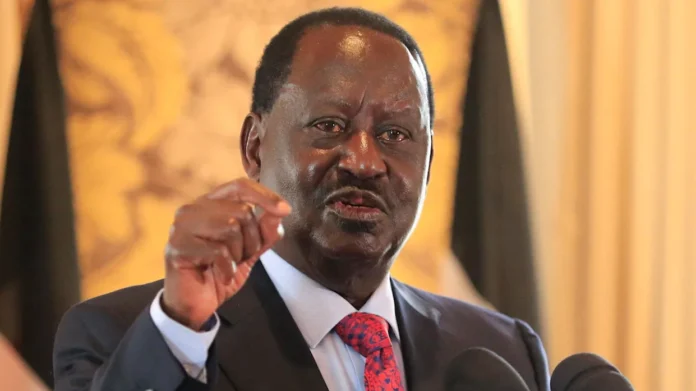
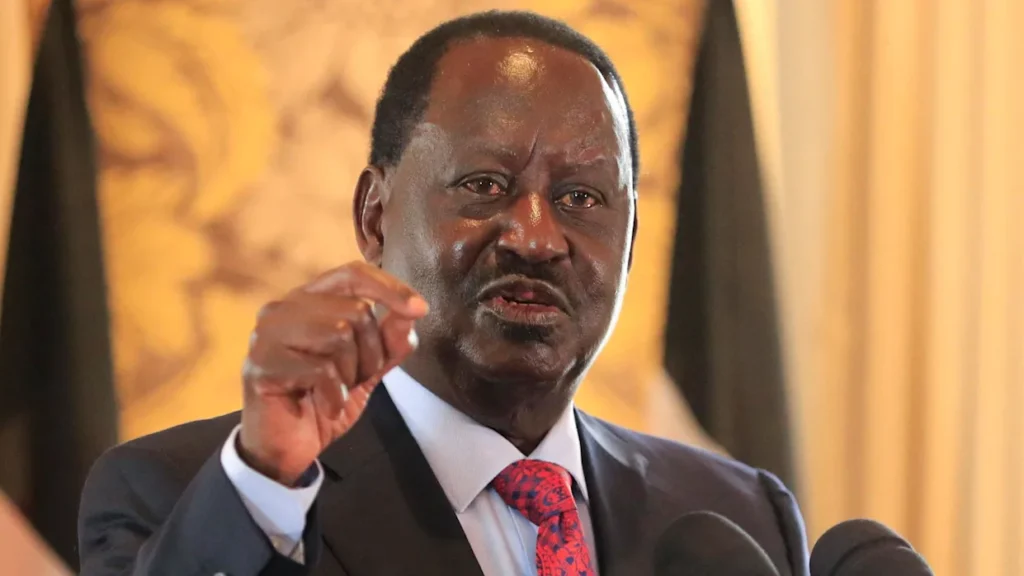
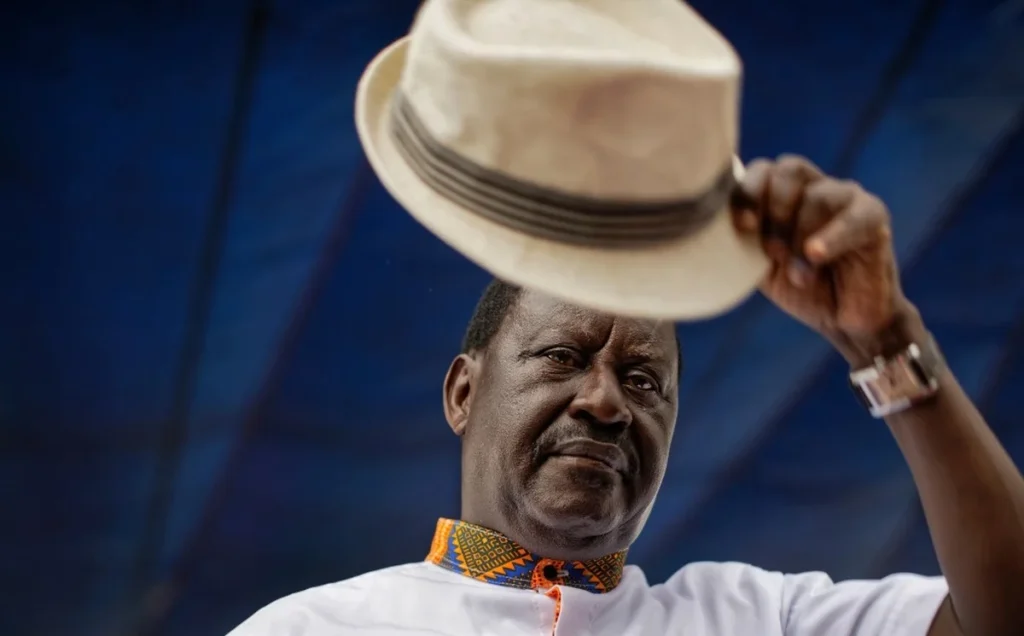
Nairobi (BN24) – Raila Odinga, the former prime minister of Kenya and a towering figure in African politics whose populist campaigns reshaped his country’s political landscape for decades, died Wednesday at age 80 while traveling in India.
Odinga suffered a fatal heart attack during a morning walk in Kerala State, India, according to Devamatha Hospital, where he was rushed after collapsing. The hospital said in a statement that he suffered a cardiac arrest and did not respond to resuscitation efforts. His death marks the end of an era for Kenya, where Odinga remained a powerful voice even outside of elected office.
A perennial presidential contender, Odinga ran five times over three decades, coming closest to winning in 2007 when he narrowly lost to then-President Mwai Kibaki in a deeply disputed election. The official results — 46% for Kibaki and 44% for Odinga — remain the tightest in Kenyan history. The disputed outcome led to widespread ethnic violence, exposing deep divisions within the country’s political system.
Odinga, a member of the Luo ethnic group from western Kenya’s Nyanza province, built his political career by positioning himself as a champion of democratic reform. He was instrumental in pushing Kenya from a one-party state to a multiparty democracy in the 1990s. His activism, charisma, and grassroots appeal earned him a devoted following across the country.
His campaigns were marked by his ability to unite political rivals and tribal kingpins. In 2007, he emerged as the rallying figure for several key groups, drawing unprecedented crowds to his campaign rallies. Many observers at the time believed he was poised to take the presidency.
Although Kibaki’s administration had delivered solid economic growth during its first term, corruption scandals and political fatigue made his government vulnerable. The disputed election result led to unrest that shocked the nation. Later, the head of the electoral authority admitted he was uncertain whether Kibaki had actually won.
Despite never becoming president, Odinga maintained significant influence over Kenyan politics. Most recently, he signed a political pact with President William Ruto that integrated his opposition party into the government, giving it a role in key policymaking and cabinet appointments.
Odinga’s death leaves a void in Kenya’s political arena. Revered by many as a statesman and reformist, he was seen as both a challenger of entrenched systems and a unifying figure who bridged political divides.
ANTANANARIVO, Madagascar (BN24) — Madagascar’s military declared it had taken control of the country on Tuesday after lawmakers impeached President Andry Rajoelina and he fled the country amid mounting youth-led protests and growing defections within the armed forces.
Colonel Michael Randrianirina, who led a recent mutiny, announced the power shift in a national radio broadcast, stating the military had assumed authority and would suspend key state institutions, except the National Assembly. “We have taken the power,” he said, adding that the armed forces would oversee a transitional government for up to two years before holding elections.
Randrianirina, a commander in the elite CAPSAT unit instrumental in Rajoelina’s own 2009 coup, broke with the president last week. He said the new ruling committee would govern alongside a transitional administration.
A statement issued by military leaders confirmed the suspension of several major institutions, including the Senate, the High Constitutional Court, the electoral commission, the High Court of Justice, and the High Council for the Defense of Human Rights and the Rule of Law.
The 51-year-old Rajoelina, whose whereabouts remain unknown, had earlier attempted to dissolve the lower house by decree. Lawmakers moved ahead regardless, voting to impeach him and sparking a constitutional crisis. That deadlock paved the way for the military to act.
In a defiant address the night before the takeover, Rajoelina insisted he had relocated for safety due to threats to his life. Multiple sources, including an opposition leader, a military official, and a foreign diplomat, confirmed he left Madagascar aboard a French military plane on Sunday.
Even his ruling coalition, which held a majority in parliament, turned against him, with members supporting the impeachment on grounds of “activities incompatible with presidential duties.” In recent days, Rajoelina had warned of an ongoing coup attempt.
Protests first erupted on September 25, triggered by shortages of water and electricity, but quickly evolved into a broader uprising against government corruption, poor services, and mismanagement. Madagascar’s predominantly young population fueled the movement—more than 75% of its 30 million citizens live in poverty, with an average age under 20.
Thousands took to the streets Tuesday at Antananarivo’s central 13 May Square, waving Malagasy flags and banners. Many bore the skull-and-crossbones symbol popularized by the “One Piece” anime, a signature emblem of the Gen Z-led protests. Chants accusing Rajoelina of serving French interests echoed through the colonial-era boulevards.
Randrianirina appeared before the crowd during the demonstration, asking if they were ready to accept military rule. The response was overwhelmingly positive.
“We’re so happy Andry Rajoelina is finally gone,” said high school student Fih Nomensanahary, celebrating with friends. Others expressed concern about the military’s next steps. “They need to hand over to a civilian administration quickly and have an election,” said Rezafy Lova, a 68-year-old IT consultant.
In the days leading up to the takeover, CAPSAT forces refused to fire on protesters and declared solidarity with them. The unit later installed a new army chief, prompting Rajoelina to accuse the military of staging an illegal power grab. The paramilitary gendarmerie and national police also broke ranks, leaving the president increasingly isolated.
Rajoelina, who originally rose to power through a military-backed coup, now finds himself ousted similarly, amid deepening economic despair. According to the World Bank, Madagascar’s GDP per capita has dropped 45% since independence in 1960.
Washington (BN24) – The United States conducted a strike on a boat off the coast of Venezuela on Tuesday, killing six suspected drug traffickers, President Donald Trump said, marking the latest in a series of aggressive operations targeting narcoterrorist networks in the region.
Trump announced the strike in a post on Truth Social, calling the targeted vessel part of a “designated terrorist organization.” He did not identify the group or provide specific details about the mission.
“Intelligence confirmed the vessel was trafficking narcotics, was associated with illicit narcoterrorist networks,” Trump said. He offered no supporting evidence for the claim.
A 30-second video posted by Trump appeared to show a stationary vessel in open water being struck by a projectile and erupting in a fiery explosion.
The operation reflects Trump’s growing use of U.S. military power in unconventional ways, including deploying active-duty troops in Los Angeles and launching counter-terrorism missions against suspected drug traffickers. The strike off Venezuela is the latest escalation in what Trump has described as a campaign to disrupt criminal organizations operating across international waters.
U.S. officials have not yet released additional information about the identities of those killed or the specific legal authority used to conduct the strike. The incident underscores the increasingly blurred line between counter-terrorism and anti-narcotics operations under Trump’s leadership.
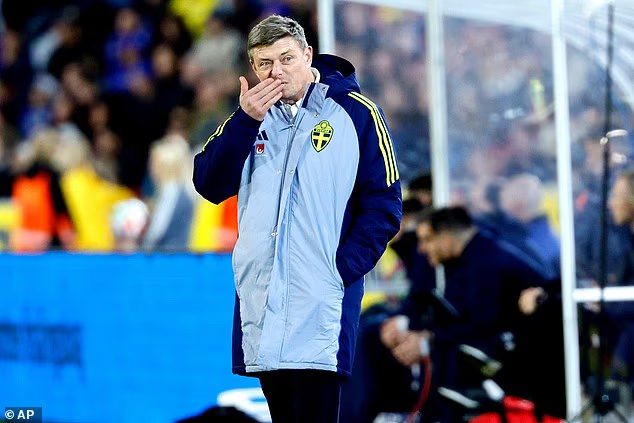
STOCKHOLM (BN24) — Sweden has sacked head coach Jon Dahl Tomasson with immediate effect following a 1-0 World Cup qualifying defeat to Kosovo that leaves the national team winless in four matches and bottom of their group.
The Swedish Football Association (SvFF) confirmed the decision on Tuesday, citing poor results and growing internal dissatisfaction. The move comes amid growing scrutiny, both from the media and within the dressing room, including a post-match outburst by Newcastle United’s Anthony Elanga.
The 49-year-old Dane, who previously managed Blackburn Rovers and enjoyed a decorated playing career with AC Milan and Feyenoord, won only nine of his 18 matches in charge of the Swedish national side.
Tensions escalated after Monday’s loss in Stockholm, with Fisnik Asllani’s first-half strike sealing Kosovo’s second win over Sweden in the group. Sweden has now scored just twice and conceded seven in the qualifiers. The defeat effectively ends any hopes of direct qualification for the 2026 World Cup, though a play-off route remains possible through their Nations League standing.
Local outlet Radiosporten reported that Elanga, who was not selected for either of Sweden’s October qualifiers, voiced his fury in the tunnel after the match, reportedly shouting, “The damn system must go.” Speaking later, Elanga offered a more measured reflection: “We have worked on a system… but it may look a little different on the field. It is also we who are on the field who have to take responsibility.”
Tomasson had already faced criticism for tactical inconsistency and communication issues. Tottenham midfielder Lucas Bergvall, who started against Kosovo but was substituted at halftime for tactical reasons, questioned the manager’s decision to withhold the starting XI until just an hour before kickoff. “It doesn’t have a big impact on me, but I can’t speak for everyone else,” Bergvall said.
Sweden’s squad, valued highly thanks to Premier League forwards such as Alexander Isak and Viktor Gyökeres, has struggled to convert talent into results. The latest setback saw confidence in Tomasson reportedly erode among several senior players, according to Swedish outlet Sportbladet.
In a statement announcing Tomasson’s dismissal, SvFF chairman Simon Åström said, “The men’s national team has not delivered the results we hoped for. There is still a chance for a playoff in March, and we believe new leadership is required to maximize that opportunity.”
Kim Källström, head of the Swedish FA, praised Tomasson’s professionalism but acknowledged that results dictated the decision. “We have a group of players we believe in very much and want to create new opportunities for them to deliver,” Källström said. “It is always sad to go our separate ways, but football is results-based and we have reached a point where results are not enough.”
Sweden face Switzerland and Slovenia in their remaining group fixtures next month. While automatic qualification is now out of reach, they are expected to secure a playoff spot provided other group winners from the Nations League qualify via traditional routes.
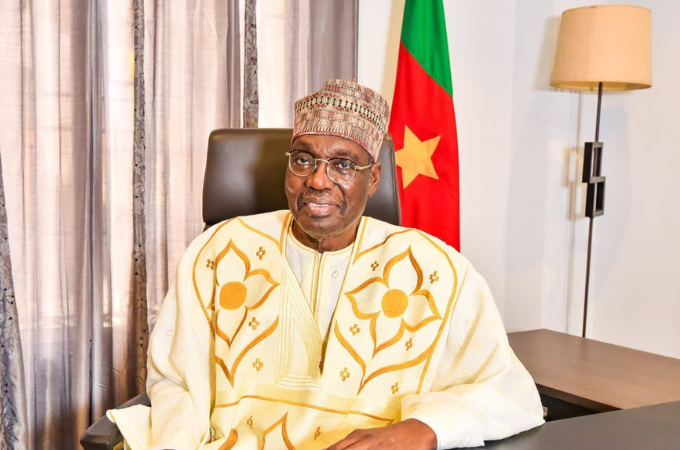
GAROUA, Cameroon (BN24) — Opposition candidate Issa Tchiroma on Monday declared victory in Cameroon’s presidential election and called on long-serving President Paul Biya to concede defeat and accept what he described as the “truth of the ballot box.”
Speaking from his hometown of Garoua in the north of the country, Tchiroma, 76, claimed a clear win in the October 12 poll during a Facebook address. “Our victory is clear. It must be respected,” he said. “The people have chosen. And this choice must be respected.”
A former government spokesman and employment minister, Tchiroma, broke with Biya’s ruling coalition earlier this year. He mounted a high-profile campaign with backing from several opposition parties and civic groups, drawing large crowds in both urban and rural regions.
President Biya, 92, who has ruled Cameroon for more than four decades, was seeking an eighth term. Despite concerns over economic stagnation and rising insecurity, many observers had expected the incumbent’s strong grip on state institutions and a historically divided opposition to favor his re-election.
Tchiroma praised voters for defying threats and staying late at polling stations to guard the vote. “I also thank candidates who have already sent me their congratulations and recognised the will of the people,” he said.
He warned the government against resisting the outcome. “We have placed the regime before its responsibilities: either it shows greatness by accepting the truth of the ballot box, or it chooses to plunge the country into turmoil that will leave an indelible scar in the heart of our nation,” Tchiroma said.
The government has not yet officially responded to Tchiroma’s self-declared victory. However, over the weekend, Minister of Territorial Administration Paul Atanga Nji issued a warning that any unilateral declaration of results would constitute “high treason.” Under Cameroonian electoral law, only the Constitutional Council has the legal authority to announce final results.
While preliminary tallies may be posted at polling stations, the law mandates that final results be validated by the Constitutional Council, which has until October 26 to declare the official winner.
Tchiroma said he would soon release his own breakdown of regional vote tallies based on data compiled from publicly posted results. “This victory is not that of one man, nor of one party. It is the victory of a people,” he said.
He also called on security forces, the military, and government officials to remain loyal “to the republic, not the regime.”
More than 8 million voters were registered for the single-round election, in which the candidate with the most votes is declared president.
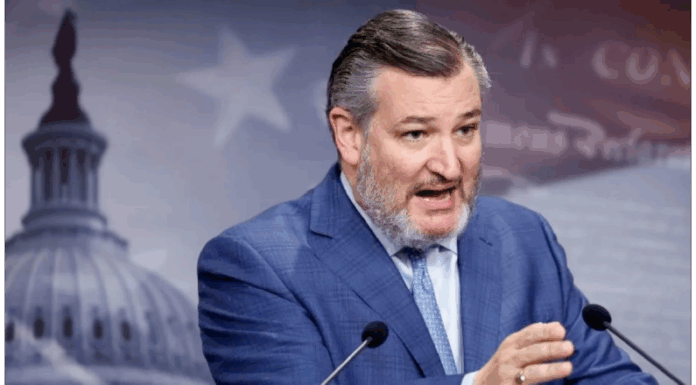
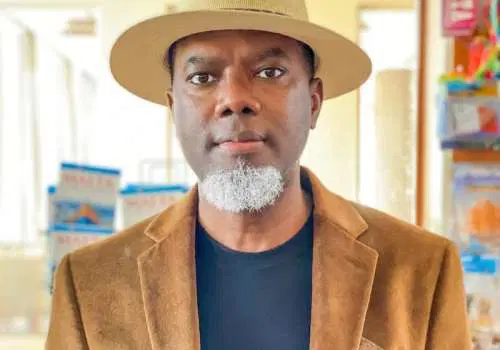
ABUJA, Nigeria (BN24) Nigerian political commentator and author Reno Omokri has rejected claims by United States Senator Ted Cruz that Christians are facing genocide in Nigeria, describing the assertions as “ludicrous,” misleading, and rooted in ignorance of the country’s complex security crisis.
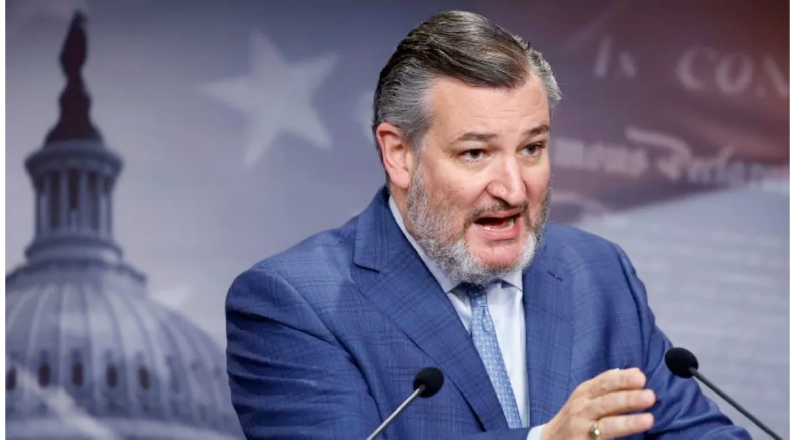
Speaking on ARISE News on Monday night, October 13, Omokri sharply criticized Cruz’s sponsorship of the Nigeria Religious Freedom Accountability Act of 2025. This bill alleges widespread Christian persecution by Islamist groups with tacit approval from the Nigerian government. Cruz’s proposed legislation seeks to have Nigeria designated by the U.S. State Department as a “Country of Particular Concern” (CPC) and impose targeted sanctions on Nigerian officials.
“Senator Ted Cruz began this tale about a Christian genocide, and Governor Greg Abbott followed along with Congressman Chip Roy,” Omokri said. “It is my patriotic duty to correct this dangerous misinformation that has the potential to destabilize Nigeria and damage our international standing.”
Cruz, a Republican senator from Texas, has accused the Nigerian government of failing to protect Christians from violent attacks and of enabling Islamic extremism through blasphemy laws, imposition of Sharia, and tacit support for jihadist groups.
But Omokri, a former aide to ex-President Goodluck Jonathan and a prominent political voice in diaspora advocacy, said the reality in Nigeria defies Cruz’s simplified narrative. While acknowledging that Christians have been victims of violence, Omokri emphasized that Muslims have also suffered equally from attacks by armed groups such as Boko Haram, ISWAP, and bandit militias.
“Yes, there are killings of Christians in Nigeria, and anyone who denies that would be dishonest,” Omokri stated. “But there are also killings of Muslims. When terrorists attack Benue State, which is predominantly Christian, most of the victims are Christians. But when they strike in Zamfara or Sokoto, which are Muslim-majority regions, Muslims bear the brunt. There is no Christian genocide in Nigeria.”
To counter what he calls a politically motivated distortion of facts by U.S. lawmakers, Omokri said he organized a fact-finding delegation from the United States comprising Mike Arnold, the Republican mayor of Blanco, Texas, and Jeff Gibbs, an American filmmaker. The delegation, he explained, visited several regions of Nigeria, including internally displaced persons (IDP) camps, and met with leaders of both the Christian Association of Nigeria (CAN) and Jama’atu Nasril Islam (JNI), the country’s major Islamic umbrella body.
“They’ve now seen things for themselves and spoken with both Christian and Muslim leaders,” Omokri said. “Their mission is to help inform Republican lawmakers who genuinely care about religious freedom but may be operating with misinformation or limited context.”
He added that the delegates had been briefed before their trip by both Senator Cruz and Congressman Chip Roy and would submit an independent report based on firsthand interactions and local assessments.
Omokri further traced the roots of Nigeria’s current security crisis to the 2011 NATO-led intervention in Libya, during the Obama administration. He argued that the toppling of Muammar Gaddafi unleashed armed mercenaries and weapons across the Sahel region, destabilizing fragile states and emboldening jihadist movements.
“This crisis did not begin in Nigeria. It began when the Obama administration intervened in Libya,” Omokri said. “After Gaddafi fell, his battle-hardened fighters and stockpiles of weapons flowed into Mali, Niger, Burkina Faso, and eventually Nigeria. The destabilization of the Sahel is the consequence of that decision, and the United States bears a moral responsibility for what followed.”
Omokri warned that branding Nigeria a “Country of Particular Concern,” a designation typically reserved for nations with systematic, ongoing, and egregious violations of religious freedom, would only embolden terrorist groups and cause further harm to ordinary Nigerians.
“If Nigeria is designated as a CPC, it will embolden terrorists and punish everyday Nigerians, both Christian and Muslim, who are already suffering,” he said. “It will not serve the cause of religious freedom, but instead, deepen divisions and make cooperation with the United States more difficult.”
Nigeria has long battled a variety of security threats, including Boko Haram insurgency in the northeast, farmer-herder conflicts in the Middle Belt, banditry in the northwest, and separatist unrest in the southeast. Religious identities are often entangled with ethnic, regional, and political affiliations, making simplistic attributions of violence to religious persecution misleading, experts say.
So far, the Nigerian government has not issued an official response to Senator Cruz’s claims or the bill currently before the U.S. Senate.
Omokri, however, urged restraint from American policymakers, calling for deeper engagement rather than punitive measures based on partial or politicized accounts.
“Nigeria is not perfect, but we are trying. What we need is support, not stigma,” he said. “I urge Senator Cruz and others to consider the facts, not fear-driven narratives.”
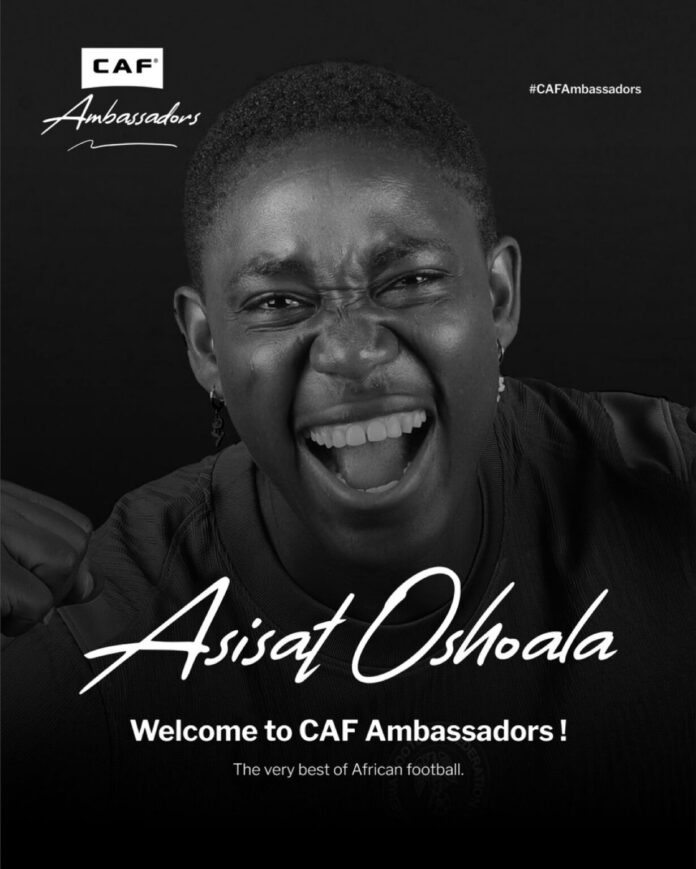
RABAT, Morocco (BN24) — Nigerian football icon Asisat Oshoala has been named a CAF Ambassador ahead of the 2024 Women’s Africa Cup of Nations (WAFCON), the Confederation of African Football announced on Tuesday. The appointment adds another milestone to Oshoala’s already storied career and underscores her growing influence both on and off the pitch.
CAF confirmed the news in a statement released just months before the continent’s premier women’s tournament kicks off in Morocco. In a post on X, CAF Women welcomed the six-time African Women’s Player of the Year, writing, “Welcome Asisat Oshoala, our new CAF Ambassador.”
The ceremonial announcement took place in Rabat, where the 30-year-old forward, currently playing for Al Hilal in the Saudi Women’s Premier League, received the honour in the presence of top CAF officials and media.
With this ambassadorial role, Oshoala joins an elite group of football personalities chosen to promote African football globally. The role includes responsibilities such as representing CAF at official events, engaging with youth development initiatives, and advocating for gender equality and social causes tied to the sport.
Born in Lagos, Oshoala has long been a symbol of excellence in women’s football. Her accolades include four WAFCON titles with Nigeria’s Super Falcons and a record six African Women’s Player of the Year awards. She has played professionally in England, China, Spain, and now Saudi Arabia, amassing widespread respect for her performance and advocacy.
CAF’s appointment of Oshoala is widely seen as a strategic move to bolster the visibility and impact of women’s football in Africa. As WAFCON 2024 approaches, her presence as a brand ambassador is expected to energize young fans, raise the profile of the tournament, and reinforce the federation’s push for broader female participation in football.
This latest honour further cements Oshoala’s place among the most influential African athletes of her generation, continuing a career that has consistently broken barriers and inspired new pathways for female footballers across the continent.
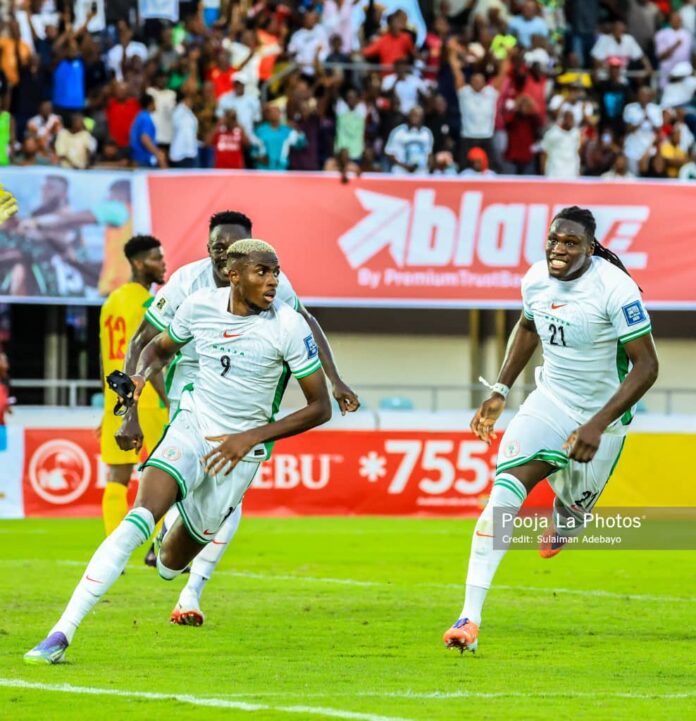
UYO, Nigeria (BN24) — Nigeria’s World Cup dreams were kept flickering on Tuesday night as striker Victor Osimhen delivered a stellar hat-trick performance, leading the Super Eagles to a resounding 4-0 victory over the Benin Republic in a crucial 2026 FIFA World Cup qualifier at the Godswill Akpabio Stadium in Uyo, south of Nigeria.
Osimhen struck in the third, 38th, and 51st minutes, converting two well-placed crosses from Samuel Chukwueze and finishing off a clinical solo effort to complete his treble. A late goal from substitute Frank Onyeka in the 90th minute sealed the dominant win for Nigeria, whose performance electrified the home crowd despite the looming reality that the result wasn’t enough to secure automatic qualification.
The Super Eagles needed a favorable result elsewhere to advance. Still, Group B leaders South Africa booked their spot at the 2026 World Cup in the United States, Canada, and Mexico with a 3-0 win over Rwanda earlier in the day. That result ultimately overshadowed Nigeria’s commanding display in Uyo.
Nigeria’s head coach, Jose Peseiro, made four changes to the lineup that previously defeated Lesotho. Wilfred Ndidi captained the side, while Osimhen partnered Akor Adams up front. Moses Simon marked his 85th international appearance in the starting XI, which also featured Calvin Bassey, Semi Ajayi, and Alex Iwobi.
The match began with a burst of energy, and it took just three minutes for Nigeria to find the net. Osimhen capitalized on an early cross from Chukwueze, coolly slotting past the Beninoise goalkeeper. Benin responded with a brief spell of pressure, nearly equalizing in the 12th minute before Calvin Bassey’s timely intervention shut down the threat.
With Nigeria dominating possession at 58%, Osimhen came close again in the 22nd minute but was denied by resolute defending. He doubled the lead in the 38th minute, once more connecting with Chukwueze to give the Super Eagles a 2-0 cushion heading into halftime.
Benin began the second half with renewed urgency, but it was Nigeria who struck again. Osimhen completed his hat-trick in the 51st minute, reaffirming his status as the team’s attacking talisman. Despite a wasted opportunity from Ndidi in the 68th minute, Nigeria continued pressing forward.
Frank Onyeka, introduced in the second half, capped off the rout with a precise finish in the final minute of regulation, firing into the bottom corner to make it 4-0.
Though the Super Eagles’ qualification path now depends on future permutations and playoff scenarios, the emphatic performance offers a measure of hope and a reminder of the firepower Osimhen brings to the national team.
The win marks a strong finish to this round of qualifying for Nigeria, who must now await further results and possible continental play-off outcomes to determine their World Cup fate.
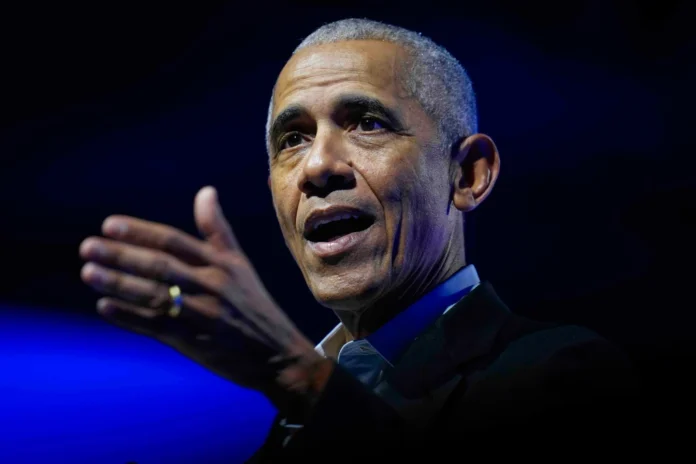
Barack Obama has stepped into the high-stakes battle for control of the U.S. House of Representatives, appearing in a new 30-second campaign ad urging Californians to support Proposition 50, a November ballot measure that could dramatically reshape the state’s congressional map.
The initiative aims to create as many as five new Democratic-held House seats in California, which could be decisive in the struggle for control of Congress. Proposition 50 was drafted by Democratic strategists to secure House gains and offset President Donald Trump’s efforts in Texas and other Republican strongholds to expand the GOP’s majority in the 2026 midterm elections.
“Republicans want to steal enough seats in Congress to rig the next election and wield unchecked power for two more years,” Obama says in the ad, speaking directly to viewers. “You can stop Republicans in their tracks.”
Democratic Gov. Gavin Newsom has characterized the California redistricting measure as a referendum on Trump’s influence, arguing that Democrats must counter Republican moves to tilt the balance of power. Voting on the proposal began earlier this month and concludes Nov. 4.
Republican leaders and opponents of Proposition 50 have condemned it as a blatant power grab. They argue that the measure would override district boundaries set by California’s independent redistricting commission, which was established by voters more than a decade ago to remove partisan influence from the process.
The political fight mirrors a growing national showdown between California and Texas, the nation’s two most populous states. In North Carolina, Republican legislative leaders announced plans this week to vote on new congressional maps, echoing Trump’s call to lock in additional GOP seats nationwide as Democrats push to redraw maps in their favor elsewhere.
Currently, Republicans hold a narrow 219–213 majority in the House, with three vacant seats. If California voters approve Proposition 50, the new map could cut five Republican-held districts while shoring up Democratic incumbents in battleground areas. That would give Democrats as many as 48 of California’s 52 House seats, up from 43 today — a shift that could be pivotal in deciding House control.
NEW YORK (BN24) — D’Angelo, the Grammy-winning R&B singer whose raspy yet smooth voice and daring artistry helped define a generation of neo-soul music, has died at 51.
The singer, born Michael Eugene Archer, died Tuesday after a prolonged battle with cancer, his family said in a statement. “He was a shining star of our family and has dimmed his light for us in this life,” the family wrote. “We are eternally grateful for the legacy of extraordinarily moving music he leaves behind.”
D’Angelo’s sound — a fusion of hip-hop grit, gospel-rooted emotion, and classic soul — made him one of the most original voices of the 1990s. Earlier this year, the Virginia native marked the 30th anniversary of his groundbreaking debut album “Brown Sugar,” a platinum-selling record that produced hits like “Lady” and its title track. Released in 1995, the album earned multiple Grammy nominations and established D’Angelo as a central figure in the neo-soul movement.
His sultry vocal delivery, marked by a unique blend of rasp and church-bred fluidity, became inseparable from the cultural impact of his 2000 single “Untitled (How Does It Feel).” The minimalist music video — featuring D’Angelo shirtless in a single shot — became an enduring cultural moment, sparking national conversations about artistry, sexuality, and Black male vulnerability.
“Untitled” won the Grammy for Best Male R&B Vocal Performance and anchored his sophomore album “Voodoo,” which debuted at No. 1 on the Billboard 200 and went on to win Best R&B Album at the Grammys.
Beyond his solo catalog, D’Angelo made a mark through collaborations. He performed a memorable duet with Lauryn Hill on “Nothing Even Matters,” a standout track from her 1998 classic The Miseducation of Lauryn Hill. He also contributed to The Roots’ 1996 album Illadelph Halflife and was part of the supergroup Black Men United, writing and co-producing “U Will Know” for the film Jason’s Lyric in 1994.
During the 1990s, D’Angelo shared both a personal and musical partnership with Grammy-nominated R&B singer Angie Stone. The two met while he was finishing Brown Sugar and bonded over their Southern upbringings and shared church influences. Stone collaborated on the album and co-wrote “Everyday” for her 1999 debut, Black Diamond.
Stone once described D’Angelo as her “musical soul mate” in a 1999 Associated Press interview, saying their chemistry was “like milk and cereal. Musically, it was magic. It’s something that I have not been able to do with any other producer or musician.”
The pair had a son together, artist Swayvo Twain, born Michael Archer Jr. Stone died earlier this year in a car crash at 63. D’Angelo is also survived by his daughter, Imani Archer.
D’Angelo’s death marks the loss of one of R&B’s most influential figures, whose work reshaped the genre’s sound and visual language for a new generation.