KUWAIT CITY (BN24) — Kuwaiti authorities announced the arrest of 67 people linked to the illegal production and distribution of locally made alcohol that has killed 23 people in recent days. The Interior Ministry confirmed late Saturday that several secret factories had been shut down in connection with the deadly operation.
Alcohol is banned in Kuwait, but underground networks produce it in unsafe and unsupervised conditions. Officials said six active factories and four others under construction were discovered in both residential and industrial districts, highlighting the scale of the illicit trade.
The Health Ministry said methanol poisoning cases tied to the tainted drinks have climbed to 160, with the death toll rising from 13 to 23 since Thursday. Most of the victims were Asian expatriates.
Authorities identified the head of the criminal network as a Bangladeshi national, who was taken into custody. Another suspect, a Nepali, reportedly explained how methanol was produced and distributed.
WASHINGTON (BN24) — Pro-democracy activists and labor organizations staged more than 300 rallies across the United States on Saturday to protest President Donald Trump’s push for Texas to redraw its congressional map in favor of Republicans.
The coordinated demonstrations spanned 44 states and Washington, D.C., drawing tens of thousands of people, according to organizers. In Texas, former Congressman Beto O’Rourke addressed a crowd, praising the resistance of Democratic state lawmakers who fled to deny Republicans the quorum needed to pass Trump’s redistricting plan.
“They do this because they are afraid,” O’Rourke said, describing the redistricting push as an attempt to silence opposition. “They fear this power they see here today.”
Drucilla Tigner, executive director of the Texas For All coalition, said the nationwide response underscored growing concerns over threats to democracy. Many of the more than 50 Texas Democrats remain in Illinois, avoiding civil arrest warrants enforceable only within Texas.
The walkout derailed a special legislative session called by Governor Greg Abbott, who quickly convened a second session, insisting redistricting, flood safety legislation, and other priorities remain unresolved.
Meanwhile, California Gov. Gavin Newsom unveiled a redistricting proposal he said would add five Democratic seats, potentially offsetting Republican gains from Texas. Texas Democrats vowed they would not return until the special session ends and California’s maps are introduced.
GAZA CITY, Gaza Strip (BN24) — Hamas on Sunday rejected Israel’s plan to relocate residents from Gaza City, calling it a “new wave of genocide and displacement” for hundreds of thousands of Palestinians in the war-ravaged enclave.
The Palestinian militant group said Israel’s deployment of tents and shelters in southern Gaza was “a blatant deception,” accusing the Israeli military of disguising forced displacement under the guise of humanitarian aid.
Israel’s military announced it would begin providing tents and equipment in southern Gaza starting Sunday as part of its plan to move civilians out of northern Gaza City, which it has identified as a key combat zone. The military said the relocation aims to ensure the safety of civilians ahead of a planned offensive to seize control of the enclave’s largest urban center.
Palestinians queue for water next to a distribution truck at a displacement camp west of Jabalia city in the northern Gaza Strip on March 11, 2025. Saudi Arabia, Qatar and Jordan on March 11 condemned Israel’s decision to cut electricity supply to the war-battered Gaza Strip, calling in separate statements for the international community to take action. (Photo by BASHAR TALEB / AFP) (Photo by BASHAR TALEB/AFP via Getty Images)
Hamas denounced the move, saying it was an attempt to “cover up a brutal crime” as Israel prepares a new assault. The relocation plan has sparked international concern over the future of the already devastated strip, home to roughly 2.2 million people.
The war erupted on Oct. 7, 2023, when Hamas launched an attack in southern Israel that killed 1,200 people and led to 251 hostages being taken, according to Israeli authorities. Israel’s ensuing military campaign has killed more than 61,000 Palestinians, according to Gaza’s health ministry, and displaced most of the enclave’s population while pushing it into a deepening humanitarian crisis.
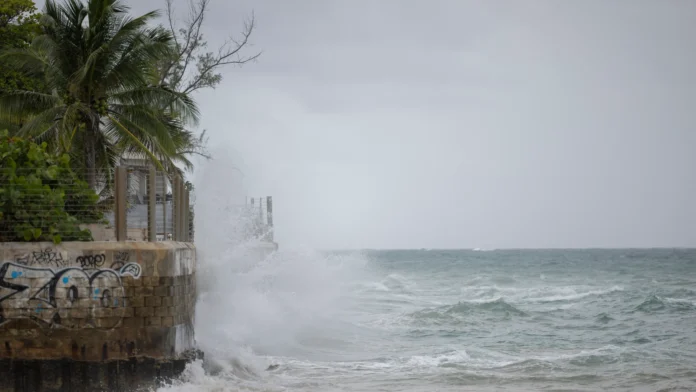
SAN JUAN, Puerto Rico (BN24) — Hurricane Erin rapidly intensified into a powerful storm over the Atlantic, lashing northern Caribbean islands with heavy rain and damaging winds on Saturday, though forecasters said it was not expected to make landfall.
Erin became the first Atlantic hurricane of 2025 and quickly grew from a tropical storm into a Category 5 system before weakening slightly to Category 4, with sustained winds of 140 mph (220 kph), according to the National Hurricane Center in Miami. The storm’s center was located about 145 miles (230 kilometers) north-northeast of San Juan, Puerto Rico, moving west-northwest at 14 mph (22 kph).
Despite its track staying offshore, Erin’s outer bands battered Puerto Rico and the Virgin Islands, cutting power to about 130,000 customers and prompting warnings of flash floods, mudslides and landslides. Tropical storm watches were issued for St. Martin, St. Barts and the Turks and Caicos Islands.
National Hurricane Center Director Mike Brennan said Erin’s explosive growth was “very powerful,” with its winds intensifying by 60 mph (96 kph) in just nine hours. Meteorologists called its speed of strengthening “incredible,” with only a handful of hurricanes in history reaching Category 5 before mid-August.
Emergency officials readied shelters in Puerto Rico, the Bahamas and along the U.S. East Coast, where forecasters warned dangerous rip currents could develop next week even as Erin remains offshore.
Scientists have linked rapid intensification of hurricanes to climate change, citing record-warm waters and higher atmospheric moisture. Erin is the fifth named storm of what experts predict will be an unusually active Atlantic hurricane season, with as many as 10 hurricanes expected, three to five of them major.
LOS ANGELES (BN24) — Lionel Messi made a triumphant return from injury on Saturday night, scoring a decisive late goal and assisting another to seal Inter Miami’s 3-1 victory over the LA Galaxy in Major League Soccer.
The Argentine star, who had missed the last two matches with a right hamstring injury, entered at the start of the second half and immediately shifted the momentum. After several near misses, Messi broke through in the 84th minute, weaving past defenders with his trademark dribbling before firing a left-footed strike from distance that put Miami ahead 2-1. Just minutes later, he delivered a dazzling back-heel assist to longtime teammate Luis Suárez, securing the two-goal cushion that put the game out of reach.
Messi’s goal was his 19th of the MLS season, keeping him atop the league’s scoring chart and propelling Miami back into fourth place in the Eastern Conference standings. The victory was crucial after Miami’s heavy 4-1 defeat to Orlando last week that had dropped them to sixth place.
Earlier in the match, Jordi Alba opened the scoring in the first half, finishing a sharp through ball from Sergio Busquets. The Galaxy equalized in the 59th minute through Joseph Paintsil, but Messi’s late surge proved decisive.
Inter Miami coach Javier Mascherano praised Messi’s impact but acknowledged the need to monitor his recovery. “The important thing is that he finished the match,” Mascherano said through an interpreter, noting that Messi appeared to loosen up as the game progressed despite occasionally stretching his right leg. The team will evaluate him further on Sunday.
The result deepened the struggles of defending MLS Cup champions LA Galaxy, who remain anchored at the bottom of the Western Conference standings.
KISUMU, Kenya (BN24) — Twenty-two victims of last week’s Kisumu-Kakamega highway bus crash in Kenya were laid to rest in a solemn mass funeral on Saturday, as grieving families and political leaders gathered to mourn and demand urgent action to improve road safety.
The interdenominational service was held at Naki Primary School, where rows of identical coffins bore testimony to the scale of the tragedy. Families, friends, and community members wept openly as they remembered loved ones whose lives were cut short in the deadly accident.
“It is a day of great sorrow,” one mourner said, recalling the loss of two pastors in the crash. The grief was mirrored by heavy skies over the gathering, as the community joined together in mourning.
Political leaders present turned their condolences into calls for change. Kisumu East MP Shakeel Shabir condemned the dangerous Coptic roundabout, saying its design had cost many lives. “That roundabout has killed very many people. When I was coming here, I was proud to see it had been taken away. Whoever did it, I don’t know,” he said, while urging accountability in roadworks.
Former Prime Minister Raila Odinga, who narrowly survived an accident at the same location years ago, called on the government to immediately redesign the road to prevent further deaths. He also used the occasion to denounce corruption, urging reforms across Kenya’s judiciary, legislature, executive, media, and private sector.
Kisumu Governor Anyang’ Nyong’o announced that KSh 7 million, contributed jointly by President William Ruto, Raila Odinga, and the county government, will be distributed to support the bereaved families, particularly orphans and children left behind.
The mass funeral comes amid growing pressure on authorities to fix the Kisumu-Kakamega road, where repeated accidents have claimed scores of lives. For many families, Saturday’s burial was both a moment of grief and a rallying cry for justice and reform.
Staten Island, NY(BN24) – An off-duty New York Police Department (NYPD) officer fatally shot a man who was reportedly pointing a fake firearm at the officer on Friday night, authorities said.
The incident occurred around 8 p.m. when a 911 call alerted authorities to a man allegedly carrying a gun behind a local diner. Assistant Chief Melissa Eger of the NYPD Patrol Borough of Staten Island confirmed that an off-duty officer later encountered the suspect, who appeared to be holding a firearm.
The off-duty officer, along with another officer, instructed the man to drop the weapon. However, instead of complying, the suspect allegedly pointed the object at the officers. Surveillance footage from the scene captured the critical moments, Eger said. In response, one of the officers fired at the man.
Following the shooting, the officers performed life-saving measures before the suspect was transported to a nearby hospital, where he was pronounced dead. “Our officers were confronted with a dangerous and unpredictable situation, and they attempted to de-escalate the situation multiple times,” Eger stated during a press briefing.
Upon investigation, authorities discovered that the weapon the suspect was wielding was an imitation firearm. While the identity of the man was not immediately disclosed, law enforcement confirmed that he had a criminal history, although further details were not provided.
The NYPD’s Internal Affairs Bureau is investigating the incident, and the circumstances surrounding the shooting remain under review.
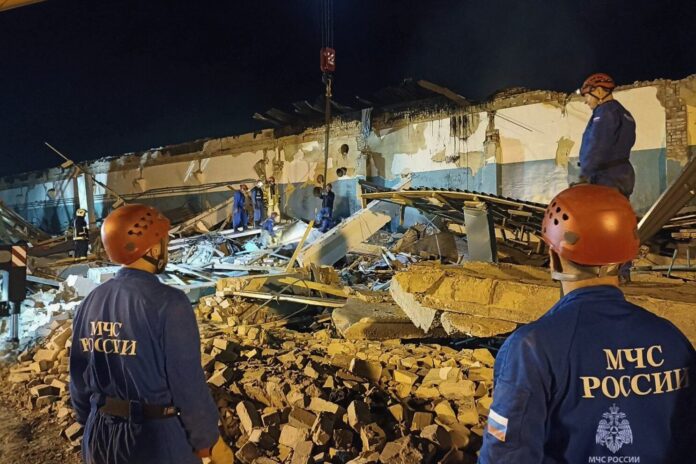
In this photo, released by the Russian Emergency Ministry Press Service on Saturday, Aug. 16, 2025, Emergency Ministry employees work in debris of an industrial plant after a fire at the facility in the Shilovsky District, Ryazan region, around 250 kilometers (155 miles) southeast of Moscow, Russia. (Russian Emergency Ministry Press Service via AP)
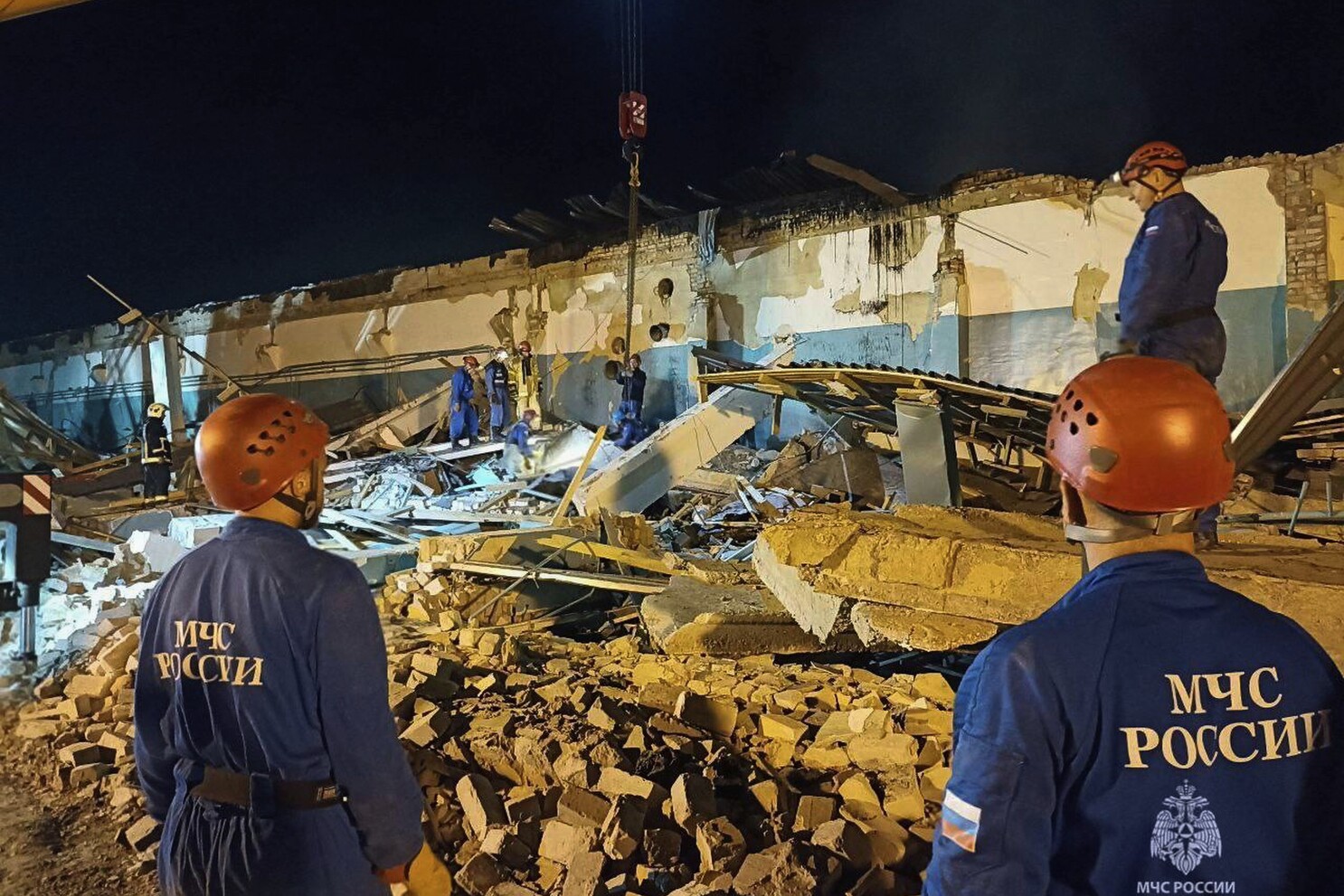
Ryazan, Russia (BN24) – A devastating fire at an industrial plant in Russia’s Ryazan region on Friday has left 11 people dead and 130 injured, according to Russian authorities. The blaze erupted at the Elastik plant in the Shilovsky District, approximately 250 kilometers (155 miles) southeast of Moscow. Emergency crews continued searching the debris throughout the weekend, with two additional bodies recovered overnight, the Russian Emergencies Ministry confirmed.
In this photo, released by the Russian Emergency Ministry Press Service on Saturday, Aug. 16, 2025, Emergency Ministry employees work in debris of an industrial plant after a fire at the facility in the Shilovsky District, Ryazan region, around 250 kilometers (155 miles) southeast of Moscow, Russia. (Russian Emergency Ministry Press Service via AP)
The fire reportedly began at a gunpowder workshop at the facility, which then triggered a powerful blast, according to RIA Novosti, the state news agency. Of the 130 injured, 29 remained hospitalized by Saturday, with 13 receiving treatment in Ryazan and 16 others transported to medical centers in Moscow for more specialized care.
Rescue operations continued as three people were pulled from under the rubble overnight, and investigators have launched a preliminary inquiry into the cause of the fire. While the exact reason for the blaze remains unclear, local authorities are treating it as a major industrial disaster.
In response to the tragedy, Ryazan Governor Pavel Malkov declared Monday a day of mourning for the region. “Flags will be lowered across the region. Cultural institutions, television and radio companies, and other organizations have been asked to cancel entertainment events,” he said in a statement on Telegram.
This marks the second deadly explosion at the Elastik plant in less than four years. In October 2021, 17 people were killed in a blast at a different workshop operated by Razryad, an explosives manufacturer, according to Interfax.
Toronto, Canada (BN24) – Air Canada suspended operations early Saturday after more than 10,000 of its flight attendants went on strike, leaving thousands of travelers stranded during the peak summer travel season. The strike began after a deadline for reaching a new labor agreement passed without a deal, prompting the airline to halt its services worldwide.
The Canadian Union of Public Employees (CUPE), which represents the flight attendants, confirmed the strike had begun, as negotiations failed to produce a resolution. Air Canada followed suit, announcing that it would cease operations and lock flight attendants out of airports.
The labor dispute escalated on Friday when the union rejected Air Canada’s proposal to enter government-directed arbitration, which would have removed the union’s right to strike and allowed a third-party mediator to determine the terms of a new contract. Flight attendants walked off the job around 1 a.m. EDT on Saturday, marking the beginning of the walkout.
Federal Jobs Minister Patty Hajdu met with both the airline and union representatives on Friday evening, urging them to make a greater effort to reach a resolution. “It is unacceptable that such little progress has been made. Canadians are counting on both parties to put forward their best efforts,” Hajdu said in a statement posted on social media.
The conflict centers on wages and working conditions. CUPE spokesman Hugh Pouliot stated that the union’s negotiations with Air Canada had been ongoing for eight months, but significant differences remain over pay and the unpaid work flight attendants are required to do when planes are not in the air. While Air Canada’s latest offer included a 38% increase in total compensation over four years, the union rejected the proposal, citing inflation and inadequate first-year pay raises.
In response to the strike, Air Canada said it would explore alternative travel options through other Canadian and international airlines, though it warned that the summer travel peak made rebooking flights difficult. Many passengers, already burdened with delayed or canceled flights, faced soaring prices for alternate tickets. “It’s just a waiting game now,” said one frustrated traveler, who considered booking a new flight but found the prices unaffordable.
The Business Council of Canada has called on the government to impose binding arbitration to end the disruption, citing the impact on both the air passenger and cargo sectors. “At a time when Canada is dealing with unprecedented pressures on our critical economic supply chains, the disruption of national air passenger travel and cargo transport services would cause immediate and extensive harm to all Canadians,” said Goldy Hyder, the council’s CEO.
This labor unrest is the latest in a series of disputes affecting Canada’s transportation sector. Last year, the federal government intervened in a rail workers’ strike by imposing arbitration, a move that sparked backlash from labor unions claiming it stripped them of leverage during negotiations.
As the strike drags on, both Air Canada and the union remain far apart on reaching a final agreement, leaving travelers and workers anxiously waiting for a resolution.
Kaduna, Nigeria (BN24) – Security operatives have arrested a suspect with a staggering N25.9 million in cash, allegedly intended for vote-buying just hours before the scheduled bye-elections in parts of Kaduna state, Nigeria. The suspect, Shehu Aliyu Patangi, was apprehended around 3:30 a.m. on Saturday, August 15, in a coordinated operation involving the Nigeria Police Force and the Department of State Services (DSS). The arrest took place at a well-known hotel on Turunku Road in Kaduna metropolis.
The Kaduna State Police Command confirmed that an initial investigation revealed the cash was intended to influence voters and disrupt the integrity of the upcoming elections. DSP Mansir Hasan, the police spokesperson, stated that Patangi had admitted to his involvement in the illegal activity during questioning, expressing remorse and pleading for leniency.
In a stern statement, the Commissioner of Police for Kaduna State, CP Rabiu Muhammad, warned that the police would take no leniency toward individuals found attempting to undermine the electoral process. “The suspect was arrested with a significant sum believed to be earmarked for voter bribery. He has confessed and begged for mercy. We want to make it clear that anyone caught trying to subvert the electoral process through vote-buying, thuggery, violence, or any illegal activity will face the full force of the law,” the CP emphasized.
The police also issued a firm warning to political figures and their supporters to refrain from acts of violence or any behaviour that could disrupt the election process. Intelligence gathered by security agencies indicated that certain politicians were planning to instigate unrest, prompting a strategic deployment of security personnel to monitor polling units, collation centers, and other potential flashpoints.
“The command will not hesitate to deal decisively with those who attempt to create chaos. Whether high-ranking or not, anyone involved in violence, vote-buying, thuggery, or intimidation will be arrested and prosecuted,” the statement continued.
Ahead of the elections, the police assured the public of robust security measures to ensure the peaceful conduct of the voting process. Residents were encouraged to participate in the elections without fear of intimidation, confident that their safety would be prioritized before, during, and after the polling.