Home Blog Page 256

Mexico Demands Repatriation of 14 Nationals Held at U.S. ‘Alligator Alcatraz’ Detention Center-Reuters

MEXICO CITY (BN24) — President Claudia Sheinbaum said Tuesday that 14 Mexican nationals are currently being held at a U.S. immigration detention center nicknamed “Alligator Alcatraz,” and that her government is seeking their immediate repatriation. The facility, located in a remote wetland near Miami, has become a controversial symbol of the Biden-era immigration rollback under President Donald Trump’s administration.

“All arrangements are being made to ensure they are repatriated immediately to Mexico,” Sheinbaum said during her daily press briefing. She added that consular and legal teams are actively working with U.S. authorities to secure the release of the detainees, many of whom have not yet seen a judge.

The detention center, situated roughly 37 miles west of Miami, is surrounded by swamplands inhabited by alligators, crocodiles and invasive Burmese pythons. The site’s location and its harsh conditions have been used by the White House to illustrate its commitment to removing migrants it claims were unlawfully permitted to remain in the U.S. during the Biden presidency.

Since Trump returned to office in January, Mexico has received 73,533 deportees, including 67,008 Mexican citizens, according to figures released by Sheinbaum in a separate briefing earlier this month. Most of the repatriations occurred via air transport.

The plight of two detainees, brothers Carlos and Alejandro Gonzalez, has drawn widespread attention in Mexico. Their father, Martin Gonzalez, told local radio station W that his sons were locked up in the Alligator Alcatraz facility despite holding valid tourist visas. He said Carlos, 26, was initially pulled over by a state trooper while driving in the U.S. and detained for lacking vehicle registration. When Alejandro arrived shortly afterward to deliver the document, he was also taken into custody.

“It’s really bad. The facility is completely closed—no sunlight gets in. The lights are on 24/7, so they don’t even know if it’s day or night,” Martin Gonzalez said. “Obviously my sons are desperate to get out of this situation.”

The U.S. Department of Homeland Security has not responded to requests for comment regarding the brothers’ case.

Mexico’s consul in Orlando, Juan Sabines, released a video on Monday with the brothers’ father, confirming that the two young men remain in legal limbo. He said a court-appointed lawyer has yet to gain access to their case files, and no immigration judge has been assigned.

The Sheinbaum administration has made the defense of Mexican nationals abroad a key part of its foreign policy platform, and the president reiterated that her government would not tolerate violations of their rights on foreign soil.

Coca-Cola to Launch Cane Sugar Coke in U.S. as Higher Prices Drive Profit Gains

ATLANTA (BN24) — Coca-Cola says it will introduce a version of its flagship soda sweetened with cane sugar in the U.S., a move the company confirmed Tuesday as it posted stronger-than-expected quarterly earnings fueled by higher pricing—even as product volumes slipped globally.

AUSTIN, TEXAS – JULY 17: In this photo illustration, Coke beverages are displayed in an ice-cooler at a park on July 17, 2025 in Austin, Texas. U.S. President Donald Trump stated in a Truth Social post that Coca-Cola has agreed to use real cane sugar in its U.S. beverages, similar to Mexican Coke. (Photo illustration by Brandon Bell/Getty Images)

The beverage giant reported a 2.5% increase in comparable revenue, reaching $12.62 billion for the quarter ending June 27, surpassing Wall Street estimates of $12.54 billion. Earnings per share came in at 87 cents, beating the 83 cents expected by analysts, according to data compiled by LSEG. Despite the revenue growth, overall sales volumes dropped 1%, following two consecutive quarters of 2% growth, with declines noted in major markets like India, Mexico and the U.S.

CEO James Quincey said in a post-earnings call that Coca-Cola is preparing to roll out a cane sugar version of Coke in the U.S. in response to shifting consumer preferences and broader calls for healthier alternatives. “We’re using the whole toolkit of sweetening options to meet consumer demand,” Quincey said, noting that the new product will “complement” existing offerings.

The decision comes amid public pressure to respond to health trends and political momentum from Health Secretary Robert F. Kennedy Jr.’s “Make America Healthy Again” campaign. President Donald Trump announced last week that Coca-Cola had agreed to produce Coke with real cane sugar for U.S. consumers.

Coca-Cola already markets cane sugar-sweetened Coke in international markets, particularly in Mexico, and it is available in the U.S. in select stores as “Mexican Coke,” typically sold in glass bottles. The expansion of cane sugar-based products domestically could help Coca-Cola better align with evolving consumer preferences and political sentiment.

Industry analysts, however, cautioned that the move may significantly increase production costs and strain supply chains. “Cane sugar is more expensive, and shifting away from high-fructose corn syrup will require adjustments across the board,” said Sean King, an analyst with Columbia Threadneedle. Still, Quincey emphasized that costs associated with global trade dynamics remain “manageable.”

The pricing hikes, rather than volume growth, were the key driver of earnings this quarter. Overall prices rose 6% in Q2, especially in inflation-impacted markets. However, higher shelf prices may prove challenging for consumers already facing economic strain. Quincey acknowledged that volume declines in North America stemmed from “uncertainty and pressure” on certain socioeconomic groups.

A notable source of sales decline was a boycott among Hispanic consumers in both the U.S. and Mexico, triggered by viral allegations that Coca-Cola had laid off Latino workers and reported them to U.S. Immigration and Customs Enforcement (ICE). Reuters reported in February that there was no public evidence supporting those claims, and Quincey said the boycott’s effects have largely dissipated.

Coca-Cola’s Zero Sugar line was a standout performer, with global volumes surging 14%, indicating continued demand for no-calorie options even amid price hikes.

The company reaffirmed its full-year guidance, saying it expects earnings per share growth near the upper end of its 2% to 3% target range, buoyed by a weaker dollar. Despite the strong earnings, Coca-Cola shares dipped 0.6% to $69.61 in afternoon trading.

The cane sugar Coke rollout is likely to further differentiate the brand in an increasingly health-conscious market, as rivals like PepsiCo also pivot toward natural ingredients where consumer demand exists.

Trump-Era Justice Department Seeks Meeting With Ghislaine Maxwell Amid Pressure Over Epstein Files

WASHINGTON (BN24) — The U.S. Justice Department has asked Ghislaine Maxwell, the longtime associate of convicted sex offender Jeffrey Epstein, to meet with federal prosecutors, amid renewed political pressure to unseal records and revisit allegations tied to Epstein’s sex-trafficking network. Deputy Attorney General Todd Blanche confirmed Tuesday that he expects to speak with Maxwell “in the coming days.”

The request marks a significant development in a case that continues to shadow public institutions and political figures years after Epstein’s 2019 death in federal custody, which was ruled a suicide. Maxwell is currently serving a 20-year sentence following her 2021 conviction for sex trafficking underage girls to Epstein.

Blanche’s announcement came as Attorney General Pam Bondi faces mounting criticism from President Donald Trump’s supporters, who have demanded the release of additional case materials, including client names and flight records linked to Epstein’s alleged criminal enterprise. The renewed attention follows earlier promises by Bondi to provide “a lot of names” and full transparency—promises that critics say have not yet been met.

“President Trump has told us to release all credible evidence,” Blanche posted on X, formerly Twitter. He said if Maxwell “has information about anyone who has committed crimes against victims, the FBI and the DOJ will hear what she has to say.”

Blanche also noted that he had been in communication with Maxwell’s attorneys to determine her willingness to cooperate. Maxwell’s lawyer, David Oscar Markus, confirmed discussions were underway. “Ghislaine will always testify truthfully,” Markus said, adding, “We are grateful to President Trump for his commitment to uncovering the truth in this case.”

Trump himself weighed in during remarks in the Oval Office, saying it would be “appropriate” for the Justice Department to interview Maxwell, who did not testify during her trial and is appealing her conviction to the U.S. Supreme Court.

Also on Tuesday, two federal judges in Manhattan ordered the Justice Department to submit detailed legal arguments by July 29 in support of its bid to unseal grand jury transcripts and other sealed documents from both the Epstein and Maxwell cases. U.S. District Judges Richard Berman and Paul Engelmayer instructed Maxwell, representatives for Epstein’s estate, and alleged victims to submit their positions on the proposed disclosures by August 5.

The Justice Department’s move comes after it released only a limited set of records earlier this year, which critics say revealed little new information. The DOJ and FBI also issued a joint memo this month dismissing longstanding conspiracy theories, stating there is “no incriminating client list” or proof of blackmail involving Epstein’s associates.

Still, some Trump allies have urged the administration to go further. Alan Dershowitz, Epstein’s former defense attorney, said during an appearance on Fox News Sunday that Maxwell should be granted immunity in exchange for testifying before Congress. He also urged the release of FBI interview reports from Epstein’s victims, arguing those files might offer more insight than the grand jury material.

Despite growing demands from Trump’s political base, legal experts caution that unsealed grand jury transcripts are unlikely to contain evidence directly implicating high-profile individuals, due to the nature of such proceedings and their limited focus.

Nonetheless, the Justice Department’s decision to re-engage with Maxwell underscores the political weight the Epstein case continues to carry, particularly in an election year where transparency and institutional accountability are dominating political discourse.

Trump Accuses Obama of Treason in Escalating Feud Over 2016 Russia Election Probe

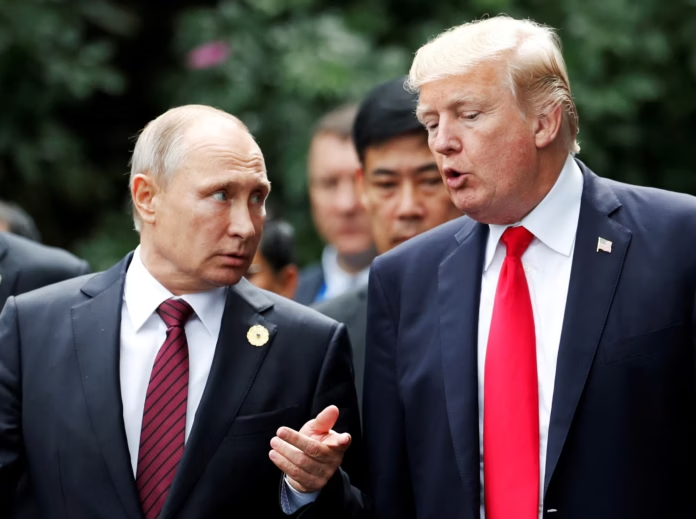
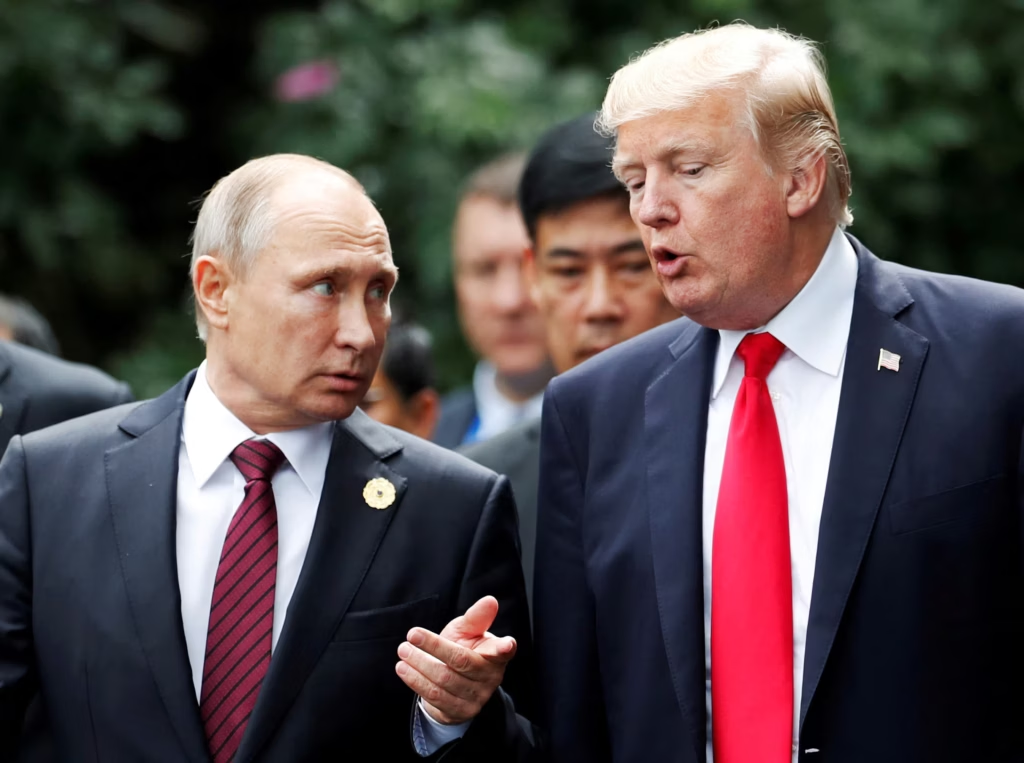
WASHINGTON (BN24) — President Donald Trump on Tuesday intensified his attacks against former President Barack Obama, accusing him of “treason” in connection with the U.S. intelligence community’s investigation into Russian interference in the 2016 election. The accusation, made without evidence, marked Trump’s most aggressive rhetorical escalation against his Democratic predecessor since returning to office in January.

Speaking from the Oval Office, Trump seized on recent remarks by his director of national intelligence, Tulsi Gabbard, who last week threatened to refer Obama-era officials to the Justice Department over their role in producing a 2017 intelligence assessment that concluded Russia had interfered in the 2016 election to benefit Trump’s candidacy.

“They tried to steal the election,” Trump said. “This was treason. They did things nobody’s ever imagined, even in other countries.” He offered no supporting documentation to substantiate the claim.

Gabbard recently declassified a set of intelligence documents that she claimed show a “treasonous conspiracy” by senior Obama officials. Democrats and intelligence experts quickly dismissed the assertion as politically driven and lacking factual foundation. A spokesperson for Obama, Patrick Rodenbush, called Trump’s charges “bizarre,” “ridiculous,” and a “weak attempt at distraction.”

Despite Trump’s claims, the U.S. intelligence assessment produced in January 2017 and endorsed by multiple agencies, concluded that the Russian government sought to harm Democratic candidate Hillary Clinton and boost Trump through hacking, social media manipulation, and coordinated disinformation campaigns. The report found no evidence votes were changed or tampered with.

A separate bipartisan Senate Intelligence Committee report in 2020 found that Russia had leveraged individuals like Trump campaign chairman Paul Manafort and platforms like WikiLeaks to try to influence the election outcome. That report also found no indication that intelligence findings were politically manipulated—countering accusations now repeated by Trump and Gabbard.

Trump has repeatedly dismissed the Russia investigations as a “hoax” and has long claimed victimhood in what he terms a political witch hunt. He has recently amplified this narrative through social media, including reposting a doctored video showing Obama being arrested inside the Oval Office.

Trump’s remarks Tuesday also shifted quickly to attacking both Obama and former Secretary of State Hillary Clinton when questioned about growing demands from his conservative base to release records related to Jeffrey Epstein’s death in 2019. Instead of addressing the matter directly, Trump pivoted, claiming that “the witch hunt that you should be talking about” was led by Obama.

“It’s time to go after people,” Trump added. “Obama has been caught directly.”

Democratic Congressman Jim Himes rebuked Trump’s allegations, writing on X: “This is a lie,” and citing former Republican Senator Marco Rubio—now Trump’s Secretary of State—who had helped lead the Senate’s bipartisan inquiry that found no evidence of politicization in the intelligence community’s behavior.

Trump’s return to office has been marked by heightened attacks on his political adversaries and claims that federal institutions were weaponized against him during and after his presidency. He continues to assert that those behind the Russia investigation, the January 6 Capitol attack inquiry, and probes into his handling of classified documents conspired to undermine him.

Obama has remained a central target of Trump’s ire dating back to the false “birther” movement Trump helped promote in 2011. That conspiracy prompted Obama to release his long-form birth certificate to quell public doubt over his U.S. citizenship.

Trump has also revived unfounded claims against President Joe Biden, alleging that his administration signed official documents with an autopen without proper authorization. Biden has dismissed those accusations as “ridiculous.”

Gabbard’s allegations, now amplified by Trump, rest on a misrepresentation of U.S. intelligence. Documents she released show two separate assessments—one concluding Russia had not hacked voting systems, and the other, more significant, concluding Moscow used cyber tools to influence U.S. politics through data theft, leaks, and propaganda.

A subsequent review ordered by former Director of National Intelligence John Ratcliffe raised questions about how the 2017 assessment was produced but reaffirmed the credibility of the classified CIA report that formed its core.

As Trump continues to lean into these allegations, the battle over the legacy of the 2016 election—and the role of the U.S. intelligence community—remains a charged flashpoint in his confrontational return to the White House.

17 Dead in Zimbabwe Head-On Collision Between Minibus Taxi and Truck, Police Say

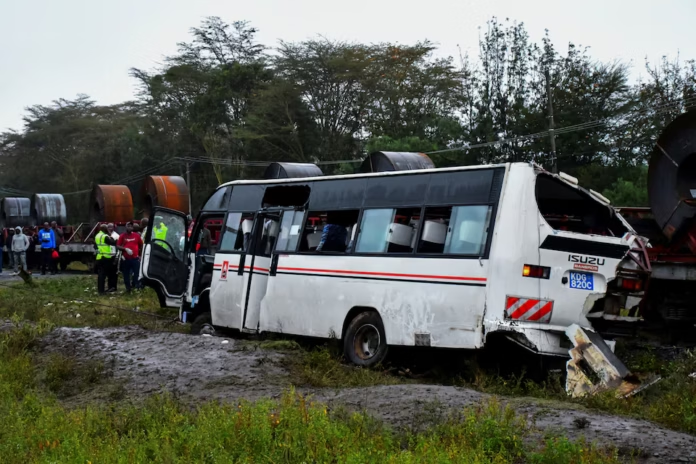
CHITUNGWIZA, Zimbabwe (BN24) — At least 17 people were killed and several others injured Tuesday in a head-on collision between a minibus taxi and a haulage truck, police said. The fatal accident, which occurred near Chitungwiza—approximately 25 kilometers southeast of Harare—claimed the lives of 17 victims, including pedestrians, according to spokesperson Paul Nyathi.

Nyathi explained that the truck, after losing control, veered into the opposite lane and struck the minibus. Prior to colliding with the taxi, the truck hit two pedestrians walking on what police described as an “island of the road.” Fifteen of the minibus’s passengers died instantly at the scene, while the remaining victims were rushed to hospital.

State-run media reported that rescuers arrived at the accident site to find the minibus completely flattened, with only fragments of its chassis visible under the truck’s undercarriage. Twisted metal, shattered glass, and debris littered the roadway as emergency teams worked to extract survivors and recover bodies. Although the crash occurred in the morning, officials continued to retrieve victims’ remains at noon.

Chitungwiza Mayor Rosaria Mangoma described the incident as “one of the most disturbing and traumatic scenes” witnessed in the town and urged the government to declare a national disaster to address the widespread loss. She emphasized that deadly road accidents involving public transportation are common in Zimbabwe, where speeding and poorly maintained roads contribute to a high fatality rate—statistics show that the nation experiences a road accident every 15 minutes, killing at least five people daily.

This tragedy follows a similar fatal incident in February near Beitbridge, where a head-on collision between a bus and a truck claimed 24 lives along the South African border.

Authorities continue investigating the incident, while calls for improved road safety and stricter enforcement of traffic laws grow louder amid the persistent dangers on Zimbabwe’s roads.

Trump Says Philippines Will Face 19% Tariffs Under New Trade Deal with President Marcos

WASHINGTON (BN24) — President Donald Trump on Tuesday announced a new trade deal with the Philippines that will see the United States impose a 19% tariff on Philippine goods—down from the 20% previously threatened—while American exports to the Philippines will enter duty-free.

The agreement followed a high-profile meeting between Trump and Philippine President Ferdinand Marcos Jr. at the White House. Trump revealed the broad terms on his social media platform Truth Social, calling the visit “beautiful” and praising Marcos as “a very good, and tough, negotiator.”

The deal marks a step forward in Washington’s push to deepen security and economic ties with Manila amid heightened tensions with China over the South China Sea. While details of the agreement remain scarce, Trump said the Philippines agreed to open its market to U.S. products without charging tariffs—an apparent win for American exporters.

Ahead of the meeting, Marcos’ administration had signaled it was willing to reduce or eliminate tariffs on certain U.S. goods. The Philippine Embassy has not commented publicly on the finalized arrangement.

“This has evolved into as important a relationship as is possible to have,” Marcos said in the Oval Office before their closed-door session. He is the first Southeast Asian leader to meet with Trump during the president’s second term.

The White House framed the deal as part of a broader strategic realignment in the Indo-Pacific, with Trump pursuing stronger ties to treaty allies like the Philippines to counter China’s growing influence. At the same time, the U.S. is attempting to maintain open lines of communication with Beijing.

China responded warily to the agreement. Foreign Ministry spokesperson Guo Jiakun warned the U.S.-Philippines cooperation should “not target or harm any third party, still less incite confrontation and heighten tensions in the region.”

Beijing continues to assert sweeping territorial claims in the South China Sea, leading to repeated confrontations with Manila. The Chinese coast guard has used water cannons against Filipino vessels, drawing international condemnation.

Marcos’ visit also included meetings with Secretary of State Marco Rubio and Defense Secretary Pete Hegseth. At the Pentagon, Marcos reaffirmed the U.S.-Philippines Mutual Defense Treaty as the “cornerstone” of their alliance. He cited growing security cooperation, including joint military exercises and American support for modernizing the Philippine armed forces.

Defense Secretary Hegseth said the U.S. is reorienting its strategic posture to deter “aggression by Communist China,” echoing the Biden and Obama administrations’ efforts to pivot U.S. focus toward Asia.

Even so, U.S. officials have kept diplomatic channels open with China. Rubio and Chinese Foreign Minister Wang Yi met in Malaysia earlier this month, agreeing to manage tensions and explore areas of cooperation.

Trump’s announcement of the 19% tariff rate suggests a more transactional approach to foreign policy, one he has emphasized throughout his presidency. While the long-term economic implications of the deal remain unclear, Trump characterized it as a victory for American trade interests.

Still, the White House session was not without controversy. Trump, asked about the Justice Department’s interest in Jeffrey Epstein’s former girlfriend, veered into familiar political territory—repeating false claims about the 2020 election, attacking political rivals, and vowing retaliation.

“After what they did to me, whether it’s right or wrong, it’s time to go after people,” Trump told reporters, reigniting partisan tensions even as he tried to spotlight a strategic diplomatic win.

Cellphone Video Sparks Outrage After Florida Deputies Seen Punching, Dragging Black Driver From Car

JACKSONVILLE, Fla. (BN24) — A viral cellphone video showing Florida deputies punching and forcibly removing a 22-year-old Black man from his car during a traffic stop has ignited national outrage and renewed scrutiny over law enforcement’s use of force and transparency.

The incident, which occurred on Feb. 19 in Jacksonville, shows William McNeil Jr. seated in the driver’s seat asking to speak to a supervisor when deputies suddenly shattered his window, punched him in the face, dragged him from the car, and appeared to strike him again before forcing him to the ground.

The cellphone video, shared widely on social media, has prompted civil rights attorneys to accuse deputies of excessive force and of omitting crucial details in their arrest reports. “William was calm and compliant,” attorneys Ben Crump and Harry Daniels said in a joint statement. “Yet instead of answers, he got his window smashed and was punched in the face — all over a questionable claim about headlights in broad daylight.”

Jacksonville Sheriff T.K. Waters defended his deputies, cautioning against drawing conclusions based solely on video captured from inside the vehicle. He said the footage lacks important context and doesn’t reflect everything officers experienced during the stop. “Cameras can only capture what can be seen and heard,” Waters said, “but so much context is absent because a camera simply cannot record what the people involved know.”

Body camera footage released by authorities shows deputies repeatedly ordering McNeil to exit the vehicle. At one point, McNeil had opened his car door but later closed and locked it, remaining inside for several minutes. The bodycam’s limited angle makes it difficult to clearly see the blows that were allegedly delivered.

Authorities say McNeil was reaching toward the driver’s side floorboard where a large knife was later found, an assertion sharply disputed by his lawyers. “The only time he moves at all is when the officer knocks him over by punching him in his face,” said Crump and Daniels. “Then this young man calmly sits back straight and holds his empty hands up.”

Officer D. Bowers, in his arrest report, claimed McNeil reached down toward the floor, where the knife was later discovered. He stated McNeil refused to exit the vehicle and attempted to pull away. However, Bowers did not acknowledge any punches being thrown, describing the interaction only as involving “physical force.”

A second officer provided more detail in a supplemental report, writing that after helping pull McNeil from the vehicle, he delivered six closed-fist punches to the back of McNeil’s right thigh in an effort to subdue him. “After delivering the six closed fist strikes, the subject stopped resisting,” the report said.

McNeil’s legal team flatly denies any attempt by their client to resist. “He’s never combative, never raises his voice, and he certainly never reaches for a knife,” they said, accusing Bowers of fabricating details to justify the aggressive response. “He simply asks for a supervisor — then they break his window and beat him. Yet somehow, the report failed to mention that.”

McNeil was arrested and later pleaded guilty to resisting an officer without violence and driving with a suspended license. He was also cited for possession of less than 20 grams of marijuana. Sheriff Waters said an internal administrative review is underway, though the State Attorney’s Office has already concluded that no criminal charges against the deputies are warranted.

The controversy has added to ongoing national conversations about policing and racial bias, especially surrounding traffic stops involving Black drivers. Civil rights advocates say the footage underscores the risks Black Americans face even during routine encounters with law enforcement.

U.S. Government Employee Barred From Leaving China Amid Growing Tensions Over Exit Bans-AP

WASHINGTON (BN24) — A U.S. government employee has been barred from departing China after traveling there in a personal capacity, the State Department confirmed Tuesday, marking the latest case in which Beijing has prevented an American citizen from leaving the country.

The individual, an employee of the U.S. Patent and Trademark Office under the Commerce Department, has not been publicly identified. The State Department said it is “tracking this case very closely” and has been in contact with Chinese authorities in hopes of securing a resolution.

“The Department of State has no higher priority than the safety and security of American citizens,” a spokesperson said.

China’s increasingly frequent use of exit bans — restrictions that prevent foreign nationals from leaving the country — has drawn scrutiny from Washington and human rights groups. While Chinese officials often cite legal investigations or civil disputes as justification, critics say the measure is sometimes wielded arbitrarily or for political leverage.

The latest development comes amid renewed concerns about the safety of Americans traveling to China. Although the U.S. government eased its travel advisory to China last November — following the release of three long-detained U.S. citizens — the practice of barring departures continues to strain bilateral relations.

Last week, The Wall Street Journal reported that Chenyue Mao, a U.S.-based Wells Fargo banker, had also been blocked from leaving China. In response, the bank suspended all staff travel to the country. Mao’s case has not been officially confirmed by U.S. authorities, who declined to comment citing “privacy and other considerations.”

Wells Fargo issued a brief statement on Tuesday: “We are closely tracking this situation and working through the appropriate channels so our employee can return to the United States as soon as possible.”

China’s Foreign Ministry addressed the case, with spokesman Guo Jiakun confirming that Mao is “involved in a criminal case” and is “subject to exit restrictions in accordance with the law.” Guo characterized the matter as a “judicial case” and insisted that China remains open to international visitors.

“China will as always welcome people from all countries to travel and do business in China and ensure their rights and interests in accordance with the law,” Guo said.

Pressed on the case of the U.S. government employee, Guo offered no new details, stating only that “China upholds the rule of law and handles entry and exit affairs in accordance with the law.”

Exit bans have affected other American citizens in recent years. In 2021, two American siblings were allowed to leave China after being stranded there for more than three years due to an investigation involving their father, a former Chinese official accused of corruption. The pair had been visiting relatives when they were barred from leaving.

The latest case underscores ongoing diplomatic friction between Washington and Beijing, particularly regarding legal transparency, citizen protections, and consular access. U.S. officials have repeatedly urged Americans to exercise increased caution when traveling to China due to arbitrary enforcement of local laws, including exit bans.

China Arrests 6 After Over 230 Kindergarten Children Poisoned by Industrial Lead in Food

BEIJING, China (BN24) — Chinese authorities have arrested six people and launched sweeping investigations into nearly 30 others after more than 230 kindergarten children in Gansu province were poisoned by food tainted with industrial-grade lead pigment, according to an official report released Sunday.

The scandal, one of the most severe school food safety incidents in China in recent years, unfolded at the privately run Brownstone Peixin Kindergarten in Tianshui city. The school’s principal allegedly ordered the addition of industrial pigments to enhance the appearance of food served to children in a bid to boost enrollment, despite warnings on the product labels that the substances were not safe for consumption.

Initial tests showed that 235 children were hospitalized earlier this month with symptoms ranging from stomach pain and vomiting to discoloration of the teeth. Subsequent testing confirmed elevated blood lead levels in 247 people, including students and several staff members, with some pigments found to contain lead concentrations 400,000 times above the legal limit.

The Gansu provincial party committee’s investigation detailed systemic failures at every stage of the crisis, from food safety oversight to medical response and regulatory enforcement. Officials said the principal and kitchen staff knowingly used toxic substances purchased online, preferring their brighter hues over cheaper, food-safe alternatives.

Six employees of the kindergarten, including the principal, are now under arrest for knowingly serving toxic food. Meanwhile, disciplinary investigations have been launched into 27 others, including hospital personnel, education officials, and local government employees accused of misconduct, bribery, and deliberate cover-ups.

The report sharply criticized the Gansu Provincial Centre for Disease Control and Prevention for mishandling the early stages of the investigation. It cited illegal sampling procedures that distorted test results and delayed the identification of the full scale of the poisoning.

Further scrutiny was directed at the Tianshui Second People’s Hospital, where at least two children’s test results were found to have been deliberately falsified to show lower lead levels. Investigators described hospital management as “chaotic” and highlighted the lack of basic laboratory oversight and staff training.

Compounding the scandal, the report revealed that the local education bureau had failed to monitor the kindergarten for years. The facility had reportedly operated without a proper license, charging high fees while escaping all food safety inspections typically mandated for private schools. Investigators also uncovered evidence of bribes accepted by officials from the kindergarten’s major investor and other affiliates.

The Chinese government has vowed to hold all responsible parties accountable. The country’s top anti-corruption agency has now launched formal investigations into multiple levels of local government, including senior education and health officials, as well as hospital administrators.

“All but one of the affected children have been discharged after a first round of detoxification treatment, which has lowered average lead levels by approximately 40%,” the report noted. Authorities expressed regret and offered a public apology to the affected families.

“The provincial party committee and government are deeply saddened by the blood lead incident in Tianshui and extend their sincerest apologies to the children and their parents,” the statement read.

The release of the report sparked outrage on Sunday night. Footage shared on social media appeared to show angry parents confronting police outside the kindergarten, demanding justice. Clashes reportedly erupted as plainclothes officers attempted to leave the scene under police escort, prompting parents to block the road and chant, “Hand over those who beat people up.”

The case has ignited a national debate on food safety, regulatory accountability, and corruption in China’s education and healthcare systems. It comes amid growing public scrutiny of private institutions operating with minimal oversight.

Death Toll Rises to 27 in Bangladesh Air Force Jet Crash, Most Victims Are Children

DHAKA, Bangladesh (BN24) — The death toll from Monday’s Bangladesh Air Force jet crash has risen to at least 27, including 25 children, officials confirmed Tuesday, in one of the country’s deadliest aviation disasters in recent memory.

The F-7 BGI fighter aircraft, on a routine training mission, plunged into a densely populated school and college campus shortly after taking off from the Kurmitola Air Base in Dhaka at 1:06 p.m. local time. Military officials said the Chinese-made jet suffered a catastrophic mechanical failure before spiraling into the buildings.

Scenes from the crash site showed a grim tableau — scorched walls, twisted metal, and classrooms reduced to rubble — as rescue teams combed through the charred structures. Family members and teachers stood in shock outside, many still searching for loved ones or receiving updates at nearby hospitals.

Sayedur Rahman, special assistant to the chief adviser on health, said 88 people, many of them children, were admitted with burn injuries. The confirmed fatalities include the aircraft’s pilot, a schoolteacher, and 25 students who were in class when the jet came down.

Monday’s earlier reports had placed the death toll at 19, but the number rose significantly after emergency crews completed search operations in the rubble overnight. Several victims succumbed to their injuries in hospital, according to health authorities.

The Bangladeshi government declared a national day of mourning on Tuesday. Flags flew at half-mast across the country, while mosques, temples, and churches held special prayers in memory of the dead.

The F-7 BGI is the most advanced model in China’s Chengdu J-7 fighter jet series, originally based on the Soviet MiG-21. Bangladesh acquired 16 of the aircraft between 2011 and 2013 as part of a broader modernization of its air force.

The military has opened an inquiry into the crash, focusing on potential flaws in the aircraft’s engine systems. Witnesses said the plane was trailing smoke moments before the impact. There was no distress signal recorded, raising questions about the severity of the failure and the pilot’s ability to respond in time.

The crash comes just weeks after India experienced its worst aviation tragedy in over a decade, when an Air India flight slammed into a student hostel in Ahmedabad, killing 241 passengers and 19 people on the ground. That incident had already shaken regional aviation authorities, and Monday’s crash in Bangladesh is likely to heighten concerns over flight safety and aircraft maintenance standards across South Asia.

Grief and anger are mounting as families of the victims demand accountability from the military and aviation authorities. The Ministry of Defense has promised a transparent investigation and support for the injured and bereaved.