NEW YORK (BN24) — Bitcoin surged to a record high near $112,000 late Wednesday, driven by persistent institutional demand and growing risk appetite as major financial firms deepened their embrace of the world’s largest cryptocurrency.
The digital asset touched an unprecedented peak of $111,988.90 before easing slightly to trade up 0.4% at $111,259. Since the start of the year, bitcoin has climbed more than 18%, underscoring renewed momentum across the crypto sector.
“Bitcoin is the only asset I am aware of where it becomes less risky as it grows in size,” Anthony Pompliano, founder and CEO of Professional Capital Management, wrote in a letter to investors Wednesday. “There were few sophisticated capital allocators who could gain exposure when bitcoin was a $100-200 billion market cap. Now that the asset is measured in trillions, almost every capital allocator on the planet can put the exposure on.”
Analysts also credited the Trump administration’s crypto-friendly policies for fueling the rally, saying regulatory openness has unlocked new pools of capital for digital assets.
Trump Media & Technology Group, led by the president’s family, disclosed in a filing with U.S. market regulators Tuesday that it plans to launch an exchange-traded fund investing in multiple crypto tokens, including bitcoin, ether, solana and ripple.
Bitcoin’s surge lifted other major cryptocurrencies. Ether, the second-largest digital currency by market capitalization, hit a one-month high of $2,794.95 and was last up 5.4% at $2,740.99.
Crypto-related stocks also posted gains. Strategy, the firm co-founded by bitcoin treasury advocate Michael Saylor, rose 4.7% to $415.41. Coinbase Global advanced 5.4% to $373.85.
GAZA CITY, Gaza Strip (BN24) — Hamas said Wednesday it has agreed to release 10 hostages as part of ongoing negotiations over a potential Gaza ceasefire, describing the talks as “difficult” but necessary to ease the suffering of civilians.
The announcement came after four days of indirect discussions brokered by Qatar and as the United States signaled optimism that an agreement could be finalized before the end of the week. U.S. special envoy Steve Witkoff said the proposed deal would include a 60-day truce and the return of 10 living hostages taken during Hamas’s October 7, 2023 assault on southern Israel.
Of the 251 hostages seized in the cross-border attack, 49 remain in captivity inside Gaza, according to Israeli authorities, including 27 who the military says are dead.
In its statement, Hamas cautioned that significant obstacles remain. The group cited demands for unimpeded humanitarian aid deliveries into Gaza, a withdrawal of Israeli forces, and what it called “real guarantees” for a permanent cessation of hostilities.
“The movement displayed the required flexibility and agreed to release 10 prisoners,” Hamas said. “Despite the difficulty of negotiations over these issues until now due to the intransigence of the occupation, we continue to work seriously and with a positive spirit with the mediators to overcome the hurdles and end the suffering of our people and ensure their aspirations to freedom, safety and a dignified life.”
Israeli officials have also expressed guarded optimism in recent days. Israeli army chief Eyal Zamir said military operations had created the conditions necessary to secure the hostages’ return.
Prime Minister Benjamin Netanyahu, speaking to FOX Business Network’s Mornings, suggested that a resolution could be near. “I think we’re getting closer to a deal,” Netanyahu said. “There’s a good chance that we’ll have it.”
After meeting with President Donald Trump in Washington on Tuesday, Netanyahu maintained that Israel would not abandon its campaign to dismantle Hamas but did not rule out agreeing to a temporary halt in fighting.
Foreign Minister Gideon Saar said a limited truce was “achievable” and could open the door to further negotiations toward a lasting peace. President Isaac Herzog described the talks as offering “a historic opportunity” for change in the conflict that has devastated Gaza and reshaped Israeli politics.
Hamas’s October attack on Israeli communities near the Gaza border killed roughly 1,200 people, triggering a military response that has since left tens of thousands dead across Gaza, according to local health officials. The fighting has displaced most of the territory’s 2.3 million residents, caused widespread hunger, and destroyed vital infrastructure.
As negotiations in Doha continued, aid agencies and mediators expressed hope that an initial agreement could allow more humanitarian supplies to reach civilians and create space for further diplomacy.
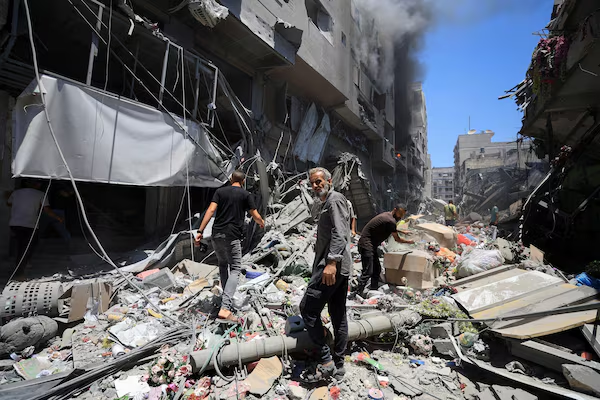
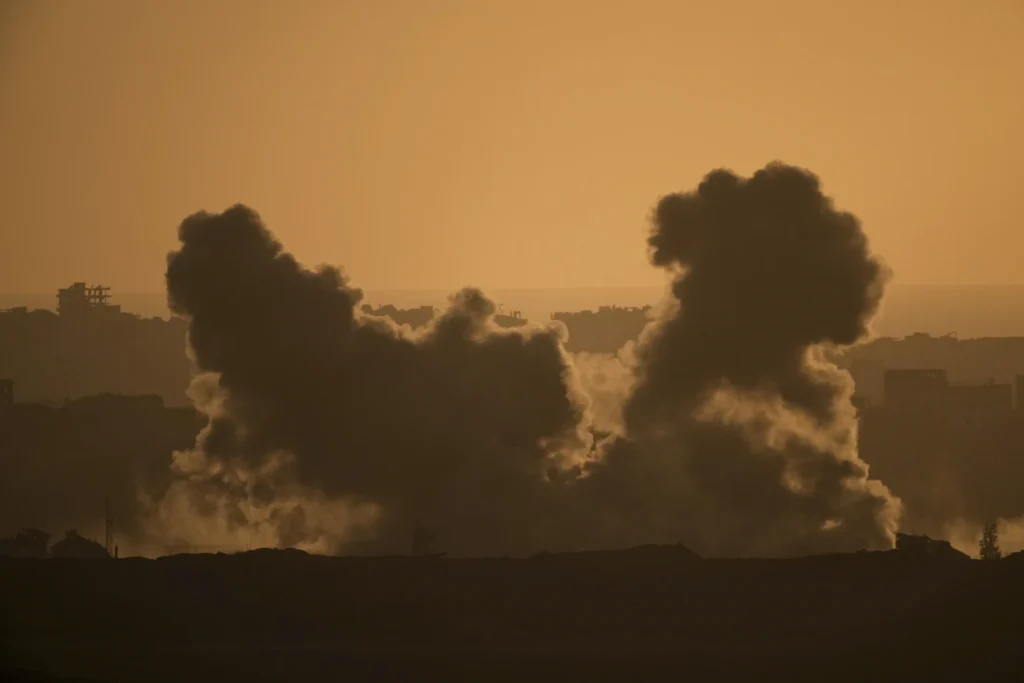
GAZA CITY, Gaza Strip (BN24) — Israeli airstrikes killed at least 40 Palestinians in the Gaza Strip on Wednesday, including 10 members of a single family sheltering in a tent, as President Donald Trump continued diplomatic efforts to broker a ceasefire that could end the 21-month war and secure the release of dozens of Israeli hostages.
The deadly strikes occurred as Trump met with Israeli Prime Minister Benjamin Netanyahu for the second time in two days at the White House on Tuesday evening, though the high-level discussions showed no apparent signs of breakthrough in the protracted negotiations.
Hospital officials at Nasser Hospital in the southern Gaza city of Khan Younis confirmed the casualties included 17 women and 10 children among the dead. The medical facility has continued operating despite Gaza’s severely damaged health system, with several hospitals rendered inoperable and leading physicians killed in Israeli strikes throughout the conflict.
The Israeli military reported conducting strikes against more than 100 targets across Gaza over the past day, including militant positions, booby-trapped structures, weapons storage facilities, missile launchers and tunnel systems. Israeli forces maintain that Hamas deliberately positions weapons and fighters among civilian populations, complicating military operations.
Um Mohammad Shaaban, whose nickname means Mohammad Shaaban’s mother, mourned the loss of the 10 Shaaban family members killed in the Israeli strike while they sheltered inside their tent in Khan Younis. The grieving woman discovered the devastating scene after the attack on what she believed was a designated safe area.
“I found all my children dead, and my daughters’ three children dead,” Um Mohammad Shaaban said through tears. “It’s supposed to be a safe area where we were.”
She noted that strikes have intensified despite rising hopes for a potential ceasefire agreement. “The hospital last night was jam-packed,” she observed, reflecting the surge in casualties from the ongoing bombardment.
Crowds of Palestinians gathered Wednesday to bid farewell to the Shaaban family members, with mourners struggling to release the bodies of the three grandchildren before burial. The emotional scene underscored the human cost of the continuing conflict as diplomatic efforts remain stalled.
Palestinians throughout Gaza are desperately seeking an end to the war that has killed tens of thousands, destroyed vast areas of the territory and displaced approximately 90 percent of the population. Aid organizations report that Israeli restrictions and the breakdown of law and order have severely hampered humanitarian assistance delivery, creating widespread hunger and fears of famine.
In the sprawling coastal Muwasi area, where hundreds of thousands of displaced people live in tents after fleeing their homes, residents described the daily struggle to secure basic necessities. Abeer al-Najjar said she had battled constant bombardments to obtain food and water for her family in the temporary settlement.
“I pray to God that there would be a pause, and not just a pause where they would lie to us,” she said, referencing an earlier ceasefire that Israel ended in March. “We want a full ceasefire.”
Her husband, Ali al-Najjar, emphasized that life has become especially difficult during the summer months with limited access to drinking water. “We hope this would be the end of our suffering and we can rebuild our country again,” he said before rushing through crowds with two buckets to fill them from a water truck.
Desperate residents chased the water vehicle as it departed for another location, highlighting the severe shortage of basic resources. Amani Abu-Omar explained that the water truck arrives only every four days, insufficient for her dehydrated children who have developed skin rashes from the summer heat and harsh living conditions.
“We had expected ceasefires on many occasions, but it was for nothing,” Abu-Omar said, expressing the frustration felt by many Palestinians who have endured repeated false hopes for peace.
The current conflict began after Hamas attacked Israel on October 7, 2023, killing approximately 1,200 people and taking 251 hostages. Most hostages have been released through earlier ceasefire agreements, though dozens remain in captivity. Israel’s military offensive in Gaza has killed more than 57,000 Palestinians, with more than half identified as women and children, according to Gaza’s Health Ministry.
The Health Ministry, operating under Gaza’s Hamas-run government, does not distinguish between civilian and combatant casualties in its reporting. The United Nations and other international organizations consider the ministry’s figures to be the most reliable statistics available on war casualties.
Netanyahu has maintained his commitment to continue the war until Hamas is completely destroyed, while the militant group insists it will only release the remaining hostages in exchange for a lasting ceasefire and complete Israeli withdrawal from Gaza. The fundamental disagreement between the parties has complicated diplomatic efforts to reach a resolution.
Netanyahu told reporters Tuesday that he and Trump see “eye to eye” on the necessity of destroying Hamas and that coordination between Israel and the United States has reached unprecedented levels. The Israeli leader’s comments suggested alignment on military objectives despite ongoing negotiations over ceasefire terms.
Trump’s Middle East envoy, Steve Witkoff, is expected to travel to Doha, Qatar, later this week to continue indirect negotiations with Hamas regarding the ceasefire proposal. The diplomatic mission represents a continuation of intensive efforts to break the deadlock in peace talks.
Witkoff and other senior administration officials met with Israeli Minister for Strategic Affairs Ron Dermer and Qatari officials at the White House on Tuesday to address remaining obstacles in the negotiations. A key sticking point involves Israel’s desire to maintain a military presence in Gaza during a potential 60-day truce, according to a White House official who spoke on condition of anonymity.
When asked about the meeting, Trump declined to confirm that “secret” talks had occurred but expressed hope that such engagement would advance peace efforts. “We want to have peace. We want to get the hostages back. And I think we’re close to doing it,” Trump stated, suggesting cautious optimism about the diplomatic progress.
The ongoing violence in Gaza continues despite the intensive diplomatic efforts, with Palestinian civilians bearing the brunt of the conflict as both sides maintain their fundamental positions. The international community watches closely as Trump administration officials work to bridge the gap between Israeli security demands and Palestinian calls for an end to the devastating war.
KYIV, Ukraine (BN24) — Russia launched more than 700 attack and decoy drones against Ukraine overnight in the largest single-night barrage of the three-year war, Ukrainian officials reported Wednesday, marking the third record-breaking assault within two weeks as Moscow intensifies its aerial campaign.
The massive overnight assault included 728 drones and 13 missiles, surpassing Russia’s previous record attacks of 550 drones launched on Friday and 477 drones fired less than a week earlier. The escalating pattern reflects Moscow’s strategy to overwhelm Ukraine’s air defense systems through sheer volume while targeting critical military infrastructure.
Ukrainian President Volodymyr Zelenskyy said the city of Lutsk bore the brunt of the attack, with the western Ukrainian city’s airfields serving as primary targets. Lutsk’s strategic location near the Polish border makes it a crucial hub for receiving Western military aid, positioning the assault as an apparent attempt to disrupt Ukraine’s vital supply lines of foreign weapons.
The timing of the record drone barrage coincides with increased uncertainty surrounding American weapons deliveries and stalled peace efforts led by the United States. Zelenskyy characterized the massive assault as the Kremlin “making a point” amid the diplomatic tensions.
Russia’s Defense Ministry confirmed its forces targeted Ukrainian air bases and declared that “all the designated targets have been hit.” The ministry’s statement underscored Moscow’s focus on degrading Ukraine’s military infrastructure through sustained aerial bombardment.
The attack extended beyond Lutsk to strike 10 regions across Ukraine, resulting in at least one death in the Khmelnytskyi region and two wounded in the Kyiv region, according to Ukrainian officials. The widespread nature of the assault demonstrated Russia’s capability to conduct simultaneous operations across multiple fronts.
NATO member Poland responded to the massive drone attack by scrambling fighter jets and elevating its armed forces to the highest alert level. The Polish Armed Forces Operational Command announced the defensive measures through social media, highlighting the regional security implications of the escalating drone warfare.
Ukraine’s air defense systems successfully intercepted 296 drones and seven missiles during the overnight attack, while an additional 415 drones were either lost from radar tracking or electronically jammed. The defensive response showcased both the effectiveness of Ukrainian air defenses and the overwhelming scale of the Russian assault.
The massive drone attack occurred as Russia’s larger army launched a new offensive to break through sections of the 1,000-kilometer front line, where Ukrainian forces face severe manpower shortages and mounting pressure from sustained Russian advances.
President Donald Trump addressed the escalating situation Tuesday, expressing dissatisfaction with Russian President Vladimir Putin’s unwillingness to modify his ceasefire and peace demands since Trump assumed office in January. Trump indicated Monday that the United States would need to increase weapons shipments to Ukraine, despite Washington’s recent pause in critical weapons deliveries to Kyiv.
Kremlin spokesman Dmitry Peskov acknowledged Trump’s “quite tough style” in diplomatic communications while expressing Moscow’s hope to continue dialogue with Washington aimed at repairing damaged bilateral relations between the two nations.
Zelenskyy urged Ukraine’s international partners to impose stricter sanctions on Russian oil and entities financing the Kremlin’s war effort through petroleum purchases. The Ukrainian leader emphasized that “everyone who wants peace must act” during meetings with Pope Leo XIV in Italy ahead of an international conference focused on Ukraine’s reconstruction.
Ukrainian officials reported that their interceptor drones, specifically developed to counter Russian Shahed drones, demonstrated increasing effectiveness against the overnight assault. Zelenskyy announced that domestic production of anti-aircraft drones was being expanded through partnerships with Western countries to meet the growing threat.
Western military analysts warn that Russia continues expanding its drone manufacturing capabilities and could soon achieve the capacity to launch 1,000 drones per night against Ukrainian targets. The Institute for the Study of War noted that Russia’s domestic drone production expansion reflects the growing importance of tactical drones in front-line combat operations.
Ukraine has developed its own offensive drone capabilities, conducting long-range strikes deep into Russian territory as part of its defensive strategy. Russian officials reported that air defenses intercepted 86 Ukrainian drones over six Russian regions overnight, including the Moscow region.
The Ukrainian drone strikes temporarily suspended flights at Moscow’s Sheremetyevo airport and Kaluga’s international airport south of the capital. Alexander Khinshtein, governor of Russia’s Kursk border region, reported that a Ukrainian drone attack on the regional capital killed three people and wounded seven others, including a 5-year-old boy who died while being transported to a hospital.
The escalating drone warfare coincided with a significant legal development as Europe’s top human rights court ruled Wednesday that Russia violated international law during the Ukraine war. The court’s decision marked the first time an international tribunal found Moscow responsible for human rights abuses since the full-scale invasion began in 2022.
The same court also ruled that Russia was responsible for downing Malaysia Airlines Flight 17 in 2014, marking the first time Moscow was named by an international court as responsible for the tragedy that claimed 298 lives. While the court’s decisions carry symbolic weight, their practical enforcement remains limited.
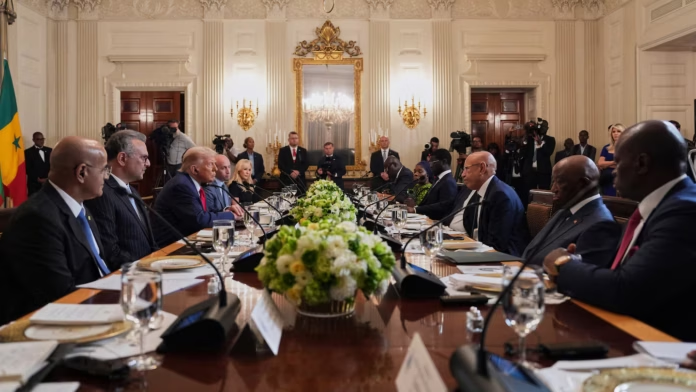
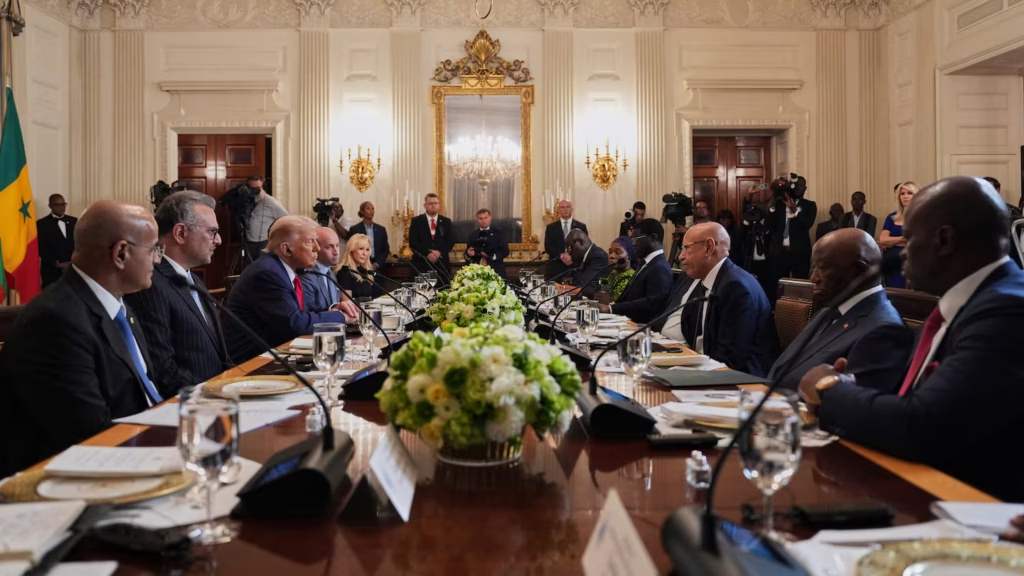
WASHINGTON (BN24) — U.S. President Donald Trump on Wednesday pledged a shift from aid to trade during a White House lunch with five West African leaders, as the region grapples with the fallout from sweeping American aid cuts.
The meeting, which came as a surprise to many observers, followed the administration’s recent decision to dissolve the U.S. Agency for International Development and abandon what officials described as “a charity-based foreign aid model.” Instead, Trump said the United States would focus on partnerships with nations that demonstrate “both the ability and willingness to help themselves.”
“There is great economic potential in Africa,” Trump told the presidents of Liberia, Senegal, Gabon, Mauritania and Guinea-Bissau. He described their countries as “very vibrant places with very valuable land, great minerals, and great oil deposits, and wonderful people.”
The five nations account for only a fraction of U.S.-Africa trade, but they hold vast reserves of natural resources that American officials view as increasingly important. Senegal and Mauritania are also key transit and origin countries for migrants, while Guinea-Bissau has struggled to stem drug trafficking—two issues that have been priorities for the Trump administration.
During the meeting, African leaders adopted a complimentary tone and expressed gratitude to Trump, including thanks for the role Washington played last month in brokering a peace deal between Rwanda and the Democratic Republic of Congo. The agreement aimed to end decades of violence in eastern Congo while securing U.S. access to critical minerals, though analysts have warned the settlement is unlikely to halt the fighting entirely, as at least one major armed group has rejected it.
Mauritania’s president, Mohamed Ould Ghazouani, emphasized his country’s resources to potential investors. “We have a great deal of resources,” he said, citing rare earth minerals, manganese, uranium and possibly lithium. “We have a lot of opportunities to offer in terms of investment.”
Trump, who during his first term used vulgar language to describe African nations, characterized trade as a tool for diplomacy and conflict resolution.
“Trade seems to be a foundation for settling disputes,” he said. “You guys are going to fight, we’re not going to trade. And we seem to be quite successful in doing that.” He added: “There is a lot of anger on your continent.”
The portion of the gathering open to reporters included little discussion of the aid cuts, which critics say could lead to severe humanitarian crises. West African countries are among the hardest hit by the USAID shutdown. According to the Center for Global Development, U.S. support accounted for 2.6% of Liberia’s gross national income—the highest share of any nation.
“We have closed the USAID group to eliminate waste, fraud and abuse,” Trump said, while vowing to forge “new economic opportunities involving both the United States and many African nations.”
Liberian President Joseph Nyuma Boakai later released a statement expressing optimism about the summit’s outcomes and reaffirming Liberia’s commitment to regional stability, democratic governance and inclusive growth.
During the lunch, Trump appeared visibly surprised by Boakai’s English, which he complimented. English has been Liberia’s official language since the country was founded in the early 1800s as a settlement for freed African Americans.
As Trump spoke, the administration was simultaneously notifying developing nations about higher tariffs set to take effect August 1, though the five West African countries were not among those targeted.
Gabon, Liberia, Mauritania and Senegal remain on a list of 36 countries under consideration for inclusion in an expanded U.S. travel ban.
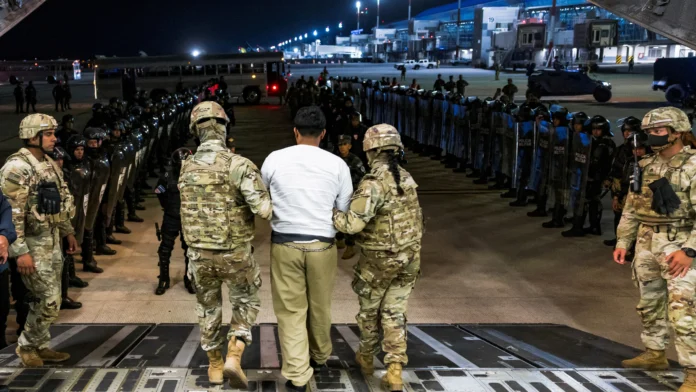
JUBA, South Sudan (BN24) — South Sudanese officials confirmed Tuesday that they have taken custody of eight men deported by the United States following a high-profile case that reached the U.S. Supreme Court.
Foreign Ministry spokesperson Apuk Ayuel told reporters the men arrived at Juba International Airport on Saturday after what she described as “standard deportation procedures undertaken” by the U.S. government.
The group includes citizens of Cuba, Laos, Mexico, Myanmar, Vietnam and South Sudan. Trump administration officials said the men were convicted of violent crimes in the United States.
U.S. authorities said Friday the eight were removed in May and held for weeks at a U.S. military base in Djibouti before their transfer to South Sudan was cleared by the Supreme Court.
Ayuel said the men are “under the care of the relevant authorities who are screening them and ensuring their safety and well-being,” though she did not specify where they were being held.
WASHINGTON (BN24) — Travelers passing through U.S. airports will no longer be required to remove their shoes at security checkpoints, Homeland Security Secretary Kristi Noem announced Tuesday, bringing an end to a practice that had become a fixture of air travel for nearly two decades.
The policy change takes effect immediately nationwide.
Noem said the Transportation Security Administration determined after a pilot program that current screening technology can effectively detect threats without passengers taking off their footwear.
“Shoe removal will no longer be standard procedure,” Noem said. “However, travelers may still be asked to remove their shoes if we think additional layers of screening are necessary.”
Mandatory shoe removal was instituted in 2006 in the aftermath of the failed attempt by Richard Reid—known as the “shoe bomber”—to blow up a transatlantic flight from Paris to Miami in December 2001.
Since then, passengers between the ages of 12 and 75 have been required to take off their shoes and place them in bins to be scanned along with carry-on bags. The policy has often been cited as one of the most visible security measures implemented after the 9/11 attacks and subsequent plots targeting commercial aviation.
The TSA said it will continue using explosive detection equipment and other screening tools to monitor footwear and other items as travelers pass through checkpoints.
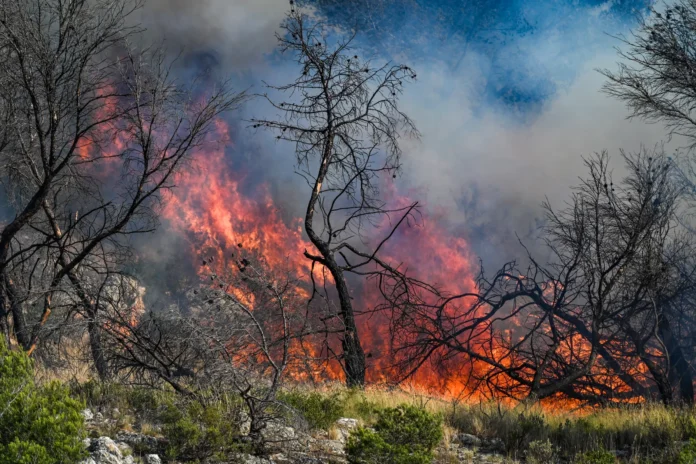
MARSEILLE, France (BN24) — Ferocious wildfires sweeping southern France have forced the closure of Marseille International Airport, as emergency crews scramble to contain the flames and evacuate residents from threatened neighborhoods.
The blaze erupted Tuesday in the area of Pennes-Mirabeau, north of Marseille, after a vehicle caught fire. Gusts reaching up to 70 kilometers per hour fanned the flames, which by afternoon had scorched 350 hectares (860 acres), French firefighters said.
Columns of thick, acrid smoke drifted across Marseille’s skyline, blanketing the city in a choking haze. The fire was so intense it could be smelled in the city center, prompting authorities to urge residents to stay indoors.
Marseille Airport, the country’s fourth-busiest air hub, halted all takeoffs and landings shortly after midday. A spokesperson said dozens of flights were canceled and others diverted to airports in Nice, Nimes and regional destinations. Officials did not confirm when the runways might reopen.
“It’s very striking—apocalyptic even,” said Monique Baillard, who lives in Les Pennes-Mirabeau, describing flames racing over dry hillsides toward residential zones.
More than 720 firefighters and 230 firefighting vehicles were deployed to fight the advancing front, according to emergency services cited by Sky News. Reinforcements included four Canadair aircraft, four water bomber helicopters and a Dash plane specializing in aerial firefighting.
The wildfire also forced the suspension of regional train traffic. French railway operator SNCF said it halted service between Marseille and the Miramas-Aix high-speed TGV station after flames neared tracks in L’Estaque, a seaside neighborhood known for its views of the Mediterranean.
Video from thesun.co.uk
Marseille Mayor Benoit Payan warned that the situation remained critical as flames advanced northward.
“The fire that started this morning in Pennes-Mirabeau continues to spread north of Marseille,” Payan said after visiting the Marseille Firefighters Battalion command post to oversee operations.
Earlier, he took to X to urge residents in northern neighborhoods to stay off roads so emergency vehicles could pass.
The mayor of Pennes-Mirabeau said two housing estates were evacuated and firefighters had surrounded a retirement home to protect residents from approaching flames.
The inferno near Marseille was the latest in a series of destructive wildfires fueled by weeks of hot weather and strong winds across southern France.
To the west, near Narbonne, more than 1,000 firefighters battled another large blaze that ignited on a winery’s property on Monday. By Tuesday morning, that fire had consumed 2,000 hectares (4,900 acres) of trees, leaving the village of Prat-de-Cest surrounded by charred forest.
As helicopters buzzed over Marseille dropping loads of water, officials repeated calls for residents to follow instructions and avoid any unnecessary travel in affected areas.
WASHINGTON (BN24) — Vice President JD Vance is facing renewed scrutiny over his past claims about the death of Jeffrey Epstein, as a series of old social media posts resurfaced just as his own administration declared the high-profile case closed.
Epstein, a convicted sex offender, was found dead in his Manhattan jail cell in 2019 while awaiting trial on federal sex trafficking charges. His connections to wealthy and influential figures, including President Donald Trump, former President Bill Clinton and tech billionaire Bill Gates, have fueled persistent conspiracy theories about a hidden “client list” and possible blackmail operations.
Vance, who was serving as a U.S. senator at the time, repeatedly called for aggressive investigation into Epstein’s death. In a 2021 post on X, he wrote, “Remember when we learned that our wealthiest and most powerful people were connected to a guy who ran a literal child sex trafficking ring? And then that guy died mysteriously in jail? And now we just don’t talk about it.”
At the time, FBI Director Kash Patel and Deputy Director Dan Bongino publicly suggested Epstein had been murdered to protect powerful interests. Both men later reversed their position after joining Trump’s White House, saying they believed Epstein died by suicide.
Vance himself had questioned whether federal agencies were deliberately shielding Epstein’s associates. “What possible interest would the US government have in keeping Epstein’s clients secret? Oh…,” he posted on X. In another post, he criticized the media, writing, “If you’re a journalist and you’re not asking questions about this case you should be ashamed of yourself.”
On Sunday, the Justice Department announced it had concluded the investigation without uncovering evidence of the alleged incriminating client list. The agency also released 10 hours of surveillance video showing no one entering Epstein’s cell the day he died, findings that align with prior reports that he took his own life. Authorities noted the video was missing one minute of footage.
The disclosure has revived criticism from conservatives who accuse Patel and Bongino of abandoning their earlier statements. Vance has also faced backlash online for his silence since the Justice Department’s findings were published.
Attorney General Pam Bondi added to the confusion in February by stating that the “list” was “sitting on my desk right now to review.” But on Monday, White House press secretary Karoline Leavitt clarified that Bondi was referring to case files, not a verified roster of Epstein’s alleged clients.
The episode also drew the attention of Elon Musk, who in June claimed that Trump “is in the Epstein files,” a remark that appeared to strain his relationship with the president.
During an October appearance on comedian Theo Von’s podcast, Vance again pressed for the release of any records that could shed light on Epstein’s connections. “Seriously, we need to release the Epstein list,” he said. “That is an important thing.”
Vance has not commented publicly on the Justice Department’s final report.
Karachi, Pakistan (BN24) – A 19-year-old girl in Karachi, Pakistan, is fighting for her life in a coma after she was allegedly sexually assaulted by her husband just days into their marriage, Pakistani police said Monday.
The young woman, who married on June 15, was brought to Karachi’s Civil Hospital after her condition rapidly deteriorated following repeated episodes of violence, authorities said. Police arrested the suspect, identified as Ashok, after the family filed a criminal complaint under sections of Pakistan’s Penal Code that cover rape and attempted murder.
“The victim, a 19-year-old from Lyari, is now in a coma,” said Dr. Summaiya Syed, Police Surgeon Karachi. “Her examination findings are consistent with sexual violence.”
Police said the assault began shortly after the wedding. According to the complaint, the woman endured severe injuries in a series of attacks that left her unconscious. Initially, she was taken to a neighborhood hospital by her in-laws, but her worsening condition prompted doctors to transfer her to the Civil Hospital’s intensive care unit.
Senior Superintendent of Police Arif Aziz said the suspect was detained immediately after the report was filed. “This brutal sexual assault is a grave and serious offence, and the police are treating it with the utmost urgency and priority to ensure the perpetrator is held accountable,” he said in a statement.
Dr. Syed noted that similar acts of violence often go unreported. “Circumstances vary and names change, but violence remains,” she said, calling the assault part of a wider pattern of abuse that persists across Pakistan.
Authorities said the investigation is ongoing as medical teams monitor the woman’s critical condition. Police pledged to pursue maximum penalties if the charges are proven, describing the case as “a priority.”