RUISOSO, N.M. (BN24) — A father and two children were swept away by powerful floodwaters in southern New Mexico late Monday, as a flash flood emergency in the mountain village of Ruidoso escalated into a life-threatening disaster, according to the National Weather Service.
The agency reported that swift-water rescue crews were searching for the missing family after the Rio Ruidoso surged to an estimated 15 feet, overtopping its banks and tearing through residential neighborhoods. The conditions developed rapidly as torrential rain poured across burn scars left by recent wildfires, intensifying the flooding and uprooting homes along the river.
In updates posted online, the Weather Service said at least one adult and two children were trapped elsewhere and awaiting rescue, while an elderly woman remained stranded inside her home as the water rose. Video footage circulating on social media appeared to show entire houses floating away in the torrent.
“Stay away from the river! Seek higher ground NOW!” the Weather Service warned in an emergency alert.
Emergency management officials in Ruidoso urged residents to move immediately to higher ground and avoid any attempts to drive through inundated streets, emphasizing that the rapidly moving floodwaters posed extreme danger.
Ruidoso, a mountain community about three hours south of Albuquerque, has been under a flash flood warning since earlier Monday evening. Forecasters said saturated slopes and fire burn scars were funneling runoff into the river system faster than residents could evacuate.
Multiple rescue operations were underway late Monday around Gavilan Trailer Park, one of the hardest-hit areas. Officials did not immediately release details about additional casualties or the condition of those reported missing.
The National Weather Service warned that additional rounds of rain could worsen flooding overnight and maintained the emergency declaration, calling it an “extremely dangerous and life-threatening situation.”
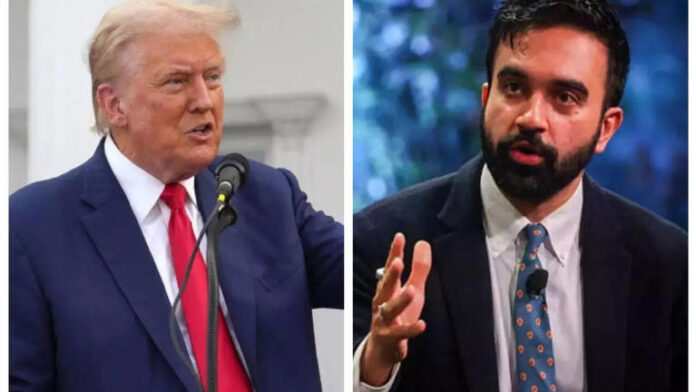
WASHINGTON (BN24) — President Donald Trump on Tuesday threatened to invoke federal authority to take over operations in New York City if Zohran Mamdani wins the mayoral election in November, calling the Democratic nominee a “communist” and warning that his leadership would fundamentally alter the city.
Speaking during a Cabinet meeting, Trump told The Post that Mamdani’s potential victory posed a threat to the city’s future and hinted at an aggressive intervention from the White House. “If a communist gets elected to run New York, it can never be the same,” Trump said. “But we have tremendous power at the White House to run places where we have to.”
The president, who has frequently clashed with New York City leadership throughout his political career, stopped short of specifying the legal mechanism by which he might assert control over the city, but emphasized, “New York City will run properly. I’m going to bring New York back. I love New York.”
Mamdani, 33, a state assemblyman and self-described democratic socialist, clinched the Democratic nomination on June 24 in a stunning primary upset that ousted former Governor Andrew Cuomo. The surprise victory has since reshaped the dynamics of the Nov. 4 general election. Trump, referencing Mamdani’s platform, claimed the candidate aimed to “take over” private grocery businesses like those owned by billionaire John Catsimatidis.
“[Catsimatidis] actually called me the other day,” Trump said. “He’s concerned, his stores are going to be taken from him.”
Though Trump stopped short of endorsing a specific candidate in the crowded mayoral race, he dismissed Republican nominee Curtis Sliwa’s chances while offering mild praise for the embattled incumbent, Eric Adams, whose re-election bid as an independent follows a federal corruption investigation that the Trump administration later dropped.
“You have Eric Adams, you have Cuomo, and you have Curtis Sliwa? Curtis runs every four years. He seems to be a fixture on the running scale,” Trump said, before adding, “[Mamdani] is not very capable, in my opinion. He’s a disaster.”
Mamdani currently leads in general election polling with 35%, followed by Cuomo at 29%, Sliwa at 16%, and Adams at 14%, according to a new American Pulse survey. His rise has prompted both celebration and concern among progressive circles and critics of his political ideology.
Vice President JD Vance, speaking privately at a California event over the weekend, said Mamdani’s success highlighted shifting voter demographics. “If President Trump’s victory in 2024 was rooted in a broad working and middle-class coalition, Mamdani’s coalition is almost the inverse of that,” Vance said, noting the New York candidate’s strength among high-income, highly-educated voters and his relative weakness among working-class and Black voters.
Trump’s threats to intervene in local governance did not end with New York. He also signaled a possible federal takeover of Washington, D.C., saying, “We want the city to run well,” and adding that the administration was “testing” the idea of asserting direct control over the capital.
The remarks echo Trump’s earlier efforts during his first term to curtail federal funding to Democratic-led cities he deemed insufficiently responsive to crime. But the president’s latest rhetoric raises the stakes as the 2024 election cycle unfolds, especially in cities that lean heavily Democratic.
With the general election just months away, Trump’s warnings signal a willingness to use federal power in unprecedented ways to influence local political outcomes—especially in cities where his critics are gaining ground. Whether that message will resonate with voters or provoke backlash remains to be seen.
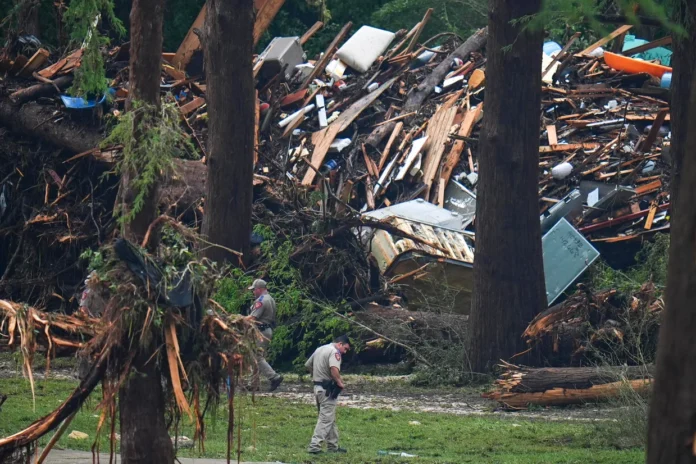
HUNT, Texas (BN24) — More than 160 people remain unaccounted for in central Texas four days after catastrophic flash floods killed over 100 during the July Fourth weekend, Governor Greg Abbott said Tuesday, underscoring the scale of the disaster that has overwhelmed riverside communities and summer camps in the Hill Country.
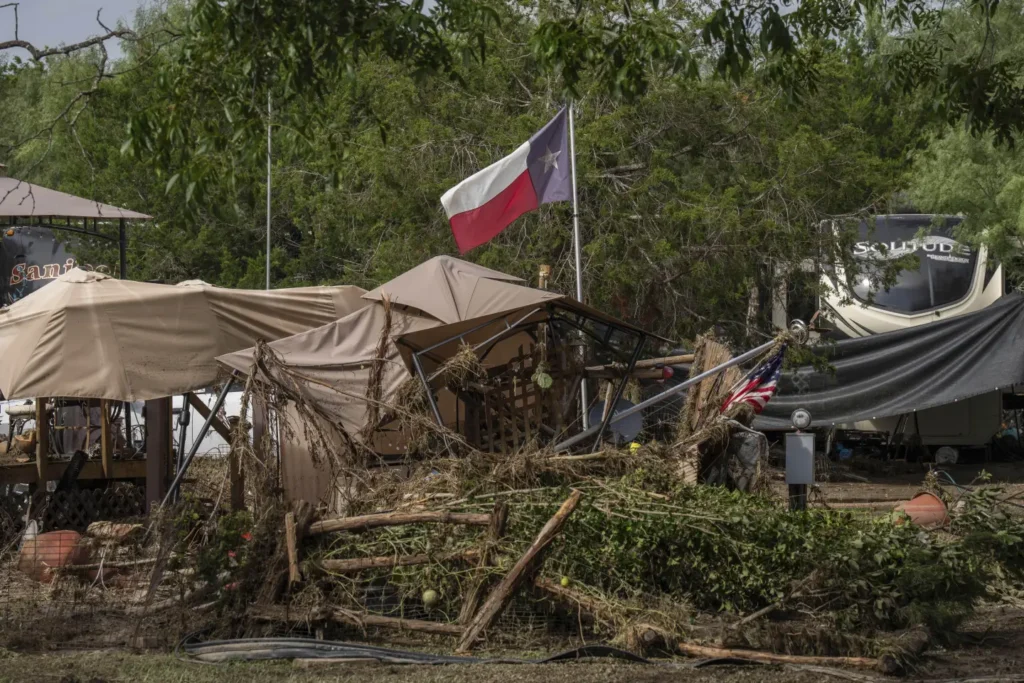
Authorities say the unprecedented surge of floodwaters along the Guadalupe River swept away cabins, trailers and campsites early Friday morning as torrential rains caused the river to rise more than 26 feet in less than an hour. The disaster has left grieving families searching for loved ones and officials scrambling to recover the dead while fielding mounting questions about whether more warnings could have saved lives.
Abbott, speaking at a news conference in Hunt after a helicopter tour of devastated areas, said the number of missing climbed sharply after officials launched a hotline for families to report unaccounted-for relatives. Many of the 161 missing were staying in Kerr County but had not registered at hotels or camps, complicating efforts to track them.
“We will not stop until every missing person is accounted for,” Abbott said.
The governor added that President Donald Trump had pledged federal aid and planned to visit Texas on Friday. “He could not stop talking about how sad he was for all the little girls who have lost their lives,” Abbott said.
Officials said at least 87 bodies have been recovered in Kerr County, which is home to a cluster of popular summer camps, including Camp Mystic, the century-old girls’ camp where at least 27 campers and staff members were killed.
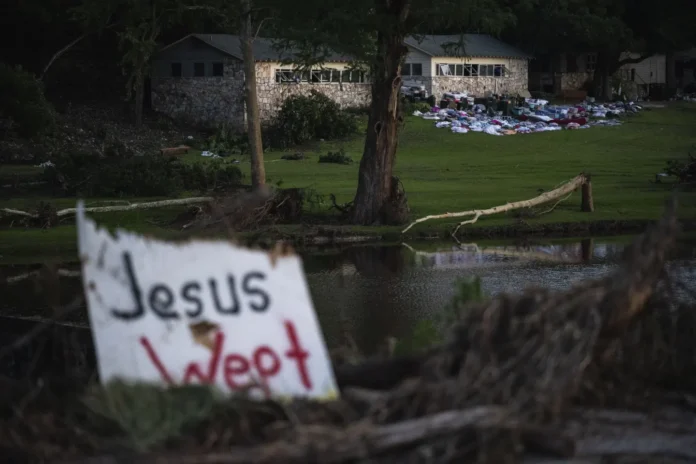
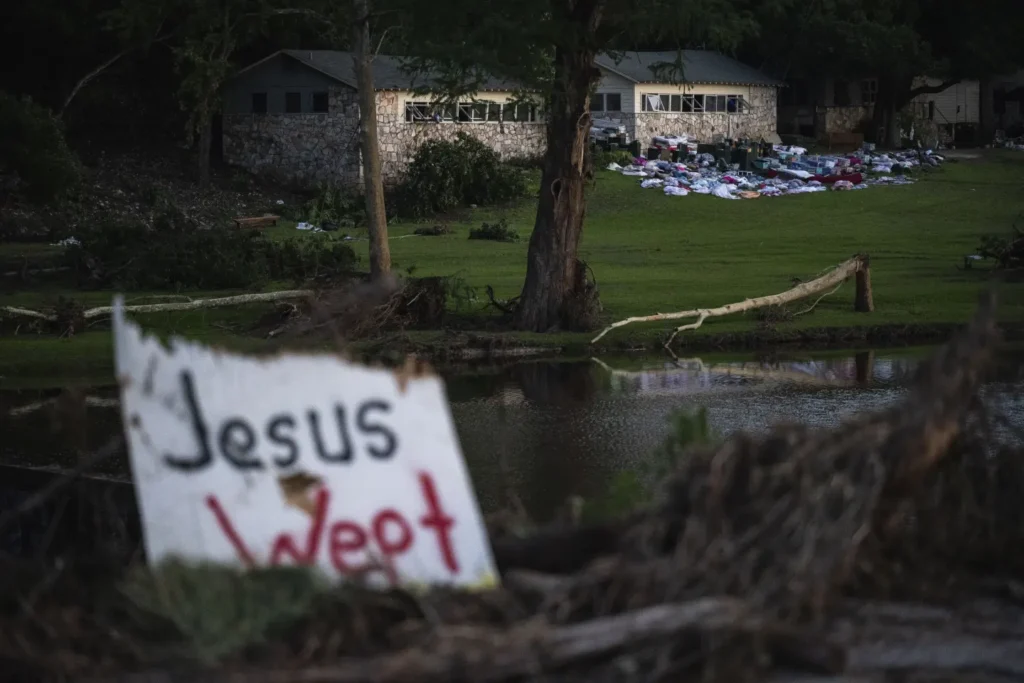
Five campers and one counselor remain missing. Scenes outside Mystic captured the heartbreak: mud-caked blankets and pillows lay scattered on grassy slopes near the river, amid overturned luggage adorned with colorful stickers.
Among the dead were a second grader who loved pink hair bows, a 19-year-old counselor who mentored younger girls, and the camp’s 75-year-old director.
In the days since the floods, rescue teams have searched hundreds of miles from the Hill Country to the outskirts of Austin, using heavy machinery to clear debris and combing tree lines for survivors. Some people were pulled alive from treetops where they clung for hours after the torrent hit before dawn.
But hope for finding additional survivors is fading. “Four days have passed since anyone has been found alive,” said Lt. Col. Ben Baker of the Texas Game Wardens.
At the same time, pressure has grown on local officials to explain how such a deadly surge could happen with little apparent warning. Residents and reporters have questioned why many camps and neighborhoods appeared to be caught off guard despite weather forecasts calling for torrential rain.
Kerr County leaders defended their response and said the focus remains on recovery, not blame. Sheriff Larry Leitha said that issuing evacuation orders isn’t “as easy as pushing a button.” County Judge Rob Kelly acknowledged Kerr County does not have a warning system and said a previous grant request for nearly $1 million in federal funding was rejected years ago by FEMA.
Generations of residents have known the risks of living in what locals call “flash flood alley.” In 1987, a similar flood killed 10 teenagers when swollen creeks overtook buses evacuating a youth camp in Comfort.
While some camps did monitor conditions and moved campers to higher ground before Friday’s disaster, many people either did not receive warnings or had no time to react as water swallowed cabins and tents.
The devastation left behind has been described as one of the largest search and recovery operations in Texas history. Hundreds of volunteers have joined professional crews to sift through mud, toppled trees and mangled vehicles.
Aidan Duncan, 17, was one of the lucky ones to escape Riverside RV Park in Ingram after hearing an evacuation call over a megaphone. On Tuesday, he surveyed what was left: a mattress, sports cards, and his parakeet’s birdcage, all caked in brown sludge.
“What’s going on right now, it hurts,” Duncan said. “I literally cried so hard.”
Even elderly residents have joined cleanup efforts. Along the riverbanks, 91-year-old Charles Hanson used a broom to clear splintered wood and piles of concrete, determined to help neighbors who could not get out themselves. “We’ll make do with the best we got,” he said.
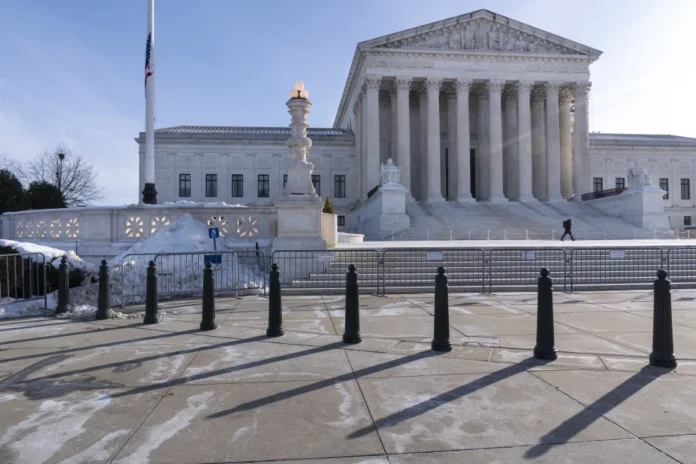
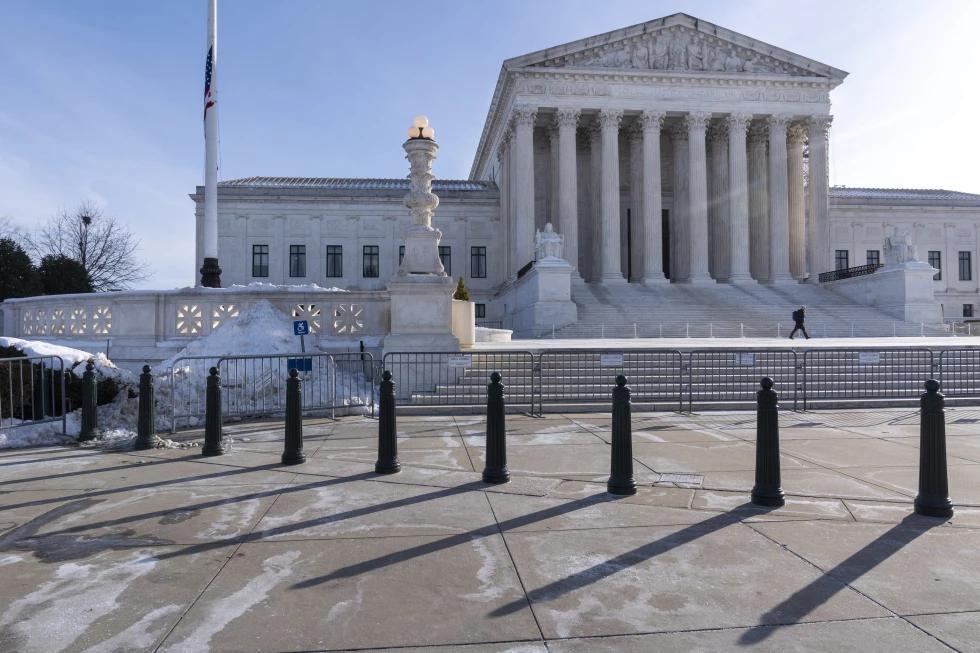
WASHINGTON (BN24) — The U.S. Supreme Court cleared the way on Tuesday for President Donald Trump’s administration to resume its plans to carry out mass job cuts and the restructuring of agencies, elements of his campaign to downsize and reshape the federal government.
In Trump’s latest victory at the top U.S. judicial body, the justices lifted San Francisco-based U.S. District Judge Susan Illston’s May 22 order that blocked large-scale federal layoffs called “reductions in force” affecting potentially hundreds of thousands of jobs, while litigation in the case proceeds.
Workforce reductions were planned at the U.S. Departments of Agriculture, Commerce, Health and Human Services, State, Treasury, Veterans Affairs and more than a dozen other agencies. The sweeping cuts represent a core element of Trump’s broader effort to fundamentally transform the federal bureaucracy and reduce government spending.
The Supreme Court in recent months has sided with Trump in several cases that were acted upon on an emergency basis since he returned to office in January, including clearing the way for implementation of some of his hardline immigration policies. In addition, Trump last week claimed the biggest legislative win of his second presidential term with congressional passage of a massive package of tax and spending cuts.
The court, in a brief unsigned order on Tuesday, said Trump’s administration was “likely to succeed on its argument that the executive order” and a memorandum implementing his order were lawful. The court said it was not assessing the legality of any specific plans for layoffs at federal agencies, leaving those determinations for lower courts to resolve as litigation continues.
Liberal Justice Ketanji Brown Jackson was the sole member of the nine-person court to publicly dissent from the decision. Jackson wrote that Illston’s “temporary, practical, harm-reducing preservation of the status quo was no match for this court’s demonstrated enthusiasm for greenlighting this president’s legally dubious actions in an emergency posture.”
Trump in February announced “a critical transformation of the federal bureaucracy” in an executive order directing agencies to prepare for a government overhaul aimed at significantly reducing the federal workforce and gutting offices and programs opposed by his administration. The executive order represented one of the most ambitious attempts to restructure the federal government in decades.
A group of unions, non-profits and local governments that sued to block the administration’s mass layoffs said Tuesday’s Supreme Court ruling “dealt a serious blow to our democracy and puts services that the American people rely on in grave jeopardy.”
The plaintiffs warned that the decision would have far-reaching consequences for government services and constitutional governance. “This decision does not change the simple and clear fact that reorganizing government functions and laying off federal workers en masse haphazardly without any congressional approval is not allowed by our Constitution,” the plaintiffs said in a statement, adding that they would “continue to fight on behalf of the communities we represent.”
U.S. Attorney General Pam Bondi welcomed the court’s action, framing it as a restoration of presidential authority over federal personnel management. “Today, the Supreme Court stopped lawless lower courts from restricting President Trump’s authority over federal personnel,” Bondi wrote on social media. “Now, federal agencies can become more efficient than ever before.”
Illston had ruled that Trump exceeded his authority in ordering the government downsizing, establishing a significant legal precedent that challenged the administration’s restructuring efforts. “As history demonstrates, the president may broadly restructure federal agencies only when authorized by Congress,” Illston wrote in her comprehensive ruling.
The judge’s ruling was the broadest of its kind against the government overhaul being pursued by Trump and the Department of Government Efficiency, a key player in the Republican president’s drive to slash the federal workforce. The ruling had effectively halted the administration’s most ambitious government restructuring efforts until the Supreme Court’s intervention.
Formerly spearheaded by billionaire Elon Musk, DOGE has sought to eliminate federal jobs, shrink and reshape the U.S. government and root out what they see as wasteful spending. Musk formally ended his government work on May 30 and subsequently had a public falling out with Trump, leaving the efficiency initiative under different leadership.
The judge had blocked the agencies from carrying out mass layoffs and limited their ability to cut or overhaul federal programs. Illston also ordered the reinstatement of workers who had lost their jobs, though she delayed implementing this portion of her ruling while the appeals process plays out.
The San Francisco-based 9th U.S. Circuit Court of Appeals in a 2-1 ruling on May 30 denied the administration’s request to halt the judge’s ruling. That prompted the Justice Department’s June 2 emergency request to the Supreme Court to halt Illston’s order, setting up the constitutional showdown over presidential authority.
“The Constitution does not erect a presumption against presidential control of agency staffing, and the president does not need special permission from Congress to exercise core Article II powers,” the Justice Department told the court, referring to the constitution’s section delineating presidential authority.
The administration argued that the president’s constitutional powers include broad supervisory authority over executive branch personnel and operations. Justice Department lawyers contended that congressional authorization was not required for the president to exercise what they characterized as inherent executive powers over federal workforce management.
Allowing the Trump administration to move forward with its “breakneck reorganization,” the plaintiffs told the court, would mean that “programs, offices and functions across the federal government will be abolished, agencies will be radically downsized from what Congress authorized, critical government services will be lost and hundreds of thousands of federal employees will lose their jobs.”
The plaintiffs warned that the pace and scope of the proposed changes would disrupt essential government services and potentially violate statutory requirements for how federal agencies must operate. They argued that such comprehensive restructuring required congressional approval and could not be accomplished through executive action alone.
The Supreme Court in recent months has let Trump’s administration resume deporting migrants to countries other than their own without offering them a chance to show the harms they could face and end temporary legal status previously granted on humanitarian grounds to hundreds of thousands of migrants.
In addition, it has allowed Trump to implement his ban on transgender people in the U.S. military, blocked a judge’s order for the administration to rehire thousands of fired employees, twice sided with DOGE and curbed the power of federal judges to impose nationwide rulings impeding presidential policies.
The pattern of Supreme Court decisions suggests broad judicial deference to presidential authority in areas traditionally considered within executive branch control. The court’s willingness to intervene on an emergency basis to support Trump administration policies represents a significant shift in how the justices approach challenges to presidential power.
The ruling clears the way for what could be the most significant reduction in federal workforce in modern American history, with implications for government services ranging from food safety inspection to veterans’ benefits processing. The ultimate scope and implementation of the layoffs will depend on ongoing litigation and the administration’s specific plans for each affected agency.
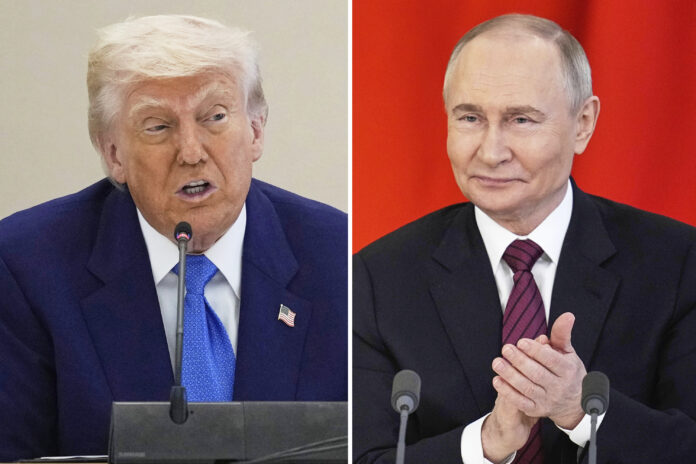
FILE - This combination photo shows U.S. President Donald Trump in a business roundtable in Abu Dhabi, United Arab Emirates, May 16, 2025, left, and Russian President Vladimir Putin at a signing ceremony at the Kremlin in Moscow, May 10, 2025. (AP Photo, Files)
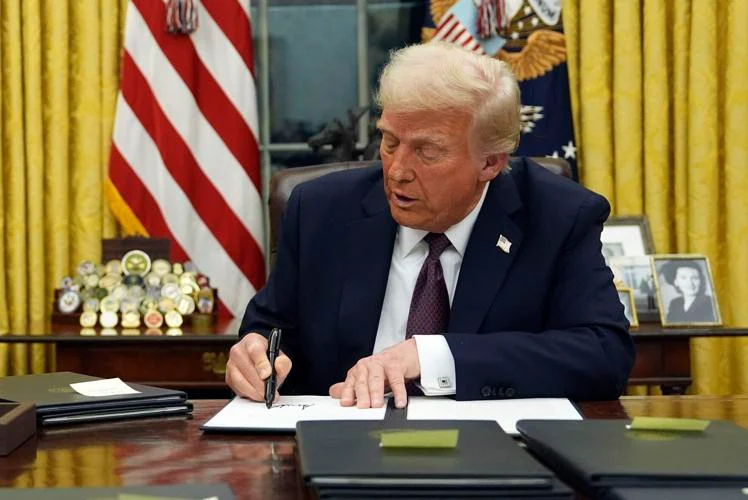
WASHINGTON (BN24) — President Donald Trump sharply criticized Russian President Vladimir Putin on Tuesday as he announced new U.S. military support for Ukraine, underscoring his growing frustration with the deepening war and the mounting death toll on both sides.
Speaking at the White House alongside top cabinet officials, Trump said he had approved the shipment of additional defensive weapons to Ukraine and was considering backing a Senate bill that would impose sweeping sanctions on Moscow, including punishing other countries that trade with Russia.
“I’m not happy with Putin. I can tell you that much right now,” Trump told reporters. “Russian and Ukrainian soldiers are dying in the thousands. We get a lot of bullshit thrown at us by Putin. He’s very nice all the time, but it turns out to be meaningless.”
The president’s comments came as Ukraine warned that a recent decision by the Pentagon to halt certain shipments of military equipment had undermined its ability to repel Russian attacks. Trump, seated next to Defense Secretary Pete Hegseth, said he did not know who ordered the pause. “Why don’t you tell me?” he quipped when pressed by a reporter.
The president reiterated that the United States would send more weapons, describing them as primarily defensive systems meant to help Ukraine stave off intensifying airstrikes and battlefield advances. “They’re getting hit very hard now,” he said Monday during a dinner with Israeli Prime Minister Benjamin Netanyahu. “We’re going to have to send more weapons.”
The Defense Department confirmed it would ship additional arms at Trump’s direction while continuing an initiative to review military supplies worldwide. Details of the specific weapons packages were not released, but Ukrainian officials have repeatedly pleaded for more Patriot missile systems to defend major cities from Russian bombardment.
FILE – This combination photo shows U.S. President Donald Trump in a business roundtable in Abu Dhabi, United Arab Emirates, May 16, 2025, left, and Russian President Vladimir Putin at a signing ceremony at the Kremlin in Moscow, May 10, 2025. (AP Photo, Files)
Ukrainian President Volodymyr Zelensky said he had instructed officials to accelerate coordination with Washington to secure critical air defense supplies. “These are deliveries that mean saving lives and protecting Ukrainian cities and villages,” Zelensky said in a statement Tuesday. “I expect results very soon.”
Zelensky also renewed his calls for tougher sanctions against Russia, arguing that further economic pressure is necessary to push the Kremlin toward a ceasefire. The Senate legislation Trump is weighing, authored by Republican Sen. Lindsey Graham and Democratic Sen. Richard Blumenthal, would impose steep penalties on Russian oil, gas and other exports, along with 500% tariffs on nations that continue trade with Moscow.
Since returning to the White House in January, Trump has repeatedly vowed to end the war quickly. But despite multiple rounds of talks and proposals for ceasefires, his administration has so far failed to deliver a lasting peace.
The Pentagon has said it continues to assess Ukraine’s defense needs, while Germany has announced talks to buy Patriot air defense systems to bolster Ukraine’s depleted stockpiles.
As the war in Ukraine grinds into its fourth year, the president’s blunt rebuke of Putin and renewed commitment to military aid signal Washington’s deepening involvement, despite Trump’s early promises to extricate the United States from foreign entanglements.
New York (BN24) – Sean “Diddy” Combs is scheduled to be sentenced on October 3 in connection with federal charges that have placed the music mogul under intense legal scrutiny. The date was confirmed Monday by court officials, setting the stage for what could be a pivotal moment in the long-running investigation into allegations involving weapons and financial crimes.
Combs, whose career spans decades and includes hits that helped define the sound of modern hip-hop, was indicted earlier this year following a series of raids and seizures by federal agents. He has denied any wrongdoing, and his attorneys have pledged to vigorously contest the case, which they say relies on overreaching tactics by prosecutors eager to secure a high-profile conviction.
The sentencing date comes as Combs’ legal team prepares to file motions challenging the scope of the evidence collected against him, arguing that law enforcement relied on improperly obtained warrants and unsubstantiated claims to bolster their investigation. Prosecutors have maintained that Combs played a central role in orchestrating illicit activities that spanned multiple states, describing him as the architect of a sprawling operation.
Combs has remained largely out of public view in recent weeks, issuing only brief statements through representatives that he looks forward to clearing his name.
The sentencing is expected to draw widespread attention in the music industry and beyond, with observers noting that Combs’ influence and business empire have long made him a singular figure in American entertainment.
BEIJING (BN24) — China has extended visa-free entry to citizens from 74 countries for up to 30 days, marking an unprecedented expansion of its visa policy as the government seeks to boost tourism, revitalize its economy and enhance its soft power following the COVID-19 pandemic.
Foreign tourists are trickling back to China after the country loosened its visa regulations to levels not seen before, with the government steadily expanding visa-free entry in a comprehensive effort to attract international visitors. More than 20 million foreign visitors entered without a visa in 2024, representing almost one-third of the total and more than double from the previous year, according to the National Immigration Administration.
The dramatic policy shift represents a significant departure from China’s historically restrictive visa requirements, which had long been cited as a major barrier to international tourism. The streamlined entry process has eliminated the time-consuming and costly visa application procedures that previously deterred many potential visitors.
Georgian visitor Georgi Shavadze, who lives in Austria, described the impact during a recent visit to the Temple of Heaven in Beijing, saying the visa-free policy “really helps people to travel because it is such a hassle to apply for a visa and go through the process.”
Travel companies and tour guides are now bracing for a bigger influx of visitors in anticipation of summer holiday travelers coming to China. Veteran English-speaking tour guide Gao Jun, with over 20 years of experience, reported being “practically overwhelmed with tours and struggling to keep up” with growing demand. To meet the increasing need for services, he launched a new business to train anyone interested in becoming an English-speaking tour guide, explaining that he “just can’t handle them all on my own.”
The visa-free expansion comes as China works to recover its pre-pandemic tourism levels. After lifting tough COVID-19 restrictions, China reopened its borders to tourists in early 2023, but only 13.8 million people visited in that year, less than half the 31.9 million who traveled to China in 2019, the last year before the pandemic disrupted international travel.
The current visa-free policy covers travelers from diverse regions across Europe, Asia, Latin America and the Middle East. In December 2023, China announced visa-free entry for citizens of France, Germany, Italy, the Netherlands, Spain and Malaysia. Almost all of Europe has been added since then, with travelers from five Latin American countries and Uzbekistan becoming eligible last month, followed by four Middle Eastern nations. The total will grow to 75 countries on July 16 with the addition of Azerbaijan.
About two-thirds of the countries have been granted visa-free entry on a one-year trial basis, suggesting the policy may be subject to review and potential adjustments based on its effectiveness and impact on Chinese tourism and security considerations.
For Norwegian traveler Øystein Sporsheim, the policy change means his family would no longer need to make two round-trip visits to the Chinese embassy in Oslo to apply for tourist visas, a time-consuming and costly process with two children in tow. He noted that embassy visits were particularly challenging because “they don’t very often open, so it was much harder.”
Travel industry professionals have reported significant business improvements as a result of the visa-free policy. Jenny Zhao, managing director of WildChina, which specializes in boutique and luxury routes for international travelers, described the new visa policies as “100% beneficial to us,” reporting that business is up 50% compared with before the pandemic.
While the United States remains their largest source market, accounting for around 30% of their current business, European travelers now make up 15 to 20% of their clients, a sharp increase from less than 5% before 2019, according to Zhao. She expressed optimism about the policy’s continued benefits, stating “we’re quite optimistic” and “we hope these benefits will continue.”
Trip.com Group, a Shanghai-based online travel agency, reported that the visa-free policy has significantly boosted tourism activity. Air, hotel and other bookings on their website for travel to China doubled in the first three months of this year compared with the same period last year, with 75% of the visitors from visa-free regions.
Notably absent from the visa-free list are major African countries, despite the continent’s relatively close economic and political ties with China. This omission may reflect ongoing concerns about immigration control or different strategic priorities in China’s tourism development approach.
For travelers from countries not included in the 30-day visa-free scheme, China offers an alternative transit policy. Citizens from 10 countries can enter China for up to 10 days if they depart for a different country than the one they came from. The policy is limited to 60 ports of entry, according to the National Immigration Administration.
The transit policy applies to 55 countries, but most are also on the 30-day visa-free entry list. It does offer a more restrictive option for citizens of the 10 countries that are not included in the longer-term program: the Czech Republic, Lithuania, Sweden, Russia, the United Kingdom, Ukraine, Indonesia, Canada, the United States and Mexico.
The exclusion of certain countries from the full visa-free program may reflect diplomatic considerations or security concerns. Sweden, aside from the United Kingdom, is the only other high-income European country that did not make the 30-day list. Ties between China and Sweden have been strained since the ruling Chinese Communist Party sentenced Swedish book seller Gui Minhai to prison for 10 years in 2020. Gui disappeared in 2015 from his seaside home in Thailand but turned up months later in police custody in mainland China.
While most tourist sites throughout China remain packed with far more domestic tourists than foreigners, the visa-free policy represents a significant step toward China’s goal of rebuilding its international tourism industry and projecting a more welcoming image to the global community.
Israeli troops run during clashes with Palestinians in Hebron in the Israeli-occupied West Bank November 18, 2022. REUTERS/Mussa Qawasma
Tel Aviv (BN24) – Five Israeli soldiers were killed and 14 others wounded in an attack in northern Gaza, the Israeli military said Tuesday, underscoring the unrelenting toll of the 21-month conflict as Prime Minister Benjamin Netanyahu met President Donald Trump in Washington to discuss a ceasefire.
Israeli troops run during clashes with Palestinians in Hebron in the Israeli-occupied West Bank November 18, 2022. REUTERS/Mussa Qawasma
The soldiers were operating in the Beit Hanoun area when explosive devices detonated around them during what the military described as a mission targeting Hamas militants regrouping in neighborhoods Israel has repeatedly assaulted since the start of the war. As forces evacuated the wounded, militants opened fire, an Israeli security official said, speaking on condition of anonymity because he was not authorized to brief reporters. Two of the wounded were in serious condition.
The deaths brought Israel’s military toll to 888 since October 2023, when Hamas fighters carried out the cross-border attack that ignited the war. Tuesday’s fatalities came less than two weeks after another deadly ambush killed seven Israeli soldiers, part of a pattern of renewed militant resistance even in areas Israel has sought to control.
Netanyahu released a statement calling the fallen soldiers heroes who died “in a campaign to defeat Hamas and to free all of our hostages.” His government faces mounting domestic pressure to reach a truce deal amid polls showing broad public support for ending the fighting.
On the Palestinian side, health officials reported that Israeli airstrikes killed 18 people in several areas of Gaza. At least four were killed when a strike hit tents sheltering displaced families in Khan Younis, in southern Gaza, according to staff at Nasser Hospital. Another strike there killed a mother, father, and their two children.
In central Gaza, airstrikes on a gathering in the Nuseirat refugee camp killed 10 people and wounded 72 others, Awda Hospital said in a statement. The Israeli military declined to comment on the strikes but said it holds Hamas responsible for any civilian casualties because the group embeds itself among civilians.
The bombardment has crippled Gaza’s health care system, already stretched by months of war and a crippling blockade. The Palestine Red Crescent said Tuesday it had shut the Al-Zaytoun Medical Clinic in Gaza City after shelling in surrounding areas endangered staff and patients. The closure leaves thousands of civilians with few options for care or vaccinations for children.
Trump, who has signaled impatience with the conflict after last month’s 12-day Israel-Iran flare-up, is pressing both sides to finalize a proposal that would halt fighting for 60 days, send large-scale humanitarian aid into Gaza and secure the release of at least some of the 50 remaining hostages, including 20 believed to be alive.
However, negotiations remain deadlocked over whether a truce would be a temporary pause or a path to ending the war. Hamas has insisted it will release all hostages only in exchange for a permanent ceasefire and full Israeli withdrawal. Netanyahu has rejected that demand, saying the war will end only if Hamas disarms and relinquishes control of Gaza — conditions the group refuses to accept.
Since Hamas’s October 7 attack, which killed roughly 1,200 people in Israel and led to the abduction of 251 hostages, Israel’s military response has devastated Gaza. According to Gaza’s Health Ministry, over 57,000 Palestinians have been killed, most of them women and children. The ministry does not distinguish between civilians and fighters, though United Nations officials consider its casualty figures the most credible tally available.
Texas (BN24) – At least 104 people have now been confirmed as dead, with dozens more remaining missing after catastrophic flash floods tore through central Texas, submerging entire communities and triggering desperate rescue operations along the Guadalupe River. The disaster has left families grieving and officials scrambling to account for those still unaccounted for, including campers and counselors from a beloved summer retreat.
Most of the fatalities were reported in Kerr County, where the river, swollen by torrential rains, surged to the height of a two-story building early Friday. Kerr County authorities confirmed 84 deaths, with at least 27 of the victims from Camp Mystic, a girls’ summer camp in Hunt. Officials said 10 campers and a counselor remain missing, marking the first definitive count after days of uncertainty.
The camp, which had nearly 750 children on-site when the floods struck, said it was working closely with authorities and described the losses as “unimaginable.” “Our hearts are broken alongside our families,” camp leaders said in a statement. “We are praying for them constantly.”
President Trump approved a major disaster declaration for Kerr County after Texas Governor Greg Abbott requested federal support. Abbott visited the devastated area on Saturday, describing Camp Mystic as “horrendously ravaged” and pledging that search efforts would not stop until every missing person is found.
Emergency responders have conducted more than 160 air rescues since the flooding began, saving hundreds stranded by rising water. The U.S. Coast Guard alone rescued 223 people, including 165 in a single mission led by Petty Officer Scott Ruskan, whom Homeland Security Secretary Kristi Noem called “an American hero.”
Across Texas, at least 20 additional deaths were confirmed in five counties beyond Kerr. In Burnet County, four people died and two remain missing, including a teenage girl and the county fire chief. Travis County, home to Austin, confirmed seven deaths, while Kendall County reported six. Williamson County officials said two people died, and in Tom Green County, a woman drowned when her car was engulfed by floodwaters.
Authorities said the disaster developed with astonishing speed. Meteorologists traced the flooding to a collision of local thunderstorms and remnants of Tropical Storm Barry. In the Guadalupe River’s headwaters, water levels surged more than 20 feet in minutes. Kerrville City Manager Dalton Rice described a night of chaos as the river overwhelmed its banks: “When we got the report, it was about 7 feet or so on the south fork, and within minutes it was up to 29 feet.”
The National Weather Service had forecast up to 8 inches of rain. Actual totals were much higher, triggering flash flood emergencies across several counties. Kerr County Judge Rob Kelly, who lost property in the flood, said authorities were caught off guard. “Nobody saw this coming,” he said.
The disaster turned deadly in the pre-dawn darkness, sweeping away vehicles, cabins and tents. Witnesses described headlights still burning as cars floated downstream. At Camp Mystic, many cabins were quickly submerged. Some children climbed to rafters to avoid the torrent.
Thirteen-year-old camper Elinor Lester said her cabin was evacuated by helicopter. “The camp was completely destroyed,” she said. “It was really scary.”
Among those confirmed dead are 8-year-old Linnie McCown of Austin and 18-year-old counselor Chloe Childress. Two girls from Dallas, 8-year-old Eloise Peck and 9-year-old Lila Bonner, also perished. Another camper, 8-year-old Hadley Hanna, remains missing.
In a poignant rescue, an 8-year-old girl was swept six miles downriver before being found alive.
Neighboring camps, including Camp La Junta and Camp Waldemar, reported all their campers and staff were safe.
Rescue teams from Florida joined Texas agencies in round-the-clock operations that continued into Monday. Officials urged anyone with information about missing people to contact authorities immediately.
Pope Leo expressed condolences during Sunday Mass at the Vatican, offering prayers for the families devastated by the flood. President Trump said he plans to visit Texas soon and called the disaster “a terrible thing,” adding that federal and state officials were coordinating to assist survivors.
Governor Abbott warned that recovery would take months or longer. “We will stop at nothing to ensure every last person is accounted for,” he said.
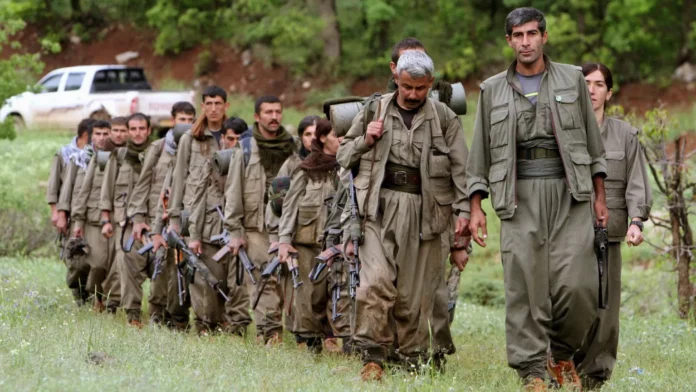
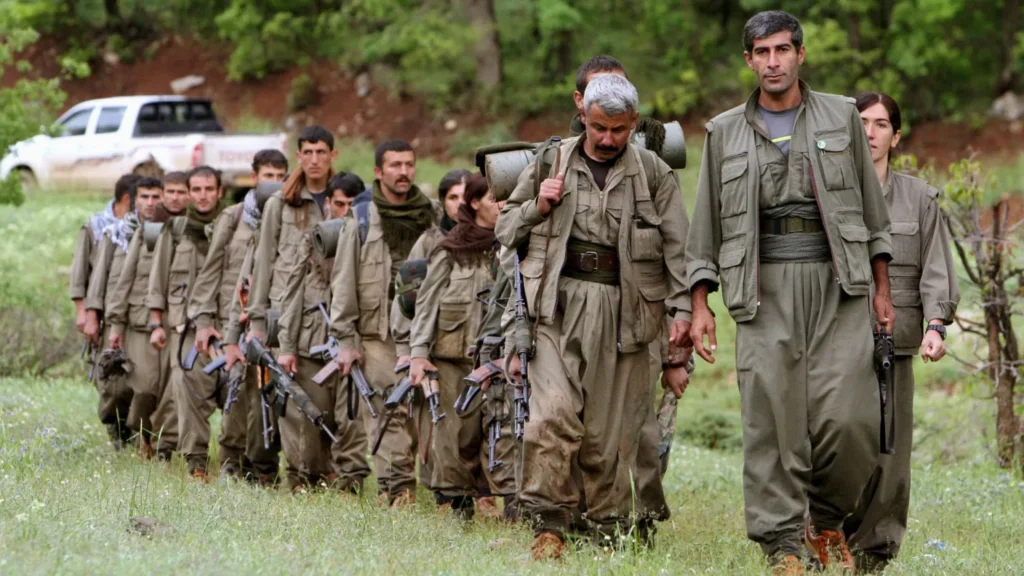
Istanbul, Turkey (BN24) – Twelve Turkish soldiers died after inhaling methane gas inside a cave in northern Iraq while searching for the remains of a soldier missing since 2022, the Turkish Ministry of National Defence said Monday. The deaths occurred during an operation in the Metina region, where Turkey has been conducting a large-scale offensive targeting positions held by the Kurdistan Workers’ Party, or PKK.
According to the ministry’s statement posted on X, the soldiers were carrying out a mission on Sunday at an altitude of nearly 2,800 feet. The cave had previously been used by PKK fighters as a makeshift hospital during their decades-long insurgency. The ministry said 19 soldiers were exposed to the gas during the operation.
Initially, officials reported that eight soldiers had died. Later, the ministry confirmed that four additional troops succumbed to the effects of the gas, raising the death toll to 12. The condition of seven others who were also affected was not immediately clear.
Turkish Interior Minister Ali Yerlikaya expressed support for the injured soldiers, writing on X that he wished them a swift recovery. President Recep Tayyip Erdogan issued a message expressing his “great sorrow” over the deaths and extended condolences to the families of the soldiers.
Defence Minister Yasar Guler traveled to the scene to oversee inspections and take part in ceremonies honoring the deceased.
The soldiers were searching for the body of a Turkish serviceman killed in 2022 by PKK fighters. The PKK, which has been designated a terrorist organization by Turkey, the United States and the European Union, fought an armed campaign for Kurdish autonomy that Ankara has declared over.
Though methane is not classified as a toxic gas, it can prove fatal in enclosed spaces because of its suffocation hazards. The Ministry of Defence has not specified how the gas accumulated to such dangerous levels inside the cave.
The incident underscores the continuing dangers Turkish troops face during Operation Claw-Lock, an intensive military campaign aimed at rooting out PKK militants entrenched in northern Iraq.