

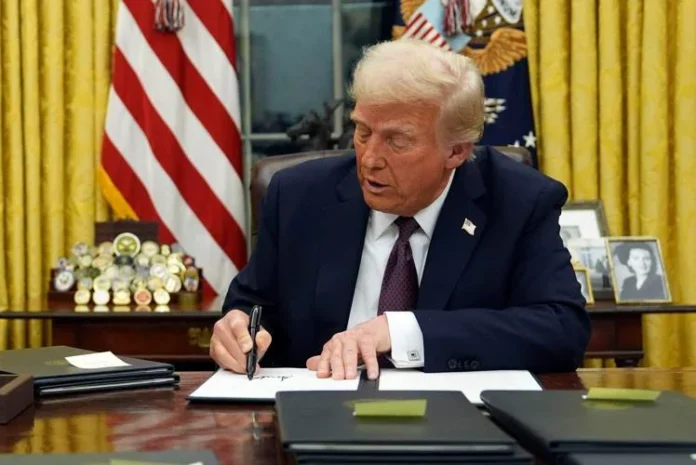
WASHINGTON — President Donald Trump announced Sunday that his administration will impose a 100% tariff on all films produced outside the United States, a move he claims is necessary to revive the declining American film industry and counter what he describes as foreign “messaging and propaganda.”

In a post on Truth Social, Trump said he had authorized the U.S. Trade Representative to begin implementing the new tariff, which would apply to all motion pictures not produced within the U.S. borders. He argued that aggressive incentives offered by foreign governments to attract film productions have created an uneven playing field and pose a direct threat to the health of the domestic industry.
“Our once great movie industry is dying a very fast death,” Trump wrote. “This is a concerted effort by other Nations and, therefore, a National Security threat. It is, in addition to everything else, messaging and propaganda!”
The surprise announcement is likely to send shockwaves through the global entertainment industry, particularly in countries such as Canada, the United Kingdom, and India — all of which have thriving film sectors and serve as production hubs for major Hollywood studios seeking lower costs and government subsidies.
While Trump did not specify whether the tariff would apply retroactively or only to future releases, his administration is expected to clarify the policy in the coming days. The Office of the U.S. Trade Representative has yet to issue a formal statement or implementation timeline.
Industry analysts warn the decision could ignite a cultural trade war and significantly disrupt international co-productions, film imports, and streaming platforms that rely heavily on non-U.S. content. The Motion Picture Association of America (MPAA) did not immediately respond to a request for comment.
Trump has long railed against globalization’s impact on American industries, including steel, autos, and manufacturing. His latest move extends that nationalist agenda into the cultural arena, where films have historically enjoyed free-flowing international exchange.
“This tariff isn’t just about economics. It’s about controlling the narrative,” said Michael Reynolds, a media policy expert at Georgetown University. “Trump is signaling that he sees foreign-produced films as a threat not only to jobs, but to American values and global influence.”
The president’s post accused foreign film incentives of draining talent and resources away from Hollywood, which he claimed has suffered job losses and declining output as a result. Although U.S.-based studios continue to dominate global box offices, many now shoot films abroad to take advantage of favorable tax breaks and cheaper production costs.
Some entertainment insiders speculate the tariff could lead to major studios reshuffling their production plans, particularly for franchises and streaming content filmed overseas. Others warned of retaliatory measures by U.S. allies whose markets remain key to American film exports.
The announcement comes amid Trump’s broader “America First” campaign platform, which has leaned heavily into economic protectionism and the revitalization of American cultural dominance. During his Sunday post, Trump stopped short of threatening further actions against foreign streaming platforms but hinted at more trade penalties to come.
The proposed tariff could face legal and logistical challenges, including scrutiny by the World Trade Organization and pushback from U.S. companies with global operations. Still, Trump’s directive appears to be in line with his broader effort to reassert American control over industries he views as under siege from foreign competition.





Trump Denies 2028 Run, Questions Constitutional Obligations in Wide-Ranging ‘Meet the Press’ Interview
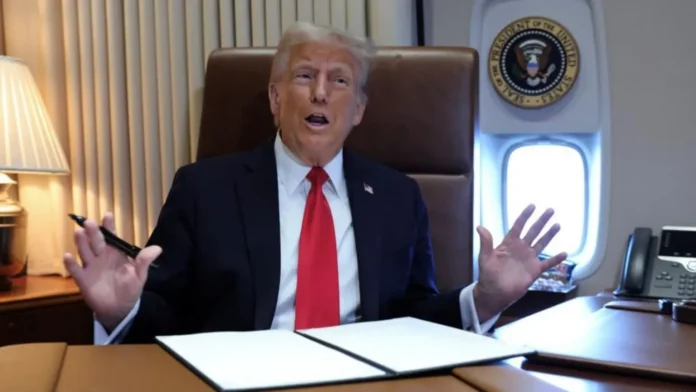
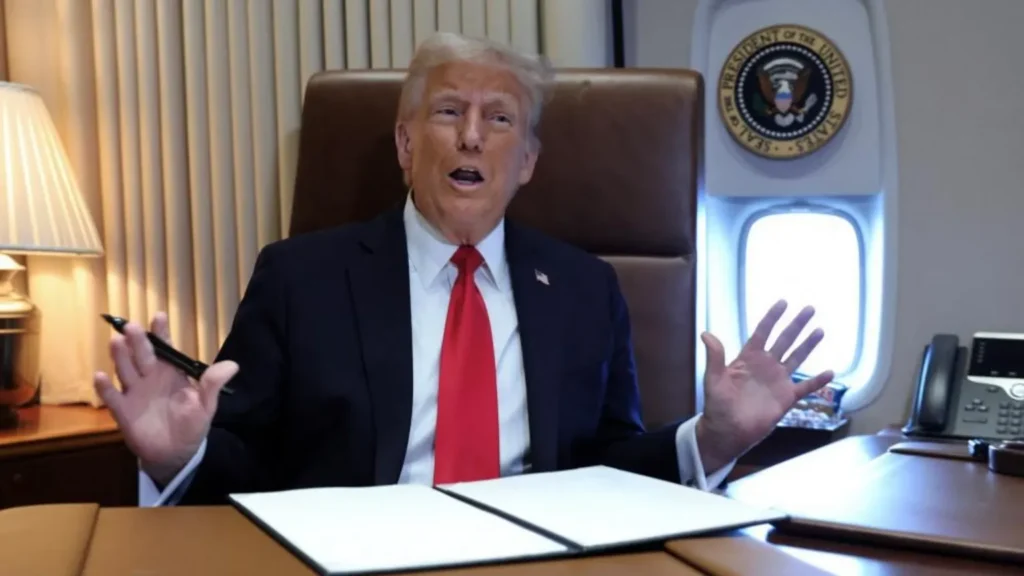
WASHINGTON — President Donald Trump ruled out the possibility of seeking a third term in 2028, deflected blame for the contracting U.S. economy, and expressed uncertainty over his constitutional duties in a contentious and sweeping interview with NBC’s Meet the Press that aired May 4.
Marking his first 100 days back in the White House during his second term, Trump used the interview to reinforce core themes of his 2024 campaign — economic nationalism, mass deportations, and tariff-heavy trade reform — while facing pointed questions from moderator Kristen Welker on mounting economic pressures, constitutional obligations, and controversial rhetoric.
Here are the key takeaways from Trump’s sit-down with Meet the Press as his administration contends with plummeting approval ratings and deepening recession fears:
Trump rules out 2028 run — despite selling ‘Trump 2028’ merchandise
Pressed on whether he is considering a third presidential term, Trump appeared to backtrack from previous teases, stating unequivocally that he is not pursuing a 2028 bid.
“I’m not looking at that,” Trump said, referencing ongoing sales of “Trump 2028” hats through his campaign store. “I will say this. So many people want me to do it. I have never had requests so strong as that. But it’s something that, to the best of my knowledge, you’re not allowed to do.”
The U.S. Constitution’s 22nd Amendment clearly prohibits any individual from being elected to the presidency more than twice. Trump acknowledged the constitutional restriction but suggested he was still unsure whether such limitations should apply.
“I’ll be an eight-year president. I’ll be a two-term president. I always thought that was very important, to be honest with you,” he added.
Trump disavows responsibility for economic contraction
As the U.S. economy shrank at an annualized rate of 0.3% during the first quarter of the year, Trump refused to accept blame, instead pinning responsibility on President Joe Biden, who left office on Jan. 19.
Asked at what point the economy becomes his responsibility, Trump replied: “It partially is right now… I think the good parts are the Trump economy and the bad parts are the Biden economy because he’s done a terrible job.”
Although economists have warned that Trump’s sweeping tariffs could fuel inflation, Trump insisted his administration was successfully reducing costs. Despite having only been in office for just over three months during the measured quarter, Trump highlighted recent gains in the stock market as evidence that his economic agenda is taking effect.
“Ultimately, I take responsibility for everything,” he said, before pointing to the market’s rebound. “Didn’t it have nine or 10 days in a row, or 11 days, where it’s gone up?”
Trump questions whether he must uphold the Constitution
In a legally fraught moment, Trump cast doubt on whether he is constitutionally obligated to uphold due process for immigrants, in the wake of a Supreme Court decision ordering the U.S. to facilitate the release of Kilmar Abrego Garcia — a Maryland resident deported without trial.
“I don’t know,” Trump said when asked if he must follow the Constitution. “I have brilliant lawyers that work for me, and they are going to obviously follow what the Supreme Court said.”
When pressed further on whether due process under the Fifth Amendment applies to all individuals, Trump again wavered: “I don’t know. It might say that, but if you’re talking about that, then we’d have to have a million or 2 million or 3 million trials.”
His comments have drawn fire from legal scholars and immigrant advocates, who say the president is signaling a willingness to sidestep constitutional protections.
Trump administration officials have accused Abrego Garcia of gang affiliations — which he denies — and have stated they do not intend to facilitate his return, despite the Supreme Court’s ruling.
Trump doubles down on doll imports and tariffs
Trump defended his universal tariffs on imported goods, using a controversial analogy involving American children and dolls.
“I don’t think that a beautiful baby girl — that’s 11 years old — needs to have 30 dolls,” Trump said, defending steep tariffs on Chinese imports. “They can have three dolls or four dolls. What we were doing with China was just unbelievable.”
Despite economic concerns and potential price hikes for everyday goods, Trump argued that tariffs would ultimately enrich the nation and rejuvenate U.S. manufacturing.
“No, I’m not saying that [store shelves will be empty],” Trump added. “I’m just saying they don’t need to have 30 dolls… they don’t need to have 250 pencils. They can have five.”
The administration recently raised tariffs on Chinese goods to 145%, while temporarily pausing increases on imports from other countries. Trump’s 10% baseline tariff remains in effect globally.
Trump says recession fears are overblown
Amid growing concern from economists that the U.S. may enter a recession due to his aggressive tariff regime and large-scale government layoffs, Trump downplayed the risks.
“Everything’s OK,” he told Welker, framing current economic instability as a necessary “transition period.”
Asked directly whether he feared a recession, Trump said, “No, I think we’re going to have the greatest economic [revival].” However, he left the door open to further volatility, admitting that permanent tariffs might be necessary to deter companies from manufacturing overseas.
“If somebody thought [tariffs] were going to come off the table, why would they build in the United States?” he asked.
The interview highlights Trump’s steadfast adherence to his populist economic vision — even as it draws scrutiny from Wall Street, global trade partners, and constitutional watchdogs.