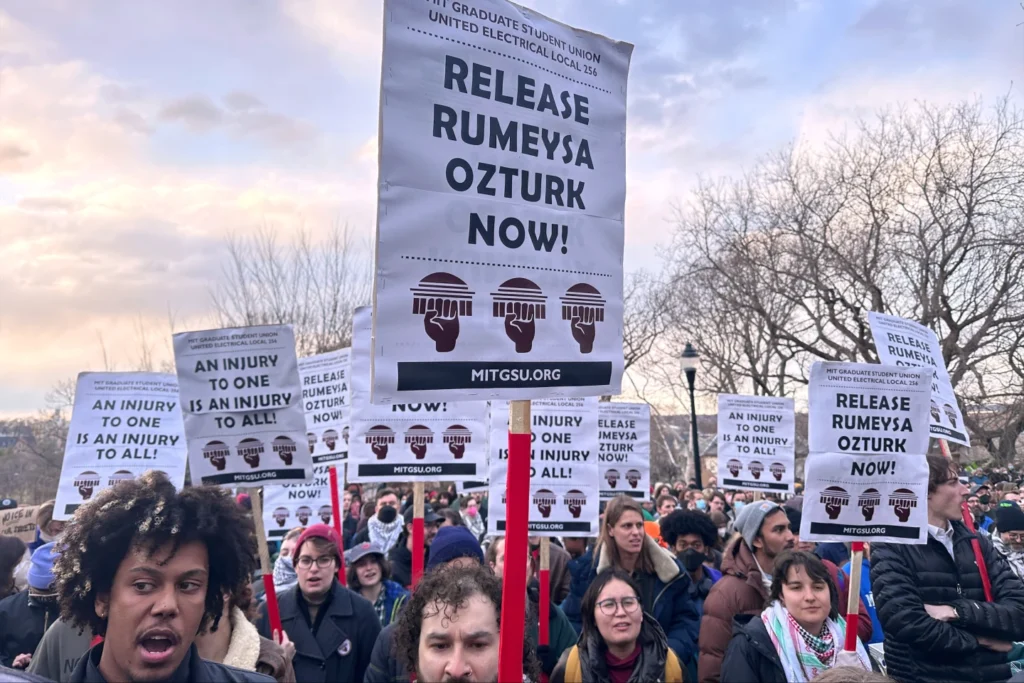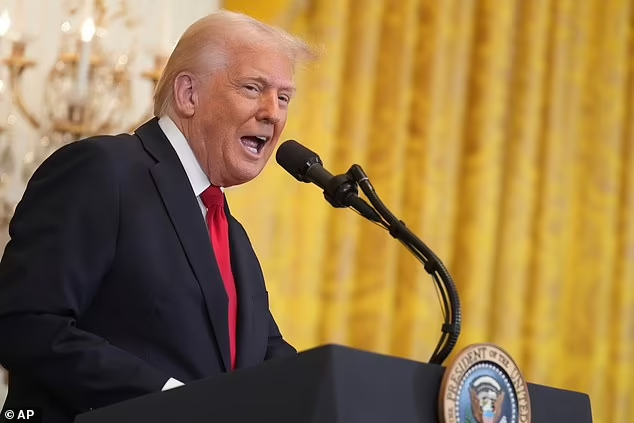
Hundreds of protesters lined roadways near a Vermont ski resort on Saturday, demonstrating against Vice President JD Vance’s visit just a day after a contentious Oval Office exchange over Ukraine.
Many demonstrators carried signs supporting Ukraine, while others waved Palestinian flags or banners advocating for immigrant rights. Protesters gathered at multiple locations, including both sides of Route 100 in Waitsfield.
The demonstrations, planned days in advance, gained further momentum after Vance’s heated discussion with President Donald Trump and Ukrainian President Volodymyr Zelenskyy. Vance criticized Zelenskyy for challenging Trump’s stance on Russian President Vladimir Putin’s credibility.
“Ski Russia because JD Vance has no friends in Vermont, but he’s got lots of friends in Russia, so he should go there for vacation,” said Tekla Van Hoven of Waterbury, speaking to WCAX-TV.
Vance and his family arrived in Vermont ahead of the weekend with plans to ski at Sugarbush Resort in Warren.
A small number of protesters gathered at the resort on Saturday.
“There were a handful of protestors at the resort throughout the day, but all were peaceful and none were disruptive,” resort spokesman John Bleh said in an email on Sunday. He declined to comment further, referring inquiries to the White House.
The White House did not immediately respond to requests for comment.
Republican Gov. Phil Scott issued a statement on Thursday welcoming Vance and his family to Vermont, urging residents to show respect despite political differences.
“I hope Vermonters remember the vice president is here on a family trip with his young children, and while we may not always agree, we should be respectful,” Scott’s statement read.
A smaller group of pro-Vance and pro-Trump demonstrators also staged a “welcome rally” at the resort.
Uyuni, Bolivia – A catastrophic head-on collision between two buses in Bolivia has left at least 37 people dead and more than 30 others injured, prompting authorities to launch an urgent investigation into the tragedy.
The crash occurred early Saturday morning, approximately three miles from the southwestern city of Uyuni, on the main road to Colchani.
Shocking images from the scene reveal the extent of the destruction, with both buses severely damaged—half of their windows and bodywork torn apart by the force of the collision. Luggage and personal belongings lay scattered along the roadside as bystanders gathered in shock at the tragic aftermath.
One of the buses was en route to Oruro, home to one of South America’s largest carnivals, but the passengers’ celebrations were cut short by the fatal accident.
Police swiftly responded to the crash, with local commander Wilson Flores confirming the heartbreaking loss of life.
“We have lost approximately 37 people who are believed to have died and around thirty wounded, whose condition we are still verifying in different hospitals,” Flores stated, according to Vision 360.
Both bus drivers survived the collision but sustained injuries. One remains in intensive care, while the other is in stable condition.
Initial police reports suggest that one of the buses may have veered into the opposite lane before the crash. Authorities have conducted alcohol tests on both drivers and are awaiting results.
This tragic incident is the latest in a series of deadly bus accidents in Bolivia.
In February, at least 30 people were killed when a passenger vehicle lost control at high speed and plunged into a ravine. The crash, which occurred on a narrow two-way road between Potosí and Oruro—near Saturday’s collision site—also left 15 people injured after the bus fell into a half-mile-deep abyss.
Another horrifying crash in December saw 38 people killed in Brazil when a packed bus collided with a lorry and burst into flames. Witnesses reported that a sudden tyre blowout caused the driver to lose control, leading to a devastating impact.
Authorities continue to investigate the latest Uyuni crash as Bolivia grapples with an ongoing crisis of road safety incidents, urging for stricter transport regulations to prevent further tragedies.
London – Prime Minister Keir Starmer pledged the United Kingdom’s “full backing” for Ukraine as he welcomed President Volodymyr Zelenskyy to Downing Street on Saturday, reinforcing the UK’s commitment to Ukraine amid shifting global diplomatic dynamics.
Zelenskyy, fresh from a contentious meeting with U.S. President Donald Trump at the White House, expressed gratitude for the UK’s steadfast support, calling the British “such friends” to Ukraine.
During their meeting, Starmer and Zelenskyy signed a £2.26 billion loan agreement to support Ukraine’s military needs, to be repaid using profits from frozen Russian assets. The financial package, first announced in October, will help produce weapons in Ukraine.
“This is true justice—the one who started the war must be the one to pay,” Zelenskyy said, referring to Russia.
Starmer’s meeting with Zelenskyy followed recent discussions with Trump, where he positioned himself as a key intermediary between Washington and Europe amid the Trump administration’s reduced involvement in European defense.
Starmer also facilitated communication between Ukraine and the U.S., reaching out to both Trump and Zelenskyy after their Oval Office dispute.
On Sunday, the prime minister will host a high-level European summit in London to discuss strategies for ending the war and bolstering European defense. The event will include leaders from France, Germany, and Poland, as well as NATO’s secretary general and European Commission officials.
Zelenskyy is also scheduled to meet King Charles III, a meeting reportedly requested by the Ukrainian president and approved by the UK government.
As Zelenskyy stepped outside Downing Street, Starmer highlighted public support for Ukraine, noting cheers from the gathered crowd.
“That is the people of the United Kingdom coming out to demonstrate how much they support you, how much they support Ukraine,” Starmer told Zelenskyy. “We stand with you and Ukraine for as long as it may take.”
Zelenskyy responded by thanking the UK for its unwavering commitment, saying, “I saw a lot of people and I want to thank you, the people of the United Kingdom, [for] such big support from the very beginning of this war.”
The Downing Street meeting comes amid heightened tensions between Kyiv and Washington following Zelenskyy’s White House meeting with Trump. Reports indicate that the discussion, originally intended to secure security guarantees for Ukraine, turned into a heated exchange.
In a statement, Zelenskyy attempted to mend relations with the U.S., acknowledging “tough dialogue” but emphasizing that Ukraine and the U.S. remain “strategic partners.” He also underscored the necessity of U.S. support, stating, “It’s crucial for us to have President Trump’s support. He wants to end the war, but no one wants peace more than we do.”
As Washington signals a shift in its approach to the war, European leaders are preparing to take on a greater defense role. At Sunday’s summit, discussions will center on increasing Europe’s military capabilities and securing long-term security guarantees for Ukraine.
Ahead of a previous summit in Paris, Starmer proposed deploying British troops to Ukraine as part of a European peacekeeping force, contingent on a U.S. security “backstop.” However, Trump has resisted committing direct military support, instead offering economic incentives such as a minerals trade deal.
Reports suggest that the Trump administration is considering cutting U.S. aid to Ukraine entirely, raising concerns among European allies.
As diplomatic negotiations continue, fighting on the ground remains intense. In Ukraine’s northeastern city of Kharkiv, seven people were injured in a Russian drone attack overnight, which also set fire to a medical facility.
Meanwhile, Russia’s defense ministry reported that it intercepted and destroyed 48 Ukrainian drones overnight, reflecting the ongoing escalation in military operations. With growing uncertainty over U.S. policy toward Ukraine, European leaders are expected to push for stronger collective defense measures at Sunday’s summit, solidifying Europe’s role in shaping the future of the conflict
The US Secretary of State Senator Marco Rubio said Friday that Ukrainian President Volodymyr Zelenskyy should apologize for a tense Oval Office exchange with President Donald Trump and Vice President JD Vance, which resulted in the collapse of a planned economic partnership between the two nations.
Speaking to CNN’s Kaitlan Collins, Rubio criticized Zelenskyy’s approach during the high-stakes meeting.
“There was no need for him to go in there and become antagonistic,” Rubio said. “I think he should apologize for wasting our time for a meeting that was going to end the way it did.”
Zelenskyy, in an interview with Fox News’ Bret Baier later that evening, declined to apologize to Trump.
Zelenskyy traveled to Washington, D.C., intending to sign an economic partnership agreement granting the U.S. access to critical minerals in Ukraine. Trump has long maintained that such a deal should be part of any continued American military support for Ukraine.
However, tensions flared during the meeting, and the Ukrainian delegation was asked to leave the White House after a heated exchange.
The confrontation escalated when Zelenskyy insisted on U.S. security guarantees to prevent Russia from resuming hostilities after a potential peace agreement. He also reaffirmed his refusal to negotiate with Russian President Vladimir Putin, whom he labeled a “killer and terrorist.”
Vice President JD Vance, who was present at the meeting, praised Trump for negotiating directly with Russia to end the war, despite Ukraine and other European nations being excluded from the discussions.
Zelenskyy pushed back, arguing that Russia’s past actions proved it to be an unreliable diplomatic partner. Vance countered by calling the Ukrainian president “disrespectful” toward Trump.
Rubio argued that Zelenskyy should not have insisted on an in-person meeting to finalize the deal and accused him of undermining Trump’s ability to engage with Russia.
“Don’t come here and create a scenario where you are going to start lecturing us about how diplomacy isn’t going to work,” Rubio said, adding that the Ukrainian leader’s public remarks could jeopardize future peace talks.
As U.S.-Ukraine relations face new uncertainty, the fallout from the aborted economic deal raises concerns about the future of American support for Kyiv amid ongoing tensions with Moscow.
The U.S. State Department has terminated a U.S. Agency for International Development (USAID) program that invested hundreds of millions of dollars in restoring Ukraine’s energy grid, according to two USAID officials involved in the agency’s Ukraine mission.
The Ukraine Energy Security Project, which has played a crucial role in stabilizing the war-torn country’s energy infrastructure, was officially shut down this week. The decision comes as Ukraine continues to endure near-constant Russian attacks on its power facilities, leading to overnight outages in several regions.
The USAID officials, speaking on condition of anonymity, warned that withdrawing U.S. support would leave Ukraine’s energy infrastructure vulnerable, particularly during the harsh winter months when Russian missile strikes have intensified.
“This significantly undercuts the administration’s ability to negotiate on the ceasefire and signals to Russia that we don’t care about Ukraine or our past investments,” one official told NBC News.
The official added that Russia is waging both a military and economic war against Ukraine, targeting essential infrastructure to weaken the country’s economy. USAID has played a pivotal role in maintaining economic resilience by bolstering Ukraine’s power grid and preventing a broader financial crisis.
In addition to ending the energy initiative, USAID is also dramatically reducing its staff in Ukraine. Previously, 64 U.S. government employees and contractors worked on the ground in Ukraine for the agency. Following the latest decision, that number will shrink to just eight, as non-essential personnel have been placed on administrative leave and ordered to return to the U.S.
A State Department spokesperson did not immediately respond to requests for comment.
USAID officials also expressed concerns that ending the program would reduce accountability over U.S. financial aid provided to Ukraine.
“We won’t have eyes on where this money has gone over the last few years,” one official said.
According to internal documents obtained by NBC News, the State Department has also ordered the termination of a program focused on financial sector reform in Ukraine.
Meanwhile, USAID’s Bureau for Europe and Eurasia, which oversees Ukraine operations, is undergoing significant cuts. Out of 115 staff members based in Washington, D.C., only 29 will remain active.
As Ukraine faces mounting pressure from Russian forces, the abrupt withdrawal of U.S. support raises serious concerns about the future stability of the country’s energy grid and economy.
A FedEx cargo plane en route from Newark to Indianapolis caught fire mid-air after colliding with a bird during takeoff on Saturday morning, prompting an emergency landing, officials said.
FedEx Flight 3609 struck a bird shortly after departure, causing damage to one of its Boeing 767 engines, the Federal Aviation Administration (FAA) confirmed in a statement. Videos circulating on social media appeared to show the aircraft’s engine on fire while airborne.
The crew declared an emergency, and the plane safely returned to Newark Liberty International Airport at approximately 8:07 a.m., according to the Port Authority of New York and New Jersey. No injuries were reported.
“Our crew declared an emergency and returned safely to Newark,” FedEx said in a statement to NBC News. “We are thankful for the quick actions of our crew and first responders.”
The aircraft remained disabled on a runway following the incident, and the FAA has launched an investigation.
The FedEx bird strike incident comes amid a series of aviation emergencies making headlines this week.
Earlier this week, a **Delta Air Lines flight** bound for Atlanta was forced to return after the crew reported “possible smoke” in the cabin.
In another incident, an **American Airlines flight** from New York to New Delhi was diverted to Rome after a bomb threat was issued against the aircraft.
Additionally, a **Delta flight to Australia** returned to Los Angeles International Airport a day earlier when smoke was detected in its galley.
The FAA continues to monitor and investigate these recent aviation incidents as part of broader safety oversight efforts.
Kurdish militants announced a ceasefire Saturday in their four-decade conflict with Turkey, potentially marking a significant breakthrough for President Recep Tayyip Erdogan’s government following their imprisoned leader’s call to disarm.
The Kurdistan Workers’ Party (PKK) declaration comes amid sweeping regional changes, including power shifts in neighboring Syria following President Bashar Assad’s overthrow, Hezbollah’s weakening in Lebanon, and the ongoing Israel-Hamas war in Gaza.
The conflict, which began in 1984, has caused tens of thousands of deaths. This ceasefire represents the first major breakthrough since peace negotiations collapsed in summer 2015.
“We declare a ceasefire effective today to pave the way for the implementation of Leader Apo’s call for peace and democratic society. None of our forces will take armed action unless attacked,” the PKK stated in a declaration published by Firat News Agency, a media outlet close to the group, referring to Abdullah Ocalan by his nickname.
The announcement follows Thursday’s visit by Kurdish politicians to Ocalan at his island prison, where the 75-year-old leader called for the PKK to lay down arms and disband.
In its statement, the PKK’s executive committee described Ocalan’s call as signaling a “new historical process has begun in Kurdistan and the Middle East,” referring to Kurdish-inhabited regions across Turkey, Iraq, Syria and Iran.
While agreeing to implement the directive, the PKK emphasized that “democratic politics and legal grounds must also be suitable for success.” The timing coincides with increased pressure on Turkey’s main pro-Kurdish political party, which has seen several mayors removed from office and replaced with government appointees in recent months.
The militants also requested Ocalan’s release from Imrali prison in the Marmara Sea to “personally direct and execute” a party congress that would facilitate disarmament.
This peace initiative began in October when Erdogan’s coalition partner, far-right politician Devlet Bahceli, suggested Ocalan could receive parole if his organization renounced violence and disbanded.
President Erdogan called Ocalan’s message a “new phase” in peace efforts. “There is an opportunity to take a historic step toward tearing down the wall of terror that has stood between (Turkish and Kurdish peoples’) 1,000-year-old brotherhood,” he said Friday.
Vice President Cevdet Yilmaz responded to the ceasefire announcement on social media: “A new phase has been entered towards the goal of a terror-free Turkey. We hope that this opportunity will be seized, this effort will be concluded quickly and successfully.”
Political analysts suggest the reconciliation effort may aim to secure Kurdish support for constitutional changes that would allow Erdogan to remain in power beyond his term’s 2028 end. Bahceli has openly advocated for such changes, stating Erdogan’s continued leadership is essential for Turkey’s future.
The government is reportedly seeking parliamentary backing from the pro-Kurdish People’s Equality and Democracy Party (DEM). Sirri Sureyya Onder, a DEM member who visited Ocalan, said: “There will be a series of meetings next week, including state officials and politicians, and many things will become clearer and more concrete. We hope that everything will be arranged in the next three months.”
Despite 25 years of imprisonment, Ocalan maintains significant influence over the Kurdish movement, which has been led in his absence by figures operating from northern Iraq’s Kurdish region.
The U.S. Social Security Administration (SSA) announced Friday that it will reduce its workforce by 7,000 employees as part of the Trump administration’s plan to streamline the federal government. The move represents a 12% workforce reduction at the agency, which provides benefits to 73 million retired and disabled Americans each month.
“The agency plans to reduce the size of its bloated workforce and organizational structure, with a significant focus on functions and employees who do not directly provide mission-critical services,” the SSA said in a statement. The agency has set a new staffing target of 50,000 employees, down from its current level of approximately 57,000.
As part of the restructuring, SSA will also close several regional offices, reducing the number from 10 to 4.
The Social Security Administration is considered a vital provider of benefits to elderly Americans, with its budget traditionally viewed as off-limits for reductions. During his re-election campaign, President Donald Trump repeatedly vowed not to cut Social Security while pursuing broader government spending reductions.
The White House and the Department of Government Efficiency (DOGE) did not immediately respond to requests for comment.
The agency’s restructuring follows the resignation of two dozen senior SSA staff members, according to an internal memo written by acting commissioner Leland Dudek. Dudek recently took over the agency following the resignation of Michelle King, the previous acting commissioner. King stepped down over concerns that members of billionaire Elon Musk’s DOGE had gained access to SSA’s computer systems, which store the personal data of tens of millions of Americans.
The Trump administration, in coordination with DOGE, has downsized more than 100,000 federal civilian positions from the government’s 2.3 million-employee workforce through layoffs and buyouts. Both Trump and Musk have argued that the government remains bloated and inefficient.
The SSA job cuts mark one of the most significant reductions in the agency’s history, raising concerns about service delivery and administrative capacity for millions of Americans relying on Social Security benefits.
Lebanese authorities seized $2.5 million in cash from a man arriving from Turkey, the finance ministry announced Friday, while three security sources claimed the funds were intended for the Shiite militant group Hezbollah.
Hezbollah flags flutter as protesters, mainly Houthi supporters, rally to show support to Palestinians in the Gaza Strip and Lebanon’s Hezbollah, in Sanaa, Yemen September 27, 2024. REUTERS/Khaled Abdullah/ File Photo
One source described the seizure as unprecedented, while Hezbollah has not issued a statement regarding the incident.
“The detainee and the seized funds will be handed over to the investigation division at the General Directorate of General Security,” Lebanon’s finance ministry said in a statement, without mentioning Hezbollah.
The development comes amid heightened tensions between Hezbollah and Israel, as cross-border strikes escalate between the two adversaries.
Israel’s military said Friday that it killed a Hezbollah weapons smuggler in a strike on eastern Lebanon a day earlier.
Lebanon’s health ministry confirmed one fatality and one injury in an airstrike targeting a vehicle in Hermel, an area near the Syrian border. The Israeli military accused the slain militant of transporting weapons from Syria to Lebanon.
A fragile ceasefire agreement between Israel and Hezbollah, brokered in November, mandates the Lebanese army’s deployment in southern Lebanon as both sides gradually withdraw forces. However, Israeli Defense Minister Yoav Gallant stated Thursday that Israeli troops would remain in southern Lebanon “indefinitely.”
Last month, Israel’s UN ambassador accused Hezbollah of using Iranian support to rebuild its arsenal. A senior Lebanese source close to Hezbollah denied the allegations.
Earlier this month, Lebanon halted an Iranian flight to Beirut after Israel accused Tehran of using civilian aircraft to smuggle cash for Hezbollah’s military operations.
The cash seizure adds another layer to the ongoing conflict, as Lebanese authorities investigate possible financial links between Hezbollah and external supporters.
A suicide bombing at a mosque inside the Darul Uloom Haqqania seminary in northwestern Pakistan killed at least six people, including prominent religious scholar Hamid-ul-Haq, and injured at least 20 others, authorities said Friday.
The attack took place just after Friday prayers in Akora Khattak, a town in Khyber Pakhtunkhwa province. Police said the blast appeared to target Hamid-ul-Haq, leader of the religious political party Jamiat Ulema Islam-Sami (JUIS), who was among the dead.
Provincial police chief Zulfiqar Hameed confirmed that the explosion was a suicide attack. “At least three policemen were injured in the blast,” he told reporters.
Prime Minister Shehbaz Sharif strongly condemned the bombing, vowing continued efforts to combat terrorism.
“Such cowardly and heinous acts of terrorism cannot dampen our resolve,” Sharif said in a statement.
No group immediately claimed responsibility, but security analysts believe the Islamic State Khorasan Province (ISKP) may be responsible.
“Given the symbolism of this seminary and its history, it is highly likely that the attack was carried out by ISKP,” said Islamabad-based security analyst Ihsanullah Tipu. “The group has ideological differences with the Afghan Taliban and their supporters.”
Darul Uloom Haqqania is a Deobandi seminary founded in 1947. It was previously led by Sami-ul-Haq, Hamid-ul-Haq’s father, who was known as the “Father of the Taliban.” Sami-ul-Haq was assassinated in 2018.
Hamid-ul-Haq, a former member of Pakistan’s National Assembly, became JUIS president after his father’s death. He had advocated for Pakistan to recognize the Afghan Taliban government and had led religious delegations to Afghanistan.
The seminary has produced several high-profile Afghan Taliban leaders, including Afghanistan’s interim interior minister Sirajuddin Haqqani and interim foreign minister Amir Khan Muttaqi.
Khyber Pakhtunkhwa has witnessed multiple attacks on mosques in recent years. In January 2023, a suicide bomber killed more than 100 people at a mosque inside a Peshawar police complex. While no group claimed responsibility, ISKP has been linked to numerous attacks on civilians and security forces in Pakistan.
In July 2023, an ISKP-claimed bombing targeted a rally organized by Jamiat Ulema Islam-Fazl (JUIF), a rival Deobandi faction, killing nearly 60 people in Bajaur district.
Pakistan has seen a surge in militant attacks in recent years, with over 1,500 deaths recorded last year. Most of these were attributed to the Tehreek-e-Taliban Pakistan (TTP), an ally of the Afghan Taliban.
Tipu, co-founder of security research portal The Khorasan Diary, emphasized the significance of the bombing.
“This seminary has deep historical ties to the Afghan Taliban. Many of its students fought against U.S. and NATO forces, and the Afghan Taliban are actively cracking down on ISKP,” he said.
The Afghan Taliban, which follows Sunni Islam’s Deobandi school, considers ISKP a “Takfiri” group—an excommunicated faction.
“This attack, targeting a mosque on a Friday, will likely be used by the Afghan Taliban and their supporters to reinforce their claim that ISKP is not part of Islam,” Tipu added.
Security forces continue investigations, while the Pakistani government faces increasing pressure to counter the rising threat of militant violence across the country.