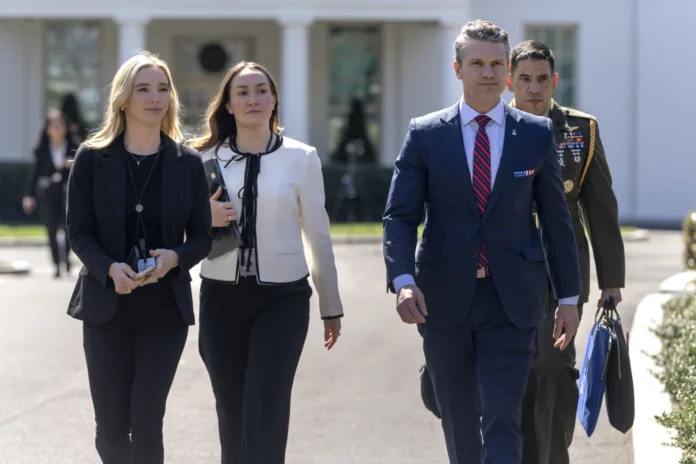
WASHINGTON – The Atlantic on Wednesday released the full Signal chat among senior national security officials, revealing that Defense Secretary Pete Hegseth shared precise details of U.S. airstrikes against Yemen’s Houthis before the attacks occurred. The chat logs show that Hegseth disclosed the exact timings of warplane launches and when bombs would be dropped, all before pilots were airborne.
The revelation comes as intelligence and defense officials struggle to explain how sensitive details—information current and former U.S. officials say would typically be classified—ended up in an unclassified Signal chat that included Atlantic Editor-in-Chief Jeffrey Goldberg. The White House maintains that no classified information was shared.
The chat notably excluded the acting chairman of the Joint Chiefs of Staff, Adm. Christopher Grady, the only military representative on the principals committee. Grady is serving in the role after President Donald Trump fired former chairman Gen. CQ Brown Jr. in February.
National Security Adviser Mike Waltz had the authority to decide whether the Joint Chiefs chairman should be included in the discussion, according to a Jan. 20 White House memo. The Pentagon declined to comment, and it remains unclear why the president’s top military adviser was not involved in a discussion on military strikes.
Hegseth, currently traveling in the Indo-Pacific, has refused to confirm whether he posted classified information. When questioned, he dismissed concerns, stating he did not reveal “war plans.” Director of National Intelligence Tulsi Gabbard and CIA Director John Ratcliffe told the Senate Intelligence Committee that it was Hegseth’s decision to determine whether the information he posted was classified.
The leaked messages contained highly specific operational details, including the timeline of airstrikes and the exact moments bombs would be dropped.
Hegseth’s messages included:
“1215 ET: F-18s LAUNCH (1st strike package)”
“1345: ‘Trigger Based’ F-18 1st Strike Window Starts (Target Terrorist is @ his Known Location so SHOULD BE ON TIME – also, Strike Drones Launch (MQ-9s)”
“1410: More F-18s LAUNCH (2nd strike package)”
“1415: Strike Drones on Target (THIS IS WHEN THE FIRST BOMBS WILL DEFINITELY DROP, pending earlier ‘Trigger Based’ targets)”
Goldberg stated that The Atlantic consulted the White House before publishing the chat logs and was told the administration would prefer the details remain unpublished.
Signal, an encrypted messaging app, is not approved for handling classified information and is vulnerable to cyberattacks. A U.S. official, speaking anonymously, said the Defense Department had warned personnel on March 14 that Russia was attempting to hack Signal. A known vulnerability allows hackers with access to a phone to remotely monitor messages in real time.
The controversy unfolds as White House Press Secretary Karoline Leavitt faces legal action from The Associated Press, which alleges the administration is retaliating against the news agency over editorial decisions. The White House insists the AP is not adhering to an executive order requiring references to the Gulf of Mexico as the “Gulf of America.”
LAS VEGAS – The son of a California woman has filed a wrongful death lawsuit against Trump International Hotels, alleging negligence after his mother was fatally injured by a revolving door at Trump Hotel Las Vegas.
The lawsuit, filed in Clark County, Nevada, on March 18, claims Diana Truschke, 78, of the San Francisco Bay Area, was struck from behind by a revolving door that suddenly accelerated as she exited the hotel. The impact allegedly “violently” ejected her, causing her to fall and sustain severe injuries.
According to the lawsuit, Truschke required extensive medical treatment before succumbing to complications from her injuries on Oct. 14, 2024. The complaint asserts that the hotel’s revolving door was in a hazardous condition, not in compliance with safety regulations, and that the hotel failed to address the issue despite being aware it was malfunctioning.
The case was first reported by the *Las Vegas Review-Journal*.
The lawsuit was filed on behalf of Truschke’s estate and its administrator, her son and sole heir, John Truschke. It seeks damages for medical and funeral expenses, as well as compensation for pain and suffering.
Trump Hotel Las Vegas, a 64-story high-rise on the north end of the Las Vegas Strip, opened in 2008 as a luxury lodging and condominium property. The Trump Organization, which oversees Trump Hotels, did not immediately respond to a request for comment.
Truschke was a longtime real estate agent in San Mateo County, California.
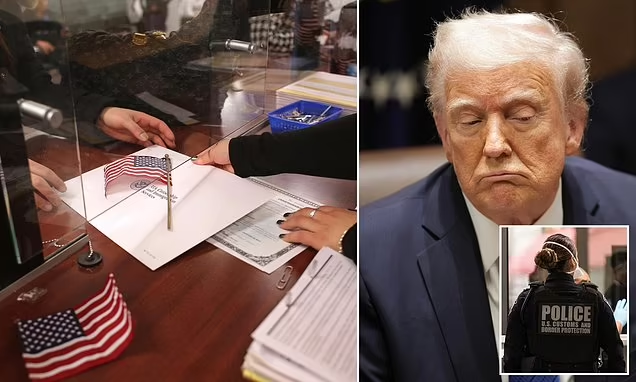
WASHINGTON – The Trump administration has temporarily paused the finalization of certain green card applications to conduct additional national security screenings, in compliance with an executive order signed by President Donald Trump.
U.S. Citizenship and Immigration Services (USCIS), part of the Department of Homeland Security (DHS), has suspended the processing of some legal permanent residency applications. The action follows Trump’s executive order, “Protecting the United States from Foreign Terrorists and Other National Security and Public Safety Threats,” signed on Jan. 20, which directs agencies to enhance screening procedures for immigrants, particularly those from regions identified as security risks.
CBS News reported that USCIS has instructed staff to implement additional vetting measures for refugees and asylum seekers applying for green cards. A DHS spokesperson confirmed the agency is “placing a temporary pause on finalizing certain adjustment of status applications pending the completion of additional screening and vetting.” The statement did not specify which applications are affected, the expected duration of the pause, or potential operational impacts on USCIS.
For refugees and asylum seekers, the measure introduces additional scrutiny beyond the extensive vetting process they already undergo before entering the U.S. Laura Collins, director of the Bush Institute-SMU Economic Growth Initiative, emphasized that individuals granted asylum or refugee status have already passed rigorous security screenings.
“There’s a certain amount of documentation you have to provide as a refugee as well as an asylee,” Collins said. “All of these people who are approved for resettlement or to remain in the United States, that’s because the United States government already approved them to be here.”
Refugees and asylum recipients are required to wait at least one year before applying for a green card. Collins noted that it remains unclear how long the additional vetting will take and what impact it may have on processing times.
During Trump’s previous term, USCIS was directed to scrutinize every application meticulously, which slowed processing times and disrupted agency operations. The increased scrutiny also contributed to financial strains, as USCIS is primarily funded through application fees.
“In slowing down those applications, because USCIS is fee-funded, if you’re not processing as many applications, you are not taking in as much money, which means you don’t have the capacity to maintain all the contractors and other staff you have, so you start to shrink the agency,” Collins said.
According to the Migration Policy Institute, federal spending on vetting increased from $53 million in 2016 to $149 million in 2020. That same year, USCIS faced a $1.2 billion budget shortfall due to declining applications and increased enforcement costs.
USCIS had recently made progress in reducing its backlog, cutting pending petitions by 15% in 2023—the first decline in a decade—and by another 11.2% last year. The pause on processing certain applications comes as the agency works to address its workload and maintain financial stability.
Russia has insisted that some Western sanctions must be lifted before implementing a maritime ceasefire with Ukraine.
Just hours after the United States announced separate agreements between Russia and Ukraine to halt strikes in the Black Sea, the Kremlin stated that the ceasefire would only take effect once sanctions on several Russian banks were removed.
Moscow’s demands include lifting sanctions on the state-owned agricultural lender Rosselkhozbank and restoring access to the Swift international payment system.
Overnight, Russian forces launched a drone attack on the Ukrainian port city of Mykolaiv, an assault President Volodymyr Zelensky described as “a clear signal” that Russia does not seek peace.
Following Russia’s full-scale invasion of Ukraine, the European Union and its allies cut off several Russian financial institutions from Swift. The move aimed to disrupt Russia’s ability to process payments for its key energy and agricultural exports.
Reversing that decision would require EU approval, a step that remains uncertain given recent European statements of continued support for Kyiv.
On Tuesday, U.S. President Donald Trump suggested that Russia might be stalling efforts to end the war.
“I think Russia wants to see an end to it, but it could be they’re dragging their feet. I’ve seen it over the years,” Trump said in an interview with Newsmax.
The U.S. announced the maritime ceasefire following three days of peace talks in Saudi Arabia. However, both Ukraine and Russia later issued conflicting statements regarding the specifics of the agreement, including when and how it would take effect.
Zelensky maintained that the agreement does not require sanctions relief and should be implemented immediately. He accused Moscow of attempting to manipulate the terms.
Washington said that all parties would continue working toward a “durable and lasting peace” and that the agreement would help reopen a crucial trade corridor.
Ukraine and Russia also agreed to “develop measures” to enforce an existing ban on targeting each other’s energy infrastructure, according to the White House.
The Black Sea, which borders Ukraine, Russia, Romania, Bulgaria, Turkey, and Georgia, is a vital shipping route. After Russia withdrew from the Black Sea Grain Initiative in 2023, it warned that any vessel heading toward Ukrainian ports could be considered a military target. The decision severely impacted Ukraine’s grain exports.
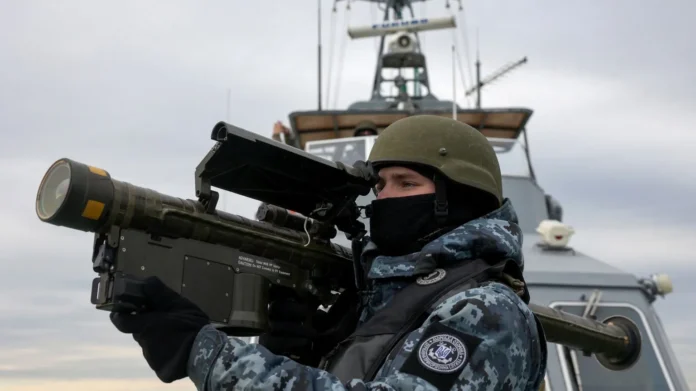
Russia and Ukraine have reached separate agreements with the United States to halt naval strikes in the Black Sea following negotiations in Saudi Arabia.
Washington stated that all sides committed to working toward “durable and lasting peace” and that the agreement would restore a key shipping route.
Both nations also pledged to “develop measures” to enforce a prior agreement banning attacks on each other’s energy infrastructure, the White House announced.
However, Russia maintained that the ceasefire would not take effect until sanctions against its food and fertilizer trade were lifted.
U.S. officials met separately with Russian and Ukrainian negotiators in Riyadh, attempting to broker a truce. The delegations from Moscow and Kyiv did not engage directly with each other.
Zelensky described the agreement as a positive step but remained cautious about its effectiveness.
“It is too early to say that it will work, but these were the right meetings, the right decisions, the right steps,” Zelensky said at a press conference in Kyiv.
“No one can accuse Ukraine of not moving towards sustainable peace after this,” he added. His remarks followed earlier accusations from Trump that Kyiv was obstructing a potential peace deal.
Shortly after Washington’s announcement, the Kremlin insisted that the ceasefire would not proceed until sanctions were lifted on Russian banks and agricultural exporters.
Moscow’s demands include reconnecting sanctioned Russian banks to the Swift payment system, removing restrictions on Russian-flagged vessels involved in food trade, and lifting bans on agricultural machinery and other goods tied to food production.
The White House did not specify when the agreement would take effect. Asked about the potential for easing sanctions, Trump said, “We’re thinking about all of them right now. We’re looking at them.”
Washington acknowledged in its statement that the U.S. would “help restore Russia’s access to the world market for agricultural and fertilizer exports.”
Zelensky criticized this as a potential weakening of Ukraine’s position, adding that Kyiv would seek additional sanctions on Russia and greater military support from the U.S. if Moscow failed to honor the agreement.
Later in his nightly address, Zelensky accused the Kremlin of lying about the ceasefire’s dependence on sanctions relief.
Ukraine’s Defense Minister Rustem Umerov stated that “third countries” could oversee parts of the agreement but warned that any movement of Russian warships beyond the eastern Black Sea would be considered a violation and a “threat to Ukraine’s national security.”
“In this case, Ukraine will have full right to exercise its right to self-defense,” Umerov said.
A previous agreement allowing safe passage for commercial vessels in the Black Sea was established in 2022 after Russia’s invasion of Ukraine.
Both nations are major grain exporters, and the war initially caused global food prices to soar. The Black Sea Grain Initiative allowed cargo ships to transport grain, sunflower oil, and essential agricultural products safely.
Originally set for 120 days, the agreement was extended multiple times before Russia withdrew in July 2023, claiming that key terms had not been fulfilled.
After the latest round of negotiations, Ukraine and Russia agreed to “develop measures” to enforce a ban on targeting each other’s energy infrastructure.
Russian missile strikes on Ukraine’s energy grid have triggered widespread blackouts, leaving thousands without power and heat during winter.
Repeated attacks on Ukraine’s nuclear power stations have also raised international alarm, with the United Nations atomic watchdog urging restraint.
An initial agreement to halt strikes on energy sites was reached last week in a call between Trump and Russian President Vladimir Putin. However, within hours of its announcement, both Moscow and Kyiv accused each other of violating the deal.
On Tuesday, Russia claimed that Ukrainian forces continued to attack its energy infrastructure during the peace talks in Riyadh. The Russian Defense Ministry accused Zelensky of being “incapable of sticking to agreements.”
Meanwhile, Russian forces launched a missile strike on the northeastern Ukrainian city of Sumy on Monday, injuring more than 100 people.
Ukrainian officials reported that Russia fired 139 drones and a ballistic missile overnight. Kyiv also claimed that an airstrike on military infrastructure in Kursk killed up to 30 Russian troops.
SAINT-DIZIER, France — Two French Air Force Alpha Jets from the Patrouille de France collided mid-air Tuesday afternoon while rehearsing an aerial stunt near Air Base 113, military officials confirmed.
Dramatic footage captured the aircraft performing synchronized maneuvers and emitting smoke trails before colliding. Both jets plummeted to the ground and were completely destroyed.
All three individuals onboard—two pilots and a passenger—ejected before impact. Emergency responders found them conscious, with two transported to a hospital in “relative emergency” condition. The third, suffering from multiple trauma injuries, is being treated by the Army, according to Le Figaro.
French Minister of the Armed Forces Sébastien Lecornu confirmed the accident in a statement on X, formerly Twitter, stating that emergency services have been mobilized and coordination is underway between the Ministry of the Interior and the Ministry of the Armed Forces.
One of the jets crashed into a silo at the Calin Concrete Company, igniting a fire. The second aircraft reportedly landed in a canal. Firefighters and police responded to the scene, working to contain the blaze. Authorities confirmed that no civilian casualties have been reported.
Witnesses described a loud explosion that shook nearby buildings. A local resident working at a dealership told Puissance Télévision that debris was seen falling from the sky. One of the pilots landed about 50 meters from the location and was immediately attended to by firefighters.
Authorities activated the Sater Plan, France’s emergency response system for downed military or civilian aircraft. An Air Force helicopter was deployed to search for debris.
Saint-Dizier Mayor Quentin Brière visited the crash site and urged residents to remain calm. He commended the professionalism of the pilots, emphasizing that their actions prevented further risk to civilians.
The French Aerobatic Patrol had scheduled air exercises from Monday to Friday, including a nighttime drill on Tuesday. It remains unclear whether training will continue as planned.
France has been using Alpha Jets to train Ukrainian pilots following Russia’s invasion of Ukraine. The accident raises concerns about aviation safety amid growing military cooperation.
In August 2024, two French pilots died in a mid-air collision involving Rafale fighter jets, marking another rare but tragic incident in France’s military aviation history.
LONDON – A newborn baby has been tragically discovered dead inside a bag outside a church in Notting Hill, West London, prompting an urgent police search for the infant’s mother amid fears she may need medical attention.
The heartbreaking discovery was made just before 1 p.m. today. Metropolitan Police officers and paramedics responded to the scene, where the baby was confirmed deceased. Authorities are now working to determine the baby’s gender and age while launching an investigation into the circumstances surrounding the incident.
Superintendent Owen Renowden described the case as “extremely sad and shocking,” emphasizing the urgent need to locate the mother.
“This investigation is in the early stages, and our immediate priority is to find the baby’s mother, who we believe may have very recently given birth,” Renowden stated. “If you are the baby’s mother and are reading this, please come forward to police or medical professionals. You must feel very frightened, but please let us help—you are not alone. We are deeply concerned about your well-being, and it is vitally important that you receive medical care and support. You can walk into any hospital or police station for assistance.”
Residents in the area expressed their grief over the shocking discovery.
One local neighbor told *The Sun*, “It’s tragic—absolutely heartbreaking. The police have been out there all day, and forensics teams have been going in and out. I can’t imagine how it must feel for the person who found the baby.”
A churchgoer at All Saints Church added, “This is deeply sad and tragic. We hear about violent crime in London all too often, but something like this is truly shocking. My thoughts are with the mother—she must be in an unimaginable situation.”
Police are urging anyone with information to come forward. Witnesses or those who may have knowledge of the case are encouraged to contact authorities by calling 101 and quoting reference CAD 3431/25March.
WASHINGTON – U.S. House Speaker Mike Johnson declared Tuesday that Congress holds the authority to eliminate entire district courts, intensifying tensions between the legislative and judicial branches. His remarks come as the White House criticizes “activist” judges who have blocked key policies under Republican President Donald Trump.
Johnson, the top Republican in the House of Representatives, condemned what he called a “dangerous trend” of nationwide injunctions issued by federal judges that have obstructed Trump’s initiatives.
“It violates separation of powers when a judge thinks they can enjoin something that a president is doing—something the American people voted for,” Johnson stated at his weekly press conference.
The House Judiciary Committee, he added, will hold a hearing next week to highlight “judicial abuses” and recently advanced legislation to restrict district judges from issuing nationwide injunctions against federal policies.
“We do have authority over the federal courts,” Johnson said. “As you know, we can eliminate an entire district court. We have power over funding, over the courts, and all these other things. But desperate times call for desperate measures, and Congress is going to act.”
Nationwide injunctions have been used frequently in recent years, affecting policies enacted by presidents of both parties. However, any House-passed legislation seeking to limit judicial authority would face significant hurdles in the Democrat-controlled Senate.
Following criticism, Johnson later clarified that his remarks were not intended as a direct threat but rather to illustrate Congress’ broad authority over the judiciary.
Senate Democratic Leader Chuck Schumer swiftly rebuked the comments, calling it “outrageous to even think of defunding the courts.” The Administrative Office of the U.S. Courts declined to comment.
Johnson’s remarks also addressed impeachment resolutions filed by conservative House members targeting six judges who blocked actions by Trump and Elon Musk’s Department of Government Efficiency. Among them is U.S. District Judge James Boasberg, who drew Trump’s ire after halting the removal of hundreds of Venezuelan migrants.
Trump called for Boasberg’s impeachment—a move met with a rare rebuke from U.S. Supreme Court Chief Justice John Roberts, who stated, “Impeachment is not an appropriate response to disagreement concerning a judicial decision,” noting that judicial rulings can be appealed through legal channels.
WASHINGTON – U.S. President Donald Trump signed an executive order Tuesday requiring voters to provide proof of U.S. citizenship, aiming to prevent states from counting mail-in ballots received after Election Day. The order also threatens to withhold federal funding from states that fail to comply.
Trump, who has repeatedly questioned the integrity of U.S. elections, continues to claim—without evidence—that widespread fraud led to his 2020 loss to President Joe Biden. The order aligns with Republican efforts to tighten voting laws, particularly regarding non-citizen voting, which is already illegal.
The GOP-controlled House of Representatives previously passed the Safeguard American Voter Eligibility Act to ban non-citizen voter registration in federal elections, though the bill failed in the Democratic-led Senate. Voting rights groups argue that Trump’s order could disenfranchise eligible voters, particularly those without passports or other identification proving citizenship.
“We’ve got to straighten out our elections,” Trump said at the White House signing ceremony. “This country is so sick because of the elections, the fake elections and the bad elections. We’re going to straighten that out one way or the other.”
The order is expected to face legal challenges. Lisa Gilbert, co-president of advocacy group Public Citizen, called it “a blatant attack on democracy and an authoritarian power grab.”
Republicans have increasingly sought voting restrictions, while Democrats advocate for expanded mail-in ballot access and early voting. Public Citizen reports that 146 million Americans lack passports, and research from the Brennan Center indicates that 9% of eligible voters—about 21.3 million people—do not have immediate access to proof of citizenship.
The order mandates the inclusion of a citizenship question on federal voting forms and conditions federal election-related funds on states enforcing proof-of-citizenship requirements. Additionally, it criticizes mail-in ballot policies that allow votes to be counted after Election Day, stating that Trump’s policy is to “require that votes be cast and received by the election date established in law.”
According to the National Conference of State Legislatures, 18 states, Puerto Rico, the Virgin Islands, and Washington, D.C., currently accept ballots postmarked by Election Day, even if they arrive later.
The order also directs the Department of Homeland Security to ensure states have access to databases verifying voter citizenship or immigration status. Additionally, the newly created Department of Government Efficiency, overseen by Elon Musk, will work with DHS to audit state voter registration lists and issue subpoenas if necessary.
The Republican National Committee (RNC) has requested public records from 48 states and Washington, D.C., to investigate voter roll maintenance. “Voters have a right to know that their states are properly maintaining voter rolls and quickly acting to clean voter registration lists by removing ineligible voters,” RNC Chairman Michael Whatley said in a statement.
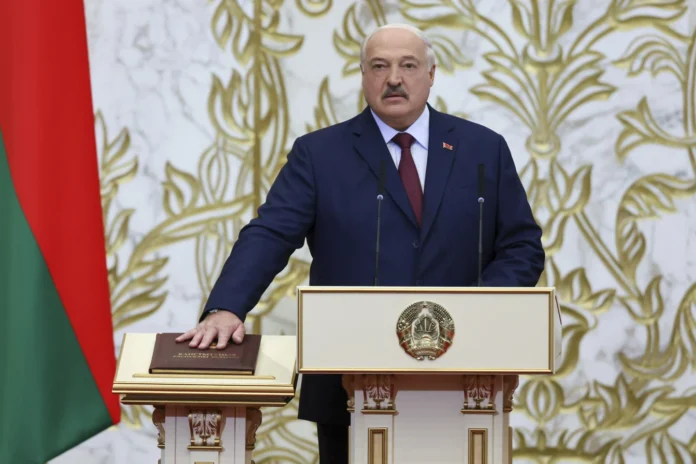
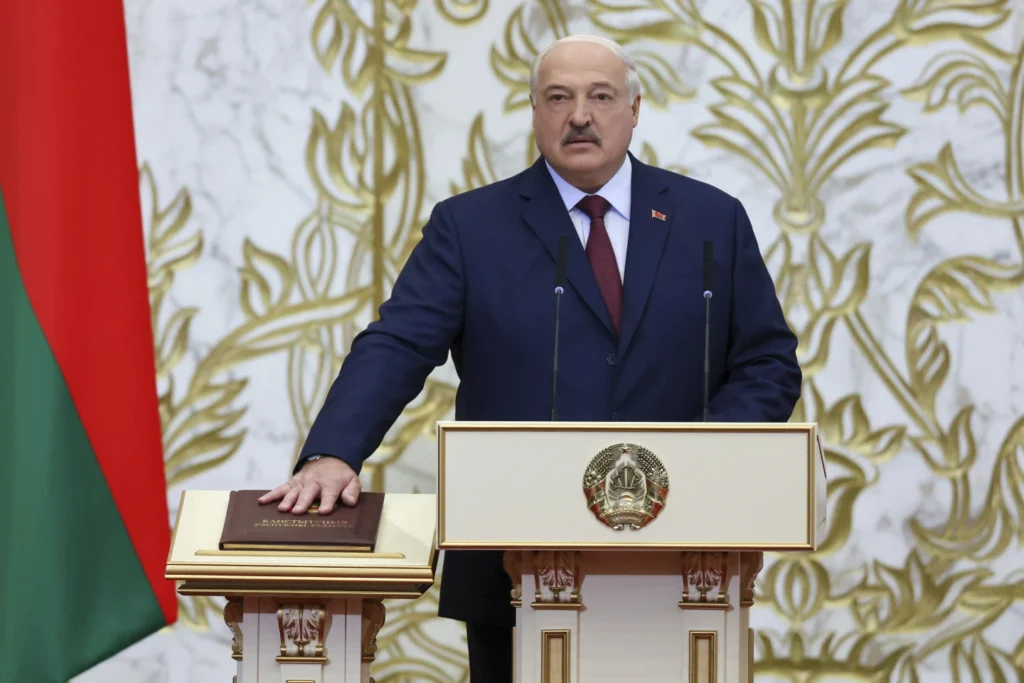
MINSK, Belarus – Belarusian President Alexander Lukashenko was sworn in Tuesday for a seventh term, reaffirming his grip on power while dismissing opposition critics, stating, “You have no future.” The 70-year-old leader, often labeled “Europe’s last dictator,” claimed in his inauguration speech that Belarus has “more democracy than those who cast themselves as its models.”
The ceremony at the Independence Palace in Minsk was attended by thousands of Lukashenko’s supporters. Meanwhile, hundreds of opposition activists living abroad staged anti-Lukashenko protests to mark the anniversary of Belarus’ brief independence in 1918.
Lukashenko’s reelection in the tightly controlled Jan. 26 election, declared a landslide victory by the Central Election Commission with nearly 87% of the vote, has been widely condemned by opponents as fraudulent. The ballot featured four nominal challengers, all of whom expressed support for his rule.
Opposition figures, independent journalists, and activists have been imprisoned or forced into exile under Lukashenko’s years-long crackdown on dissent. Following the disputed 2020 election, Belarus saw its largest protests in history, with over 65,000 arrests, reports of police brutality, and the shutdown of independent media and NGOs. Western nations imposed sanctions in response.
Human rights groups estimate that Belarus currently holds over 1,200 political prisoners, including Nobel Peace Prize laureate Ales Bialiatski, founder of the Viasna Human Rights Center. In a joint statement, Viasna and 10 other rights organizations condemned the election, calling it illegitimate and conducted “in an atmosphere of total fear.”
Lukashenko, in power since 1994, has relied on political and financial backing from Russian President Vladimir Putin, an alliance that helped him withstand the 2020 uprising. He also permitted Russia to use Belarusian territory to launch its invasion of Ukraine in 2022 and later hosted Russian tactical nuclear weapons.
Exiled opposition leader Sviatlana Tsikhanouskaya, who fled Belarus after challenging Lukashenko in 2020, vowed to continue the fight for democracy. “Our goal is to break away from the Russian occupation and Lukashenko’s tyranny, and to return Belarus into the European family of nations,” she said in a speech at the Lithuanian parliament.
Some analysts suggest Lukashenko may attempt to improve relations with the West during his seventh term. “He has been signaling a willingness to engage in dialogue and normalize ties in order to reduce dependence on the Kremlin and ease Western sanctions,” said independent political analyst Valery Karbalevich.
SEOUL, South Korea – Massive wildfires fueled by dry weather and strong winds have ravaged southern South Korea, killing 18 people, injuring 19, and forcing 27,000 residents to evacuate. The fires have destroyed more than 200 structures, including the 1,300-year-old Gounsa Buddhist temple, officials confirmed Wednesday.
The wildfires have burned approximately 43,330 acres across six southeastern regions, with the hardest-hit areas including Andong, Uiseong, Sancheong, and Ulsan, according to the Interior Ministry. Strong winds and dry conditions have intensified the spread, making containment efforts difficult.
Authorities issued mass evacuation orders Tuesday as firefighters worked to battle multiple blazes. While officials initially reported progress, worsening conditions reignited the fires. Nearly 9,000 firefighters, supported by over 130 helicopters and hundreds of emergency vehicles, have been deployed, but efforts were partially suspended overnight due to high winds.
In Uiseong, the fire completely destroyed Gounsa, a historic Buddhist temple built in the 7th century. The Korea Heritage Service confirmed that some temple treasures, including a stone Buddha statue, were rescued before the wooden structures were consumed by flames.
As of Wednesday morning, the Korea Forest Service reported at least five active wildfires nationwide. On Tuesday, the agency raised the wildfire warning to the highest “serious” level, prompting increased emergency response measures, restricted access to forests and parks, and a recommendation for military units to suspend live-fire exercises.
Four firefighters and government workers died in Sancheong on Saturday after being trapped by rapidly advancing flames. Officials suspect human error, including burning grass near family tombs and sparks from welding, may have contributed to several of the fires.
Prime Minister Han Duck-soo pledged an all-out effort to contain the wildfires and urged public caution as dry conditions persist. Authorities continue monitoring the situation as emergency crews work to control the flames.