Home Blog Page 429

US House Republicans Advance Trump’s Tax Cut Plan, Setting Stage for 2025 Agenda

0

The Republican-led U.S. House of Representatives late Tuesday advanced President Donald Trump’s tax cut and border security agenda, marking a significant step toward his 2025 policy goals. 
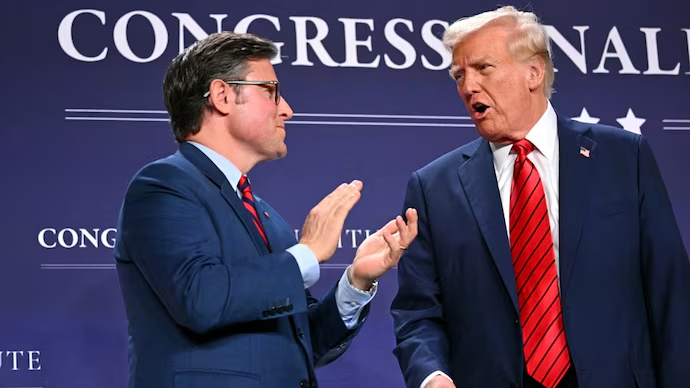
The budget resolution passed by a narrow 217-215 vote, with Rep. Thomas Massie as the lone Republican opposing the measure and no Democratic support. One Democrat was absent from the vote. 

The measure is a preliminary step toward extending Trump’s 2017 tax cuts later this year. It now moves to the Senate, where Republicans are expected to take it up. 

“We have a lot of hard work ahead of us, but we are going to deliver the America First agenda,” House Speaker Mike Johnson said after the vote. “We’re going to celebrate tonight, and we’ll roll up our sleeves and get right back in the morning.” 

The resolution’s passage followed hours of negotiations, with Johnson and House Majority Leader Steve Scalise working to secure enough votes. At one point, Johnson canceled the vote due to insufficient support, only to reverse course soon after. 

Trump himself reportedly called hesitant members, emphasizing the importance of advancing his $4.5 trillion tax plan, which includes funding for migrant deportations, border security, energy deregulation, and increased military spending. 

Initially, several hardline conservatives demanded deeper spending cuts and greater control over separate government funding bills to prevent a potential shutdown when current funding expires on March 14. Despite early resistance, three Republican holdouts—Reps. Tim Burchett, Victoria Spartz, and Warren Davidson—ultimately backed the resolution. 

Concerns over House Republican unity prompted Senate Republicans to advance their own budget resolution last week. Their $340 billion proposal addresses border security, defense, and energy priorities but postpones the debate on tax cuts. 

For Republicans to bypass Democratic opposition and the Senate filibuster, both chambers must pass the same budget resolution, allowing them to use a special legislative process to advance Trump’s agenda later this year. 

The House budget resolution proposes $2 trillion in spending cuts over the next decade to offset the cost of Trump’s priorities. His tax plan seeks to extend key provisions from the 2017 Tax Cuts and Jobs Act, which are set to expire at the end of the year. 

Beyond the budget resolution, lawmakers face a series of critical deadlines. Congress must pass fiscal year 2025 spending bills by March 14 to avoid a government shutdown. Later in the year, they will need to address the federal debt ceiling to prevent a potential default on the government’s $36 trillion debt.


6 Infants Die from Cold in Gaza as Displaced Families Endure Harsh Winter

0

At least six infants have died from hypothermia in the past two weeks in the Gaza Strip, where hundreds of thousands of displaced people are sheltering in makeshift camps and damaged buildings amid a fragile ceasefire, Palestinian medics reported Tuesday.

Gaza’s cold, wet winters bring temperatures below 10 degrees Celsius (50°F) at night, with strong storms rolling in from the Mediterranean Sea. The past few days have been particularly harsh. 

Yusuf al-Shinbari woke just after midnight on Tuesday to find his 2-month-old daughter, Sham, lifeless in their tent. 

“Yesterday, I was playing with her,” he said. “I was happy with her. She was a beautiful child, like the moon.” 

Dr. Ahmed al-Farah, head of the pediatric department at Nasser Hospital in Khan Younis, confirmed that Sham had no pre-existing illness and died due to exposure. Two other infants were treated for frostbite. 

At the Patient’s Friends Hospital in Gaza City, Saeed Salah reported five additional deaths of infants aged one month or younger in the last two weeks, including a 1-month-old who died Monday. Another child is currently on a ventilator. 

According to Zaher al-Wahedi, head of the Gaza Health Ministry’s records department, at least 15 children have died from hypothermia this winter. 

While the ceasefire has allowed an influx of humanitarian aid—primarily food—residents say blankets and warm clothing remain in short supply, and firewood is scarce. 

“There’s no central electricity, fuel for generators is nearly impossible to find, and many families sleep on damp sand or bare concrete,” said Rosalia Bollen, a spokesperson for UNICEF. “It’s incredibly cold. I have no clue how people manage to sleep in these makeshift tents.” 

The war between Israel and Hamas, triggered by Hamas’ Oct. 7, 2023, attack, has left much of Gaza in ruins. Many of the displaced have returned to northern Gaza under the ceasefire, settling among the wreckage. 

The first phase of the ceasefire is set to expire on Saturday, with no guarantee of an extension. If hostilities resume, the already limited flow of humanitarian aid could be further restricted. 

Even if peace holds, rebuilding remains uncertain. The World Bank estimates reconstruction costs to exceed $50 billion, with years needed just to clear debris. 

Israel attributes the destruction in Gaza to Hamas’ strategy of embedding military infrastructure within civilian areas. Hamas, in turn, accuses Israel of blocking essential aid, including mobile homes and tents—claims Israel denies. 

The war began after Hamas-led militants killed approximately 1,200 people—mostly civilians—and took around 250 hostages in their Oct. 7 attack. More than 60 remain captive, with about half believed to be deceased. 

Israel’s military campaign has since killed over 48,000 Palestinians, mostly women and children, according to Gaza’s Health Ministry. The ministry does not specify how many were militants. Israel claims to have eliminated over 17,000 Hamas fighters but has not provided evidence.

Supreme Court Overturns Oklahoma Inmate Richard Glossip’s Conviction and Death Sentence

0

The U.S. Supreme Court on Tuesday overturned the murder conviction and death sentence of Richard Glossip, an Oklahoma man who has long maintained his innocence in the 1997 killing of a motel owner. The ruling delivers a significant legal victory for Glossip, who has spent more than 25 years on death row and narrowly avoided execution multiple times.

Glossip’s wife, Lea, described the decision as “an answered prayer.” The 62-year-old has been incarcerated for nearly half his life for his alleged role in the killing of Barry Van Treese, a motel owner in Oklahoma City. 

In a ruling that saw a rare alliance between Glossip’s legal team and Oklahoma’s Republican attorney general, the court found that prosecutors violated his constitutional right to a fair trial by permitting false testimony from a key witness. 

“Glossip is entitled to a new trial,” wrote Justice Sonia Sotomayor on behalf of the majority. 

The decision was not unanimous. Justices Clarence Thomas and Samuel Alito dissented, arguing that the conviction and death sentence should stand. Justice Amy Coney Barrett agreed that the appellate ruling should be overturned but believed the case should be reconsidered by a state court. 

Thomas criticized the majority for disregarding the wishes of Van Treese’s family, who had urged the Supreme Court to uphold Glossip’s sentence. A message left for Van Treese’s brother was not immediately returned. 

Glossip’s attorney, Don Knight, praised the ruling as a step toward fairness. 

“Today was a victory for justice and fairness in our judicial system,” Knight said. “Rich Glossip, who has maintained his innocence for 27 years, will now be given the chance to have the fair trial that he has always been denied.” 

In a text to The Associated Press, Glossip’s wife described their reaction: 

“Rich and I opened the decision together on the phone this morning, knowing it would be a life-changing moment. To say that we are overcome with emotion is an understatement. We are deeply grateful.” 

Oklahoma Attorney General Gentner Drummond, who had supported Glossip’s bid for a new trial, said Glossip would remain incarcerated until the state determines its next steps. 

“I do not believe Richard Glossip is innocent,” Drummond stated, while also acknowledging the flaws in the original trial. However, he noted the difficulty of retrying the case decades later. 

Drummond and Oklahoma County District Attorney Vicki Behenna will decide whether to pursue a retrial. Behenna has previously indicated that the death penalty would not be sought. 

Oklahoma’s top criminal appeals court had repeatedly upheld Glossip’s conviction and sentence—even after state officials acknowledged errors in his case. 

Glossip was convicted of orchestrating the killing of Van Treese, who was bludgeoned to death with a baseball bat. Prosecutors claimed Glossip, a motel employee, hired another man, Justin Sneed, to carry out the murder in exchange for $10,000. 

Sneed, who confessed to the killing, testified against Glossip in exchange for a life sentence. His testimony was central to the state’s case. 

In 2023, Attorney General Drummond acknowledged that newly uncovered evidence had cast serious doubt on Glossip’s conviction. Documents revealed that prosecutors allowed Sneed to provide false testimony about his psychiatric condition and his use of lithium, a mood-stabilizing drug.

Additionally, a crucial box of evidence—including motel receipts, a shower curtain, and masking tape—had been destroyed. Defense attorneys argue that these materials could have bolstered Glossip’s claims of innocence. 

Over the years, Glossip has repeatedly come within hours of execution. Oklahoma scheduled his execution nine times, and he prepared for three separate “last meals.” 

In 2015, the Supreme Court halted his execution while considering a challenge to Oklahoma’s lethal injection protocol. However, the justices ultimately ruled against him in a 5-4 decision. His execution was only stopped due to a drug mix-up. 

Glossip was initially convicted in 1998, but a state appeals court later ordered a new trial. He was convicted again in 2004. 

The Supreme Court’s latest ruling reopens the case, setting the stage for a potential retrial—or a long-overdue resolution for a man who has fought for his life for nearly three decades. 

White House to Control Press Access, Altering Longstanding Media Tradition

0

The White House announced Tuesday that it will decide which news outlets receive regular access to President Donald Trump, marking a major departure from the century-old practice of independent media organizations determining coverage of the president.

White House Press Secretary Karoline Leavitt stated that traditional media outlets will be rotated out of the press pool, with some streaming services included. She framed the move as a modernization effort aimed at increasing public access. However, media experts have raised concerns over First Amendment implications, warning that the administration is asserting direct control over press coverage. 

“The White House press team, in this administration, will determine who gets to enjoy the very privileged and limited access in spaces such as Air Force One and the Oval Office,” Leavitt said during a briefing. She criticized the current system, arguing that a small group of D.C.-based journalists should no longer “monopolize” White House coverage. 

Leavitt confirmed that the administration will “double down” on its decision to bar The Associated Press from certain presidential events. The move challenges a long-standing press pool system in which journalists collectively determine access to small spaces such as the Oval Office and Air Force One, ensuring transparency for media outlets and congressional offices that cannot be physically present. 

Media scholars warn the policy undermines press independence. 

“This is a dangerous move for democracy,” said Jon Marshall, a media history professor at Northwestern University. “It means the president can pick and choose who covers the executive branch, ignoring the fact that it is the American people who, through their taxes, fund the White House, the president’s travels, and the press secretary’s salary.” 

Eugene Daniels, president of the White House Correspondents’ Association, also condemned the decision. 

“This move tears at the independence of a free press in the United States,” Daniels said in a statement. “In a free country, leaders must not be able to choose their own press corps.” 

Bruce D. Brown, president of the Reporters Committee for Freedom of the Press, called it “a drastic change in how the public obtains information about its government.” 

The announcement comes amid an ongoing legal battle between the White House and The Associated Press. A federal judge on Monday declined to immediately restore the AP’s access to certain presidential events after the outlet was barred for refusing to comply with Trump’s order to refer to the Gulf of Mexico as the “Gulf of America.” The AP has maintained that it will note Trump’s directive while continuing to use the internationally recognized name. 

U.S. District Judge Trevor N. McFadden ruled that the AP had not demonstrated “irreparable harm” but warned that legal precedent was “uniformly unhelpful to the White House.” A further hearing is scheduled for late March. 

Separately, the AP has acknowledged Trump’s executive order renaming the United States’ highest peak back to Mount McKinley from Denali, citing presidential authority over domestic geographic designations. 

Iran Rules Out Direct Talks with U.S. Amid Sanctions Pressure

0

Iranian Foreign Minister Abbas Araghchi stated that direct negotiations with the United States are not possible as long as the Trump administration maintains its “maximum pressure” strategy against Iran.

“Iran’s position regarding nuclear talks is clear, and we will not negotiate under pressure and sanctions,” Araghchi said during a joint press conference with Russian Foreign Minister Sergey Lavrov. 

“There is no possibility of direct negotiations with the U.S. as long as maximum pressure is being applied in this way,” he added. 

President Donald Trump has continued his first term “maximum pressure” strategy against Iran, aimed at halting its nuclear ambitions. The administration’s latest sanctions targeted Iran’s oil industry, with Trump vowing to reduce the country’s oil exports “to zero.” 

During his first term, Trump withdrew from the 2015 nuclear deal, which had eased sanctions in exchange for restrictions on Iran’s nuclear program. The decision faced widespread criticism, with experts arguing that diplomacy would be a more effective approach to ensuring Iranian compliance. 

Trump has insisted he prefers a diplomatic resolution, stating that he seeks an agreement with Iran rather than military conflict. However, escalating sanctions have led Iran to gradually roll back its commitments under the nuclear deal, increasing uranium enrichment to 60% and expanding its stockpile. 

Tehran has signaled that it will only engage in negotiations if the U.S. lifts sanctions and adopts a more flexible approach. 

4 Hamas Members Accused of Plotting Attacks Stand Trial in Germany

0

Four suspected Hamas members accused of planning attacks on Jewish institutions in Europe went on trial in Berlin on Tuesday, marking the first court case against members of the Islamist militant group in Germany, prosecutors said. 

The defendants were arrested in late 2023 on suspicion of plotting attacks, according to German prosecutors. 

“For the first time in Germany, suspects are facing charges of having participated as members of the foreign terrorist organization Hamas,” prosecutor Jochen Weingarten told Reuters. 

Prosecutors allege that the defendants sought to locate a secret weapons depot in Poland for potential attacks while acting under orders from the deputy commander of Hamas’ Qassam Brigades in Lebanon. 

According to previous statements from prosecutors, the defendants are also accused of operating additional weapons caches in Europe. 

Accused Mexican Drug Lord ‘El Mayo’ Seeks U.S. Plea Deal to Avoid Death Penalty

0
FILE - In this courtroom sketch, Ismael "El Mayo" Zambada, center, is seated beside his defense attorney Frank Perez, left, in federal court in the Brooklyn borough of New York, Sept. 13, 2024. (Elizabeth Williams via AP, File)

New York — Accused Mexican drug kingpin Ismael “El Mayo” Zambada is willing to plead guilty in a deal with U.S. prosecutors if it spares him from the death penalty, his attorney confirmed Monday. 

FILE – In this courtroom sketch, Ismael “El Mayo” Zambada, center, is seated beside his defense attorney Frank Perez, left, in federal court in the Brooklyn borough of New York, Sept. 13, 2024. (Elizabeth Williams via AP, File)

Zambada, who faces 17 felony charges, including drug trafficking, money laundering, and weapons violations, pleaded not guilty in federal court in New York last September. He remains in custody pending trial. 

“Mr. Zambada does not want to go to trial and is willing to accept responsibility for a charge that does not include the death penalty,” said his lawyer, Frank Perez. 

The U.S. Attorney’s Office in Brooklyn, which is prosecuting the case, declined to comment on the potential plea deal. 

Zambada, believed to be in his 70s, was taken into U.S. custody last July at a New Mexico airfield in a major law enforcement operation. The arrest also included Joaquin Guzman Lopez, one of the sons of convicted drug lord Joaquín “El Chapo” Guzmán. 

NATO Scrambles Jets Over Poland as Russia Launches Strategic Bombers Against Ukraine

0

Warsaw, Poland — NATO scrambled fighter jets over Poland on Tuesday as Russia deployed nuclear-capable strategic bombers and missiles in a large-scale attack on Ukraine, raising regional security concerns.

Russian Tu-95MS bombers targeted multiple Ukrainian cities, triggering air raid sirens and sending residents in Kyiv rushing to underground metro shelters. Explosions were reported in Kyiv, Zhytomyr, Sumy, and across the regions of Zaporizhzhia and Chernihiv. Drone strikes also caused injuries, according to local reports. 

Amid fears that Russian aircraft and missiles could approach Polish airspace, Warsaw’s Armed Forces Operational Command ordered NATO warplanes to patrol the border. 

“Due to the activity of long-range Russian aviation striking targets, particularly in western Ukraine, military aviation has begun operating in Polish airspace,” the command headquarters said in a statement. Ground-based air defenses and radar reconnaissance were also placed on high alert. 

The escalation comes just one day after a U.S. B-52 bomber flew less than 50 miles from Russia’s border in a show of force. The bomber, capable of carrying nuclear and conventional weapons, departed from RAF Fairford in the UK and was escorted by F-35 and F/A-18 fighter jets. The flight coincided with a NATO military parade in Tallinn, Estonia, marking the third anniversary of Russia’s invasion of Ukraine. 

The attack on Ukraine occurred as diplomatic tensions mount between Washington, Moscow, and Kyiv. President Volodymyr Zelensky continues to advocate for a peace agreement favorable to Ukraine, but recent U.S. diplomatic moves suggest a shift in policy. 

Over the past week, ceasefire negotiations have intensified, but they have taken place without Ukrainian representatives. President Donald Trump has faced criticism for allegedly sidelining Kyiv in discussions with Russia. Last week, Trump falsely labeled Zelensky “a dictator without elections,” despite Ukraine’s vote postponement due to martial law. 

Further straining U.S.-Ukraine relations, Washington sided with Moscow in two United Nations votes that avoided condemning Russia’s military campaign. Kremlin spokesperson Dmitry Peskov welcomed what he described as a “more balanced” American position, stating, “The U.S. is truly working toward resolving the Ukraine conflict.” 

Zelensky, aware of Trump’s apparent opposition to his leadership, signaled over the weekend that he would step down if it facilitated Ukraine’s entry into NATO or secured other international security guarantees. Meanwhile, Russian Foreign Minister Sergei Lavrov reiterated that Moscow would only end hostilities under terms that “suit” Russia. 

Hours before the latest bombardment, the European Union and the United Kingdom imposed fresh sanctions on Russia. In response, Peskov accused the West of prolonging the war. 

As Russian missiles and drones struck Ukrainian infrastructure early Tuesday, at least two Tu-95MS bombers were reported taking off from Russia’s Olenya air base in the Arctic. Ukraine’s military reported intercepting six out of seven missiles and 133 out of 213 drones, while an additional 79 drones failed to reach their targets. 

Moscow’s defense ministry later claimed the strikes had successfully targeted Ukraine’s military airfields. One reported target was Mirhorod Air Base in Poltava, home to Ukraine’s 831st Tactical Aviation Brigade. Meanwhile, Russian attacks on energy infrastructure forced emergency blackouts, according to Ukraine’s energy minister Herman Halushchenko. 

“In order to minimize the possible consequences for the energy system, emergency electricity restrictions have been applied,” Halushchenko stated. “As soon as security allows, we will assess the full damage.” 

In a retaliatory overnight operation, Ukrainian drones struck a major Russian oil refinery in Saratov, part of the Kremlin-affiliated Rosneft conglomerate. At least 11 explosions were reported near Engels, a Russian military hub home to strategic bombers. Russian air defenses engaged the attacks, but the extent of the damage remains unclear. 

Following Russia’s latest strikes, Polish military radar detected heightened NATO aircraft activity near the Polish-Ukrainian border. Warsaw’s Armed Forces Operational Command confirmed the deployment of F-16s and possibly U.S. and Norwegian F-35s stationed in Krzesiny. 

This marks the second time in recent weeks that NATO forces have been placed on high alert. Earlier this month, allied fighter jets were scrambled after Russia launched low-flying Kalibr missiles at Ukraine’s energy infrastructure. 

“The measures taken are aimed at ensuring security in the territories bordering the threatened areas,” Poland’s military command said. “Our forces remain fully prepared for an immediate response.” 

While European and Canadian leaders gathered in Kyiv to mark the third anniversary of Russia’s invasion, Trump remained in Washington, hosting French President Emmanuel Macron. Macron reaffirmed his support for Ukraine, warning that “peace must not mean a surrender of Ukraine.” 

As Moscow intensifies its aerial assaults and diplomatic tensions escalate, the risk of further conflict spilling into NATO territory remains high. 

US Federal Workers Confused as Musk Stands Firm on Compliance Ultimatum

0

U.S. government employees faced widespread confusion Monday following conflicting directives regarding an Elon Musk-backed mandate requiring them to summarize their weekly work via email or risk termination. 

Just 48 hours after the Office of Personnel Management (OPM) issued an email asking federal workers to report “what did you do last week?” the agency clarified that responses were voluntary, leaving individual departments to determine their approach. 

However, as agencies grappled with the guidance, President Donald Trump weighed in, asserting that employees who refused to comply with Musk’s directive would be fired or “sort of semi-fired.” Later Monday evening, Musk reiterated the ultimatum, offering workers a final opportunity to respond. 

The original OPM email, sent Saturday, directed recipients to submit five examples of their work over the past seven days without disclosing classified information. Employees were instructed to respond by the end of Monday. Musk, who leads the Department of Government Efficiency (DOGE), warned that failure to reply would be treated as a resignation. 

The directive sparked backlash, with federal worker unions and advocacy groups filing a lawsuit in California to block the mandate. Key agencies, including the Departments of Defense, Health and Human Services (HHS), Justice, and the FBI—now led by Trump appointees—advised employees to disregard the request, creating widespread uncertainty. Many federal workers received contradictory instructions from their respective agencies, leading to frustration. 

“They’re succeeding in driving us insane,” said one HHS employee, who spoke anonymously to the BBC out of fear of retaliation. 

On Monday afternoon, OPM convened a call with federal agency HR heads, stating that each agency could determine how to handle the directive, according to CBS News, the BBC’s U.S. partner. 

That same day, President Trump defended Musk’s mandate, calling it a “genius” move. 

“We’re trying to find out if people are working, so we’re sending a letter asking them to tell us what they did last week. If they don’t respond, it’s very possible they don’t exist or aren’t working,” Trump told reporters at the White House. “And then if you don’t answer, you’re sort of semi-fired or fired because a lot of people aren’t answering, and they don’t even exist.” 

Musk maintained that he was acting on Trump’s orders. 

“Subject to the discretion of the President, they will be given another chance,” Musk wrote on X, referring to employees who had not responded by Monday’s deadline. “Failure to respond a second time will result in termination.” 

He further criticized noncompliant employees, calling the email request “utterly trivial.” 

“The standard for passing the test was to type some words and press send! Yet so many failed even that inane test, urged on in some cases by their managers,” Musk wrote. “Have you ever witnessed such INCOMPETENCE and CONTEMPT for how YOUR TAXES are being spent?” 

Despite resistance from some agencies under Trump-appointed leadership, the White House insisted that all departments were aligned. 

“Everyone is working together as one unified team at the direction of President Trump,” White House Press Secretary Karoline Leavitt said in a statement. “Any notion to the contrary is completely false.” 

The statement did not clarify why federal agencies issued conflicting guidance to employees. 

Putin Offers U.S. Access to Russian and Ukrainian Rare Minerals in Rare Peace Deal

0

Russian President Vladimir Putin said he is open to allowing the United States access to rare earth minerals, including those extracted from Russian-occupied regions of Ukraine.

The statement follows repeated efforts by U.S. President Donald Trump to secure mineral resources from Ukraine in exchange for military and economic support, a deal that is in its final stages, according to a Ukrainian official. 

During a state television interview Monday, Putin said Russia is prepared to offer access to mineral resources through joint ventures with American companies. He specifically mentioned potential mining operations in Russia’s “new territories,” referring to areas in eastern Ukraine that Russia has occupied since launching its full-scale invasion three years ago. 

Putin also proposed cooperation between Russia and the U.S. in aluminum extraction and supply, emphasizing that such a partnership could help stabilize global prices. 

Responding to Trump’s efforts to secure Ukrainian mineral deposits, Putin said Russia remains open to working with “foreign partners,” including U.S. companies, in mineral mining projects. He dismissed concerns over a potential U.S.-Ukraine mineral deal, stating that Russia possesses significantly larger reserves of such resources than Ukraine. 

“As for the new territories, it’s the same. We are ready to attract foreign partners to the so-called new, to our historical territories, which have returned to the Russian Federation,” Putin said. 

Additionally, he suggested that the U.S. and Russia could collaborate on aluminum production in Krasnoyarsk, Siberia, home to one of Russia’s largest aluminum smelters operated by Rusal. 

Putin’s comments followed a cabinet meeting focused on Russia’s natural resources. 

Kremlin spokesperson Dmitry Peskov told reporters Tuesday that the proposal presents “broad prospects” for cooperation, adding that the U.S. has a strong demand for rare earth minerals, while Russia has abundant supplies.