

NEGOMBO, Sri Lanka — At least 26 people were killed and more than 100 injured after violent clashes erupted inside the Negombo Prison on the outskirts of Sri Lanka’s capital over the weekend and intensified Monday, in one of the deadliest prison disturbances in the country’s recent history.
The unrest began Saturday between rival drug trade gangs, escalated Sunday when female and male inmates staged rooftop protests, and reached its deadliest point Monday when inmates attacked prison officials who moved in to restore order.
What We Know So Far
The initial confrontation broke out around noon Saturday between two groups of prisoners, killing two inmates and leaving more than 25 others injured, hospital sources told the Daily Mirror Sri Lanka. Those injured were admitted to Negombo Hospital, where the two fatalities were confirmed.
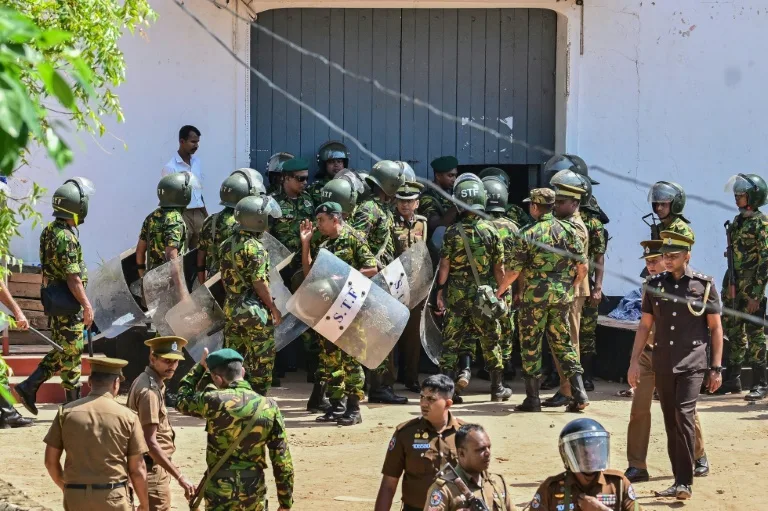
By Sunday, the situation had deteriorated further. Inmates from the women’s ward climbed onto rooftops in protest following the Saturday violence, and a separate group of male inmates occupied the rooftops of other prison buildings in a parallel demonstration. Authorities deployed large contingents of police and the Police Special Task Force to contain the situation.
The crisis reached its most violent phase Monday morning when a group of inmates attempted to force their way through the prison’s main entrance in an apparent bid to escape, the Daily Mirror Sri Lanka confirmed.
When prison guards moved to intervene, inmates turned on the officials. Police, the Special Task Force, and later the Army and Air Force were all deployed to suppress the violence. Multiple gunshots were heard from within the prison premises as security forces worked to regain control.
An official at the main state-run hospital in the area, speaking on condition of anonymity because he was not authorized to speak to the media, told the Associated Press that seven prison officials and 18 inmates had died, with another 43 being treated for injuries at that facility alone.
Three other hospitals were also treating dozens of additional wounded. The Daily Mirror Sri Lanka subsequently raised the confirmed death toll to 26, with at least five prison officers and 20 inmates among the fatalities. Eight critically injured victims were transferred to the National Hospital of Sri Lanka in Colombo for specialized care.
Justice Minister Harshana Nanayakkara confirmed that the original confrontation began between two rival gangs connected to the illegal drug trade. After order was restored Monday evening, Nanayakkara said the inmates identified as having led the violence had been transferred to two other prisons. Army troops remained deployed around the facility.
Prison Commissioner and spokesperson A.C. Gajanayake said the broader transfer of inmates to prisons across the country was being arranged as an urgent measure to ease tensions and restore stability at Negombo.
What Authorities Are Saying
Gajanayake described Monday’s escalation directly. “They started attacking the prison officials,” he told reporters, explaining that guards had attempted to intervene among the inmates before becoming targets themselves.
Justice Minister Nanayakkara’s confirmation that drug trade rivalries sparked the initial confrontation points to a pattern of gang activity inside Sri Lankan prisons that has persisted despite repeated government pledges to address it.
The deployment of the Army and Air Force alongside police and the Special Task Force to control a single prison reflects the seriousness with which authorities viewed the threat of a mass escape and the scale of violence inside the facility.
Why This Matters
The Negombo Prison violence is the inevitable consequence of a correctional system operating at nearly four times its intended capacity. Sri Lanka’s prisons hold more than 39,000 inmates across a network built for just 10,000, the Associated Press confirmed. That level of overcrowding does not simply create discomfort. It creates the conditions under which gang rivalries are intensified, contraband networks flourish, and minor confrontations escalate rapidly into mass violence because there is no physical space to separate competing factions.
The drug trade dimension is central to understanding what happened at Negombo. Sri Lanka has experienced a significant expansion of narcotics trafficking in recent years, and prisons have become organizing hubs for drug networks whose rivalries do not stop at the prison gate.
Rival groups that compete on the outside for territory and supply chains continue those conflicts inside, and the extreme overcrowding means that the physical distance between rival factions is often nonexistent.
The rooftop protests by both female and male inmates on Sunday, before the Monday escalation, also signal something broader than a straightforward gang fight. Inmates were communicating publicly, taking visible action in view of the world outside, suggesting a level of collective grievance that extends beyond the specific Saturday confrontation.
Whether those grievances relate to conditions, treatment, the handling of the initial deaths, or some combination of factors, the willingness of prisoners to climb onto rooftops in public protest indicates that tensions inside Negombo had been building well before the first punch was thrown on Saturday.
Sri Lanka’s prison system has faced criticism from human rights organizations for years over overcrowding, inadequate healthcare, violence, and the conditions in which remand prisoners await trial. Many of those counted in the prison population have not been convicted of any crime. The Negombo deaths will add new urgency to those longstanding concerns.
What Happens Next
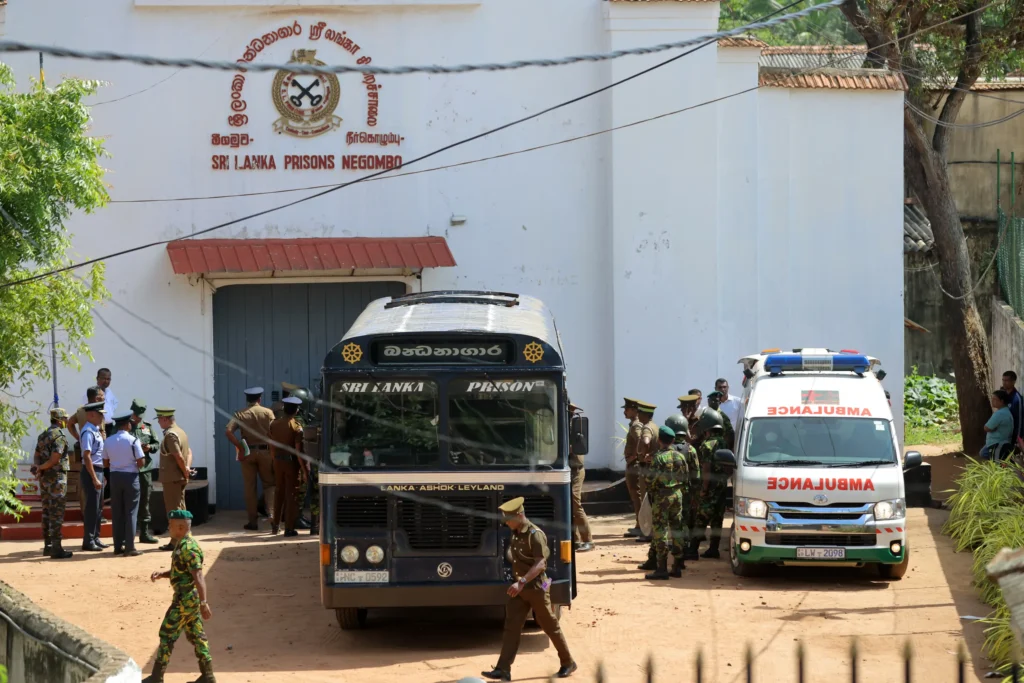
Authorities were continuing to transfer inmates from Negombo to other facilities Monday in an effort to reduce the population at the prison and prevent further violence. The ringleaders of Monday’s attack had already been removed to separate prisons, the justice minister confirmed.
Army troops remained deployed around the perimeter as of Monday evening, and the Police Special Task Force maintained a presence inside. Whether the transfers and security deployments will be sufficient to prevent a recurrence will depend in part on whether the underlying gang rivalries that sparked the original confrontation can be physically separated through the dispersal of key individuals across the prison network.
Sri Lanka’s government faces broader questions that cannot be resolved through individual transfers. A prison system holding nearly four times its intended population requires either a substantial expansion of capacity, a meaningful reduction in the remand population through faster judicial processing, or both.
Without structural change, the conditions that made Negombo a site of lethal violence on Saturday will continue to exist in every overcrowded facility across the country.
The justice ministry had not announced a formal independent investigation into the deaths as of Monday evening. Families of those killed, both inmates and prison officers, will be pressing for accountability as the full circumstances of the weekend’s events become clearer.
Sources: AP/DailyMirrorSriLanka





