Home Blog Page 463

Nigerian Police Kill Masterminds of Anambra Attack, Arrest 300+ Suspects, Seize Explosive Devices and Weapons

0

Nigerian police in Anambra state reported on Monday that they had killed the masterminds behind a 2024 gunmen attack on officers attached to the Rapid Response Squad (RRS) in the Uruagu Nnewi area. The police also arrested over 300 suspects, rescued 14 kidnapping victims, and recovered over 43 unexploded Improvised Explosive Devices (IEDs) during operations since January.

Police spokesperson SP Tochukwu Ikenga confirmed that in addition to the IEDs, officers seized more than 100 different brands of firearms, including AK-47s, pump-action guns, and locally made pistols. The operation also resulted in the recovery of 2,937 rounds of ammunition, 40 stolen vehicles, and motorcycles.

A notorious kidnapper, identified as Ablo, was arrested. Ablo had been terrorizing areas in Anambra, Enugu, and Delta states. His arrest was one of several key successes in Anambra’s ongoing crime-fighting efforts.

“Over 300 suspects have been arrested for various crimes, and we have secured more than 30 convictions with ongoing trials,” Ikenga said, emphasizing the effectiveness of the police operations in reducing crime. “We have also rescued 14 kidnapping victims unharmed.”

In addition to major drug and weapons busts, police operations led to the elimination of key criminal elements. One of the significant breakthroughs was the elimination of the masterminds behind the attack on the police RRS operatives in Uruagu Nnewi.

Other operations included the arrest of an 18-year-old boy in Nibo over a planned cult killing, the destruction of multiple criminal camps, and the recovery of 19 unexploded devices from a notorious camp in Nimo, Njikoka Local Government Area.

Two female victims of sexual abuse were also rescued, and two cultists were arrested in Awka, leading to the recovery of weapons and suspected hard drugs.

The police also made strides in community engagement by visiting local government headquarters and establishing a Community Policing Committee to enhance collaboration and improve public security.

In a separate case, police operatives rescued three children who were stolen from their parents in Bauchi state and sold to a new family in Anambra. Four suspects, including an illegal foster mother, were arrested in connection with the crime.

Ikenga further highlighted a tragic incident where two suspects were arrested for the murder of their brother, Chibuzor Okeke, who was killed after being accused of burglary. The suspects buried his body in a shallow grave to cover up the crime.

The Anambra Police Command continues its efforts to maintain public safety and combat criminal activities throughout the region.

saharareporters

UN Reports 901 Executions in Iran in 2024, Including 31 Women

The United Nations reported on Tuesday that Iran executed 901 people in 2024, including 31 women. The executions primarily involved drug-related offenses, though political dissidents and individuals connected to the 2022 mass protests were also among the victims.

The U.N. Human Rights Office revealed that some of the women executed were convicted of murder, often related to domestic abuse or forced marriages. Many of these women were victims of violence, including domestic abuse and child or forced marriages, according to the U.N.

Volker Türk, the United Nations High Commissioner for Human Rights, condemned the rising number of executions, calling it “deeply disturbing.” He urged Iran to halt the increasing number of death sentences, stating that it was “high time” the country addressed the ongoing surge in executions.

In total, at least 901 people were executed by hanging in Iran last year, an increase from 853 executions in 2023. This marked the highest execution rate since 2015, when 972 executions were recorded.

The spike in executions coincided with the aftermath of the 2022 protests sparked by the death of Mahsa Amini, a 22-year-old Kurdish Iranian woman who died in police custody after being arrested for allegedly violating Iran’s mandatory dress code. The protests were among the most significant unrest in Iran since the 1979 Islamic Revolution.

Among the executed were political activists and protesters involved in the demonstrations following Amini’s death. At least 31 women were executed in 2024, marking the highest number of female executions in at least 15 years, according to U.N. spokesperson Liz Throssell.

Masoud Pezeshkian, Iran’s newly elected president as of July 2024, made commitments during his campaign to improve the rights of women and minorities in the country.

Three Palestinians Killed in Intensified Israeli Operations in the West Bank

Israeli forces killed three Palestinian militants on Tuesday as military operations intensified across the occupied West Bank, following the killing of three Israelis near a Jewish settlement. 

The Palestinian Health Ministry confirmed the deaths of an 18-year-old in an Israeli airstrike in Tamun, a town northeast of Nablus, and a 40-year-old who was shot in the nearby village of Taluza. According to the Israeli military, an airstrike killed two fighters in the Tamun area after clashes with militants. WAFA, the official Palestinian news agency, also reported a second casualty in Tamun from the strike. 

In Taluza, a third militant was killed in a firefight with Israeli forces. Hamas’ armed wing, the al-Qassam Brigades, identified the deceased as one of its members. The Israeli military stated that several individuals were arrested during various incidents throughout the region. 

WAFA reported retaliatory attacks by Jewish settlers, including the burning of a Palestinian vehicle and attacks on a village overnight. Violence in the West Bank has escalated alongside the 15-month-long conflict between Israel and Hamas in Gaza. This surge includes killings by Palestinian militants, intensified Israeli military raids and airstrikes, and increased attacks by Jewish settlers. 

Casualties have mounted on both sides, with hundreds of Palestinians and dozens of Israelis killed during the unrest. The situation is further complicated by infighting among rival Palestinian factions. 

The escalating violence creates additional challenges for international mediators attempting to broker a ceasefire and hostage exchange deal in Gaza. These efforts are pressing as U.S. President-elect Donald Trump prepares to take office on January 20. 

Prime Minister Benjamin Netanyahu met with senior military and security officials after Monday’s killing of three Israelis. He authorized a series of “offensive and defensive actions” in the West Bank, alongside measures to apprehend those responsible for the killings. 

According to WAFA, the Israeli military has increased checkpoints, road closures, and incursions across the West Bank. 

The West Bank has remained under Israeli occupation since its capture during the 1967 Arab-Israeli War. Palestinians seek to include the territory as part of a future independent state. However, expanding Jewish settlements and ongoing violence, including the war in Gaza, have deepened fears that Israel may seek to formally annex the territory, further complicating any path to peace. 

reuters

Saudi Arabia Pressures Florida Man to Renounce U.S. Citizenship Over Critical Tweets, Family Says

A 74-year-old Florida retiree, Saad Almadi, claims Saudi authorities are coercing him to renounce his U.S. citizenship after jailing him for tweets critical of Crown Prince Mohammed bin Salman. According to his son, Ibrahim Almadi, Saudi Arabia’s government has pressured at least four dual Saudi-American nationals to give up their U.S. citizenship as part of a broader crackdown on dissent. 

74-year-old Florida retiree, Saad Almadi

Almadi, a retired project manager who immigrated to the U.S. in the 1970s, was arrested in Saudi Arabia in 2021 during a family visit. He was sentenced to over 19 years in prison on terrorism-related charges tied to his tweets, which included commentary on the killing of journalist Jamal Khashoggi and the crown prince’s rise to power. Though released after a year, Almadi remains barred from leaving Saudi Arabia under an exit ban. 

According to Ibrahim Almadi, Saudi intelligence agents summoned his father in November 2022, promising to lift the exit ban if he relinquished his U.S. citizenship. Feeling pressured, Saad Almadi signed a document and attempted to return his U.S. passport to the U.S. Embassy, though American law requires a formal, voluntary process to renounce citizenship. The U.S. State Department confirmed Almadi remains a citizen and continues to receive consular support. 

A human rights group, the Middle East Democracy Center, reported that three other dual U.S.-Saudi nationals have faced similar pressure. These individuals, like Almadi, are not known activists but appear to have drawn scrutiny for mild criticism or personal connections. 

The case highlights ongoing tensions in U.S.-Saudi relations, complicated by the legacy of the 2018 killing of Washington Post journalist Jamal Khashoggi, which U.S. intelligence linked to Crown Prince Mohammed bin Salman. President Joe Biden initially promised to hold Saudi leaders accountable but softened his stance amid rising gas prices. 

Former President Donald Trump, whose family maintains extensive business ties with Saudi Arabia, is expected to further strengthen ties with the kingdom during his upcoming presidency. His real estate organization recently announced plans for a luxury high-rise in Jeddah, while his son-in-law Jared Kushner secured a $2 billion investment from Saudi Arabia’s sovereign wealth fund. 

Almadi’s case underscores the challenges the U.S. faces in addressing rights violations by allies like Saudi Arabia. Mickey Bergman, CEO of Global Reach, a group advocating for detained Americans abroad, noted that actions by allies complicate U.S. foreign policy, particularly when contrasted with arbitrary arrests by adversaries such as Iran, Russia, and Venezuela. 

Despite diplomatic complexities, Ibrahim Almadi continues to push for his father’s release. “Words can’t describe it,” he said, reflecting on his years-long effort to secure his father’s freedom. Having paused his own career to focus on advocacy, he remains determined to reunite with his father and bring him home to the U.S. 

Strong Earthquake Near Mount Everest Kills at Least 95 in Western China

A powerful earthquake struck western China near the Tibet-Nepal border on Tuesday, leaving at least 95 people dead, over 130 injured, and hundreds trapped beneath rubble as dozens of aftershocks shook the region. The magnitude 7.1 quake, according to the U.S. Geological Survey (USGS), caused extensive damage in Tibet’s high-altitude Tingri County, near Mount Everest. 

Rescue workers sifted through piles of debris in heavily damaged villages, using ladders and makeshift tools to search for survivors. Videos released by China’s Ministry of Emergency Management showed rescuers pulling people from the wreckage, with some carried out on stretchers amid collapsed buildings. 

More than 1,000 homes were damaged in the sparsely populated region, China’s state broadcaster CCTV reported. Streets were strewn with fallen debris and crushed vehicles. The vice mayor of Shigatse city confirmed the injuries, while relief teams deployed over 3,000 rescuers and 100 million yuan ($13.6 million) in disaster relief funding. 

Chinese President Xi Jinping urged authorities to make all-out efforts to rescue survivors, reduce casualties, and provide shelter for displaced residents. Vice Premier Zhang Guoqing visited the quake-hit region to oversee recovery efforts. 

The quake struck in a seismically active zone where the Indian and Eurasian tectonic plates collide, an area prone to earthquakes powerful enough to reshape the towering Himalayan mountains. 

Residents of Nepal, about 230 kilometers (140 miles) from the epicenter, also felt the tremors. In Kathmandu, the capital city, people rushed into the streets in panic. However, Nepal’s National Emergency Operation Center reported no immediate injuries or significant damage. 

The quake’s epicenter was about 75 kilometers (50 miles) from Mount Everest. The scenic area on the Chinese side of the mountain was closed after the disaster. The region, largely deserted in winter, sees many residents migrate south to escape the harsh cold. 

This region has experienced 10 earthquakes of at least magnitude 6 over the past century, according to USGS data. The shallow depth of this quake—just 10 kilometers (6 miles)—increased its potential for destruction. 

Tibet, where the epicenter lies, remains a politically sensitive area. Although part of China, many Tibetans remain loyal to their exiled spiritual leader, the Dalai Lama, who fled following a failed uprising against Chinese rule in 1959. Human rights groups and Western governments frequently criticize Beijing for its treatment of Tibetans, citing crackdowns on dissent despite significant economic investments in the region. 

The earthquake triggered about 50 aftershocks within three hours, further complicating rescue efforts. Thousands of residents have been displaced, struggling to cope with freezing temperatures at an average altitude of 4,200 meters (13,800 feet). 

Videos from Kathmandu and surrounding areas showed water spilling from ponds and frightened residents describing the magnitude of the tremors. “It is a big earthquake,” one woman exclaimed in a video, with visible shaking in the background. 

The full extent of the damage is still being assessed as rescue operations continue in one of the most remote and challenging terrains in the world. 

Mexico Relocates Migrants to Acapulco Amid Border Dispersal Policy

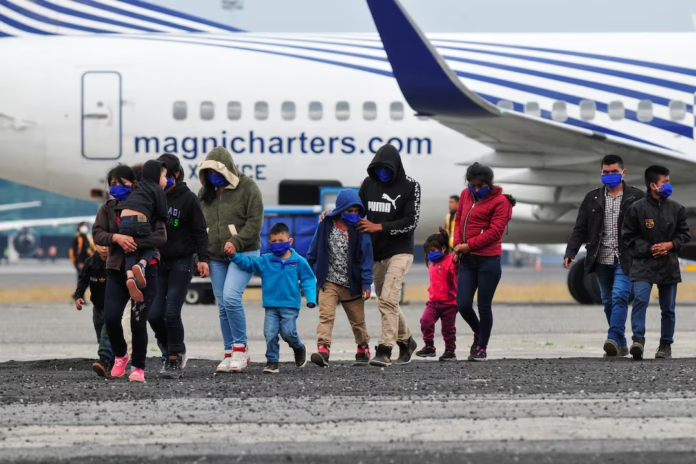
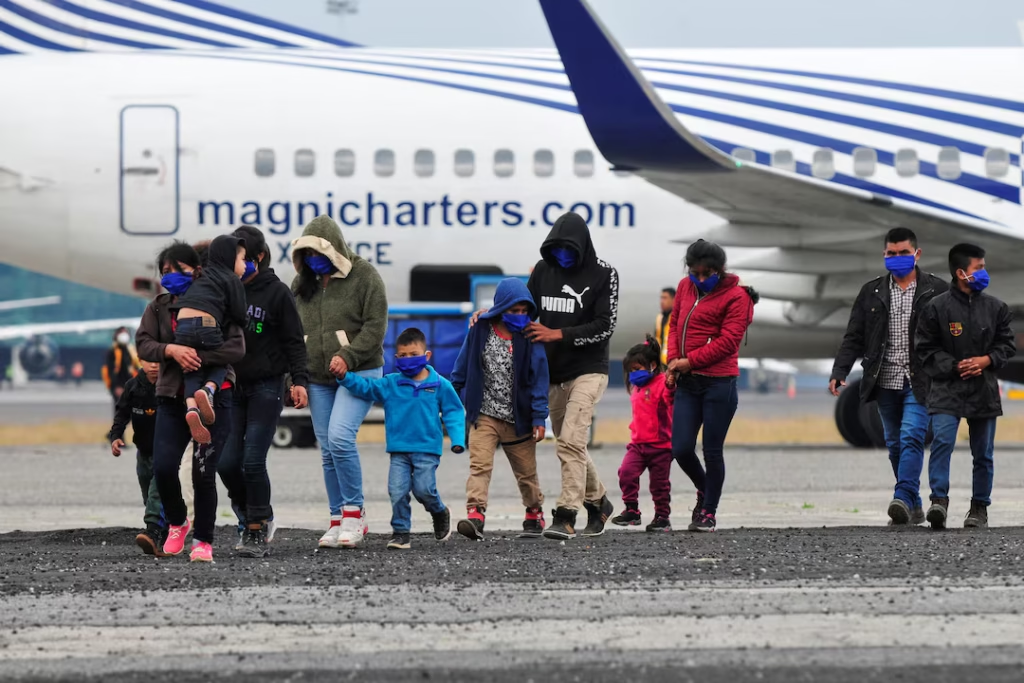
Hundreds of migrants, including about 100 who found themselves stranded in Acapulco, continue to face hardships as Mexico implements its policy of dispersing migrant caravans far from the U.S. border. 

Migrants from countries like Venezuela and Cuba, lured by promises of transit permits to continue their journey north, found themselves stuck in the Pacific coast resort city of Acapulco on Monday. Struggling to navigate their next steps, many were left sleeping on streets or seeking shelter in a Catholic church near the local immigration agency offices. 

“Immigration [officials] told us they were going to give us a permit to transit the country freely for 10, 15 days, and it wasn’t like that,” said 28-year-old Venezuelan migrant Ender Antonio Castañeda. “They left us dumped here without any way to get out. They won’t sell us [bus] tickets; they won’t sell us anything.” 

Acapulco, a city still recovering from the devastation of Hurricane Otis in 2023 and grappling with high levels of organized crime, is an unusual destination for migrants. Despite federal efforts to restore the city, including deploying soldiers and the National Guard for reconstruction and security, violence and economic difficulties persist. 

The policy of “dispersion and exhaustion,” employed by Mexican authorities, aims to break up high-profile migrant caravans and prevent a buildup of migrants near the U.S. border. Officials allow migrants to walk for days before offering transportation to various cities where their immigration status will be processed. 

While some migrants receive permits allowing transit across Mexico, others are restricted to specific states, including Guerrero, where Acapulco is located. Meanwhile, the dangers of traveling through Mexico remain prevalent. Migrants frequently face risks of extortion and kidnapping by drug cartels, as well as corruption and bribes demanded by authorities. 

Mexico’s President Claudia Sheinbaum has described her government’s approach as “humanitarian,” citing efforts to ease congestion in the southern city of Tapachula, a key waypoint near the Guatemalan border. However, migration advocates have criticized the relocation of migrants to areas like Acapulco, which lack the resources and infrastructure to support them. 

Rev. Leopoldo Morales, a priest assisting migrants in Acapulco, expressed concern over their dire circumstances. “We know they’re going through a very difficult time, with a lot of needs. They arrive without money,” he said, adding that local churches have provided food, water, and clothing. 

Acapulco’s high unemployment, compounded by storm damage and ongoing violence, makes it difficult for migrants to find work or safe passage north. For many, the journey to the U.S. border remains fraught with uncertainty and danger. 

Three Feared Dead, Nine Trapped in India’s Assam Coal Mine Flooding

Three miners are feared dead, and nine others remain trapped inside a flooded coal mine in Assam’s hilly Dima Hasao district in northeastern India. Rescue operations are ongoing as authorities and the military work to save the trapped miners. 

Local officials confirmed on Tuesday that three bodies have been spotted inside the flooded mine, though recovery efforts have not yet succeeded. The incident occurred on Monday when water inundated the mine, trapping 12 workers inside. 

According to district police chief Mayank Kumar, the flooding was caused by miners accidentally striking an underground water channel. “The mine got flooded yesterday — the source was internal. They [the miners] probably hit some water channel, and water came out and flooded it,” Kumar told Reuters. 

The Indian military has deployed divers, helicopters, and engineers to assist with the rescue efforts. Assam’s Mines Minister, Kaushik Rai, said the workers are feared to be trapped approximately 300 feet (91 meters) below the surface. “We are mobilizing resources to rescue them,” he added. 

Photos shared by the Indian Army on social media show rescue workers equipped with ropes, cranes, and other tools at the edge of the vertical mine shaft. 

The mine’s flooding highlights the ongoing dangers of coal extraction in India’s northeastern states, where miners often work in unsafe conditions in “rat hole” mines. These small, narrow mines are common in hilly regions, and workers use rudimentary methods to extract coal, hoisting it to the surface using pulleys. 

Accidents in such illegal mining operations are frequent. One of the most significant incidents occurred in 2019 in neighboring Meghalaya, where 15 miners were trapped and killed after water from a nearby river flooded an illegal mine. 

US Transfers 11 Yemeni Detainees From Guantanamo Bay to Oman

The United States has transferred 11 Yemeni detainees from the Guantanamo Bay detention center to Oman after holding them for more than two decades without charge. The move is part of ongoing efforts to reduce the prison’s population and eventually close the facility, which has long been criticized as a symbol of human rights abuses during the “war on terror.”

In a statement released on Monday, the U.S. Department of Defense expressed gratitude to Oman for supporting efforts to reduce the detainee population. “The United States appreciates the willingness of the government of Oman and other partners to assist in responsibly reducing the detainee population and ultimately closing the Guantanamo Bay facility,” the statement read.

Among those transferred is Sharqawi al-Hajj, who spent 21 years in detention following two years of CIA custody that included reported torture. Al-Hajj engaged in repeated hunger strikes during his time at Guantanamo to protest his prolonged detention. Pardiss Kebriaei, a lawyer with the Center for Constitutional Rights (CCR) representing al-Hajj, welcomed his release, saying, “Our thoughts are with Mr. Al Hajj as he transitions to the free world after almost 23 years in captivity. His release is hopeful for him and for us.”

The transfer leaves only 15 detainees at Guantanamo, down from a peak of nearly 800 in the years following the September 11, 2001, attacks. Human rights groups, including Amnesty International, have called for the closure of the detention center, labeling it a “glaring, longstanding stain on the human rights record of the United States.”

In recent weeks, U.S. authorities have accelerated efforts to transfer detainees. Several prisoners, including individuals held without charge for decades, were recently released to various countries. The Biden administration has reiterated its commitment to closing the facility, though significant hurdles remain.

Of the remaining 15 detainees, six are uncharged, with three cleared for transfer. The Defense Department noted that nine detainees are linked to high-profile terrorism cases, including the September 11 attacks and the USS Cole bombing.

aljazeera

Indonesia Joins BRICS Group of Emerging Economies

Indonesia has officially joined the BRICS group, a bloc of emerging economies that includes Russia, China, Brazil, and others, widely seen as a counterweight to Western influence.

Brazil, which currently holds the rotating presidency of the group, announced on Monday that Indonesia would join as a full member. On Tuesday, Indonesia confirmed the decision, stating it “welcomes” the development.

The Ministry of Foreign Affairs in Jakarta called BRICS membership “a strategic step to improve collaborations and cooperation with other developing nations, based on the principles of equality, mutual respect, and sustainable development.” The ministry also expressed its “gratitude to Russia,” which will chair BRICS in 2024, for its “support and leadership in facilitating Indonesia’s joining.”

Brazil’s foreign ministry highlighted the alignment between Indonesia and other BRICS members, saying Southeast Asia’s largest economy “shares the will to reform global governance institutions and contribute positively to cooperation within the Global South.”

Indonesia’s bid to join BRICS was approved at the 2023 summit held in Johannesburg.

Ukraine Denies Russian Claims of Kurakhove Capture, Fighting Ongoing

Ukraine’s military reported ongoing clashes in the eastern town of Kurakhove on Tuesday, disputing Russia’s claims of capturing the strategic location a day earlier.

Moscow described Kurakhove as an “important logistics hub” and claimed its seizure would expedite Russian advances across the Donetsk region. However, Ukraine’s Khortytsia army unit countered the claims, stating that “active” combat continued in the urban area of Kurakhove, with defense forces repelling attacks.

“In the Kurakhove sector, the defense forces are countering the enemy’s attempts to use their superiority in manpower and develop an offensive,” the Khortytsia unit said in a social media post. It also confirmed measures were underway to “localize and destroy enemy assault groups” that had infiltrated Ukrainian positions.

Kurakhove, with a pre-war population of approximately 18,000, is a critical location due to its power station, proximity to a reservoir, and significant lithium deposits. Ukrainian forces claimed to have repelled 26 attacks in the region, including those near the contested town.

Russian forces have been advancing in the Donetsk region for months, a territory Moscow declared annexed in 2022. Both sides are intensifying operations to secure territory ahead of major geopolitical shifts, including U.S. President-elect Donald Trump’s return to office later this month.

In another development, Ukraine’s military reported killing 13 North Korean soldiers in fighting in Russia’s Kursk region. Ukrainian Special Operations Forces claimed five soldiers were killed in a gun battle and eight in drone strikes. Western, South Korean, and Ukrainian intelligence allege that Pyongyang has sent over 10,000 troops to assist Russian forces.

Russia’s military reported that Ukraine launched a renewed counterattack in the Kursk region over the weekend, months after Kyiv’s forces captured dozens of border settlements during a surprise cross-border offensive.