Home Blog Page 602

Hamas Leader’s Wife Spotted with Luxury Hermès Birkin handbag Worth $32, 000 Before October 7 Massacre

The Israel Defense Forces (IDF) has released controversial footage showing Hamas leader Yahya Sinwar and his wife, Abu Zamar, entering a tunnel system shortly before the October 7 massacre in Israel. The video, which has sparked outrage, appears to show Sinwar’s wife carrying what the IDF claims is a £25,000 Hermès Birkin handbag, highlighting the stark contrast between the lifestyle of Hamas leadership and the struggles of ordinary Gaza residents.

In the three-minute video, Sinwar is seen moving supplies into an underground lair, including water bottles and pillows. The footage shows him helping his two young sons through the narrow concrete tunnel, followed by his wife, who is smiling and clutching the luxury bag. This occurred just a day before the deadly attack on Israeli communities.

IDF spokesperson Daniel Hagari commented on the video, stating, “Hours before the massacre, Sinwar cared only about himself and his family while he sent terrorists for the murderous attack on Israeli children, women and men. This was a luxury that the people of Gaza did not have as Sinwar always prioritised himself, his money and Hamas terrorists over the people of Gaza.”

The IDF also released images of Sinwar’s underground bunker, revealing a well-stocked hideout with modern amenities, including toilets, shower suites, and a large TV. The bunker reportedly contained UNRWA food parcels intended for civilian families, as well as a safe filled with millions in Israeli shekels and US dollars.

This revelation comes shortly after Sinwar’s reported death in Rafah last week, which the IDF claims was due to a long-range gunshot wound to the head. The military initially did not realize they had killed Sinwar until after the operation, confirming his identity through DNA and dental tests.

The release of this footage and information appears to be part of Israel’s ongoing efforts to discredit Hamas leadership and justify its military operations in Gaza. It has reignited debates about the disparity between the lives of Hamas leaders and the civilian population they claim to represent, as well as the ethical implications of such luxury amid the ongoing humanitarian crisis in Gaza.

As the conflict continues to unfold, this incident adds another layer to the complex narrative surrounding the Israel-Hamas war and its impact on civilians in both Israel and Gaza.

Israeli Forces Intensify Operations in Northern Gaza, Storming Shelters and Besieging Hospitals

Israeli forces have intensified their military operations in northern Gaza, particularly in the Jabalia refugee camp, leading to widespread destruction, civilian displacement, and a deepening humanitarian crisis. The campaign, which began over two weeks ago, has seen Israeli troops storming shelters, detaining men, and besieging hospitals in the area.

On Monday, residents and medical personnel reported that Israeli forces were blowing up homes and surrounding schools and shelters for displaced people in Jabalia, the largest of Gaza’s eight historic refugee camps. Eyewitnesses described scenes of chaos as troops rounded up men and ordered women to leave the camp.

At the Indonesian Hospital, medics told Reuters that Israeli troops stormed a nearby school, detaining men before setting the facility on fire. The blaze reportedly reached the hospital’s generators, causing a power outage. Health officials at the hospital stated they refused orders from the Israeli army to evacuate, citing their responsibility to care for patients.

Similar reports emerged from the Kamal Adwan Hospital, where staff reported heavy Israeli fire in the vicinity during the night. Hadeel Obeid, a supervising nurse at the Indonesian Hospital, described dire conditions, with dwindling medical supplies, no water, and a lack of food for the fourth consecutive day.

The United Nations expressed growing concern over the situation, stating it has been unable to reach the three hospitals in northern Gaza. The UN Human Rights Office warned that the manner of Israeli military operations, including interference with humanitarian assistance and forced displacement orders, may be causing the destruction of the Palestinian population in Gaza’s northernmost governorate.

Palestinian health officials reported 18 people killed in Jabalia and eight elsewhere in Gaza due to Israeli strikes. The Israeli military stated that troops were continuing ground operations across the Gaza Strip, dismantling militant infrastructure and tunnel shafts, and killing fighters in the Jabalia area.

The intensification of military campaigns in both Gaza and Lebanon follows the recent killing of Hamas leader Yahya Sinwar, which had initially raised hopes for potential ceasefire talks. Israel has vowed to eradicate Hamas, but the campaign has resulted in widespread destruction and a severe humanitarian crisis, with over 1.9 million people left homeless.

Hamas has accused Israel of carrying out acts of “genocide and ethnic cleansing” against the people of northern Gaza to force them to leave. The militant group claims its fighters have attacked Israeli forces with anti-tank rockets, mortar fire, and pre-planted explosives.

The ongoing conflict has devastated Gaza, with Palestinian health authorities reporting over 42,500 deaths and an estimated 10,000 more uncounted dead believed to be under the rubble. The international community continues to express concern over the humanitarian situation and the mounting civilian casualties.

As the conflict escalates, the focus remains on the urgent need for humanitarian access, the protection of civilians, and efforts to find a diplomatic solution to the crisis. The situation in northern Gaza, particularly around hospitals and refugee camps, remains critical as international organizations call for immediate action to address the growing humanitarian disaster.

Four Killed in Houston Helicopter Crash, Radio Tower Destroyed

A tragic helicopter crash in Houston’s Second Ward on Sunday evening resulted in the deaths of four people and the destruction of a radio tower, prompting a multi-agency investigation and raising concerns about aviation safety in urban areas.

The incident occurred just before 8 p.m. when a private Robinson R44 II helicopter, carrying four individuals including a child, went down shortly after taking off from Ellington Field, located approximately 15 miles southeast of the crash site. Mayor John Whitmire, speaking at a news conference, confirmed the fatalities but noted that the helicopter’s destination remained unknown.

Houston Police Chief J. Noe Diaz stated that the helicopter either struck a cable or the radio tower itself, leading to the crash. The identities and ages of the victims have not been released pending notification of next of kin.

The crash site, situated in a residential area, narrowly avoided causing further damage to nearby homes. Mayor Whitmire emphasized the fortunate aspect of the crash’s location, stating, “It is surrounded by residences and that’s where we were very fortunate — that it didn’t topple in one direction or another.” While some area residents lost power due to the incident, no additional injuries or property damage were reported.

Fire Chief Thomas Muñoz confirmed that a large area of grass caught fire as a result of the crash, but firefighters from a nearby station quickly responded to the scene after hearing the impact. The radio tower and helicopter were completely destroyed in the incident.

The National Transportation Safety Board (NTSB) announced via social media that it had launched an investigation into the crash. Multiple agencies, including the Federal Aviation Administration (FAA), Department of Public Safety, and Houston fire and police departments, are collaborating on the investigation.

Local authorities have urged residents near the crash site to contact emergency services if they discover any debris or potential evidence on their properties that could assist in the ongoing investigation.

City Councilmember Mario Castillo clarified on social media that the helicopter involved was not affiliated with the Houston Police Department but was a private touring helicopter, although this information is still pending official confirmation.

Two Children Killed by Train in Egypt, Sparking Violent Protests

A tragic incident occurred on Monday in Al-Ayat, a town outside Cairo, Egypt, when a train struck and killed two children attempting to cross the tracks at an unauthorized location. The accident sparked violent protests from local residents, who attacked a railway guard and his post in the aftermath.

According to the Egyptian National Railways, the incident took place near the town of Bilaydah in Al-Ayat. The children, reportedly on their way to school, were attempting to cross the tracks at a point not designated for pedestrian use. Local media sources indicated that the level crossing was closed at the time of the accident.

In response to the tragedy, an angry crowd gathered at the intersection where the accident occurred. Protestors targeted the railway guard responsible for securing the level crossing, attacking him and setting fire to his post. The exact fate of the guard remains unclear at this time.

Train accidents are unfortunately common in the country, with another recent crash in southern Egypt resulting in one death and over 20 injuries earlier this month.

The Egyptian government has announced various initiatives in recent years aimed at improving railway safety and infrastructure. However, this latest tragedy and the ensuing violent reaction from the local community highlight the persistent challenges and public frustration with railway safety standards.

As investigations into the incident continue, attention is likely to focus on both the circumstances that led to the children accessing the tracks at an unauthorized point and the broader issues of railway safety and public education about the dangers of crossing tracks improperly.

Police and Prosecutors in Mexico’s Sinaloa State Implicated in Cover-Up of Political Opponent’s Murder

Federal prosecutors in Mexico have unveiled a bombshell revelation implicating police, prosecutors, and forensic examiners in Sinaloa state in a conspiracy to cover up the killing of Héctor Cuén, a political opponent of ruling-party Governor Ruben Rocha. The announcement, made on Sunday, corroborates claims made by imprisoned drug lord Ismael “El Mayo” Zambada and deepens the political crisis in the violence-plagued northern Mexican state.

The federal Attorney General’s Office stated that their investigation has “confirmed the presumed administrative and criminal responsibilities of Sinaloa police, detectives, forensic examiners and state prosecutors” in relation to Cuén’s death. This statement supports Zambada’s account of events from July 25, when he claims he was kidnapped at the same time and location where Cuén was murdered.

Key elements of the federal prosecutors’ findings include blood evidence from the crime scene: Cuén’s blood was found at the ranch where Zambada claims the kidnapping and murder took place, contradicting the state’s official narrative and falsified video evidence: Security camera footage of an alleged robbery at a gas station, presented by state prosecutors as the scene of Cuén’s murder, was proven to be falsified.

Other hidden facts are discrepancies in forensic evidence: Post-mortem records showed Cuén’s body had four gunshot wounds, while only one shot was audible in the faked security footage, improper handling of evidence: Sinaloa officials violated murder investigation protocols by allowing Cuén’s body to be cremated almost immediately, and blood-stained vehicle: A white pickup truck seen in the falsified footage contained blood from one of Zambada’s bodyguards, suggesting state police either disposed of a body or misused evidence to stage the fake robbery scene.

The case has further complicated the position of Governor Rocha, a member of President Claudia Sheinbaum’s ruling Morena Party. Rocha has faced criticism for his handling of the escalating violence between rival factions of the Sinaloa drug cartel following the events of July 25. Despite ongoing gunbattles, killings, kidnappings, and cartel roadblocks in the state capital Culiacan, Rocha has attempted to downplay the situation, stating on Thursday that “there is nothing to worry about” and “everything is under control.”

Zambada’s account of the July 25 events suggests a complex interplay between politics and organized crime in Sinaloa. He claims he was invited to a meeting to mediate the political rivalry between Governor Rocha and Cuén, indicating the drug lord’s perceived role as an arbiter in state political disputes.

The revelation has reignited questions about Governor Rocha’s potential involvement in the events of July 25. While Rocha denies knowledge of or attendance at the meeting where Zambada was allegedly abducted, doubts persist about his whereabouts that day, as he has not provided conclusive evidence of his claimed trip to California.

This case has exposed the deep-rooted corruption and entanglement of politics with organized crime in Sinaloa, a state long plagued by drug-related violence. As federal authorities continue their investigation, the implications for local and national politics, as well as the ongoing struggle against drug cartels, remain significant and far-reaching.

AP

Moldova Narrowly Votes in Favor of EU Path Amid Claims of Russian Interference

Moldova has narrowly voted in favor of securing its path toward European Union membership, with final electoral data showing a razor-thin majority of 50.39% voting “Yes” against 49.61% voting “No.” The referendum, held on Sunday, saw a turnout of approximately 1.4 million voters, representing about 51% of eligible voters.

President Maia Sandu, a staunch pro-EU advocate, accused “criminal groups” of working with foreign forces to undermine the vote. She claimed these groups attempted to buy 300,000 votes, describing it as “a fraud of unprecedented scale.” Sandu asserted that these efforts were aimed at keeping Moldova “trapped in uncertainty and instability.”

The European Commission in Brussels echoed concerns about Russian interference, with spokesperson Peter Stano stating that the vote took place under “unprecedented interference and intimidation by Russia and its proxies.” The Commission underlined its continued support for Moldova’s EU accession path.

Concurrent with the referendum, a presidential election was held, with Sandu winning the first round at 42% but failing to secure an outright majority. She will face Alexandr Stoianoglo, a Russia-friendly former prosecutor general who garnered around 26% of the vote, in a runoff on November 3.

The close result of the referendum has raised questions about the strength of pro-EU sentiment within Moldova. Cristian Cantir, a Moldovan associate professor at Oakland University, suggested that polls may have overestimated pro-EU feelings inside the country, noting that the referendum might have failed without votes from the diaspora.

Moldovan authorities have reported uncovering a massive vote-buying scheme allegedly orchestrated by Ilan Shor, an exiled pro-Russia oligarch. The scheme reportedly involved paying 15 million euros to 130,000 individuals to undermine both the referendum and presidential election. Shor, who was convicted in absentia last year for fraud and money laundering, has denied these allegations.

Further complicating the political landscape, Moldovan authorities claimed to have foiled a plot involving over 100 young Moldovans who received training in Moscow on how to create civil unrest around the votes. Some reportedly attended “more advanced training in guerrilla camps” in Serbia and Bosnia.

The referendum and election results underscore Moldova’s complex geopolitical position, caught between pro-EU aspirations and Russian influence. As a former Soviet republic with a population of about 2.5 million, Moldova applied to join the EU following Russia’s invasion of Ukraine in 2022 and was granted candidate status that summer.

With parliamentary elections scheduled for next year, the narrow victory in the EU referendum and the upcoming presidential runoff highlight the ongoing challenges Moldova faces in balancing its Western aspirations with its historical ties to Russia. The international community continues to watch closely as Moldova navigates these complex political waters.

apnews

Turkish Cleric Fethullah Gülen Dies in U.S. Exile, Leaving Complex Legacy

Fethullah Gülen, the influential Turkish Islamic cleric who inspired a global social movement and was accused by Turkey of masterminding a failed 2016 coup, has died in self-imposed exile in Pennsylvania, USA. The death of the octogenarian spiritual leader was confirmed by his nephew, Kemal Gülen, and acknowledged by Turkish Foreign Minister Hakan Fidan.

Gülen, who had been living on a secluded compound in the Pocono Mountains, was a controversial figure who blended Sufi Islamic teachings with advocacy for democracy, education, and interfaith dialogue. His Hizmet movement, also known as the Gülen movement, established a vast network of schools, businesses, and media outlets across more than 100 countries.

Once an ally of Turkish President Recep Tayyip Erdogan, Gülen became a fierce opponent, accusing Erdogan of authoritarianism. The Turkish government, in turn, labeled Gülen a terrorist and accused him of orchestrating the July 15, 2016 coup attempt, which resulted in 251 deaths and over 2,200 injuries. Gülen consistently denied these allegations.

Following the failed coup, Turkey launched a extensive crackdown on Gülen’s followers, arresting tens of thousands and dismissing over 130,000 civil servants suspected of links to his movement. The U.S. refused to extradite Gülen, citing insufficient evidence.

Born in Erzurum, eastern Turkey, in the late 1930s, Gülen trained as an imam and gained prominence in Turkey for his teachings that merged Islam with Western values and Turkish nationalism. His movement operated universities, hospitals, charities, and media outlets in Turkey before the crackdown.

Gülen had been living in the United States since 1999, initially for medical treatment. He won a legal battle for permanent U.S. residency despite accusations in Turkey of plotting to overthrow the secular government.

Turkish Foreign Minister Fidan stated that Gülen’s death would not end the government’s efforts against his organization, calling it a “threat rarely seen in the history of our nation.” He urged Gülen’s followers to abandon what he termed a “treasonous wrong path.”

As news of Gülen’s death spreads, it marks the end of an era in Turkish politics and global Islamic movements. The impact of his life and the future of his movement remain subjects of intense debate and scrutiny.

AP

Togo Suspends Russian-Owned Ride-Hailing App Yango Over Security Concerns

Togo’s transport ministry has suspended the operations of Yango, a ride-hailing app owned by Russian tech giant Yandex, just months after it began operating in the West African country. The decision, announced on Thursday, cites security concerns and violations of the country’s procedures.

According to the ministry’s statement, Yango commenced operations in June without proper authorization, contravening Togo’s established protocols. The suspension was implemented due to concerns over passenger safety, public order, and adherence to legal procedures.

“The activities of the operator YANGO are therefore suspended across the entire national territory,” the ministry declared in its official statement.

In response to the suspension, Yango claimed that it operates independently from Yandex and is headquartered in Dubai. The company stated that discussions are currently underway with the Togolese government, expressing confidence that a solution will be reached to allow the continuation of its services in the country.

The case of Yango in Togo raises questions about the regulation of digital platforms in emerging markets and the balance between fostering innovation and ensuring public safety. As negotiations continue between Yango and Togolese authorities, the outcome may set a precedent for how similar services are regulated in the region. This development comes at a time when many African countries are grappling with how to integrate new technologies and services into their existing transportation ecosystems while maintaining control over security and regulatory compliance

Seven-Story Building Collapses in Northern Nairobi, Prompting Evacuation and Rescue Efforts

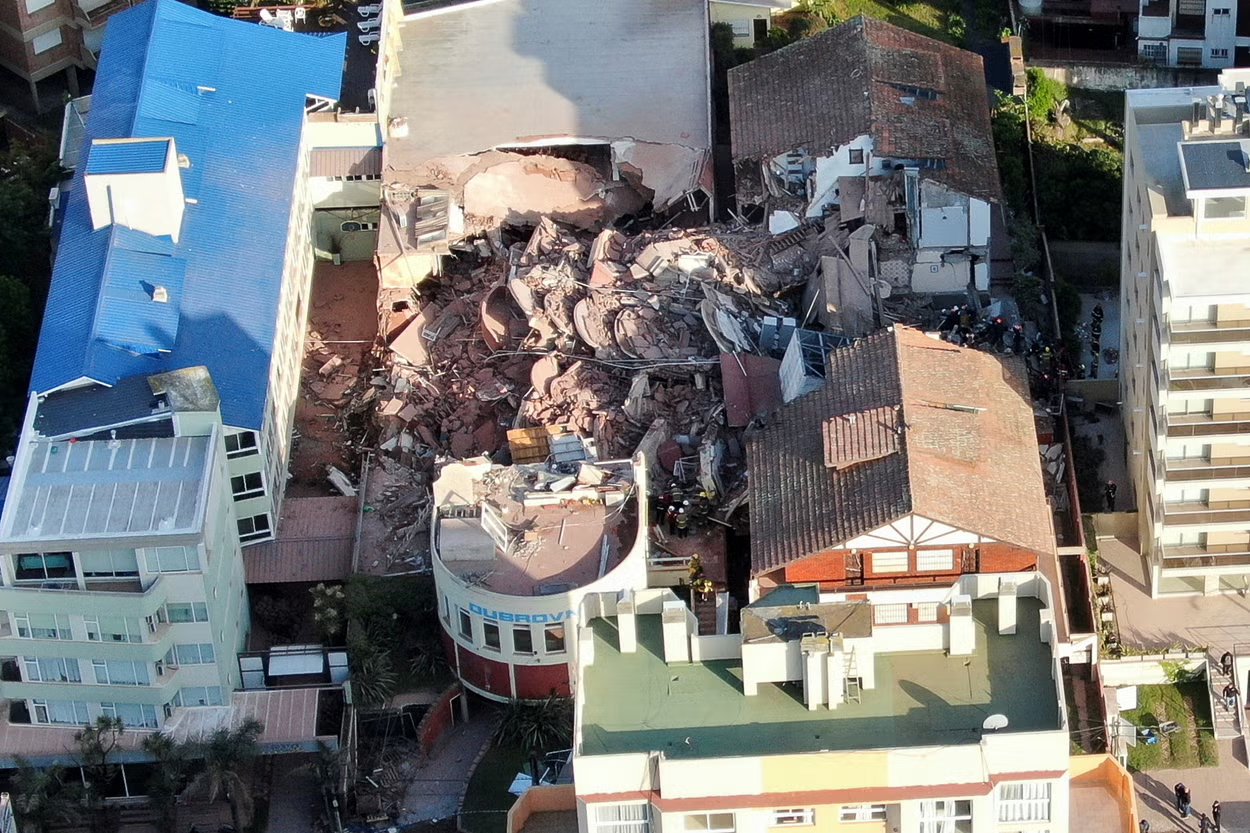
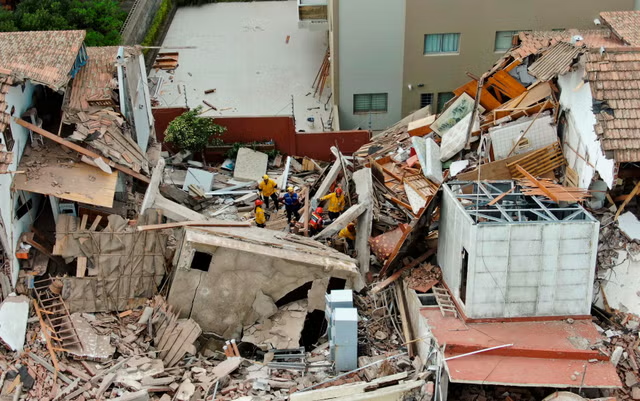
A seven-story residential building in Nairobi’s Kahawa West neighborhood in Kenya collapsed on Sunday, prompting an immediate search and rescue operation. The incident, captured on video, shows the structure crumbling as onlookers flee in panic.

Nairobi Governor Johnson Sakaja reported one confirmed casualty, a middle-aged woman who was injured outside the building during the collapse. She is currently receiving treatment and is in stable condition. However, the Kenya Red Cross has stated that several families may still be trapped inside the rubble.

Eyewitness Dicken Muchena, 31, reported that the building had been identified as a potential hazard earlier in the day, leading some residents to evacuate. “There were signs of collapse so people started vacating,” Muchena said, describing the scene as one of “horror” and “confusion.”

Nairobi police chief Adamson Bungei confirmed that an evacuation had taken place prior to the collapse due to concerns about the building’s structural integrity. “We are not sure if there were people still therein, but I know there was an evacuation that happened. They knew it was weak,” Bungei stated.

The Kenya Red Cross has reported that two people have been rescued and transported to Kenyatta University Teaching, Referral & Research Hospital. Governor Sakaja assured that all necessary equipment has been mobilized for the rescue operation, with Deputy Governor Njoroge Muchiri overseeing efforts at the site.

This incident raises concerns about building safety and construction standards in Nairobi, a rapidly growing urban center. As rescue efforts continue, authorities are likely to face questions about the enforcement of building codes and the prevention of similar incidents in the future.

The collapse has prompted the evacuation of adjacent buildings as a precautionary measure. Officials are urging residents to cooperate with emergency services and to report any signs of structural instability in their neighborhoods. As the search and rescue operation continues, local authorities are working to account for all residents and provide support to those affected by the collapse

Nigeria Police Release 22 Protesters Detained at #EndSARS Memorial March

The Lagos State police command in Nigeria has released at least 22 individuals who were detained during the #EndSARS memorial protest on Sunday. The arrests occurred in the Lekki tollgate area of Lagos, where protesters had gathered to commemorate victims of police brutality and demand the implementation of judicial panel recommendations.

Demonstrators assembled around 8:30 am to honor those who lost their lives during the 2020 police brutality protests. The crowd called for the full implementation of findings from judicial panels established in the wake of the #EndSARS movement. However, police officers intervened to disperse the gathering, leading to multiple arrests, including the organizer of the memorial event.

The #EndSARS protests, which began four years ago, saw thousands of Nigerians rally against the actions of the now-disbanded Special Anti-Robbery Squad (SARS), a unit accused of widespread police brutality. An Amnesty International report states that at least 12 protesters were killed at the Lekki tollgate in 2020 when Nigerian security forces opened fire on demonstrators.

Sunday’s protest was met with a significant police presence, preventing marchers from proceeding through the tollgate. The police action reflects ongoing tensions between law enforcement and activists seeking accountability for past incidents of police violence.

The release of the detained protesters comes amid continued calls for police reform and justice for victims of brutality. As Nigeria grapples with these issues, the #EndSARS movement remains a potent symbol of the struggle for human rights and accountability in the country’s law enforcement system.

Lagos authorities have not provided further comments on the arrests or the decision to release the protesters.