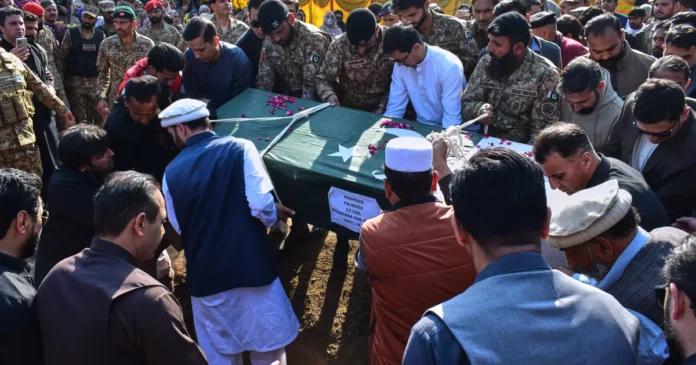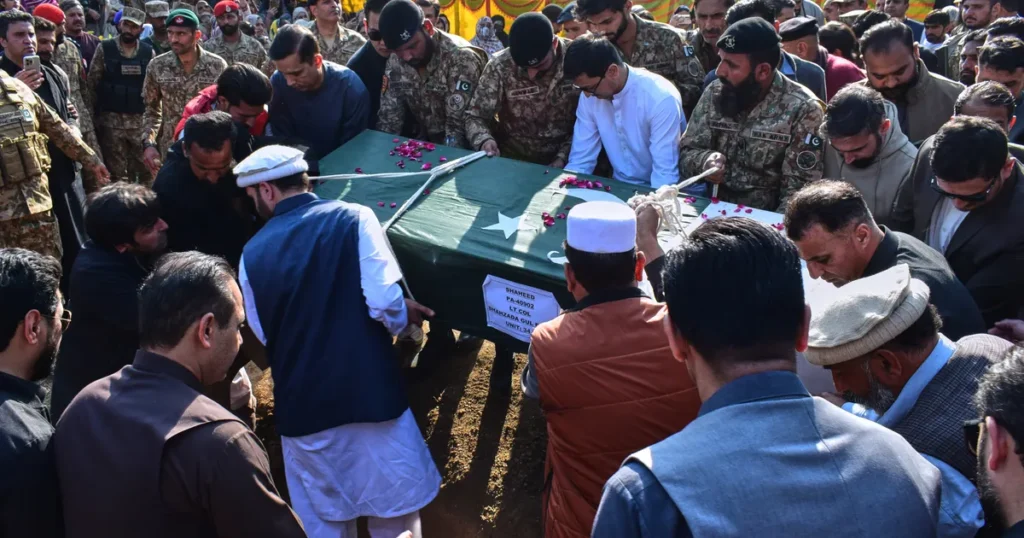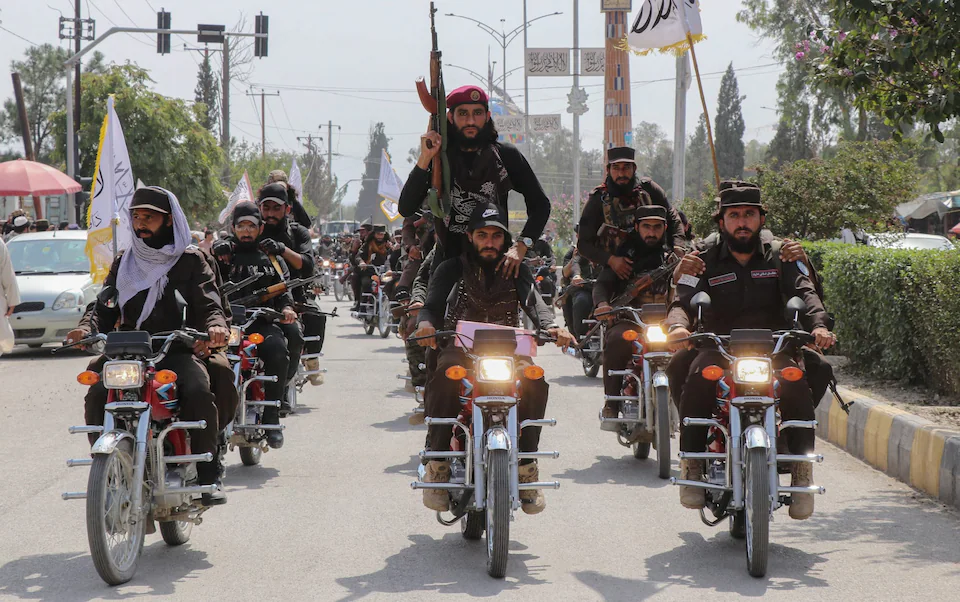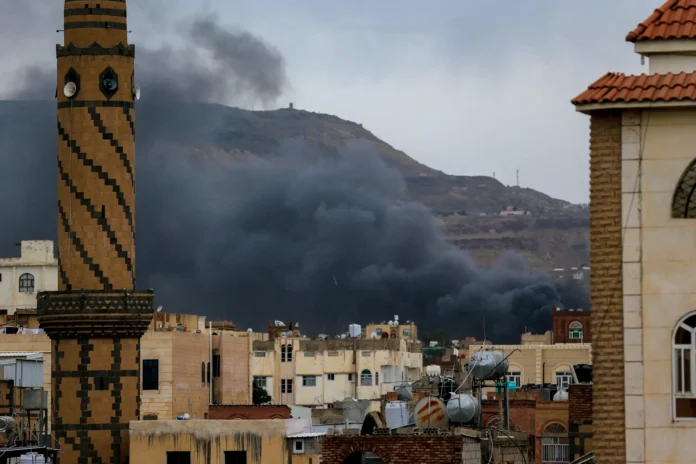
A motorcycle packed with explosives detonated outside a police station in northwestern Pakistan on Monday, killing at least two people — including a child — and injuring several others, authorities said, in the latest episode of violence to strike the restive border region.
The blast occurred near the entrance gate of a police facility in Bannu, a district in Khyber Pakhtunkhwa province that lies along Pakistan’s frontier with Afghanistan. The explosion also damaged nearby shops, sending debris across the street and shattering storefronts, local officials indicated.
Fida Mohammad, a local police official, confirmed that the dead and injured were transported to a nearby hospital. He declined to provide additional operational details, citing the ongoing investigation.
No group immediately asserted responsibility for the attack. However, suspicion is expected to center on the Pakistani Taliban, also known as Tehreek-e-Taliban Pakistan, or TTP, which has carried out similar assaults in the province in recent years.
Khyber Pakhtunkhwa has witnessed repeated attacks targeting security installations, police checkpoints and government offices. Bannu, in particular, has experienced periodic violence as militants seek to undermine state authority in the region.
Pakistan has seen a marked escalation in militant activity in recent years. Authorities in Islamabad frequently attribute such incidents to the TTP, a group that is separate from but closely aligned with Afghanistan’s Taliban rulers. The Afghan Taliban returned to power in Kabul in 2021 following the withdrawal of U.S. and NATO forces.
The resurgence of militant operations has intensified tensions between Pakistan and Afghanistan. Pakistani officials have alleged that TTP fighters operate from sanctuaries across the border inside Afghanistan — an accusation both the TTP and Afghan authorities have denied.
The attack in Bannu underscores the fragility of security conditions along the mountainous frontier, where decades of insurgency and cross-border militancy have complicated stabilization efforts. Security forces have conducted multiple counterterrorism operations in the region, yet bombings and targeted assaults continue to pose a persistent threat.
Monday’s explosion reflects a tactical pattern frequently employed by militant groups operating in northwestern Pakistan: improvised explosive devices mounted on motorcycles or other vehicles to strike high-profile security targets. Such attacks are relatively low-cost yet highly disruptive, often intended to project strength and erode public confidence in law enforcement.
The targeting of a police installation suggests militants remain focused on weakening local security infrastructure rather than engaging in large-scale territorial offensives. Police stations and paramilitary posts are often chosen because they symbolize state presence in districts where government authority has historically been contested.
The inclusion of a child among the fatalities may intensify public outrage and increase pressure on authorities to deliver a swift response. Civilian casualties in densely populated urban settings can complicate counterinsurgency strategies, particularly in areas where security operations already face community sensitivities.
The broader uptick in violence coincides with a period of regional uncertainty. Since the Afghan Taliban’s return to power, cross-border security cooperation has become more complex. Islamabad has repeatedly urged Kabul to curb militant activity directed at Pakistan, while Afghan officials maintain they do not permit their territory to be used for attacks abroad.
Security analysts note that sustained instability in Khyber Pakhtunkhwa could strain Pakistan’s military and intelligence resources at a time when the country is also grappling with economic challenges and political transitions. Attacks like the one in Bannu serve as reminders that despite years of counterterrorism campaigns, militant networks retain operational capability.
As investigators examine the scene and gather forensic evidence, authorities are likely to increase patrols and tighten security around government installations in the region. Whether the incident signals a broader campaign or remains an isolated strike will depend on developments in the coming days.
The Department of Justice delivered a contentious six-page letter to Congress Saturday listing hundreds of prominent figures mentioned in millions of documents related to convicted sex offender Jeffrey Epstein, immediately triggering bipartisan condemnation from lawmakers who accused Attorney General Pam Bondi’s department of deliberately obscuring genuine connections to the disgraced financier.
The catalog of “politically exposed persons” includes more than 300 names spanning presidents, business magnates, government officials, and cultural icons—many of whom appear to have no actual association with Epstein beyond incidental references in emails, news articles, or investigative materials. The indiscriminate compilation places deceased celebrities like Marilyn Monroe, who died when Epstein was nine years old, and singer Janis Joplin, who died in 1970 when Epstein was seventeen, on the same roster as individuals with documented ties to the convicted predator.
Deputy Attorney General Todd Blanche signed the letter addressed to senior members of the House and Senate Judiciary Committees, stating the department had “released ‘all records, documents, communications and investigative materials in possession of the Department’ that relate to” Epstein. The communication signals what the Justice Department characterizes as its final disclosure under the Epstein Files Transparency Act, legislation Congress passed compelling release of investigative materials.
CNN obtained a copy of the letter, which provides no contextual information distinguishing between individuals who maintained extensive direct contact with Epstein and those whose names appear merely because they were mentioned in tangential documents, press clippings, or routine law enforcement communications unrelated to Epstein’s criminal activities.
“Names appear in the files released under the Act in a wide variety of contexts,” the Justice Department letter acknowledges. “For example, some individuals had extensive direct email contact with Epstein or Maxwell while other individuals are mentioned only in a portion of a document (including press reporting) that on its face is unrelated to the Epstein and Maxwell matters.”
Representative Ro Khanna, a co-author of the transparency legislation, delivered scathing criticism of the Justice Department’s approach, characterizing it as a deliberate strategy to protect powerful individuals with genuine Epstein connections by diluting the list with irrelevant names.
“The DOJ is once again purposefully muddying the waters on who was a predator and who was mentioned in an email,” Khanna declared on social media platform X. “To have Janis Joplin, who died when Epstein was 17, in the same list as Larry Nassar, who went to prison for the sexual abuse of hundreds of young women and child pornography, with no clarification of how either was mentioned in the files is absurd.”
Khanna demanded the Justice Department “stop protecting predators” and release complete files with only survivor identities redacted, arguing the current approach serves to shield rather than expose those who enabled or participated in Epstein’s criminal enterprise.
Republican Representative Nancy Mace, a vocal advocate for Epstein’s victims, condemned the disclosure in a Saturday evening social media post, alleging “missing names on the list disclosed this evening.” Mace has emerged as one of Congress’s most persistent voices demanding comprehensive transparency around Epstein investigations and prosecution decisions.
The list includes numerous high-profile figures with previously documented associations with Epstein, including President Donald Trump, former President Bill Clinton, former Trump adviser Steve Bannon, former White House Counsel Kathy Ruemmler, and billionaire retail magnate Les Wexner. Trump maintained social connections with Epstein during the 1990s and early 2000s but has stated he severed contact before Epstein’s 2008 Florida conviction on solicitation charges.
However, the compilation also incorporates deceased cultural figures including Princess Diana, Elvis Presley, Michael Jackson, Cher, and Beyoncé—individuals whose inclusion appears to stem from their names appearing in emails, newsletters, or news articles within the vast document trove rather than any actual interaction with Epstein or involvement in his activities.
Current lawmakers also appear on the list because their names surfaced in Justice Department press briefings or FBI daily news summaries that happened to be included in the released files, despite having no connection to Epstein investigations. This inclusion of sitting members of Congress based on routine law enforcement communications further illustrates the list’s lack of discriminating criteria.
No individual listed beyond Epstein himself and his accomplice Ghislaine Maxwell has ever faced criminal charges connected to Epstein’s sex trafficking enterprise. Maxwell is currently serving a 20-year federal prison sentence following her 2021 conviction on charges including sex trafficking of minors and conspiracy.
The Justice Department defended its compilation approach by noting that Congress never defined what constitutes a “politically exposed person” in the transparency legislation, leaving the department to interpret the requirement broadly. This explanation has failed to satisfy lawmakers who authored the legislation with the explicit intent of exposing individuals who facilitated, enabled, or participated in Epstein’s crimes.
According to The Independent, lawmakers who championed the document release remain deeply dissatisfied with the Justice Department’s latest disclosure, believing officials are deliberately employing vague presentation to protect powerful figures with substantive Epstein connections. The bipartisan criticism suggests the controversy transcends typical partisan divisions, uniting progressive and conservative members around demands for genuine transparency.
The department has faced sustained criticism from Epstein victims and congressional members since beginning file releases over what critics characterize as inconsistent redaction standards that appear to protect certain individuals while exposing others. Some lawmakers who reviewed unredacted document versions subsequently claimed the Justice Department was shielding powerful men, prompting them to publicly disclose additional names the department had obscured.
As in previous congressional correspondence, the Justice Department cited rationales for redacting information extending beyond statutory requirements in the transparency legislation. Officials invoked privileges protecting deliberative processes, attorney work product, and attorney-client communications—legal doctrines that, while established in other contexts, appear to contradict the transparency law’s intent.
The millions of released documents represent materials accumulated during federal investigations spanning years and involving multiple jurisdictions. Epstein’s 2008 Florida conviction resulted from a controversial non-prosecution agreement with federal prosecutors that allowed him to plead guilty to state solicitation charges while avoiding federal sex trafficking charges that could have resulted in life imprisonment.
That agreement, negotiated when Alexander Acosta served as U.S. Attorney for the Southern District of Florida, sparked outrage when details became public, ultimately forcing Acosta’s resignation as Trump’s Labor Secretary in 2019. The deal’s terms, which were concealed from victims in potential violation of the Crime Victims’ Rights Act, exemplify the preferential treatment wealthy, connected defendants sometimes receive within the criminal justice system.
Epstein faced new federal sex trafficking charges in New York in July 2019 following investigative journalism that exposed the extent of his abuse and the protection he’d received from law enforcement. However, he died by apparent suicide in his Manhattan jail cell in August 2019 while awaiting trial, eliminating the possibility of courtroom testimony that might have implicated other individuals in his trafficking network.
His death under suspicious circumstances while housed in a federal detention facility sparked conspiracy theories and intensified demands for investigating others who may have participated in or enabled his crimes. The subsequent prosecution and conviction of Ghislaine Maxwell provided some measure of accountability but left unresolved questions about other potential conspirators.
Epstein’s extensive connections to political, business, and cultural elites—documented through flight logs, telephone records, and witness testimony—have fueled speculation about a broader network of powerful individuals who either participated in his crimes or maintained relationships despite awareness of his predatory behavior. However, distinguishing between social acquaintances and criminal accomplices requires evidence that remains largely sealed or unreleased.
The Justice Department’s document release, mandated by congressional legislation, was intended to provide transparency around federal investigative efforts and potentially expose individuals who escaped accountability. However, the indiscriminate listing of names without contextual information appears to have achieved the opposite effect, creating confusion that obscures rather than clarifies genuine Epstein associations.
Victims’ advocates have consistently demanded comprehensive disclosure of investigative materials, arguing that survivors deserve full knowledge of how federal authorities handled cases involving their abuse and why certain individuals avoided prosecution despite potential evidence of involvement. The advocacy groups view transparency not merely as historical accountability but as essential to preventing future institutional failures that enable predators.
The controversy illustrates broader tensions between legitimate privacy interests, investigative confidentiality requirements, and public demands for transparency in cases involving powerful figures. While protecting innocent individuals from unfounded association with criminal activities represents a valid concern, critics argue the Justice Department’s approach prioritizes protecting the reputations of elites over serving justice for victims.
As congressional committees review the Justice Department’s submission, lawmakers face decisions about whether to accept the disclosure as satisfying transparency legislation requirements or to pursue additional investigative avenues compelling more discriminating information release. Some members have suggested subpoenaing Justice Department officials to testify about redaction decisions and document handling.
The dispute may ultimately require judicial intervention if Congress determines the Justice Department failed to comply with statutory disclosure requirements. Courts would then balance transparency mandates against privacy interests and investigative privileges, potentially establishing precedents affecting future document releases in high-profile cases.
For Epstein’s victims, the document controversy represents another chapter in a lengthy struggle for accountability and recognition. Many survivors have criticized federal authorities for prioritizing institutional interests over victim rights throughout investigations and prosecutions, viewing the current disclosure dispute as consistent with patterns of official indifference to their suffering.
The Saturday letter’s release ensures the Epstein files will remain a subject of political controversy and public fascination, with each revelation prompting renewed speculation about who knew what and when. Whether the Justice Department’s approach represents appropriate balancing of competing interests or deliberate obfuscation protecting powerful wrongdoers will continue dividing lawmakers, victims’ advocates, and the public as the documents receive ongoing scrutiny.
Three United States military aircraft transporting troops and equipment have landed in northeastern Nigeria, marking the opening phase of a broader American security deployment aimed at strengthening Nigeria’s fight against insurgent groups.
The first aircraft touched down Thursday night in Maiduguri, the capital of Borno State, a region that has endured years of militant violence. By Friday evening, two additional planes had arrived, with personnel and cargo being unloaded at the airbase, according to accounts published by The New York Times and confirmed by defense sources in both countries.
A U.S. Defense Department official, speaking to The New York Times on condition of anonymity because of operational sensitivities, indicated that these flights represent the initial wave of C-17 cargo aircraft bound for three separate locations across Nigeria. Additional aircraft carrying personnel and matériel are scheduled to arrive over the weekend, with further rotations expected in the weeks ahead.
The deployment follows earlier indications that up to 200 U.S. military personnel — including intelligence analysts, advisers and trainers — would be sent to Nigeria. The American presence is intended to bolster targeted counterterrorism efforts, particularly in the country’s northeast, where armed insurgent groups have mounted sustained campaigns of violence.
Maj. Gen. Samaila Uba, spokesperson for Nigeria’s Defence Headquarters, emphasized in remarks to both The Wall Street Journal and The New York Times that U.S. troops will not take part in direct combat operations. Nigerian forces will retain full command authority over missions conducted on sovereign territory, he said.
“These personnel do not serve in a combat capacity and will not assume a direct operational role,” Uba conveyed to The New York Times. He underscored that operational decisions remain solely with Nigeria’s military leadership.
Senior officers within Nigeria’s Defence Headquarters, who discussed the matter separately with Punch newspaper correspondents, indicated that the aircraft carried ammunition and other logistical supplies provided by the United States. One officer, who requested anonymity due to lack of authorization to speak publicly, characterized the deliveries as part of broader bilateral security cooperation following high-level talks between Abuja and Washington.
Another senior official described the shipments as routine replenishment of ammunition stocks following recent military operations. He noted that collaboration between the two governments, coordinated in part through Nigeria’s Office of the National Security Adviser, has intensified in response to persistent insecurity.
Online flight trackers and social media users also observed U.S. aircraft activity. An X account operated by a user identifying as a counterterrorism analyst stated that a U.S. Air Force C-130J-30 transport aircraft landed at Kaduna International Airport after departing Ghana. The post speculated that Kaduna’s military depot could serve as a training hub for U.S. advisers working with Nigerian forces.
Separately, another X user who monitors military aviation activity wrote that significant equipment appeared to be delivered to the Maiduguri Airbase by U.S. C-130 and C-17 aircraft. Nigerian defense officials have not publicly confirmed specific equipment details.
The Director of Defence Media Operations, Maj. Gen. Michael Onoja, did not respond to requests for comment at the time of publication.
The arrival of U.S. aircraft comes amid sustained pressure from President Donald Trump, who has repeatedly criticized Nigeria’s government over what he has described as insufficient protection of Christian communities from extremist violence. In 2025, Trump warned that the United States would consider further action if Nigeria failed to curb deadly attacks.
The United States subsequently designated Nigeria as a Country of Particular Concern and conducted an airstrike targeting Islamic State-affiliated militants in Sokoto State on Christmas Day of that year. Since then, security engagement between the two countries has expanded.
The broader deployment aligns with ongoing U.S.-Nigeria bilateral discussions focused on counterterrorism cooperation, intelligence sharing and capacity building. While American officials have framed the mission as advisory and logistical in nature, it signals a notable deepening of military ties between the two nations.
The arrival of U.S. military aircraft in Maiduguri represents more than a routine logistical transfer; it marks a strategic recalibration in U.S.-Nigeria security relations. For years, Washington’s role in Nigeria’s counterinsurgency efforts remained largely confined to intelligence support and limited advisory programs. The visible landing of multiple U.S. cargo planes in a conflict-prone region underscores a more robust and overt partnership.
Borno State has long been at the epicenter of Nigeria’s insurgency, with militant groups exploiting porous borders and remote terrain. By positioning American advisers and equipment closer to operational theaters, the United States appears to be prioritizing rapid-response coordination and enhanced training capabilities.
However, the deployment also carries political implications. Nigeria’s government must balance domestic sensitivities about foreign military presence with the practical need for international assistance. Public perception of sovereignty remains a delicate matter, particularly in regions where historical memories of external intervention run deep.
For the Trump administration, the move reinforces a broader narrative of assertive engagement against extremist threats abroad, especially where religious persecution concerns have been raised. Linking security cooperation to the protection of vulnerable communities may strengthen political backing in Washington while reshaping bilateral diplomacy.
Operationally, the advisory role outlined by Nigerian officials suggests that American personnel will focus on intelligence fusion, logistics coordination and specialized training. Such roles, while officially non-combat, often place advisers near active conflict zones. Ensuring clear command structures and delineation of responsibilities will be essential to avoid mission creep or misunderstandings.
Regionally, expanded U.S.-Nigeria security collaboration could influence counterterrorism dynamics across West Africa, where insurgent networks often span national boundaries. Neighboring countries may seek similar partnerships or reassess their own security alignments in response.
Ultimately, the landing of three U.S. military aircraft in Nigeria signals a deepening alliance at a moment when security challenges remain acute. Whether the deployment translates into measurable improvements in stability will depend on sustained coordination, political consensus and the effectiveness of joint operational planning in the months ahead.
Indonesia’s military announced Sunday that as many as 8,000 troops could be prepared by late June for possible deployment to Gaza as part of a humanitarian and peacekeeping mission, marking the first formal pledge of personnel to a security framework linked to President Donald Trump’s postwar reconstruction initiative.
Brig. Gen. Donny Pramono, spokesperson for the Indonesian National Armed Forces, known as TNI, said the military has completed its proposed troop composition and timeline for readiness. A final political decision on whether and when to deploy has not yet been made.
“In principle, we stand ready to serve wherever assigned,” Pramono said in an interview with The Associated Press. He added that the force could mobilize on short notice once the government grants formal authorization.
The proposed deployment consists of a composite brigade of roughly 8,000 personnel, structured following deliberations at a Feb. 12 planning meeting. Preparations include medical screenings and administrative processing throughout February, culminating in a readiness review at month’s end.
Pramono indicated that about 1,000 troops could form an advance contingent by April if approval is granted, with the remainder of the force reaching operational readiness by June. He emphasized that readiness does not equate to automatic deployment, noting that the mission hinges on both domestic political authorization and international arrangements.
Indonesia’s Foreign Ministry has consistently maintained that any role in Gaza would be strictly humanitarian. Officials have said the focus would center on civilian protection, medical assistance and reconstruction efforts. Indonesian forces would not engage in combat operations or undertake actions that could result in direct clashes with armed groups.
If carried out, the deployment would make Indonesia the first nation to publicly commit troops to the stabilization component of President Donald Trump’s Board of Peace initiative for Gaza. The ceasefire between Israel and Hamas, which took effect Oct. 10 after two years of intense warfare, remains fragile but in place.
Indonesia, the world’s largest Muslim-majority country, does not maintain diplomatic ties with Israel and has long supported a two-state solution to the Israeli-Palestinian conflict. The Southeast Asian nation has provided sustained humanitarian assistance to Gaza, including financial backing for a hospital serving civilians affected by the war.
Government officials in Jakarta have explained their participation in the Board of Peace framework as a means of safeguarding Palestinian interests from within the diplomatic process. Israel is represented in the initiative, while Palestinian representation is absent — a dynamic Indonesian leaders have said warrants their involvement to balance perspectives.
Indonesia brings extensive experience in international peacekeeping. It ranks among the top 10 contributors to United Nations missions worldwide and has deployed personnel to conflict zones including Lebanon under U.N. mandates. That background, military officials say, positions the country to manage complex stabilization and humanitarian operations in volatile environments.
Indonesia’s readiness announcement carries both diplomatic and strategic implications. By preparing troops without yet committing them, Jakarta signals support for international stabilization efforts while preserving political flexibility at home. Parliamentary debate and public opinion could influence the final decision, particularly given Indonesia’s longstanding solidarity with the Palestinian cause.
Participation also reflects Indonesia’s broader ambition to assert itself as a leading voice in the Global South and the Muslim world. A role in Gaza could elevate its diplomatic standing, especially if reconstruction and stabilization efforts succeed in reducing violence and restoring basic services.
At the same time, the mission presents potential risks. Even in a non-combat capacity, peacekeeping forces operating in Gaza would face significant security challenges. The enclave’s dense urban landscape, history of militant activity and deep mistrust among parties to the conflict complicate stabilization efforts. Past peacekeeping operations in similarly volatile settings have demonstrated how quickly humanitarian mandates can become entangled in security confrontations.
For President Donald Trump’s reconstruction framework, Indonesia’s announcement offers a tangible sign of international buy-in. Securing troop commitments has been viewed as one of the most difficult elements of the plan, particularly given the political sensitivities surrounding foreign forces in Gaza. An early pledge from a Muslim-majority nation could encourage broader participation from other countries seeking to balance humanitarian objectives with political caution.
Regionally, Indonesia’s move may also influence debates among other nations considering involvement. Countries with established peacekeeping traditions could view Jakarta’s preparations as precedent-setting, while others may wait to assess operational details, command structures and legal mandates before committing personnel.
Ultimately, Indonesia’s declaration of readiness underscores both the opportunity and uncertainty surrounding postwar Gaza. While reconstruction and civilian protection are widely supported goals, translating diplomatic frameworks into secure, on-the-ground realities will require sustained coordination, clear mandates and durable political backing from all sides involved.
Whether Indonesian troops ultimately deploy will depend on decisions in Jakarta and international negotiations still underway. For now, the military’s preparations signal that at least one nation is positioning itself to play a direct role in shaping Gaza’s fragile post-conflict landscape.
Israeli warplanes struck multiple locations across the Gaza Strip on Sunday, killing at least 11 Palestinians, Gaza health and civil defense officials said, as Israel’s military declared the attacks were carried out in response to what it characterized as a serious breach of the ceasefire by Hamas fighters.
Medical personnel in Gaza indicated that one airstrike hit a tent encampment housing displaced families in northern Gaza, leaving at least four people dead. In the southern city of Khan Younis, hospital authorities confirmed that five others were killed in a separate strike. Another Palestinian was fatally shot in northern Gaza, local officials added.
Israeli forces also targeted sections of Gaza City, including the Tel Al-Hawa neighborhood, where the military asserted that militants were operating from underground tunnel networks. Palestinian authorities did not immediately provide casualty figures from those strikes.
An Israeli military official described the aerial bombardment as “precise” and consistent with international law. The official maintained that the operation followed what Israel considers a “blatant violation” of the October ceasefire agreement in the Beit Hanoun area one day earlier.
The military contended that armed militants surfaced from subterranean infrastructure near Israeli troops and crossed the so-called “Yellow Line,” a boundary established under the truce to delineate Israeli and Hamas-controlled areas. Approaching Israeli positions while armed amounted to a direct violation of the ceasefire’s terms, the official said.
Hamas rejected Israel’s account. Hazem Qassem, a spokesperson for the group in Gaza, denounced the strikes as a “massacre” targeting displaced civilians and labeled the operation a grave breach of the truce. He urged international mediators to intervene, particularly ahead of a high-level diplomatic meeting in Washington later this week.
The ceasefire, brokered with U.S. involvement, entered a new phase last month and forms a central pillar of President Donald Trump’s broader effort to wind down the war in Gaza. U.S. officials have indicated that President Donald Trump intends to unveil a multi-billion-dollar reconstruction initiative for Gaza and outline plans for a United Nations-authorized stabilization force during the upcoming talks.
Under the truce, Israeli troops repositioned behind the Yellow Line while retaining control of significant portions of the enclave. The agreement envisioned a gradual reduction in hostilities and included provisions calling for Hamas to relinquish its weapons — a stipulation the group has so far declined to fulfill. Israeli officials have cautioned that military measures will continue if Hamas does not comply with the framework.
Since the truce took effect, casualty figures have remained disputed. Gaza’s health ministry says more than 600 Palestinians have been killed by Israeli fire during the ceasefire period. Israel’s military states that four Israeli soldiers have died in Gaza over the same span.
The war erupted on Oct. 7, 2023, when Hamas militants carried out a cross-border attack on southern Israel that left more than 1,200 people dead, based on Israeli tallies. Israel’s subsequent military campaign in Gaza — encompassing extensive airstrikes and ground operations — has killed more than 72,000 Palestinians, Gaza health authorities say.
Media access to Gaza remains limited, complicating independent verification of casualty counts and battlefield claims.
Sunday’s strikes highlight the precarious nature of the ceasefire. Both Israel and Hamas have repeatedly accused one another of violations, underscoring the deep mistrust that persists despite diplomatic mediation. While the agreement has reduced large-scale offensives compared with earlier phases of the conflict, localized violence continues, particularly near contested zones such as the Yellow Line.
The renewed violence illustrates the structural fragility of ceasefires in asymmetrical conflicts, where ambiguous boundaries and competing narratives frequently undermine enforcement. The Yellow Line, conceived as a buffer to separate Israeli and Hamas forces, has become both a tactical and symbolic flashpoint. Its shifting interpretation by each side complicates implementation and increases the likelihood of clashes triggered by disputed movements.
Politically, the timing of the strikes adds pressure to President Donald Trump’s diplomatic initiative. Any escalation risks weakening international support for reconstruction efforts and complicating negotiations over stabilization forces. Hamas’ refusal to disarm remains a central obstacle; Israel regards disarmament as nonnegotiable for long-term security, while Hamas frames it as surrender.
Regionally, renewed hostilities may also influence neighboring states, particularly Egypt and Qatar, which have previously played mediating roles. Persistent ceasefire violations could strain diplomatic channels and affect broader Middle East stability at a time when international actors are seeking to prevent spillover.
Humanitarian implications are equally significant. Displacement remains widespread, and strikes on tent encampments underscore the vulnerability of civilians even during periods labeled as ceasefires. Rebuilding Gaza’s infrastructure will require not only financial commitments but sustained security guarantees — a challenge that remains unresolved.
The developments suggest that while the ceasefire framework has prevented full-scale warfare from resuming, it has not eliminated the underlying drivers of conflict. Without mutual confidence-building measures and enforceable monitoring mechanisms, each reported violation risks unraveling the fragile calm.
As diplomatic efforts continue in Washington and the region, Sunday’s airstrikes serve as a stark reminder that the Gaza truce remains tenuous, with both military calculations and political negotiations shaping its uncertain trajectory.
More than half a million demonstrators took to the streets worldwide Saturday as Iran’s exiled Crown Prince Reza Pahlavi urged democracies to intensify pressure on Tehran, warning that failure to act would embolden authoritarian rule.
Police in Munich said roughly 250,000 people gathered in the German city, where world leaders were meeting for an annual security conference. Organizers had anticipated a smaller turnout. The rally formed part of what Pahlavi described as a “global day of action” following deadly nationwide unrest inside Iran.
Chanting “Change, change, regime change,” demonstrators waved Iran’s pre-1979 green, white and red flag emblazoned with the lion and sun — a symbol associated with the monarchy toppled during the Islamic Revolution. Drums echoed across central Munich as protesters called for the fall of Iran’s clerical establishment.
At a news conference, Pahlavi cautioned that additional bloodshed was likely if democratic nations failed to confront Tehran. “We gather at an hour of profound peril to ask: Will the world stand with the people of Iran?” he said, arguing that the regime’s survival sends a message that lethal repression preserves power.
Large demonstrations also unfolded in Toronto, where police spokesperson Laura Brabant estimated 350,000 participants marched during the Global Day of Action Rally. Smaller protests occurred in Los Angeles and outside the presidential palace in Nicosia, Cyprus, where about 500 people assembled.
Many in Munich wore red caps reading “Make Iran Great Again,” echoing the campaign slogan popularized by Donald Trump. Among attendees was U.S. Sen. Lindsey Graham, who addressed the crowd and was photographed holding one of the caps.
Some protesters carried placards bearing Pahlavi’s image and slogans declaring him king. The son of Iran’s deposed shah has lived in exile for nearly five decades but has sought to position himself as a potential figure in a post-clerical Iran.
Demonstrators said they were amplifying voices inside Iran, where internet blackouts and disrupted communications have made independent verification difficult. “There is an internet blackout, and their voices are not going outside of Iran,” said Daniyal Mohtashamian, who traveled from Zurich to attend the Munich rally.
Inside Iran, unrest has persisted for weeks. The U.S.-based Human Rights Activists News Agency has tallied at least 7,005 deaths in last month’s protests, including 214 government forces. Iran’s government, in a Jan. 21 statement, cited 3,117 fatalities. The Associated Press has not independently verified either figure amid communication restrictions.
Earlier phases of the unrest were reported to have resulted in at least 116 deaths and more than 2,600 detentions, according to the same activist network, which has documented prior protest crackdowns.
Iranian state television has highlighted casualties among security forces while largely omitting discussion of slain demonstrators, referring to many as “terrorists.” Officials acknowledged protests continuing into Sunday morning in Tehran and Mashhad.
Ali Khamenei signaled a tightening response. Iran’s attorney general, Mohammad Movahedi Azad, declared that participants could face charges as “enemies of God,” a capital offense under Iranian law. A statement broadcast on state television called for prosecutions “without leniency.”
Meanwhile, President Trump has renewed pressure on Tehran over its nuclear program and regional policies. Posting on social media, he wrote that “Iran is looking at FREEDOM, perhaps like never before. The USA stands ready to help!!!” The New York Times and The Wall Street Journal, citing unnamed U.S. officials, indicated Trump had been presented with military options but had not reached a final decision. The State Department warned Tehran not to underestimate his resolve.
Protests also targeted Iran during earlier gatherings in Munich, including demonstrations by supporters of the opposition group People’s Mujahedeen Organization of Iran, or Mujahedeen-e-Khalq.
Iran’s government has restricted internet access and international calls, complicating efforts to gauge the scale of unrest. State outlets aired footage they said showed armed protesters attacking security compounds, while semiofficial agencies reported arrests of nearly 200 individuals described as members of “operational terrorist teams.”
Airlines have adjusted schedules amid the instability. Austrian Airlines suspended flights to Iran through Monday as a precaution, and Turkish Airlines canceled 17 flights to three Iranian cities.
The global demonstrations represent one of the most visible expressions of coordinated diaspora activism in recent years. The scale of participation in Munich and Toronto suggests that opposition to Tehran’s leadership extends far beyond Iran’s borders and has mobilized communities across Europe and North America.
For Pahlavi, the rallies signal a renewed effort to consolidate opposition forces around a recognizable figurehead. While not universally embraced inside Iran, he has cultivated support among segments of the diaspora who view the monarchy-era lion-and-sun flag as a unifying national emblem rather than a restorationist symbol.
The involvement of prominent U.S. political figures and references to Trump-era slogans underscore the geopolitical dimension of the protests. Iran’s leadership is confronting not only domestic dissent but also heightened international scrutiny as Washington weighs its options.
At the same time, Tehran’s response — including threats to prosecute protesters as capital offenders — suggests a strategy aimed at deterring further unrest through. Analysts note that previous protest waves in 2009, 2019 and 2022 were met with forceful crackdowns once communications were curtailed.
The widening death toll figures, sharply disputed between activists and Iranian authorities, illustrate the information vacuum created by internet blackouts. Independent confirmation remains elusive, amplifying mistrust between the government and its critics.
Whether sustained international pressure will influence events inside Iran remains uncertain. The protests abroad may embolden demonstrators at home, but they also risk reinforcing Tehran’s narrative of foreign interference.
As rallies continue and diplomatic tensions rise, Iran stands at a volatile crossroads — with demonstrators demanding sweeping political change and authorities signaling little tolerance for dissent.
Hindu holy men and thousands of mostly young devotees openly smoked cannabis Sunday as Nepal observed Shivaratri, one of the country’s largest annual religious festivals honoring the god Shiva.
Long lines of worshippers formed before dawn outside Pashupatinath Temple, the revered temple complex dedicated to Shiva on the banks of the Bagmati River in the capital. The festival, known as Shivaratri, draws pilgrims from across Nepal and neighboring India each year, transforming the temple grounds into a sea of saffron robes, devotional music and incense smoke — along with the unmistakable scent of marijuana.
Though marijuana is illegal under Nepalese law, authorities customarily tolerate its use during the festival in recognition of Shiva’s longstanding cultural association with cannabis. In Hindu mythology and iconography, Shiva is frequently depicted as a meditative ascetic who consumes bhang, a traditional cannabis preparation.
Across the Bagmati River on the wooded slopes of the Bankali hills, ash-smeared sadhus — Hindu holy men — passed pipes among themselves, while groups of Nepali men and some women gathered to smoke openly. Young devotees danced and sang bhajans, or devotional songs, as festival-goers celebrated through the night.
Nepal’s Narcotics Drugs Control Act of 1976 criminalizes the cultivation, sale and consumption of cannabis. Under the law, users can face prison sentences of up to one month, while traffickers risk penalties of up to 10 years. Despite the prohibition, enforcement during Shivaratri has traditionally been relaxed.
Hindus make up roughly 81% of Nepal’s population, and the Pashupatinath temple remains one of the most significant pilgrimage sites in the Himalayan nation. Visitors from India and other countries traveled to Kathmandu for the observance, underscoring the festival’s regional importance.
Nepal’s complicated relationship with cannabis stretches back decades. During the 1960s, the country became a destination for Western hippies, and marijuana was openly cultivated and sold in government-licensed shops and tea houses. That changed in 1976, when Nepal outlawed cannabis production and sales amid international pressure to curb narcotics.
Efforts to revisit the ban have surfaced periodically. In 2020, lawmaker Sher Bahadur Tamang registered a private bill in Nepal’s parliamentary secretariat seeking to legalize cannabis cultivation, sales, medical use and scientific research. Tamang, a former law minister affiliated with the ruling Nepal Communist Party at the time, argued that regulated cannabis farming could generate substantial income for Nepali farmers and recognize the plant’s medicinal properties.
“The main reason behind registering the bill to legalize the cultivation and sales of cannabis is that it has proved to be a medicinal plant and it can also contribute to increasing income of Nepali farmers massively,” Tamang told Xinhua when introducing the proposal. He also noted that countries such as Canada and several U.S. states had already legalized cannabis production and sales.
The proposed legislation, titled the “Cannabis Farming (Management) Act,” called for licensed production, transportation and export of cannabis under government oversight. It included age restrictions, barring individuals under 18 from engaging in cultivation and prohibiting sales to those under 21 or to pregnant women. It further envisioned designated farming zones and regulatory agencies to oversee distribution.
The bill remains stalled, and cannabis continues to be illegal nationwide outside limited religious tolerance during Shivaratri.
The annual suspension of strict enforcement during Shivaratri highlights the tension between Nepal’s legal framework and its religious traditions. While the Narcotics Drugs Control Act reflects decades-old international anti-drug policies, the cultural association between Shiva and cannabis remains deeply embedded in Hindu practice.
For many devotees, smoking marijuana during the festival is less about intoxication and more about spiritual symbolism. Shiva is revered as an ascetic deity who renounced worldly attachments; cannabis use during Shivaratri is often framed by participants as an act of devotion rather than recreation.
At the same time, Nepal faces mounting economic pressures that have revived debate about cannabis reform. Proponents of legalization argue that regulated cultivation could provide a new revenue stream for rural farmers in a country where agriculture remains a major employer. They also point to shifting global attitudes toward cannabis, particularly in North America and parts of Europe.
Opponents, however, caution that legalization could complicate public health and law enforcement efforts in a country already grappling with limited regulatory capacity. They argue that religious exemptions should not automatically translate into broad commercial legalization.
The visible cannabis consumption during Shivaratri also underscores generational change. While sadhus have long been associated with the ritual use of marijuana, the growing presence of young urban participants suggests that cultural tradition and modern youth identity are intersecting in new ways.
Whether Nepal ultimately amends its 1976 law remains uncertain. Parliamentary momentum has slowed, and competing legislative priorities have sidelined reform proposals. Yet each Shivaratri, as smoke drifts above the temple spires of Pashupatinath, the contradiction between prohibition and practice becomes harder to ignore.
For now, the festival stands as a singular moment each year when religious devotion and relaxed enforcement briefly override statutory bans — a reminder of how tradition, law and politics continue to shape Nepal’s evolving approach to cannabis.
Former President Barack Obama said Friday that the conduct of federal immigration agents in Minnesota under the Trump administration mirrors patterns more commonly associated with authoritarian governments, escalating his criticism of intensified immigration enforcement operations in the state.
Speaking during an interview released Saturday with podcast host Brian Tyler Cohen, Obama described what he called “rogue behavior” by certain agents of the federal government as “deeply concerning and dangerous.” He argued that the deployment and tactics used during recent operations in Minneapolis and St. Paul were without precedent in modern American history.
“It is important for us to recognize the unprecedented nature of what ICE was doing,” Obama said, referring to Immigration and Customs Enforcement. He asserted that agents were sent into cities “without any clear guidelines” and engaged in actions that included removing individuals from their homes and dispersing crowds with tear gas, even when demonstrators were not breaking laws.
Obama also commended Minnesota residents who took part in peaceful protests, saying civic engagement remains central to democratic accountability. He described the demonstrations as a necessary spotlight on conduct that, in his words, resembled practices seen “in authoritarian countries” and “in dictatorships,” but not traditionally in the United States.
The former president’s remarks followed the Trump administration’s announcement earlier this week that it would wind down a months-long immigration enforcement surge in Minnesota. White House border adviser Tom Homan said Feb. 12 that federal immigration agents would begin drawing down operations in the state.
The enforcement surge, which involved roughly 3,000 federal agents, came after two fatal incidents in Minneapolis in January in which U.S. citizens Renee Nicole Good and Alex Pretti were killed during encounters with immigration agents. The shootings ignited widespread protests in Minnesota and prompted renewed scrutiny of federal enforcement tactics.
Obama characterized the operations as “deeply concerning and dangerous,” singling out what he described as aggressive confrontations captured on widely circulated videos. He maintained that the scale and manner of the deployment distinguished it from prior federal immigration actions.
Administration officials have defended the operations. Vice President JD Vance rejected allegations that agents used a five-year-old child as leverage in an enforcement action. Responding to critics, Vance argued that law enforcement cannot be constrained from arresting individuals solely because they are parents, framing the criticism as impractical and inconsistent with public safety obligations.
The White House has consistently emphasized its view that stricter immigration enforcement is necessary to uphold federal law and deter unlawful entry. Officials have also pushed back against characterizations of agents’ conduct as excessive, contending that operations were conducted within legal bounds and in response to specific enforcement priorities.
Obama’s comments mark a notable reentry into the national political debate. During much of former President Joe Biden’s term, Obama maintained a comparatively low public profile, allowing emerging Democratic leaders to take center stage. His latest interview signals a more assertive posture as disputes over immigration enforcement intensify.
In addition to addressing immigration policy, Obama commented on the broader tone of political discourse. Earlier this month, a video posted and later removed from President Donald Trump’s social media account depicted Obama and former first lady Michelle Obama in racially offensive imagery. Trump has said a staff member was responsible for the post and indicated he had not reviewed the final frames before it was shared.
Without naming Trump directly, Obama criticized what he described as a “clown show” atmosphere in segments of social media and television commentary. He suggested that political figures who once felt compelled to demonstrate decorum now appear unconcerned with maintaining traditional standards of respect.
“I think it’s important to recognize that the majority of the American people find this behavior deeply troubling,” Obama said, adding that such controversies can serve as distractions from substantive policy debates.
Obama’s intervention underscores the degree to which immigration enforcement has become one of the defining fault lines of the 2026 political landscape. His comparison of ICE tactics to authoritarian regimes is among his sharpest critiques of federal law enforcement actions since leaving office. Such language is likely to galvanize progressive activists while intensifying partisan divisions.
The Minnesota operations illustrate the tension between federal authority and local response. While immigration enforcement is a federal responsibility, the visibility of agents in urban neighborhoods — and the optics of heavily armed personnel conducting operations — have heightened public sensitivity. In the age of viral video, isolated incidents can quickly shape national narratives.
At the same time, the administration’s defenders argue that the federal government must retain the ability to enforce immigration laws consistently across states, particularly when local jurisdictions decline to cooperate fully. They contend that characterizing enforcement efforts as authoritarian risks undermining confidence in institutions tasked with public safety.
The deaths of Good and Pretti have become focal points in the debate. For critics, the incidents symbolize the potential human cost of aggressive enforcement. For supporters of the crackdown, they represent tragic but isolated outcomes within a broader effort to reassert border and interior enforcement priorities.
Negotiations between congressional Democrats and the White House over Department of Homeland Security funding add another layer of complexity. Democrats have sought new constraints on immigration agents in exchange for supporting funding measures. The outcome of those talks could shape operational guidelines for years to come.
Obama’s remarks also reflect a broader concern among some political leaders about democratic norms and civil discourse. His assertion that public protests in Minnesota offer “hope” suggests a belief that civic activism can serve as a corrective force when institutional oversight is perceived as insufficient.
Whether his renewed public engagement influences legislative negotiations or shifts public opinion remains uncertain. What is clear is that the immigration debate — already a central theme of President Donald Trump’s administration — is now entwined with questions about executive power, federal-state relations and the resilience of democratic norms.
As the Minnesota operations wind down, the broader national conversation appears far from settled.
A man stands in front of a damaged and burnt house following a deadly gunmen attack in Yelwata, Benue State, Nigeria, June 16, 2025. REUTERS/Marvellous Durowaiye
MINNA, Nigeria — Armed raiders mounted on motorcycles massacred at least 30 civilians and incinerated homes and businesses during coordinated predawn assaults on three villages in northwestern Nigeria’s Niger State on Saturday, survivors fleeing the violence told Reuters, marking the latest escalation in the region’s deepening security catastrophe.
A man stands in front of a damaged and burnt house following a deadly gunmen attack in Yelwata, Benue State, Nigeria, June 16, 2025. REUTERS/Marvellous Durowaiye
The attacks targeted communities in Borgu Local Government Area near Nigeria’s border with Benin Republic, where heavily armed groups locally termed “bandits” have unleashed waves of deadly violence, mass abductions for profit, and forced displacement affecting thousands across northern Nigeria’s rural heartland.
Insecurity has emerged as a defining crisis confronting the Nigerian government, with mounting public pressure demanding authorities restore order to regions increasingly characterized by lawlessness and predatory violence against vulnerable farming communities.
Wasiu Abiodun, spokesman for the Niger State police command, confirmed the assault on Tunga-Makeri village, though his initial casualty figures proved substantially lower than accounts provided by multiple witnesses who experienced the violence directly.
“Suspected bandits invaded Tunga-Makeri village … six persons lost their lives, some houses were also set ablaze, and a yet-to-be ascertained number of persons were abducted,” Abiodun stated in an official notification issued Saturday. He acknowledged that assailants subsequently advanced to Konkoso village, though details regarding additional attacks remained incomplete in police communications.
Jeremiah Timothy, a Konkoso resident who escaped to a nearby locality, described how the raid on his community commenced in the early morning hours with sporadic gunfire that rapidly intensified into sustained assault.
“At least 26 people were killed so far in the village after they set the police station ablaze,” Timothy recounted, explaining that attackers entered Konkoso approximately 6:00 a.m. local time while firing weapons indiscriminately at civilians and structures. He reported hearing military aircraft overhead during the attack, suggesting government forces attempted aerial response to the unfolding massacre.
Another witness requesting anonymity for security concerns described a massive assault force exceeding 200 motorcycles sweeping through the region in what appeared to be a carefully coordinated multi-village operation. The scale and organization of the assault force indicates sophisticated planning and substantial manpower unavailable to opportunistic criminal bands, raising questions about the nature and capabilities of groups Nigerian authorities characterize as “bandits.”
Auwal Ibrahim, a Tunga-Makeri resident, provided harrowing testimony about the approximately 3:00 a.m. local time assault on his community that initiated the night’s violence.
“The bandits stormed our town around 3:00 a.m. (local time), riding so many motorcycles while shooting sporadically, beheading six people and killing others. They set shops on fire and forced the whole village to flee,” Ibrahim told Reuters. He emphasized that numerous villagers remain too terrified to return home as armed groups continue operating in proximity to their devastated communities.
Punch Nigeria confirmed that the coordinated assaults unfolded across February 14, with attackers methodically moving between villages while overwhelming minimal security presence and terrorizing civilian populations. The news organization’s investigation corroborated witness accounts of systematic violence including executions, arson targeting both residential and commercial structures, mass abductions, and the destruction of a police outpost.
The initial raid struck Tunga-Makeri on Friday evening, where assailants killed six residents and systematically burned homes before advancing to additional targets. Mohammed Ibrahim, an eyewitness interviewed by Punch, described how raiders encountered negligible resistance from security forces, emboldening their progression to Paso and subsequently to other villages including Pisa.
“They moved to another village called Pisa again to carry out another operation. Seven people have been slaughtered by the bandits in Konkoso,” Mohammed Ibrahim explained, his account documenting the methodical nature of the multi-location assault. “This is how they destroyed the Pissa police outpost. So far, 26 deaths have been recorded in the Konkoso bandit attack.”
The destruction of a police station during the rampage demonstrates both the raiders’ military capabilities and the severe security vacuum afflicting rural northwestern Nigeria. That armed groups can assault and destroy law enforcement facilities with apparent impunity underscores the government’s struggle to maintain basic state authority across vast territories where banditry has metastasized from nuisance criminality into an existential threat to communities.
The Niger State Police Command confirmed the attacks occurred but declined to address questions regarding the police station’s destruction or provide comprehensive casualty assessments. Spokesman Abiodun indicated that a joint security team comprising multiple agencies had been deployed to affected areas to evaluate the situation, secure surviving residents, and attempt rescuing abducted victims.
“On 14/2/2026 at about 6 a.m., a report was received indicating that at about 3 a.m., suspected bandits invaded Tunga-Makeri village via Shafachi district, Borgu LGA. During the attack, six people lost their lives,” Abiodun stated in the official police account. “Some houses were also set ablaze, and a yet-to-be ascertained number of persons were abducted, as the terrorists were also reported to have moved to Konkoso village. Other details are still sketchy.”
The discrepancy between official police casualty figures acknowledging six deaths in Tunga-Makeri and witness accounts documenting at least 30 deaths across multiple villages reflects persistent challenges in documenting violence in remote rural areas where government presence remains minimal and communication infrastructure proves unreliable. Survivors often flee to distant locations before authorities arrive, while fear of retaliation discourages cooperation with investigators.
The Borgu attacks exemplify a broader pattern of escalating violence across northwestern Nigeria, where armed groups have evolved from cattle rustling and sporadic raids into sophisticated criminal enterprises controlling territory, taxing populations, and challenging state authority. These groups maintain extensive motorcycle fleets enabling rapid mobility across difficult terrain, sophisticated weapons rivaling security forces’ capabilities, and intelligence networks identifying vulnerable targets.
The terminology “bandits” employed by Nigerian authorities and media understates the scale and nature of the security threat. Many groups operate with quasi-military organization, maintaining camps in forested areas, coordinating multi-village operations, and demonstrating tactical sophistication suggesting training and leadership beyond typical criminal organizations. Some maintain links to extremist groups operating in Nigeria’s northeast, though the extent of ideological alignment versus pragmatic cooperation remains debated among security analysts.
Mass abductions for ransom have become a primary revenue source for these organizations, with families forced to pay substantial sums for relatives’ release. Schools, religious institutions, and entire villages have been targeted, with captives sometimes held for months while negotiations proceed. The profitability of kidnapping fuels the groups’ expansion and emboldens increasingly brazen operations.
Rural communities bear disproportionate suffering from this violence, lacking resources to hire private security or relocate to safer areas. Farmers frequently abandon fields due to abduction risks, creating food security challenges as agricultural production declines in affected regions. Markets and commercial activity collapse when traders fear traveling roads controlled by armed groups, further impoverishing already marginalized populations.
The Nigerian government has deployed military forces to combat banditry, conducting air strikes against suspected camps and ground operations to reclaim territory. However, the vast ungoverned spaces across northwestern Nigeria, porous borders facilitating weapons flows, and limited intelligence on group movements complicate military responses. Corruption within security forces occasionally enables bandits to evade operations through advance warning or safe passage arrangements.
State governments have attempted various approaches including amnesty programs offering financial incentives for bandits to surrender weapons, communication blackouts disrupting group coordination, and livestock market restrictions reducing rustling profitability. These initiatives have produced mixed results, with some former bandits returning to violence after exhausting amnesty payments, while communication restrictions also hamper legitimate economic activity and emergency response.
Civil society organizations and traditional leaders advocate addressing root causes including poverty, unemployment, ethnic tensions over land and resources, and youth marginalization that makes banditry attractive to young men lacking alternative economic opportunities. However, structural reforms require long-term investment and political will often overshadowed by demands for immediate security responses.
The international community has provided limited assistance to Nigeria’s security challenges, with Western partners offering training and intelligence support while expressing concerns about human rights violations by security forces. Regional cooperation through the Economic Community of West African States remains constrained by member states’ own security challenges and limited resources for coordinated action.
For residents of Tunga-Makeri, Konkoso, and surrounding villages now displaced by Saturday’s violence, immediate survival takes precedence over long-term solutions. Sheltering with relatives in safer locations or in makeshift camps, they face uncertain futures without homes, livelihoods, or confidence that authorities can protect them from future attacks.
Security operations continue in affected communities as forces work to secure areas and locate abducted residents, though the raiders’ head start and familiarity with local terrain typically enable escape before military reinforcements arrive. Previous patterns suggest abducted victims will face weeks or months of captivity while families scramble to assemble ransom payments, with those unable to pay sometimes killed or held indefinitely.
The psychological trauma inflicted on survivors extends beyond immediate physical danger. Witnessing neighbors beheaded, homes destroyed, and communities scattered creates lasting mental health impacts compounded by limited access to counseling or support services in rural areas. Children who experience such violence carry these traumas into adulthood, potentially perpetuating cycles of violence and instability.
As Nigeria approaches elections and political attention focuses on national issues, the grinding violence in rural northwestern communities risks becoming normalized—a tragic backdrop to national life rather than an urgent crisis demanding comprehensive response. For the at least 30 people killed Saturday in obscure villages far from power centers, their deaths may warrant brief headlines before fading from public consciousness.
Yet each massacre represents individual lives destroyed, families shattered, and communities traumatized. The accumulation of such violence across hundreds of incidents annually threatens Nigeria’s social fabric and territorial integrity, raising fundamental questions about state capacity and the social contract between government and citizens. Without dramatic improvements in security, governance, and economic opportunity, northwestern Nigeria faces a future where violence becomes the defining reality for millions trapped in zones of lawlessness.
Members of army walks near a destroyed military vehicle and bombed buildings, as Sudan's army retakes ground and some displaced residents return to ravaged capital in the state of Khartoum Sudan March 26, 2025. REUTERS/El Tayeb Siddig
United Nations human rights investigators have documented the deaths of more than 6,000 civilians during a catastrophic three-day assault on the Sudanese city of el-Fasher in late October, describing systematic atrocities by paramilitary forces that constitute war crimes and potentially crimes against humanity.
The Rapid Support Forces unleashed what the UN Human Rights Office characterized as “a wave of intense violence … shocking in its scale and brutality” when they overran el-Fasher, the Sudanese military’s final remaining bastion in the Darfur region. The offensive culminated on October 26 following an 18-month siege that had already devastated the city’s population and infrastructure.
“The wanton violations that were perpetrated by the RSF and allied Arab militia in the final offensive on el-Fasher underscore that persistent impunity fuels continued cycles of violence,” declared UN High Commissioner for Human Rights Volker Türk in a statement accompanying the 29-page report released Friday.
The investigation documented at least 4,400 people killed within el-Fasher between October 25 and October 27, with an additional 1,600 civilians slaughtered as they attempted to flee the paramilitary rampage. Researchers compiled the death toll through interviews with 140 victims and witnesses, cross-referenced against independent satellite imagery analysis and contemporaneous video documentation.
However, investigators cautioned that the actual casualty figures from the week-long offensive remain “undoubtedly significantly higher” than confirmed deaths. The documented toll excludes at least 460 people killed when RSF fighters stormed the Saudi Maternity Hospital on October 28, according to the World Health Organization, and approximately 300 residents killed during shelling and drone strikes on the Abu Shouk displacement camp northwest of the city between October 23 and October 24.
The report catalogues a horrifying litany of atrocities including mass killings, summary executions, widespread sexual violence, abductions for ransom, torture, arbitrary detention, and enforced disappearances. Investigators found that attacks frequently targeted specific ethnic groups, with African communities from the Zaghawa and other non-Arab tribes bearing disproportionate violence.
In one particularly gruesome incident on October 26, RSF combatants opened fire with heavy weapons on approximately 1,000 civilians sheltering in the Rashid dormitory at el-Fasher University, killing an estimated 500 people. A witness described seeing bodies hurled into the air by the explosions, comparing the scene to “a horror movie,” according to testimony recorded in the UN report.
That same day, approximately 600 people—including 50 children—were executed while seeking refuge in other university facilities. The deliberate targeting of educational institutions where civilians had gathered for protection demonstrates what investigators characterize as systematic rather than incidental violence against non-combatants.
Sexual violence emerged as a pervasive weapon of war during the el-Fasher offensive. RSF fighters and their allied Janjaweed Arab militias systematically raped women and girls, particularly targeting those from Zaghawa communities accused of maintaining links to or supporting the Sudanese military. Both individual rapes and gang rapes occurred with apparent frequency, according to survivor testimonies.
Türk, who traveled to Sudan last month to assess the humanitarian catastrophe firsthand, emphasized that sexual violence survivors provided accounts demonstrating the practice “was systematically used as a weapon of war” rather than isolated criminal acts by individual combatants.
The paramilitaries established at least 10 detention facilities throughout el-Fasher following their capture of the city, including converting the Children’s Hospital into an interrogation and holding center. Thousands of residents have been confined in these facilities, with several thousand more remaining missing and unaccounted for weeks after the offensive concluded.
Many civilians attempting to escape el-Fasher were abducted by RSF forces and released only after families paid substantial ransoms—a pattern that transforms wartime violence into profitable criminal enterprise while terrorizing populations already traumatized by combat and displacement.
The RSF did not respond to requests for comment on the UN findings. General Mohammed Hamdan Dagalo, the paramilitary force’s commander, has previously acknowledged that his fighters committed abuses but has consistently disputed the scale and systematic nature of reported atrocities.
The el-Fasher massacre mirrors RSF operational patterns documented in previous offensives, including attacks on the Zamzam displacement camp 15 kilometers south of el-Fasher and the 2023 assaults on West Darfur’s Geneina city and the nearby town of Ardamata. This consistency across multiple locations and timeframes supports UN assessments that atrocities represent deliberate strategy rather than breakdowns in discipline.
Türk concluded that “reasonable grounds” exist to determine that RSF forces and allied Arab militias committed war crimes during the el-Fasher offensive, with their actions potentially rising to the threshold of crimes against humanity—the gravest category of international criminal law short of genocide. He demanded accountability for those responsible, including commanders who directed operations or failed to prevent subordinate atrocities.
The violence in el-Fasher unfolds within Sudan’s broader civil war, which erupted in April 2023 when power-sharing tensions between the RSF and the Sudanese Armed Forces exploded into open combat in Khartoum and rapidly spread nationwide. The conflict has created what aid organizations describe as the world’s largest humanitarian emergency, with multiple regions experiencing famine conditions and millions displaced both internally and as refugees in neighboring countries.
The International Criminal Court has announced investigations into alleged war crimes and crimes against humanity committed during the conflict. The Biden administration determined in its final months that RSF forces were committing genocide in Darfur—a designation carrying significant legal and diplomatic implications, though the Trump administration has not yet confirmed whether it will maintain that assessment.
Diplomatic efforts to negotiate a ceasefire resumed Wednesday in Cairo, where Egyptian and United Nations officials convened talks aimed at securing a nationwide humanitarian truce as the war approaches its three-year anniversary. Egyptian Foreign Minister Badr Abdelatty emphasized that Cairo would not accept Sudan’s collapse, institutional disintegration, or territorial partition, describing such outcomes as “red lines” for Egyptian national security.
“There is absolutely no room for recognizing parallel entities or any militias. Under no circumstances can we equate Sudanese state institutions, including the Sudanese army, with any other militias,” Abdelatty declared during a joint press conference with Ramtane Lamamra, the UN Secretary-General’s personal envoy for Sudan. The comments signal Egypt’s fundamental rejection of treating the RSF as a legitimate political or military actor equivalent to Sudan’s internationally recognized government.
Lamamra offered cautious optimism that diplomacy could still produce resolution despite repeated previous failures. “The meeting demonstrated that diplomacy remains a viable path toward peace,” he said, though he acknowledged the enormous challenges facing negotiators.
Members of army walks near a destroyed military vehicle and bombed buildings, as Sudan’s army retakes ground and some displaced residents return to ravaged capital in the state of Khartoum Sudan March 26, 2025. REUTERS/El Tayeb Siddig
Massad Boulos, senior U.S. adviser for Arab and African Affairs, participated in the Cairo discussions and announced that more than 1.3 metric tons of humanitarian supplies reached el-Fasher on Wednesday—the first aid delivery since the RSF siege began 18 months ago. The shipment resulted from American-led negotiations, demonstrating limited progress on humanitarian access despite continued military confrontation.
“As we press the warring parties for a nationwide humanitarian truce, we will continue to support mechanisms to facilitate the unhindered delivery of assistance to areas suffering from famine, malnutrition, and conflict-driven displacement,” Boulos wrote on social media platform X.
Egyptian President Abdel Fattah el-Sissi met with Boulos to coordinate bilateral efforts toward stabilizing Sudan, expressing appreciation for President Donald Trump’s engagement on the crisis. The Egyptian leader emphasized the interconnection between Egyptian and Sudanese national security, suggesting Cairo’s willingness to take direct action if Sudan’s territorial integrity faces existential threats.
The United States, Saudi Arabia, Egypt, and the United Arab Emirates—collectively known as the Quad—have proposed a humanitarian truce that both warring parties reportedly accepted in principle. However, fighting has continued unabated despite these commitments, raising questions about the belligerents’ sincerity and the international community’s leverage to enforce agreements.
Violence continued this week with fresh atrocities reported across multiple fronts. The UN Office for the Coordination of Humanitarian Affairs confirmed that at least 19 civilians died during ground operations Monday in Jarjira, North Darfur. A Darfur rebel group aligned with the Sudanese military claimed responsibility for a joint operation that reportedly liberated the area and forced RSF withdrawal southward.
An additional 10 civilians died and nine sustained injuries Monday when a drone strike hit Sinja, the capital of Sennar province, according to OCHA and the Sudan Doctors Network. The medical advocacy organization attributed the attack to RSF forces and condemned the deliberate targeting of civilians as “a full-fledged war crime.”
“The network holds the RSF fully responsible and demands an end to the targeting of civilians and the protection of civilian infrastructure,” the group stated, reflecting mounting frustration among humanitarian workers witnessing persistent attacks on non-combatants and medical facilities.
Recent violence has displaced more than 8,000 additional people from North Darfur villages, with some seeking safer locations within the province while others fled across the border into Chad, according to International Organization for Migration estimates. The fresh displacement adds to millions already uprooted by nearly three years of conflict.
The el-Fasher massacre and continuing atrocities present the international community with profound moral and practical challenges. Despite extensive documentation of war crimes, crimes against humanity, and potential genocide, mechanisms for accountability remain largely theoretical. The Sudanese government has not accepted ICC jurisdiction, limiting the court’s ability to prosecute suspects, while UN Security Council action faces potential vetoes from members prioritizing geopolitical considerations over humanitarian imperatives.
Sudan’s descent into what some analysts characterize as state collapse creates additional complications for peacemaking efforts. With military forces controlling some regions, RSF paramilitaries dominating others, and various armed groups holding additional territory, no clear path exists toward restoring unified governance even if a ceasefire could be achieved.
The humanitarian catastrophe continues expanding as international attention and resources remain limited. Famine conditions persist in multiple regions, with aid organizations warning that hundreds of thousands face starvation without immediate intervention. Yet insecurity, bureaucratic obstacles, and deliberate obstruction by warring parties prevent adequate humanitarian access to populations in desperate need.
For the survivors of el-Fasher’s October massacre and Sudan’s broader civil war, the international community’s response will determine whether perpetrators face justice or impunity prevails. The UN report’s documentation provides essential evidence for future accountability mechanisms, but translating evidence into prosecutions requires political will that has proven elusive in previous African conflicts.
As diplomatic efforts resume in Cairo and humanitarian workers struggle to reach suffering populations, the fundamental question remains whether the international system possesses the capacity and determination to halt mass atrocities in real time rather than merely documenting them for historical record. For the 6,000 civilians who died in el-Fasher and countless others killed throughout Sudan’s war, the answer has already arrived too late.