Home Blog Page 63

Iran Says 555 Dead in U.S.-Israeli Strikes as Interim Leaders Vow Defiance After Khamenei’s Killing

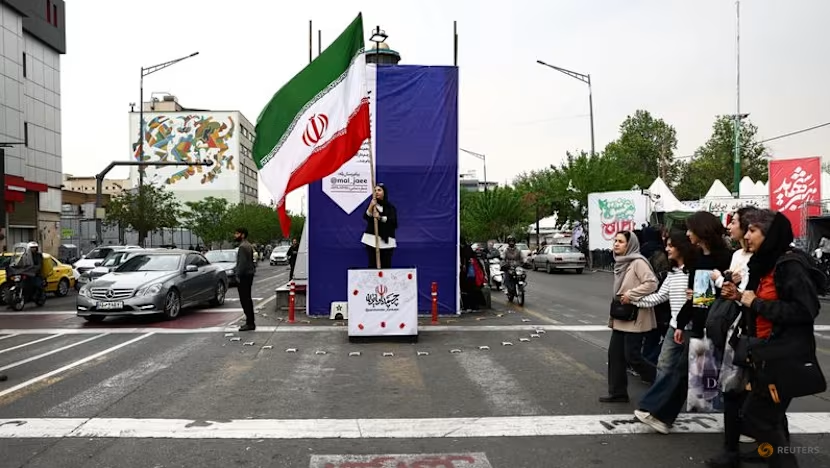
TEHRAN, Iran (BN24) — At least 555 people have been killed in U.S. and Israeli strikes across Iran, the Iranian Red Crescent announced, as emergency crews continue rescue operations in dozens of cities and the country’s interim leadership seeks to consolidate authority following the reported killing of Supreme Leader Ayatollah Ali Khamenei.

The humanitarian organization indicated that bombardments have affected a broad swath of the country, with attacks recorded in 131 cities nationwide. The figures were made public in a statement carried by The Telegraph, citing the Red Crescent’s assessment.

“Following enemy attacks in recent days, so far 131 cities have been involved in the incident,” the Iranian Red Crescent declared, adding that relief and medical teams were operating continuously.

The organization said 555 people had been killed and described ongoing efforts involving rescue, transport, and emergency medical services. More than 100,000 aid and relief personnel have been placed on heightened alert, it added, as authorities respond to what officials characterize as a widening humanitarian emergency.

The reported casualty toll emerges amid a dramatic shift in Iran’s political landscape. Iranian officials say the country’s Supreme Leader, Ayatollah Ali Khamenei, was killed in joint U.S.-Israeli strikes earlier in the conflict, an event that has intensified both domestic and regional tensions.

Iran’s temporary leadership council convened its second meeting late Sunday. Following the session, President Masoud Pezeshkian delivered a recorded address reaffirming continuity in governance and resistance to foreign pressure.

“The temporary leadership council started its work today and by God’s grace and power will continue the path of the late imam and the dear martyred leader and the path of all truth-seekers in the world,” Pezeshkian said.

He also directed pointed remarks toward Washington and Tel Aviv, asserting that the killing of Iran’s supreme leader would not diminish the country’s resolve.

“America and the Israeli regime should know that martyring the supreme leader of the Islamic Revolution will bring them nothing but humiliation,” Pezeshkian declared in the video message.

Calling on citizens to demonstrate unity during what he described as a period of mourning and national trial, Pezeshkian urged public solidarity in mosques, on the streets, and in civic spaces.

“Our dear nation is mourning this great martyr today, and all of us, with our presence on the scene and in the field, in mosques and streets, must thwart the enemies’ sinister plans with empathy and hand in hand,” he said.

He further maintained that Iran’s armed forces remain prepared for escalation.

“The armed forces of the Islamic Republic of Iran are ready and will be ready to crush the bases of enemies, and will disappoint enemies as always,” Pezeshkian said.

U.S. and Israeli officials have not immediately issued public responses to the casualty figures released by the Iranian Red Crescent. Independent verification of the toll was not immediately available.

The reported strikes represent one of the most expansive military operations inside Iran in recent years, affecting urban centers across multiple provinces. The geographic breadth of 131 cities suggests sustained and coordinated targeting rather than isolated incidents.

If confirmed, the death toll of 555 would mark a significant escalation in direct hostilities involving Iran, the United States, and Israel. Historically, confrontations between the three have often unfolded indirectly, through proxy groups or limited air operations. Large-scale strikes spanning more than 100 cities indicate a substantial shift in operational scope.

The killing of Ayatollah Ali Khamenei, if independently corroborated, would represent one of the most consequential geopolitical events in the Middle East in decades. As Iran’s supreme leader since 1989, Khamenei has been the country’s highest authority on military, political, and religious matters. His death could trigger both internal succession challenges and broader regional recalibrations.

Iran’s interim leadership council appears to be moving swiftly to project stability. Public messaging emphasizing continuity, religious symbolism,m and national unity reflects a strategic effort to prevent internal fragmentation. In times of crisis, Iranian officials have historically leaned on themes of martyrdom and resistance to rally public support.

At the same time, the mobilization of more than 100,000 relief workers underscores the humanitarian dimension of the crisis. Large-scale urban strikes often strain hospital capacity, infrastructure, re and supply chains. The Red Crescent’s description of round-the-clock operations suggests sustained casualty management efforts that could continue for days or weeks.

Regionally, the developments raise the prospect of broader conflict. Iran maintains alliances and partnerships with armed groups across the Middle East. Retaliatory measures, whether direct or through allied actors, could widen the confrontation beyond Iran’s borders.

Global energy markets may also respond to the instability. Iran occupies a strategic position along key oil transit routes, including the Strait of Hormuz. Heightened military activity in or near those waterways could disrupt shipping and influence global crude prices.

Diplomatically, the situation may intensify pressure on international mediators seeking to prevent a broader war. European governments, Gulf states,tes and multilateral organizations could face renewed calls to facilitate de-escalation.

For now, much of the available information comes from Iranian official channels, including the Red Crescent and statements by national leaders. Independent assessments of casualty figures, operational details, and the circumstances surrounding Khamenei’s reported death remain limited.

As rescue efforts continue across the country, the political and military consequences of the strikes appear poised to reverberate well beyond Iran’s borders, shaping the trajectory of Middle East security in the weeks ahead.

Belgium detains 2 suspected Cameroon separatists in war crimes probe

BRUSSELS (BN24) — Belgian authorities have taken three individuals into custody on suspicion of involvement in crimes against humanity and war crimes connected to Cameroon’s protracted separatist conflict, federal prosecutors confirmed Tuesday.

The detainees are believed to be senior figures within the Ambazonia Defence Forces (ADF), an armed separatist movement seeking independence for Cameroon’s English-speaking North-West and South-West regions. Cameroon is predominantly French-speaking, and tensions between its linguistic communities have fueled nearly a decade of violence.

In a statement, Belgium’s federal prosecutor’s office disclosed that the suspects are accused of coordinating or supporting militant operations from Belgian territory. Authorities contend that funds were allegedly raised in Belgium to sustain the armed campaign and to procure weapons and ammunition. Investigators also allege that operational directives for attacks in Cameroon may have been transmitted from within Belgium.

The arrests followed coordinated searches conducted Sunday in the port city of Antwerp and the Flemish municipality of Londerzeel. Four individuals were initially apprehended. After questioning, an investigating judge ordered three of them held in pretrial detention. The fourth individual was released under conditions that were not immediately disclosed.

Belgian prosecutors indicated that the inquiry began last summer and centers on individuals residing in Belgium suspected of belonging to the leadership structure of the ADF. The office emphasized that the investigation remains ongoing.

The United Nations estimates that more than 6,500 people have died since violence erupted in Cameroon’s Anglophone regions nearly a decade ago. The conflict has drawn international concern over allegations of serious abuses committed by both separatist fighters and government forces.

The ADF is among several armed groups that emerged after tensions escalated in 2017. Separatist fighters declared the formation of an independent state known as “Ambazonia,” intensifying clashes with security forces loyal to President Paul Biya’s government. Human rights organizations have documented allegations of extrajudicial killings, arbitrary detentions, village burnings and attacks on civilians on both sides of the conflict.

According to UN figures, the crisis has displaced more than 490,000 people internally and left over 1.5 million in need of humanitarian assistance. Entire communities have been uprooted as fighting continues across rural and urban areas of the North-West and South-West regions.

Belgium’s action comes amid a broader pattern of international scrutiny. Authorities in Norway and the United States have previously initiated investigations targeting individuals suspected of financing or directing separatist activities from abroad. The cross-border nature of these inquiries reflects growing concern over diaspora-based fundraising and coordination efforts tied to armed movements in Cameroon.

Cameroon’s Anglophone crisis traces its roots to late 2016, when lawyers and teachers in the English-speaking regions launched strikes to protest what they described as the imposition of French in courts and schools. Demonstrators argued that the Francophone-dominated government had marginalized the minority Anglophone population, eroding cultural and legal protections inherited from British colonial administration.

When activists proclaimed the independence of Ambazonia in 2017, security forces responded forcefully. The confrontation quickly evolved into a sustained armed insurgency involving the ADF and other separatist factions.

President Paul Biya, who has led Cameroon for more than four decades, has maintained that his administration has undertaken meaningful steps to address grievances and restore stability. The government has highlighted decentralization reforms and dialogue initiatives aimed at easing tensions.

Nonetheless, Biya’s administration continues to face criticism from opposition figures and civil society groups over its handling of the unrest and broader concerns regarding political freedoms. Rights advocates argue that restrictions on dissent and press activity have compounded mistrust in affected regions.

Belgian authorities have not disclosed the identities of the detainees, citing the sensitivity of the investigation. Prosecutors underscored that those arrested are presumed innocent unless proven guilty in court.

The detentions in Belgium underscore how Cameroon’s internal conflict has increasingly taken on international dimensions. European nations hosting diaspora communities are facing mounting pressure to examine whether fundraising and advocacy efforts cross into material support for armed groups accused of serious violations.

The legal framework underpinning Belgium’s investigation reflects the principle of universal jurisdiction, which allows national courts to prosecute certain grave crimes regardless of where they were committed. By pursuing allegations tied to crimes against humanity and war crimes, Belgian authorities signal that accountability mechanisms may extend beyond Cameroon’s borders.

Such cases also highlight the complex role of diaspora networks. While many expatriate Cameroonians engage in peaceful political advocacy or humanitarian support, authorities across Europe and North America have become more vigilant about the potential misuse of financial channels to sustain armed insurgencies.

For Cameroon, international investigations may intensify diplomatic sensitivities. The government in Yaoundé has long framed the separatist movement as a security threat requiring firm action. However, external probes focusing on alleged abuses by all sides risk amplifying calls for independent monitoring and judicial reform within Cameroon itself.

The humanitarian toll remains stark. With hundreds of thousands displaced and social infrastructure strained, the conflict continues to hinder economic development in affected regions. Schools have periodically closed due to violence, depriving children of consistent education. Agricultural production a key livelihood source has also suffered disruptions.

Whether Belgium’s investigation will lead to prosecutions remains uncertain. Yet the case illustrates a broader shift: conflicts once viewed as localized are now subject to transnational legal and financial scrutiny. As authorities in multiple countries examine alleged overseas coordination of separatist activity, the legal exposure for individuals operating beyond Cameroon’s borders may increase.

At the same time, sustainable resolution of the Anglophone crisis ultimately depends on political dialogue and domestic reforms within Cameroon. International legal action may address accountability, but it cannot substitute for negotiated solutions to the grievances that sparked the conflict in 2016.

For now, Belgian prosecutors continue their inquiry, while Cameroon’s long-running crisis shows little sign of immediate resolution.

Mojtaba Khamenei Emerges as Leading Contender to Succeed Father as Iran’s Supreme Leader Amid War

As Iran grapples with war and the sudden death of its long-serving supreme leader, attention has shifted to a familiar but largely unseen figure within the Islamic Republic’s power structure: Mojtaba Khamenei.

The son of the late Ali Khamenei, Mojtaba Khamenei has for years been viewed by insiders as a potential successor, despite never holding elected office or an officially appointed government post. The Israeli airstrike that killed his 86-year-old father at the outset of the conflict has now intensified scrutiny of his possible ascension.

Mojtaba Khamenei has not appeared publicly since the strike that targeted the supreme leader’s offices. His wife, Zahra Haddad Adel, whose family has longstanding ties to Iran’s clerical establishment, was also killed. Iranian state media have not disclosed his whereabouts, though analysts believe he remains alive and is likely in seclusion as U.S. and Israeli airstrikes continue.

Even before his father’s death, Mojtaba Khamenei’s name circulated among conservative clerics as a potential heir. The idea of a son succeeding his father in the Islamic Republic has drawn criticism from reformists and some conservatives, who warn it risks echoing the hereditary monarchy overthrown in the 1979 revolution.

Yet the narrative may be shifting. Hard-liners have portrayed Ali Khamenei and his daughter-in-law as martyrs in what they describe as a war against the United States and Israel. That framing could strengthen Mojtaba Khamenei’s standing among members of Iran’s 88-seat Assembly of Experts, the clerical body tasked with selecting the next supreme leader.

The stakes are immense. The next leader will assume command of Iran’s military forces during an active conflict and inherit authority over a stockpile of highly enriched uranium, which could potentially be used for a nuclear weapon if sanctioned by decree.

Born in 1969 in Mashhad, Mojtaba Khamenei grew up during the final years of Shah Mohammad Reza Pahlavi’s rule. His childhood coincided with his father’s political activism and periodic detention by the shah’s secret police.

After the 1979 Islamic Revolution, the family relocated to Tehran. Mojtaba later fought in the Iran-Iraq war as part of a Revolutionary Guard battalion whose members would go on to occupy senior intelligence and security roles.

When his father became supreme leader in 1989, Mojtaba Khamenei’s proximity to power deepened. Over time, he developed influence within his father’s office and cultivated alliances within the powerful Islamic Revolutionary Guard Corps, the paramilitary force that plays a central role in Iran’s military and economic life.

U.S. diplomatic cables published by WikiLeaks in the late 2000s described him as “the power behind the robes,” alleging he acted as a gatekeeper and political operator within the supreme leader’s circle. One cable suggested he was building his own base of influence, though it noted his limited theological credentials.

In 2019, the United States imposed sanctions on Mojtaba Khamenei during the administration of Donald Trump, accusing him of advancing his father’s regional and domestic agenda. U.S. officials have also alleged he maintained close ties with the Guard’s Quds Force and the Basij militia, which suppressed anti-government protests.

The supreme leader occupies the apex of Iran’s Shiite theocratic system, with final authority over the military, judiciary, state broadcasting and key policy decisions. Only one succession has occurred since the revolution: when Ruhollah Khomeini died in 1989 and Ali Khamenei assumed the role.

Following the recent killing, Iran moved swiftly to activate a constitutional mechanism for temporary leadership. A council composed of President Masoud Pezeshkian, Judiciary Chief Gholamhossein Mohseni Ejei and a cleric selected by the Guardian Council has taken on interim duties while the Assembly of Experts deliberates.

The transition unfolds against the backdrop of a 12-day war with Israel and ongoing U.S.-Israeli operations aimed at degrading Iran’s military infrastructure and nuclear capabilities. The Islamic Revolutionary Guard Corps — designated a terrorist organization by the United States in 2019 — remains a decisive actor, controlling ballistic missile forces and overseeing a network of allied militant groups across the Middle East.

Whether Mojtaba Khamenei ultimately secures the supreme leadership will depend on behind-the-scenes negotiations among senior clerics and power brokers within the Guard and the broader political establishment.

His critics argue that elevating him would blur the line between revolutionary theocracy and dynastic rule. Supporters contend his decades within the system and close ties to security institutions provide continuity at a moment of national crisis.

With Iran at war and its political future uncertain, the question of succession has become inseparable from the country’s broader struggle over identity, governance and regional power. The decision now rests with a clerical body whose deliberations are largely opaque — but whose choice will shape the trajectory of the Islamic Republic for years to come.

The Associated Press

Pentagon Identifies U.S. Troops Killed in Iran Drone Strike as Trump Clashes With Allies Over War Strategy

The Pentagon on Tuesday identified the first four American service members killed in the expanding conflict with Iran, as President Donald Trump lashed out at European allies over what he called insufficient cooperation in the war effort.

The Defense Department said Capt. Cody A. Khork, 35; Sgt. 1st Class Noah L. Tietjens, 42; Sgt. 1st Class Nicole M. Amor, 39; and Sgt. Declan J. Coady, 20, were killed Sunday in a drone attack at Port Shuaiba, Kuwait, while supporting Operation Epic Fury, the U.S. military campaign targeting Iran.

Capt. Cody A. Khork, Sgt. 1st Class Noah L. Tietjens, Sgt. 1st Class Nicole M. Amor and Sgt. Declan J. Coady were killed during the ongoing war on Iran.

The four soldiers were assigned to the 103rd Sustainment Command based in Des Moines, Iowa. Two additional American service members were killed in the same strike, but their names have not yet been released pending notification of next of kin.

The deadly attack came as Trump publicly criticized allied governments, including Britain and Spain, for what he described as delays and refusals in granting access to key military bases for U.S. operations tied to the war.

According to the Pentagon, the soldiers died when an unmanned aircraft system struck a tactical operations center in Port Shuaiba.

The Army Reserve identified the fallen service members as:

  • Capt. Cody A. Khork, 35, of Winter Haven, Florida
  • Sgt. 1st Class Noah L. Tietjens, 42, of Bellevue, Nebraska
  • Sgt. 1st Class Nicole M. Amor, 39, of White Bear Lake, Minnesota
  • Sgt. Declan J. Coady, 20, of West Des Moines, Iowa

Lt. Gen. Robert Harter, chief of the U.S. Army Reserve, said in a statement that the soldiers “served fearlessly and selflessly in defense of our nation,” adding that their sacrifices would not be forgotten.

Maj. Gen. Todd Erskine, commanding general of the 79th Theater Sustainment Command, expressed condolences to the families and described the soldiers as representing “the heart of America.”

Khork enlisted in the National Guard in 2009 and was commissioned into the Army Reserve in 2014, deploying to Saudi Arabia, Guantanamo Bay and Poland during his career. Amor enlisted in 2005 and deployed to Kuwait and Iraq in 2019. Tietjens joined the Reserve in 2006 and completed two previous Kuwait deployments. Coady enlisted in 2023 and was posthumously promoted from specialist to sergeant.

The Pentagon said the incident remains under investigation.

U.S. Central Command initially reported three service members killed in Kuwait, later confirming a fourth died from injuries sustained in the attack. The remains of two previously unaccounted-for personnel were subsequently recovered from the strike site.

As of Tuesday morning, 10 U.S. service members remained seriously wounded, down from an earlier count of 18 as some progressed through medical treatment, according to a U.S. official.

Defense Secretary Pete Hegseth called those killed “the absolute best of America” and said the military would continue operations in a manner that honors their sacrifice.

Earlier Tuesday, Trump praised the effectiveness of U.S. and Israeli strikes against Iranian forces, claiming that Tehran’s military capabilities had been “shattered” after four days of sustained bombardment.

At the same time, he criticized European leaders for what he described as a lack of cooperation. He publicly rebuked Britain’s prime minister over delays in access to airbases and threatened to cut off trade with Spain after Madrid declined to allow U.S. forces to use certain military hubs.

During a White House meeting, German Chancellor Friedrich Merz reportedly reminded Trump that Spain, as a member of the European Union, could not be excluded from broader trade agreements.

Trump has framed the conflict as a decisive effort to eliminate threats posed by Iran’s ballistic missile arsenal and nuclear program. On Monday, he described the campaign as the “last best chance” to neutralize those risks and said operations could last four to five weeks.

The U.S. and Israel launched a large-scale military operation over the weekend targeting Iranian leadership and military infrastructure, including a strike on the compound of Supreme Leader Ayatollah Ali Khamenei in Tehran. Israeli officials said additional senior Iranian commanders were killed.

Iran has responded with retaliatory strikes against Israel and U.S.-allied nations across the Middle East.

In a video message Sunday night, Trump offered condolences to the families of the fallen soldiers while warning that additional casualties may occur as the campaign continues.

“We pray for the full recovery of the wounded,” he said. “And sadly, there will likely be more before it ends.”

The identification of the first American casualties underscores the rising cost of Operation Epic Fury, both militarily and diplomatically. As U.S. forces sustain losses, Trump’s increasingly confrontational tone toward European partners suggests that the conflict is straining transatlantic alliances even as military coordination intensifies.

With casualties mounting and operations projected to continue for weeks, the war’s trajectory appears likely to deepen U.S. involvement — and test the durability of alliances Washington has relied on for decades.

Israel Intensifies Strikes on Tehran as Iran Expands Retaliation Across Gulf, Targeting U.S. Sites

(AP) — Israel intensified its aerial assault on Tehran and key Iranian military installations Tuesday, while Iran broadened its retaliation beyond Israeli territory, launching drone and missile attacks across the Gulf and striking U.S. diplomatic compounds in Saudi Arabia and the United Arab Emirates.

Plumes of smoke from two simultaneous strikes rise over Tehran, Iran, Monday, March 2, 2026. (AP Photo/Mohsen Ganji)

Four days into a widening conflict that President Donald Trump has indicated could stretch on for weeks, the human toll is mounting. Nearly 800 people have been killed in Iran since the fighting began, according to figures cited by The Associated Press, while at least 11 people in Israel have died amid sustained Iranian missile barrages.

Explosions reverberated across Tehran overnight as Israeli aircraft targeted ballistic missile infrastructure and what Israeli officials described as a covert underground nuclear research facility. In neighboring Lebanon, Israel said it carried out retaliatory strikes against the Iranian-backed militant group Hezbollah.

Iran, in turn, expanded its campaign across the region. Drone strikes hit the U.S. Embassy in Riyadh, igniting a small fire, and struck a parking area outside the U.S. Consulate in Dubai, U.S. Secretary of State Marco Rubio said. No American personnel were reported injured in either incident.

The conflict’s accelerating tempo has raised urgent questions about its scope, objectives and endgame.

The Israeli military announced it conducted a series of air operations in Tehran and Isfahan aimed at facilities used to manufacture and store ballistic missiles. Military spokesperson Brig. Gen. Effie Defrin said Israeli forces also destroyed what he described as Iran’s “secret underground nuclear headquarters,” alleging the site had been used for research tied to nuclear weapons development.

Iran has long maintained that its nuclear program is peaceful and denies seeking atomic weapons capability.

The International Atomic Energy Agency said Iran’s Natanz enrichment site had sustained “recent damage” but reported no expected radiological consequences. The United States struck Natanz during a 12-day war in June, significantly degrading Iran’s nuclear capacity at the time.

Satellite imagery released by a Colorado-based commercial firm indicated that part of Iran’s presidential complex in Tehran sustained heavy structural damage, including the destruction of a domed roof. Iranian authorities did not immediately acknowledge the strike.

Communications within Iran have been disrupted amid continuous bombardment and tightened restrictions on journalists. Residents in northern Tehran described hearing repeated explosions through the night. In the normally busy Tajrish district, many storefronts remained shuttered, though bakeries and grocery stores stayed open.

Iran has fired dozens of ballistic missiles toward Israel, most of which Israeli air defenses intercepted, according to Israeli authorities.

Beyond Israel, Iranian drones and missiles have targeted U.S. diplomatic sites and Gulf infrastructure. The Saudi Defense Ministry confirmed that two drones struck the U.S. Embassy compound in Riyadh, causing limited damage. The United Arab Emirates said it intercepted the vast majority of more than 1,000 Iranian missile and drone launches directed toward its territory.

U.S. embassies in Saudi Arabia, Kuwait and Lebanon closed to the public as Washington ordered the departure of non-essential personnel and families from several Middle Eastern nations, including Kuwait, Bahrain, Iraq, Qatar, Jordan and the UAE. The State Department is arranging military and charter flights for American citizens seeking to leave the region.

The U.S. military also confirmed the deaths of four Army Reserve soldiers in a drone strike on a command center in Kuwait. The soldiers were assigned to the 103rd Sustainment Command based in Des Moines, Iowa. Two additional service members were killed in the same strike.

The Pentagon identified the four soldiers as Capt. Cody A. Khork of Florida; Sgt. 1st Class Noah L. Tietjens of Nebraska; Sgt. 1st Class Nicole M. Amor of Minnesota; and Spc. Declan J. Coady of Iowa.

The Biden administration has articulated multiple objectives for the joint U.S.-Israeli campaign, including dismantling Iran’s missile arsenal, crippling its navy, preventing nuclear weapons development and curbing support for allied militant groups.

Although initial strikes reportedly killed Iran’s Supreme Leader, Ayatollah Ali Khamenei, senior U.S. officials later clarified that regime change is not an official policy goal. Trump, speaking from the Oval Office, said the United States had considered potential successors within Iran’s leadership but indicated those figures are now dead.

He added that an internal figure within Iran might ultimately assume power but cautioned against the possibility that any successor could prove equally hardline.

Iranian authorities are now navigating a rare leadership transition. The selection of a new supreme leader marks only the second such shift since the 1979 Islamic Revolution. Possible candidates range from hardliners favoring confrontation with the West to reformist figures advocating renewed diplomacy.

In Lebanon, Israel’s strikes against Hezbollah killed 50 people, including seven children, according to Lebanon’s health ministry. The Iranian-backed group has exchanged fire with Israeli forces since hostilities escalated.

Turkish Foreign Minister Hakan Fidan sharply criticized Iran’s decision to target Gulf neighbors that had sought to avoid direct involvement. He described the strategy as dangerously flawed and warned it risked drawing additional states into open conflict.

The cumulative casualties underscore the widening geographic footprint of the war. According to the Iranian Red Crescent Society, at least 787 people have been killed inside Iran. Additional fatalities have been reported in the United Arab Emirates, Kuwait and Bahrain.

The expanding battlefield reflects a strategic shift by both Israel and Iran. Israel appears intent on degrading Iran’s long-term military and nuclear infrastructure rather than merely responding to immediate threats. By targeting missile production sites and alleged nuclear research facilities deep inside Tehran, Israel signals a willingness to reshape Iran’s strategic posture.

Iran’s retaliation, meanwhile, suggests a calculated effort to internationalize the conflict. By striking U.S. diplomatic compounds and Gulf infrastructure, Tehran may be seeking to pressure Washington’s regional allies and raise the economic costs of continued operations.

Energy markets have already reacted nervously amid concerns over potential disruptions to Gulf shipping lanes. Insurance premiums for commercial vessels transiting the Strait of Hormuz have climbed, reflecting fears of further escalation.

At the same time, the leadership vacuum in Tehran introduces uncertainty. A contested succession process could embolden hardline factions or prompt internal instability, complicating diplomatic efforts to contain the conflict.

Despite the mounting casualties and widening theater of operations, neither side has articulated a clear pathway toward de-escalation. With U.S. personnel now among the dead and diplomatic compounds under attack, Washington’s role risks deepening further.

As airspace closures strand civilians and foreign governments scramble evacuation flights, the war’s trajectory appears increasingly volatile — and its endpoint uncertain.

Trump Threatens Trade Embargo on Spain After Madrid Bars U.S. Bases From Iran Strike Operations

(AP/Reuters) — President Donald Trump threatened Tuesday to sever trade ties with Spain after the European ally declined to allow U.S. forces to use jointly operated bases for missions tied to strikes on Iran, intensifying a diplomatic rift that now spans military policy, trade authority and NATO defense spending.

Speaking during an Oval Office meeting with German Chancellor Friedrich Merz, Trump declared that he had directed Treasury Secretary Scott Bessent to explore cutting off commercial dealings with Spain.

“We’re going to cut off all trade with Spain,” Trump said. “We don’t want anything to do with Spain.”

The remarks followed comments a day earlier by Spanish Foreign Minister José Manuel Albares, who said Madrid would not authorize U.S. use of joint military installations in southern Spain for operations not covered by the United Nations charter. Albares emphasized that the bases were not involved in weekend strikes targeting Iran.

Spain hosts U.S. forces at Naval Station Rota and Morón Air Base under long-standing bilateral defense agreements. While Trump insisted that U.S. forces could access the facilities if necessary, he added that “we don’t have to,” signaling frustration with Spain’s refusal.

Reuters separately detailed that the United States had repositioned 15 aircraft, including refueling tankers, from Rota and Morón after Spain’s Socialist-led government indicated they could not be used in operations against Iran.

It remains uncertain how the president could unilaterally suspend trade with Spain, which is part of the European Union. The EU negotiates trade agreements collectively on behalf of its 27 member states.

A spokesperson for Spanish Prime Minister Pedro Sánchez said any U.S. review of trade arrangements must respect private enterprise autonomy, international law and existing agreements between Washington and Brussels.

European Commission spokesperson Olof Gill said the bloc expects the Trump administration to honor a trade framework negotiated in Scotland last year after months of economic turbulence linked to Trump’s earlier tariff actions.

Trump’s warning comes shortly after the U.S. Supreme Court invalidated sweeping tariffs he had imposed under the International Emergency Economic Powers Act (IEEPA). While the court concluded that IEEPA does not grant authority for broad tariff programs, Trump has argued that the ruling leaves intact his power to implement embargoes.

During the Oval Office session, Trump publicly asked Bessent and U.S. Trade Representative Jamieson Greer for their views. Bessent said the court had reaffirmed the president’s embargo authority, adding that the Treasury, Commerce Department and USTR would initiate reviews into potential actions under other trade statutes.

Trade law specialists noted that invoking IEEPA for an embargo would require a declaration that Spain poses an “unusual and extraordinary threat” to U.S. national security or foreign policy. Peter Shane, a professor at New York University, told Reuters that it was difficult to see how Spain’s refusal to allow use of air bases for strikes on Iran would meet that threshold.

A spokesperson for the Treasury Department did not provide additional comment to The Associated Press.

Trump also renewed criticism of Spain’s defense expenditures. He asserted that Spain was the only NATO member unwilling to commit to a 5% of GDP defense spending benchmark, a level the United States has advocated.

Last year, Spain indicated it could meet capability targets by allocating 2.1% of GDP to defense. Germany’s Merz acknowledged that Spain had resisted higher commitments and said European leaders were urging Madrid to raise spending closer to 3% or 3.5%.

Spain’s government maintained Tuesday that it remains a “key member of NATO,” contributing significantly to European security.

The defense spending debate has been a recurring flashpoint. Trump previously threatened tariff measures when Spain declined to endorse the 5% benchmark, tying military commitments to economic leverage.

Sánchez has openly criticized U.S. and Israeli strikes on Iran, describing them as “unjustifiable” and “dangerous,” while also condemning Iranian attacks in the region. His administration has called for immediate de-escalation and diplomatic engagement.

Spain’s stance marks another chapter in strained relations between the Trump administration and Madrid. Under Sánchez, Spain has also criticized Israel’s campaign in Gaza and denied port access to vessels carrying weapons bound for Israel.

Despite Trump’s threat, Spain’s economic exposure to U.S. retaliation may be limited relative to other European states. Spain is the world’s largest exporter of olive oil and ships auto parts, steel and chemicals to the United States. However, U.S. Census Bureau figures show Washington recorded a $4.8 billion trade surplus with Spain in 2025, marking the fourth consecutive year of surplus. U.S. exports totaled $26.1 billion, including growing shipments of crude oil and liquefied natural gas, while imports from Spain reached $21.3 billion.

Trump’s warning reflects a broader strategy of linking economic pressure to geopolitical objectives. By pairing NATO spending demands with trade threats, the administration appears intent on compelling allies to align more closely with U.S. security priorities, particularly amid escalating tensions with Iran.

Yet the approach carries risks. Any attempt to impose a full embargo on an EU member could trigger coordinated retaliation from Brussels, potentially escalating into a transatlantic trade confrontation at a time of fragile global growth.

The legal pathway is also uncertain. While embargo authority exists under IEEPA, applying it to a NATO ally over basing access could face judicial scrutiny and political pushback from Congress. Moreover, framing Spain’s decision as a national security threat may prove legally tenuous.

Diplomatically, the dispute exposes fissures within NATO. As European governments debate appropriate defense spending levels and engagement in Middle Eastern conflicts, Washington’s assertive posture may deepen divisions rather than consolidate unity.

Energy markets and defense planners are closely watching whether the confrontation remains rhetorical or evolves into formal trade action. If implemented, punitive measures could disrupt supply chains involving energy exports, agricultural goods and industrial components on both sides of the Atlantic.

For now, Spain has signaled it intends to defend its economic interests while maintaining cooperation within NATO and the EU framework. Whether the dispute becomes a symbolic warning shot or the opening salvo in a broader trade battle may depend on how aggressively the administration moves from rhetoric to execution.

The episode underscores how rapidly military conflicts abroad can spill into economic and diplomatic arenas, reshaping alliances long considered stable.

Iranian Drone Strike Hits U.S. Embassy in Riyadh as Israeli Ground Forces Enter Southern Lebanon

An Iranian drone struck the U.S. Embassy compound in Saudi Arabia’s capital early Tuesday, igniting a small fire and prompting American officials to urge citizens to avoid the area, as Israeli ground forces advanced into southern Lebanon in what has become a rapidly expanding regional war.

The embassy said the blaze was quickly contained and no casualties were immediately reported. The strike followed a similar drone incident targeting the U.S. Embassy in Kuwait earlier, underscoring Iran’s widening campaign against American installations in Gulf states that host U.S. troops and military assets.

Tehran has escalated retaliatory attacks since the United States and Israel launched coordinated strikes inside Iran over the weekend. The confrontation has since spread beyond the original battlegrounds, drawing in Lebanon, Gulf Arab states and multiple Iran-aligned groups.

In Lebanon, Israeli Defense Minister Israel Katz announced that Israeli troops had been directed to “hold and advance” into areas of southern Lebanon to prevent further cross-border attacks by Hezbollah. The statement marked Israel’s first public confirmation that its campaign would extend beyond airstrikes to include ground operations.

Israeli forces have issued evacuation orders for villages south of the Litani River, leaving much of the region largely deserted. Southern suburbs of Beirut, long regarded as Hezbollah strongholds, appeared largely emptied as residents fled north.

What began as direct hostilities between Iran and a U.S.-Israeli coalition has evolved into a broader confrontation spanning at least nine countries.

The joint U.S.-Israeli aerial campaign commenced Saturday with strikes in Tehran that killed Iran’s supreme leader, Ali Khamenei, according to Israeli and American officials. Iran responded with missile salvos aimed at Israel and attacks targeting American positions across the Gulf.

Israeli Prime Minister Benjamin Netanyahu cautioned that the conflict could persist for an extended period, telling Fox News that while it would not last years, it would require time to achieve its objectives.

U.S. President Donald Trump offered varying timelines, saying Monday that operations could extend “far longer” than the month initially envisioned.

Secretary of State Marco Rubio said in televised remarks that the most severe blows against Iran “are yet to come,” while Defense Secretary Pete Hegseth publicly raised the possibility of deploying American ground forces — a prospect many analysts describe as fraught given Iran’s mountainous terrain and population size.

Rubio indicated the administration believed Israeli military action would provoke retaliation against U.S. forces and argued that preemptive strikes were intended to limit American casualties.

Trump has alternated between describing the campaign as an effort to halt Iran’s nuclear ambitions and suggesting that regime change in Tehran could result. Iran maintains its nuclear program is peaceful.

Overnight explosions reverberated across Iranian cities, particularly Tehran. Casualty figures remain difficult to verify independently, with estimates ranging from 555 to as many as 1,500 deaths. Iranian authorities reported that 165 people were killed in a strike on a girls’ elementary school in southern Iran.

Iran has launched repeated ballistic missile barrages toward Israel. Israeli defense systems intercepted most projectiles, though 11 people were killed when several missiles penetrated defenses.

The United States acknowledged the deaths of six service members in Kuwait, where American forces are stationed.

Iran has also targeted Gulf energy infrastructure. Qatar announced a suspension at its largest liquefied natural gas facility, and Saudi Arabia halted operations at the Ras Tanura refinery.

Tehran declared the Strait of Hormuz closed after several vessels were struck while attempting passage. Brig. Gen. Ebrahim Jabbari, an adviser to Iran’s paramilitary Revolutionary Guards, warned ships against entering the waterway, a critical artery for global oil shipments.

Energy markets reacted swiftly, with global prices climbing amid fears of prolonged supply disruptions.

Hezbollah said it launched two waves of missiles overnight against Israeli military installations in the north, including the Ramat David and Meron airbases. It also claimed rocket strikes in the Golan Heights.

Israel’s military announced it had killed several senior Hezbollah figures, including intelligence chief Hussein Makled. Israeli forces also struck facilities linked to Hezbollah’s financial network, including al-Qard al-Hassan bank, and targeted infrastructure tied to its media outlet al-Manar.

Human rights organizations cautioned that attacks on non-military targets, even if affiliated with armed groups, could violate international law.

Israeli airstrikes in Lebanon have killed at least 52 people and displaced roughly 29,000, according to local authorities.

In an unprecedented move, Lebanon’s government prohibited Hezbollah’s military and security activities and directed judicial authorities to pursue those responsible for launching rockets into Israel, reflecting mounting domestic criticism that Hezbollah’s actions jeopardize national stability.

The rapid expansion of hostilities highlights the fragility of deterrence frameworks that have governed Middle Eastern security for decades. The simultaneous targeting of diplomatic missions, energy infrastructure and military installations signals a shift toward broader strategic confrontation rather than limited proxy exchanges.

Iran’s move to disrupt the Strait of Hormuz introduces global economic consequences that could draw additional powers into crisis management efforts. Roughly one-fifth of the world’s oil supply transits the narrow waterway, and prolonged closure could trigger sustained inflationary pressures worldwide.

Israel’s ground incursion into southern Lebanon suggests a willingness to neutralize Hezbollah’s capabilities decisively, even at the risk of extended conflict. Yet Hezbollah’s degraded but still operational missile arsenal indicates that Israel faces a protracted security challenge on its northern frontier.

For Washington, policy coherence remains under scrutiny. Diverging public explanations regarding objectives — whether preventing nuclear proliferation, deterring attacks or fostering regime change — complicate diplomatic messaging to allies and adversaries alike.

With civilian casualties mounting and energy markets unsettled, international mediation efforts may intensify. However, absent clear off-ramps from principal actors, the trajectory points toward sustained instability rather than swift resolution.

As embassies harden defenses and regional militaries mobilize, the Middle East appears to be entering one of its most volatile chapters in recent memory.

Iran Signals Possible World Cup Withdrawal After U.S.-Israeli Airstrikes Kill Ayatollah Ali Khamenei

TEHRAN, Iran (BN24) — Iran’s national football team could withdraw from this summer’s World Cup following U.S. and Israeli airstrikes that killed Supreme Leader Ayatollah Ali Khamenei, the head of the country’s football federation indicated Sunday, casting uncertainty over one of the tournament’s most politically sensitive participants.

The comments came a day after a coordinated military operation struck several major Iranian cities, including Tehran, amid escalating tensions between Iran and Western allies. Iranian state television broadcast remarks from Mehdi Taj, president of the Iranian Football Federation, suggesting that participation in the global tournament may no longer be assured.

“With what happened today and with that attack by the United States, it is unlikely that we can look forward to the cup,” Taj said on the Iranian TV network “Tehran,” as cited by Marca. He added that a final determination would rest with the country’s sports authorities.

“But the sports chiefs are the ones who must decide on that,” Taj said.

The World Cup, scheduled to take place across the United States, Canada and Mexico, is set to begin in just over three months. Iran is slated to open its campaign against New Zealand at SoFi Stadium in Los Angeles. The team is also scheduled to face Belgium and Egypt during the group stage, with matches in Los Angeles and Seattle.

If Iran advances beyond the group stage and both it and the United States finish second in their respective groups, the two nations could meet in Dallas on July 3 a matchup that would carry heightened political significance given the latest developments.

FIFA officials addressed the unfolding situation cautiously. Speaking Saturday at an International Football Association Board (IFAB) meeting in Wales, FIFA General Secretary Mattias Grafstrom acknowledged awareness of the breaking news but refrained from detailed comment.

“I read the news the same way you did this morning,” Grafstrom said. “We had a meeting today, and it would be premature to comment on that in detail.”

He added that FIFA’s priority remains the safe organization of the tournament.

“Of course we will monitor the developments around all issues around the world,” Grafstrom said. “We had a final draw in Washington where all teams participated, and our focus is to have a safe World Cup with everybody participating.”

Iran earned qualification for its fourth consecutive World Cup by finishing first in Group A of Asian qualifying, reinforcing its status as one of the strongest sides in the Asian Football Confederation. The team has increasingly established itself as a consistent presence on the global stage, advancing through a competitive regional field to secure its place in the expanded tournament.

The sudden geopolitical upheaval, however, introduces uncertainty that extends beyond sport.

The possibility of Iran’s withdrawal presents complex logistical and diplomatic challenges for FIFA and tournament organizers. Replacing a qualified team at this late stage could require emergency procedures under FIFA regulations, potentially involving the next-best finisher in Asian qualifying or a special playoff arrangement.

Beyond scheduling considerations, security planning could face intensified scrutiny. The World Cup is expected to draw millions of spectators across North America, and any escalation of hostilities or retaliatory actions could heighten security concerns in host cities, particularly if politically sensitive matchups materialize.

The prospect of a U.S.–Iran match on American soil already carried symbolic weight even before the airstrikes. Past encounters between the two nations in international competitions have drawn global attention, blending sport with diplomatic undertones. A renewed confrontation under current circumstances would likely amplify those dynamics.

Political analysts note that national teams often become symbols of unity during times of domestic crisis. Iran’s leadership may face competing pressures balancing public sentiment, security concerns and international optics when determining whether to proceed with participation.

A withdrawal could also have economic consequences. The World Cup represents significant commercial opportunity through sponsorships, broadcasting revenue and global exposure. For Iranian players, many of whom compete internationally, missing the tournament would represent both a professional setback and a loss of global visibility.

While the immediate focus centers on whether Iran will compete, the broader significance lies in how geopolitical conflict increasingly intersects with global sporting events. International tournaments such as the World Cup are designed to transcend politics, yet history shows they often reflect the prevailing international climate.

FIFA’s cautious language underscores the delicate balance it must strike. The organization seeks to avoid political entanglement while ensuring safety and competitive integrity. However, in situations involving state-level conflict, neutrality becomes more complicated.

Should Iran withdraw voluntarily, FIFA may avoid imposing sanctions. But if security concerns or political pressure compel external intervention, the governing body could face criticism from multiple sides. Additionally, the potential absence of a major Asian team would alter competitive dynamics in Group G and beyond.

The coming weeks will likely determine whether diplomacy, de-escalation or further conflict shapes the trajectory of Iran’s participation. For now, uncertainty clouds preparations just 107 days before kickoff.

As global attention turns toward North America for the expanded 2026 tournament, organizers confront a stark reminder: even the world’s most celebrated sporting spectacle is not insulated from geopolitical shockwaves.

FIFA officials have indicated they will continue monitoring developments as they assess the path forward.

Zimbabwe Releases Nearly 4,000 Prisoners Under Presidential Amnesty Amid Constitutional Reform Debate

HARARE, Zimbabwe (BN24) —Zimbabwean authorities on Monday initiated the release of nearly 4,000 inmates following a presidential amnesty aimed at reducing prison overcrowding, a move that comes as the government advances contentious constitutional reforms that could extend President Emmerson Mnangagwa’s tenure in office.

Justice Minister Ziyambi Ziyambi, addressing journalists in Harare, confirmed that the discharge of 3,978 beneficiaries had commenced. He indicated that the measure forms part of a broader clemency initiative designed to ease pressure on correctional facilities while prioritizing inmates considered vulnerable or demonstrably rehabilitated.

National correctional data shows Zimbabwe’s prison population exceeded 24,000 during the second quarter of 2025, a figure that has intensified concerns over overcrowding and strained infrastructure within detention centers.

Ziyambi explained that the total number of individuals eligible for release under the decree will reach 4,305, including 223 women. He emphasized that the selection criteria targeted inmates who had shown measurable reform during incarceration.

“This initiative underscores the nation’s dedication to restorative justice and the humane management of correctional institutions,” Ziyambi told reporters, framing the amnesty as both compassionate and strategic.

The cabinet unveiled the clemency decision in February on the same day it endorsed sweeping constitutional amendments. Those proposed changes include provisions that would allow the 83-year-old president’s term to run until 2030. The legislative package also seeks to extend presidential terms from five to seven years and eliminate direct general presidential elections, transferring authority to parliament to select the head of state. The amendments require parliamentary approval, where Mnangagwa’s ruling Zanu-PF party holds a dominant majority.

Among those released Monday was 23-year-old Tendai Chitsika, who had been serving a six-month sentence for theft and was nearing completion of his term. Speaking to AFP at Harare Central Prison, Chitsika described his incarceration as transformative.

“It was a learning curve for me. I’m a changed person, and I promise to do good out there,” he said, expressing gratitude to the president for the opportunity.

Scenes at the prison reflected both relief and lingering uncertainty. Inmates assembled in separate groups: those still clad in orange uniforms awaiting continued confinement, and those who had changed into civilian attire, preparing to depart. Some detainees chanted slogans praising Mnangagwa, while one held a banner bearing the president’s image.

Authorities clarified that the amnesty excludes individuals convicted of serious offenses such as murder, armed robbery, and rape. It also does not extend to those found guilty of violating the Maintenance of Peace and Order Act, legislation previously invoked in cases involving protesters and political opponents.

The political climate surrounding the amnesty remains tense. Zimbabwe has experienced mounting public frustration over economic hardship, governance issues, and political reforms since last year. Leading opposition figures have condemned the proposed constitutional changes as a “constitutional coup,” arguing that the amendments could entrench executive authority and weaken democratic accountability.

While government officials portray the prison release as an administrative and humanitarian necessity, critics question its timing. The alignment of the amnesty announcement with the constitutional reform package has fueled debate about whether the move carries broader political symbolism.

Factually, the amnesty affects thousands of inmates and excludes those convicted of violent or grave crimes. It follows official prison population data indicating overcrowding. The constitutional amendments remain subject to parliamentary approval.

Beyond those established details, analysts note that prison congestion has long plagued Zimbabwe’s correctional system. Limited resources, aging facilities, and rising incarceration rates have placed sustained pressure on the country’s penal institutions. Amnesty programs, while not unprecedented, are often deployed to mitigate logistical challenges and demonstrate executive clemency.

At the same time, the political ramifications cannot be ignored. The simultaneous progression of constitutional reforms that would lengthen presidential terms and shift electoral mechanisms has heightened scrutiny from civil society groups and opposition leaders. They contend that transferring presidential selection powers to parliament,t where Zanu-PF maintains a commanding presence, could effectively sideline competitive national elections.

Supporters of the government argue that structural changes are necessary for political stability and long-term development planning. They maintain that extended terms would allow for policy continuity in a country navigating economic volatility and international sanctions.

The release of inmates may also carry social implications. Reintegration efforts will test the capacity of community support systems, employment markets, and social services to absorb thousands of former prisoners. Experts frequently caution that successful rehabilitation hinges not only on clemency but also on post-release opportunities.

For Mnangagwa, the amnesty reinforces an image of executive mercy at a politically sensitive moment. For opponents, it highlights the intersection of governance reforms and power consolidation.

Zimbabwe’s next parliamentary deliberations on the constitutional amendments will likely intensify debate. With Zanu-PF holding a legislative advantage, passage appears plausible, though opposition parties and advocacy groups have pledged to challenge what they describe as democratic backsliding. As inmates exit prison gates and the political process unfolds, the country stands at a crossroads marked by both institutional reform and deepening political contestation.

Zendaya and Tom Holland Secretly Married, Stylist Law Roach Reveals at 2026 SAG Awards

LOS ANGELES (BN24) —Actors Zendaya and Tom Holland have quietly married, according to a remark made by Zendaya’s longtime stylist, Law Roach, during a red carpet appearance at the 2026 SAG Awards.

While speaking to Access Hollywood on Sunday in Los Angeles, Roach indicated that the couple’s wedding had already taken place. “The wedding has already happened,” he said during the exchange. “You missed it.”

Roach, who has collaborated with Zendaya for more than a decade and has played a prominent role in shaping her public image, did not provide further details about the ceremony, including when or where it occurred. Representatives for Zendaya and Holland have not publicly responded to the comment, and neither actor has independently confirmed the marriage.

The pair, both 29, first met in 2017 while filming Spider-Man: Homecoming, where Holland portrayed Peter Parker, and Zendaya played Michelle “MJ” Jones. Their on-screen rapport quickly sparked widespread speculation during the film’s promotional tour, though both actors consistently deflected questions about a possible off-screen romance at the time.

Public confirmation of their relationship came in July 2021, when photographs published by Page Six showed the couple kissing inside a car in Los Angeles. From that point forward, the actors adopted a notably guarded approach to their personal lives, rarely discussing their relationship in interviews and limiting public displays of affection to occasional social media posts.

Despite maintaining privacy, both have seen their professional profiles rise sharply in recent years. Zendaya has starred in high-grossing releases, including Dune: Part Two and Challengers, reinforcing her status as one of Hollywood’s most in-demand performers. Holland, meanwhile, remains closely associated with the Marvel Cinematic Universe through his role in the Spider-Man franchise.

Speculation about a possible engagement first intensified in January 2025 when Zendaya appeared at the Golden Globe Awards wearing a prominent diamond ring. Observers quickly circulated images online, prompting questions about whether Holland had proposed. In September of that year, Holland acknowledged in an interview that he had indeed asked Zendaya to marry him.

Rumors resurfaced earlier this year when Zendaya was seen wearing a simple gold band in place of the diamond ring, prompting online conjecture that a wedding might have taken place away from public view. Roach’s latest comments now appear to lend weight to that theory, although no official announcement has followed.

As of Monday, no marriage records or formal statements have been released, and the couple’s representatives have not issued clarification.

What is established: Law Roach told Access Hollywood at the 2026 SAG Awards that the wedding “has already happened.” Holland previously confirmed an engagement in September 2025 following months of speculation. Zendaya was later seen wearing a gold band that fueled marriage rumors.

What remains unverified: The date, location, and circumstances of any ceremony have not been disclosed by the actors themselves. Without direct confirmation, Roach’s remark stands as the sole public assertion that the marriage has taken place.

High-profile actors increasingly choose private ceremonies over large, media-centered weddings. In an era defined by social media scrutiny and constant paparazzi presence, celebrity couples often seek to retain control over personal milestones. Zendaya and Holland, who have repeatedly emphasized the importance of maintaining boundaries between their professional and personal lives, fit that pattern.

Both performers rose to fame within massive franchise ecosystems, where public interest frequently extends beyond their roles into their private affairs. The “Tomdaya” moniker, widely used by fans online, reflects the intensity of that interest. Yet unlike many celebrity couples, the two have avoided leveraging their relationship for publicity, opting instead for discretion.

From a career standpoint, marriage is unlikely to alter their trajectories. Zendaya’s recent projects have demonstrated her ability to transition between blockbuster spectacle and character-driven drama, while Holland has spoken publicly about balancing large-scale franchise commitments with smaller independent films. Industry analysts suggest that their individual brand strength makes them resilient to shifts in the public narrative surrounding their relationship.

Still, the revelation, if confirmed, underscores the evolving dynamic between celebrity culture and privacy. A decade ago, a wedding involving two global stars would almost certainly have unfolded under intense media coverage. The possibility that such an event could occur without widespread detection illustrates how carefully managed public images can coexist with private realities.

For fans, Roach’s brief comment has already generated extensive online reaction, with social media platforms amplifying the news within minutes of its circulation. Whether Zendaya and Holland choose to formally acknowledge the marriage may determine how long the speculation cycle persists.

Until then, the couple’s silence aligns with the approach they have maintained since confirming their relationship in 2021: selective visibility, minimal commentary, and firm control over what aspects of their lives become public.