Home Blog Page 738

Two Indian Men Indicted for Delivering Over 400 Kilograms of Cocaine and 30 Kilograms of Methamphetamine-DOJ

Defendants allegedly traveled from California to Massachusetts with cocaine and methamphetamine valued at over $10.5 million

BOSTON – Two Indian nationals were indicted by a federal grand jury in Boston yesterday in connection with the distribution of cocaine and methamphetamine. 

Simranjit Singh, 28, and Gusimrat Singh, 19, of Fresno, Calif. were each charged with one count of conspiracy to distribute and to possess with intent to distribute five kilograms or more of cocaine and 500 grams or more of methamphetamine, and one count of distribution of and possession with intent to distribute five kilograms or more of cocaine and 500 grams or more of methamphetamine. Both men were arrested on July 29, 2024 and have remained in federal custody since their arrests.

According to the charging documents, investigators became aware of a California-based drug-trafficking organization (“DTO”) interested in transporting methamphetamine and other drugs to Boston. A member of the DTO agreed to sell 65 pounds (approximately 30 kilograms) of methamphetamine to undercover agents. On July 29, 2024, at approximately 10:15 p.m., a white tractor trailer arrived at a planned Andover address to deliver methamphetamine to the undercover agents.

The driver and passenger of that tractor trailer, later identified as Gusimrat Singh and Simranjit Singh, allegedly handed off 65 pounds of suspected methamphetamine to the undercover agents. The men were immediately taken into custody. 

According to court documents, while searching the cab of the tractor trailer, over 400 kilogram bricks of suspected cocaine was discovered, worth more than $10.5 million.

The charges provide for a mandatory minimum of 10 years and up to life in prison, at least five years and up to life of supervised release and a fine of up to $10,000,000. Sentences are imposed by a federal district court judge based upon the U.S. Sentencing Guidelines and statutes which govern the determination of a sentence in a criminal case.

Acting United States Attorney Joshua S. Levy and Michael J. Krol, Special Agent in Charge, Homeland Security Investigations, in New England made the announcement today.

Valuable assistance was provided by U.S. Customs and Border Protection, U.S. Drug Enforcement Administration, Andover Police Department, Milton Police Department and the Massachusetts State Police. Assistant U.S. Attorney Steve Hassink of the Narcotics & Money Laundering Unit is prosecuting the case.

This investigation is part of an Organized Crime Drug Enforcement Task Forces Strike Force Initiative, which provides for the establishment of permanent multi-agency task force teams that work side-by-side in the same location.

This co-located model enables agents from different agencies to collaborate on intelligence-driven, multi-jurisdictional operations to disrupt and dismantle the most significant drug traffickers, money launderers, gangs, and transnational criminal organizations.

The details contained in the charging documents are allegations. The defendants are presumed innocent unless and until proven guilty beyond a reasonable doubt in a court of law.

Nigeria’s EFCC Arrests 24 Suspected Internet Fraudsters in Benin City Raid

BENIN CITY, Nigeria  – Nigeria’s Economic and Financial Crimes Commission (EFCC) has arrested 24 suspected internet fraudsters in a series of raids across Benin City, Edo State. The operation, conducted on Wednesday, August 28, 2024, was based on intelligence reports regarding the suspects’ alleged involvement in online fraud activities.

Dele Oyewale, Head of Media and Publicity for the EFCC, released a statement detailing the arrests and seizures made during the operation. “Operatives of the Benin Zonal Directorate of the Economic and Financial Crimes Commission, EFCC, on Wednesday, August 28, 2024, arrested 24 suspected internet fraudsters at different locations within Benin City,” Oyewale stated.

The EFCC’s action comes as part of ongoing efforts to combat cybercrime and financial fraud in Nigeria, which has gained international notoriety for online scams. The arrests highlight the agency’s commitment to tackling what has become a significant issue affecting Nigeria’s international reputation and economic stability.

During the raids, law enforcement officials seized several valuable items from the suspects. “Items recovered from them include 11 exotic cars, laptops and phones,” Oyewale reported. The confiscation of luxury vehicles suggests that some of the alleged fraudsters may have amassed significant wealth through their illicit activities.

The EFCC spokesman emphasized that the investigation is ongoing, with plans to bring formal charges against the suspects. “They would be charged to court as soon as investigations are concluded,” Oyewale added, indicating that the agency is gathering evidence to build strong cases against the accused.

This operation in Benin City is part of a larger crackdown on cybercrime across Nigeria. The EFCC has been intensifying its efforts to combat internet fraud, which has become increasingly sophisticated and widespread in recent years. These activities not only harm individual victims but also damage Nigeria’s international business relationships and investment climate.

The arrests and seizures send a strong message to potential fraudsters and demonstrate the EFCC’s determination to root out cybercrime. However, the persistence of such activities also highlights the ongoing challenges faced by law enforcement in keeping pace with evolving criminal tactics in the digital age.

Major IT Outage in Netherlands Grounds Flights, Disrupts Emergency Services

A significant network outage originating from the Dutch Ministry of Defence has triggered widespread IT failures across the Netherlands, grounding flights and forcing police to resort to text messaging for on-duty communication. The full extent and cause of the problems remain unclear as authorities scramble to address the situation.

A spokesperson for the Dutch Defence Ministry confirmed that the issue can be traced back to one of their networks, which is also utilized by other branches of the Dutch government. The outage has had far-reaching consequences, affecting various sectors including transportation and emergency services.

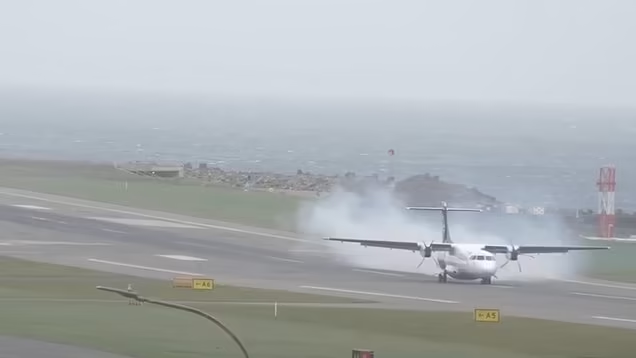
At Eindhoven Airport, the country’s second-largest air hub, travelers have been stranded since early morning, with flights from budget airlines Ryanair and Transavia cancelled. Judith de Roy, an airport spokesperson, stated, “There is no air traffic at all and we have very little information about the cause.” All flights at the airport were grounded until at least 5 pm local time (4 pm UK time), resulting in at least 14 cancelled flights.

Some flights were diverted to Germany’s Weeze Airport, approximately 90km from Eindhoven, as well as Amsterdam’s Schiphol Airport and Belgium’s Brussels Airport, both about 125km away. Notably, Schiphol, the country’s largest airport, has not reported any problems related to the outage.

The disruption has extended beyond air travel, impacting critical emergency services. Alarm and communications systems for emergency workers have been affected, with the coastguard reporting that they were unreachable by phone or radio. Police officers have been forced to rely on mobile phones and text messages to maintain contact, abandoning their normal communication systems.

Adding to the complexity of the situation, telecom company KPN experienced a major outage with its mobile service. However, the company stated it was unclear if this problem was related to the issues at the Defence Ministry.

The Dutch national cybersecurity centre has yet to determine if the outage is a result of a cyber attack, emphasizing the uncertainty surrounding the cause and potential duration of the disruption. The Defence Ministry has not provided an estimated timeline for resolving the issue.

Source: news.skynews.com

Kremlin Rejects Zelenskyy’s Peace Plan, Vows to Continue ‘Special Military Operation’ in Ukraine

MOSCOW – The Kremlin on Wednesday firmly rejected Ukrainian President Volodymyr Zelenskyy’s discussion of a plan to end the ongoing conflict, asserting that Russia will continue its “special military operation” in Ukraine. This response comes after Zelenskyy announced on Tuesday his intention to present a comprehensive peace plan to U.S. President Joe Biden and potential successors.

Kremlin spokesman Dmitry Peskov,

Kremlin spokesman Dmitry Peskov, addressing reporters, dismissed Zelenskyy’s proposal: “This is not the first time that we have heard such statements from representatives of the Kyiv regime. We are aware of the nature of this Kyiv regime,” Peskov stated. “We are continuing our special military operation and will achieve all of our goals.”

Zelenskyy, speaking at a news conference, revealed that Ukraine’s three-week-old incursion into Russia’s Kursk region forms part of his broader strategy. While not disclosing full details, he indicated that the plan encompasses economic and diplomatic measures alongside military actions. The Ukrainian leader emphasized that the objective is to compel Moscow to end the war, partly by leveraging long-range U.S.-supplied arms to strike deep inside Russian territory – a move he is urging Washington to approve.

The Kremlin’s dismissal underscores the deep divide between Moscow and Kyiv’s perspectives on the conflict and potential resolutions. Russia currently faces the challenge of repelling the Ukrainian incursion that began on August 6, while simultaneously advancing its offensive in the Donetsk region of eastern Ukraine.

Peskov also addressed recent diplomatic efforts by India, acknowledging Prime Minister Narendra Modi’s stance on the need for a peaceful settlement. Modi had recently engaged in discussions with both Russian President Vladimir Putin and Zelenskyy, advocating for an early, peaceful resolution to the conflict. However, Peskov tempered this acknowledgment, stating, “It is more than obvious that there is no basis for talks right now.”

The exchange highlights the complex international dynamics surrounding the conflict, with various nations attempting to mediate or influence its course. India’s efforts, while recognized, are viewed by Moscow as premature given the current military situation and political standoff.

Acclaimed Iranian Filmmaker and Actress Daughter Charged for Violating Hijab Law

Iranian authorities have brought charges against prominent filmmaker Rakhshan Banietemad and her actress daughter Baran Kosari for violating the country’s Islamic dress code by appearing in public without wearing hijabs, the judiciary announced Wednesday.

“The Tehran prosecutor charged filmmaker Rakhshan Banietemad and her daughter, the actress Baran Kosari, after they removed their hijab in public,” reported Mizan Online, the judiciary’s official news website.

Banietemad, 70, is one of Iran’s pioneering female screenwriters and film directors, with a career spanning decades. Her work has garnered numerous accolades, including several awards at the Tehran Fajr film festival, Iran’s most prestigious cinematic event. Her daughter, Kosari, 38, is also an accomplished actress in her own right, having received the best actress award at the Fajr festival in 2015.

The charges stem from an incident on Tuesday when pictures of the two women without the mandatory headscarf at a film event were posted online and quickly went viral. The images sparked immediate controversy in a country where, since the 1979 Islamic Revolution, failing to wear the hijab in public is considered a criminal offense and a violation of the Islamic Republic’s strict dress code for women.

This incident highlights the ongoing tensions in Iran regarding women’s rights and personal freedoms. The mandatory hijab law applies to all women in Iran, regardless of nationality or religious beliefs, and has been a source of contention both domestically and internationally.

The indictment of such high-profile figures in Iran’s cultural sphere is likely to draw significant attention both within the country and abroad. It underscores the challenges faced by women in Iran’s public life, particularly those in the arts, who often find themselves at the intersection of creativity, public visibility, and strict religious laws.

As the case develops, it may reignite debates about personal freedom, artistic expression, and the role of women in Iranian society. The international film community will likely be watching closely, given Banietemad and Kosari’s respected status in cinema.

Global Police Operation Targets Nigerian Criminal Network Black Axe

In a sweeping international effort, police units from 21 countries have joined forces to target one of West Africa’s most feared criminal networks, Black Axe. Operation Jackal III, coordinated by global policing agency Interpol, led to the arrest of 300 individuals linked to Black Axe and affiliated groups between April and July 2024.

Tomonobu Kaya, a senior official at Interpol’s Financial Crime and Anti-Corruption Centre, described the operation as a “major blow” to the Nigerian crime network. However, he warned that Black Axe’s international reach and technological sophistication continue to pose a significant global threat.

“They are very organized and very structured,” Kaya told the BBC, highlighting the group’s adaptability to new technologies. “These criminal syndicates are early adopters of new technologies… A lot of fintech developments make it really easy to illegally move money around the world.”

The operation, which involved officers in body armor carrying out raids across multiple countries, resulted in the seizure of $3 million in illegal assets and the freezing of more than 700 bank accounts. This latest effort builds on previous “Jackal” operations that have been ongoing since 2022, allowing Interpol to create a vast intelligence database shared among its 196 member countries.

Black Axe, known for its secretive nature and diverse criminal activities including trafficking, prostitution, and cyber-crime, has been linked to massive financial fraud schemes. In 2017, Canadian authorities uncovered a money-laundering operation connected to Black Axe worth over $5 billion.

The group’s sophistication is partly attributed to its recruitment of university-educated members. Cyber-crime, targeting both individuals and businesses, remains the organization’s largest source of revenue.

Despite the success of Operation Jackal III, some experts argue that more needs to be done to address the root causes of these crime syndicates in West Africa. Dr. Oluwole Ojewale, West Africa Regional Coordinator from the Institute for Security Studies, emphasized the need for prevention rather than solely focusing on law enforcement operations.

Screenshot

“The emphasis must actually be on prevention, not on outright operations against these criminal groups,” Ojewale stated. He pointed to widespread poverty in Nigeria, Black Axe’s main recruitment ground, as a significant factor. The World Bank estimates that as many as 87 million people in Nigeria live below the poverty line, despite the country being one of Africa’s largest economies.

Corruption and alleged collusion between Black Axe and local authorities remain major obstacles in combating the group’s influence. “It is the politicians who are actually arming these boys,” Ojewale added, highlighting the complex political dimensions of the issue.

The genesis of Interpol’s Jackal Operations can be traced back to Ireland, where a series of raids by the Garda National Economic Crime Bureau (GNECB) in 2020 exposed a wider network of Black Axe operations. Detective Superintendent Michael Cryan of the GNECB noted, “The amount of money being laundered through Ireland was astronomical.”

A bbc.com story

Study Reveals 31.8 Million Nigerians Face Acute Food Shortage Amid Security Challenges and Subsidy Removal

A new study conducted by several international development partners reveals that over 31.8 million Nigerians are facing acute food shortages, the Nigerian government announced on Tuesday. This alarming figure represents a significant increase from previous assessments and highlights the growing food security crisis in Africa’s most populous nation.

The Ministry of Budget and Economic Planning cited the study’s findings, which were presented during a two-day meeting with government officials. The research points to two primary factors exacerbating the food crisis: ongoing security challenges and the recent removal of fuel subsidies.

“The surge in food commodity prices, which is a result of the removal of fuel subsidy in addition to security challenges, has placed millions of Nigerians in a precarious situation,” the ministry stated. This sharp rise in food insecurity contrasts starkly with the U.N. World Food Programme’s assessment from October to December 2023, which identified 18.6 million people as vulnerable to acute food insecurity.

The study, produced by partners including the U.N. Food and Agriculture Organization, the Global Alliance for Improved Nutrition, and the German development agency GIZ, utilized statistics from the Cadre Harmonise, a regional food security framework. It highlights the severe impact on women and children, with rising malnutrition rates reported across the country.

Nigeria’s food security crisis is compounded by persistent raids by armed bandits in rural areas, forcing many farmers to abandon their fields. This exodus has contributed to higher food prices and soaring inflation, pushing the country into its worst cost of living crisis in a generation.

President Bola Tinubu’s decision to remove fuel subsidies shortly after taking office in May 2023, aimed at reducing government spending, has led to a significant increase in transportation costs. This policy change has had far-reaching effects on food accessibility and affordability for millions of Nigerians.

Sanjo Faniran, Nigeria’s national convener of Food Systems and director of social development in the Ministry of Budget and Economic Planning, emphasized the study’s importance in identifying gaps, successes, and challenges in addressing food insecurity. The findings are expected to inform policy recommendations and guide future interventions.

Swiss Citizen Working on US-Funded Aid Project Arrested in Burkina Faso

A Swiss citizen working on a U.S.-funded aid project has been arrested in Burkina Faso, the Swiss Federal Department of Foreign Affairs (FDFA) confirmed on Tuesday. The motive for the arrest remains unclear, adding to growing concerns about diplomatic relations between Western nations and countries in the Sahel region.

“The FDFA is aware of the arrest of a Swiss citizen in Burkina Faso,” the department stated, providing no further details about the individual or the circumstances of their detention.

According to a foreign official familiar with Sahel issues, the arrested Swiss national was employed as the chief of party for Winrock International, a U.S.-based nonprofit organization. The individual was working on a U.S.-funded aid project spanning both Niger and Burkina Faso, focusing on water security and resilience efforts in the region.

The official revealed that the Swiss citizen was initially detained in Niger alongside a British national. Both were subsequently released. However, upon traveling to Burkina Faso, the Swiss citizen was arrested and detained once again.

Winrock International, which maintains domestic offices in Arkansas and Virginia, has not responded to requests for comment on the situation.

This incident occurs against a backdrop of increasing political instability in the Sahel region. Burkina Faso has experienced two military coups in recent years, leading to strained relations with Western powers. The country’s military junta, which seized power in a 2022 coup, faces accusations of suppressing dissent through kidnappings and forced conscription of critics.

The arrest also follows a series of diplomatic tensions in the region. On Monday, Denmark announced the closure of its embassies in Mali and Burkina Faso. This decision came in the wake of Mali’s expulsion of Sweden’s ambassador earlier this month following a diplomatic dispute.

Burkina Faso’s army is currently engaged in a fight against a jihadist insurgency that has spread across the Sahel region over the past 12 years. The worsening violence has contributed to political instability, leading to coups not only in Burkina Faso but also in neighboring Mali and Niger since 2020.

As of Tuesday, attempts to reach Burkina Faso’s ruling military junta for comment on the Swiss citizen’s arrest have been unsuccessful. The situation continues to develop, with international observers closely monitoring its potential impact on diplomatic relations and aid efforts in the region.

Reuters

Haiti’s Army Recruitment Drive Attracts Thousands Amid Gang Violence Crisis

Thousands of young Haitians are flocking to join the country’s military, viewing it as a rare opportunity for employment and a chance to combat the widespread gang violence plaguing the nation. The recruitment drive comes as Haiti’s government seeks to rebuild and expand its once-disbanded armed forces to address the escalating security crisis.

Maurenceley Clerge, a 21-year-old smartphone repairman, exemplifies the eagerness among Haiti’s youth to enlist. “It’s the moment I have been waiting for,” Clerge said, standing in line with hundreds of other applicants under the scorching sun. “I want to serve as a citizen of this country and also to move up and upgrade my life.”

The recruitment announcement, broadcast over local radio, has resonated deeply in a country where approximately 60% of the nearly 12 million inhabitants earn less than $2 a day. Inflation has soared to double digits in recent years, exacerbating the economic hardship.

Samuel Delmas, 20, another applicant, expressed his motivation despite the risks involved. “I have always wanted to be useful to my country,” he said, recounting how gang violence forced his family to flee their home two years ago. “I want to protect citizens who are on the run like me.”

While the government has not disclosed specific recruitment targets, documents from the Defense Ministry indicate that at least 3,000 individuals were selected in mid-August for further evaluation. If all are hired, it would more than double the force’s early 2022 strength of 2,000.

The military’s resurgence marks a significant shift in Haiti’s recent history. The armed forces were disbanded in 1995 following a series of coups and human rights abuses. The decision to demobilize the army “proved to be one of the most catastrophic decisions in the country’s history,” according to Michael Deibert, author of two books on Haiti. He argues that this created a security void filled by politically-aligned gangs.

The army was reinstated in 2017 by President Jovenel Moïse, who was assassinated in July 2021. Since then, it has played a limited role in combating gang violence. However, with the recent appointment of Gen. Derby Guerrier as the new armed forces chief and the massive recruitment drive, the military appears poised for a more prominent role in restoring peace.

Recaptured inmates are escorted by police back to the Croix-des-Bouquets Civil Prison after an attempted breakout, in Port-au-Prince, Haiti, Thursday, Feb. 25, 2021. At least seven people were killed and one injured on Thursday after eyewitnesses told The Associated Press that several inmates tried to escape from a prison in Haiti’s capital. (AP Photo/Dieu Nalio Chery).

Prime Minister Garry Conille has pledged to modernize the military, investing in technology, infrastructure, and improved conditions for soldiers and their families. “A soldier … whose family is safe and well cared for is a soldier who is more determined and focused,” Conille stated.

The expanded military is expected to work alongside Haiti’s police force and a UN-backed mission led by Kenya, which has already deployed 400 police officers to Haiti. Additional personnel from countries including Benin, Chad, and Jamaica are expected to arrive in the coming months, forming a total foreign contingent of 2,500.

As Haiti grapples with unprecedented levels of gang violence – with over 3,200 killings reported from January to May and more than half a million people displaced in recent years – the military’s expansion represents a critical component of the government’s strategy to restore order and provide hope to a beleaguered population.

For young Haitians like Emerson Celadon, a 25-year-old mechanic who has applied to join, the army offers not just a job but a vision for a better future. “I would love to see the country like how I heard it was back in the day: a Haiti where everyone can move around freely, where there are no gangs, where everybody is able to work,” he said.

As the recruitment process continues, the international community watches closely, hoping that this reinvigorated military can play a pivotal role in stabilizing Haiti and providing a path forward for its youth.

6 Polish Students and Lecturer Released from Detention in Nigeria, Set to Return Home

Six Polish students and a lecturer from Warsaw University, who were detained in Nigeria during recent protests, have been released and are preparing to return home, the Polish foreign ministry announced Wednesday. The group, held in the northern city of Kano, is reported to be in good health and expected to arrive in Poland later this week.

Foreign ministry spokesman Pawel Wronski confirmed that the seven Polish citizens have had their passports, laptops, and personal belongings returned. They are currently staying at the university campus in Kano while arrangements for their departure are finalized.

The group was in Nigeria as part of a program to study the Hausa language when they were detained earlier this month during political protests in Kano state. Nigeria’s secret service initially claimed they were carrying Russian flags, an allegation that Polish officials deemed highly improbable given Poland’s strained relations with Russia.

“Our students were at the wrong time at the wrong place,” Wronski stated, emphasizing the importance of caution when traveling to distant locations. He noted that the foreign ministry regularly posts travel warnings and advice on its website, including a specific warning about the “quite complicated” political situation in Kano state.

The detention of the Polish nationals occurred against the backdrop of widespread protests in Nigeria against the country’s cost-of-living crisis and alleged governmental mismanagement. In some northern states, a few protesters were seen waving Russian flags, a phenomenon previously uncommon in Africa outside of coup-affected countries where pro-Russian sentiments have been growing.

Polish officials maintained throughout the incident that the situation was likely a misunderstanding. The group was held at a hotel in Kano while diplomatic efforts to secure their release were underway.

The case had raised concerns in Poland, where pro-Russian sentiment is rare due to historical grievances and current opposition to Russian aggression in Ukraine. Polish society has been strongly supportive of Ukraine in the ongoing conflict.

As the Polish nationals prepare to return home, the incident serves as a reminder of the potential risks faced by international students and researchers in politically volatile regions. It also highlights the complexities of international relations and the importance of diplomatic channels in resolving such situations.

The Polish foreign ministry has not provided further details about the circumstances leading to the group’s release or any conditions attached to their departure from Nigeria. As the situation unfolds, it is likely to prompt discussions about safety protocols for academic programs in potentially unstable areas and the need for enhanced communication between foreign ministries and citizens traveling abroad for extended periods.