At least 25 civilians were killed in a predawn assault by militants linked to the Islamic State group in eastern Democratic Republic of Congo, a local human rights organization said, underscoring the persistent insecurity that continues to plague the mineral-rich but conflict-scarred region.
The attack unfolded around 4 a.m. Sunday in and around Apakulu village, located in the Irumu territory of Ituri province, according to the Convention for the Respect of Human Rights, a rights group based in the province. The organization said fighters from the Allied Democratic Forces, commonly known as the ADF, carried out coordinated killings that left entire families devastated.
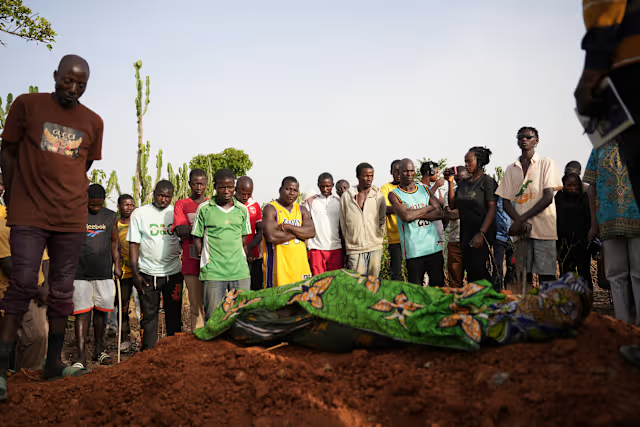
Christophe Munyanderu, president of the rights group, said 15 men were burned alive inside a house that was set ablaze during the raid, while seven others were shot dead as the attackers swept through the village. Three additional victims were killed in the nearby Walese Vonkutu administrative area, bringing the confirmed death toll to at least 25.
“This tragedy occurred around 4 a.m. and claimed the lives of at least 25 people,” Munyanderu said in a statement. “This incursion by the ADF is a true massacre.”
There was no immediate comment from the ADF, which rarely issues public statements after attacks but has previously claimed responsibility for violence through Islamic State-linked media channels.
The latest killings add to a growing list of deadly assaults in eastern Congo, where armed groups have operated for decades amid weak state control, porous borders and competition over land and natural resources. In recent months, the region has seen a renewed spike in violence involving multiple factions, including the ADF and the Rwanda-backed M23 rebel group.
While the M23 has drawn international attention for its territorial gains in North Kivu province, the ADF has continued to mount deadly raids in Ituri and parts of North Kivu, frequently targeting civilians in rural communities. Rights groups say such attacks are often designed to instill fear, punish perceived collaboration with government forces and assert control over strategic areas.
The ADF traces its origins to an Islamist insurgency launched in the 1990s against the government of Ugandan President Yoweri Museveni. After sustained military pressure from Ugandan forces, the group retreated into eastern Congo, where it gradually embedded itself in remote forested areas along the border between the two countries.
In recent years, the ADF has pledged allegiance to the Islamic State group, which has claimed some of its attacks under the banner of its Central Africa Province. United Nations experts and regional analysts say the group has since adopted more brutal tactics, including mass killings, abductions and village burnings.
Last July, the ADF carried out a series of coordinated assaults that left more than 100 people dead, one of the deadliest episodes attributed to the group in recent memory. Despite repeated military offensives, the militants have shown an ability to regroup and strike with lethal effect.
Ugandan and Congolese armed forces have been conducting joint operations against the ADF as part of a bilateral security effort aimed at dismantling the group’s leadership and supply networks. While officials say those operations have disrupted some militant bases, local residents and humanitarian groups argue that security gains have been fragile and uneven.
Sunday’s attack highlights the challenges facing authorities as they attempt to protect civilians across a vast and difficult terrain where armed groups exploit dense forests, poor infrastructure and limited state presence. Many villages in Ituri province remain accessible only by foot or motorcycle, complicating rapid military response and emergency aid delivery.
Humanitarian organizations warn that repeated violence is deepening an already severe crisis in eastern Congo, where millions of people have been displaced by conflict. Survivors of attacks often flee to overcrowded camps or host communities with little access to food, healthcare or protection.
Analysts say the continued resilience of the ADF raises broader questions about the effectiveness of military-first strategies in addressing the root causes of violence in the region. While joint operations have degraded some armed groups, experts argue that long-term stability will require improved governance, accountability for abuses and sustained investment in local communities.
The attack in Apakulu is also likely to intensify calls for greater international engagement, particularly as the Islamic State brand continues to exploit instability in parts of Africa. Security specialists caution that while the ADF’s operational capacity remains largely localized, its ideological alignment with global jihadist networks amplifies its threat and propaganda reach.
For residents of Ituri, however, the consequences are immediate and personal. Families are left to bury their dead, villages are emptied overnight and fear becomes a constant companion. As Munyanderu and other rights advocates have repeatedly stressed, without stronger protection for civilians, such massacres risk becoming a grim routine rather than isolated tragedies.
A private jet carrying eight people crashed while attempting to take off Sunday night at Bangor International Airport in Maine, federal aviation officials said, as a powerful winter storm battered much of the eastern United States.
The aircraft, identified as a Bombardier Challenger 600, went down at about 7:45 p.m., according to the Federal Aviation Administration. There was no immediate information on the condition of those on board.
The FAA said it is investigating the crash alongside the National Transportation Safety Board.
Bangor International Airport confirmed that emergency crews responded to what it described as an incident involving a single departing aircraft. The airport was temporarily closed following the crash as first responders secured the scene.
The accident occurred amid widespread severe weather across New England and large parts of the country. Bangor experienced steady snowfall throughout Sunday as the winter storm system brought snow, sleet and freezing rain to much of the eastern half of the United States.
The storm caused extensive travel disruptions nationwide, grounding flights, snarling road traffic and knocking out power to hundreds of thousands of homes and businesses, particularly across the Southeast.
Commercial aviation was heavily affected, with flight-tracking service FlightAware reporting about 12,000 flight cancellations and nearly 20,000 delays on Sunday alone. Major airports in Philadelphia, Washington, Baltimore, North Carolina, New York and New Jersey were among those impacted.
Bangor International Airport, located about 200 miles north of Boston, serves as a regional hub with direct flights to destinations including Orlando, Florida; Washington, D.C.; and Charlotte, North Carolina.
The Bombardier Challenger 600 is a wide-body business jet typically configured to carry between nine and 11 passengers. Introduced in 1980, it was the first private jet designed with a full “walk-around” cabin and remains a popular option for charter operations.
Authorities said the cause of the crash has not yet been determined, and investigators will examine weather conditions, aircraft performance and other factors as the inquiry continues.
MINNEAPOLIS — Former President Barack Obama issued an extraordinary rebuke of the Trump administration Sunday, characterizing the fatal shooting of 37-year-old nurse Alex Pretti by federal immigration officers as a constitutional crisis that demands immediate intervention and threatens America’s foundational principles.
The shooting Saturday in Minneapolis has ignited a political firestorm that now threatens to trigger a partial government shutdown, with Democratic lawmakers vowing to block Department of Homeland Security funding unless fundamental changes occur in federal immigration enforcement operations. Pretti’s death marks the second fatal shooting of a U.S. citizen by federal agents in Minnesota within three weeks, following the January 7 killing of Renee Good by an Immigration and Customs Enforcement officer.
Obama and former First Lady Michelle Obama released a forcefully worded joint statement Sunday describing Pretti’s death as “a heartbreaking tragedy” and “a wake-up call to every American, regardless of party, that many of our core values as a nation are increasingly under assault.” The statement represents a rare direct confrontation between the former president and his successor’s administration, breaking the customary restraint former chief executives typically maintain regarding current policy disputes.
The controversy centers on video evidence that appears to contradict official administration accounts of the incident. Multiple recordings circulating on social media platforms show federal officers removed a handgun from Pretti—which he possessed legally under Minnesota law and was not handling at the time—before fatally shooting him. The former president emphasized that Trump administration officials “appear to be directly contradicted by video evidence” yet seemed “eager to escalate the rhetoric before an investigation had been undertaken.”
Obama’s statement specifically challenged the operational legitimacy of federal immigration enforcement in Minnesota. “For weeks now people across the country have been rightly outraged by the spectacle of masked ICE recruits and other federal agents acting with impunity and engaging in tactics that seem designed to intimidate, harass, provoke and endanger the residents of a major American city,” he declared, adding that federal law enforcement and immigration agents were not operating in a lawful or accountable manner.
The bipartisan nature of concern became evident when Republican Senator Bill Cassidy of Louisiana warned that the “credibility” of ICE and the Department of Homeland Security hangs in the balance. Cassidy demanded a full joint federal and state investigation via social media platform X, asserting that authorities “can trust the American people with the truth.” His intervention signals potential fractures within Republican support for the administration’s immigration enforcement approach.
Congressional Democrats have escalated their response beyond rhetoric to concrete legislative action. Senate Minority Leader Chuck Schumer first announced Saturday that Democratic senators would withhold necessary votes if DHS funding remains in the broader government appropriations measure. A spokesperson for Senate Majority Leader John Thune confirmed that DHS and other government funds will be voted on as a single package, setting up a potential collision course that could result in partial government shutdown by month’s end without compromise.
Minnesota Senator Amy Klobuchar delivered a blunt assessment during an appearance on NBC’s Meet the Press, explaining her decision to vote against homeland security funding. “When they’re killing two constituents in my state, and they’re taking two-year-olds out of the arms of their mom, and they are taking an elder Hmong man out of his house and putting him out there in his underwear, and then figuring out they have the wrong man … no, I am not voting for this funding,” Klobuchar stated, referencing multiple incidents involving federal immigration agents that have generated intense media scrutiny.
California Senator Adam Schiff amplified this position, declaring he was “not giving ICE or border patrol another dime, given how this agency, these agencies are operating.” He warned that Republicans bear responsibility for any government shutdown if they “insist” on combining immigration enforcement funding with other government appropriations, characterizing it as “a Republican decision.”
Connecticut Senator Chris Murphy intensified the rhetorical stakes during an appearance on CNN’s State of Union, asserting that Democrats “can’t vote to fund this lawless Department of Homeland Security … that is murdering American citizens, that is traumatizing little boys and girls all across the country, in violation of the law.”
New Jersey Governor Mikie Sherrill, a Democrat, offered perhaps the most incendiary comparison during her CNN interview, describing the federal presence in Minneapolis as transcending sanctuary city disputes. “This is about a basically Stasi-type force of secret police that wear masks, that are unidentifiable, that are unaccountable, that have leadership in the Trump administration blatantly lying about what’s going on, when the American people can see the video,” Sherrill contended, invoking the East German secret police notorious for surveillance and suppression of dissent.
New York Congresswoman Alexandria Ocasio-Cortez framed the confrontation in constitutional terms, posting on X that “we have a responsibility to protect Americans from tyranny” while urging Senate Democrats to oppose homeland security funding and demanding federal immigration authorities withdraw from Minnesota entirely.
The factual dispute between administration officials and eyewitness evidence has emerged as a central flashpoint. Homeland Security Secretary Kristi Noem claimed Pretti brandished a gun before agents fired “defensive shots” at him. However, none of the extensive video documentation shows Pretti brandishing a weapon. The discrepancy prompted Klobuchar to emphasize visual evidence over official narratives: “I just keep thinking, your eyes don’t lie. Law enforcement is based on trust, and we have had a total breakdown of trust.”
Pretti’s parents, Michael and Susan, issued their own statement Sunday expressing profound grief mixed with fury at official characterizations of their son. “We are heartbroken but also very angry,” they wrote. “The sickening lies told about our son by the administration are reprehensible and disgusting.” Their statement directly challenges the administration’s credibility on fundamental facts surrounding the shooting.
Deputy Attorney General Todd Blanche attempted to defend the administration’s position during his Meet the Press appearance, acknowledging “there’s obviously an investigation that’s ongoing” while disputing the notion that available videos tell the complete story. “We don’t know what happened in the minutes leading up to what we just watched. We don’t know what ICE saw, what ICE heard,” Blanche argued. “You see a violent interaction with the man who was shot. And so we don’t know. No matter how many times you look at it, no matter how many different angles that we see, there’s a lot that we don’t see.”
Blanche also contested characterizations of anti-immigration enforcement demonstrators as peaceful, claiming “they are trying to impede and obstruct ICE, and it makes the job that our men and women have to do virtually impossible to do without interactions like that.” He deflected ultimate responsibility to Minnesota Governor Tim Walz and Minneapolis Mayor Jacob Frey, asserting the incident was “entirely avoidable if we had a governor, if we had a mayor, if we had leadership in Washington and over in Minnesota that actually cared about their citizens.”
Border Patrol Commander-at-Large Gregory Bovino adopted an even more confrontational posture during his CNN interview with Dana Bash. When Bash referenced evidence showing Pretti was unarmed, Bovino responded, “You don’t know he was unarmed. I don’t know he was unarmed. That’s freeze-frame adjudication of a crime scene via a photo. That’s why we have investigators.” When pressed on whether he was blaming the victim, Bovino replied, “The victims are the border patrol agents.”
During a Sunday afternoon press conference, Bovino maintained that numerous videos exist with varying perspectives, justifying the need for comprehensive investigation rather than relying on what he characterized as “freeze frame concept” analysis. He acknowledged investigators have not yet determined how many shots were fired and confirmed that all agents involved in the incident have been reassigned to locations outside Minneapolis “for their safety.”
The operation’s stated objective centered on apprehending Jose Huerta-Chuma, whom Bovino described as an undocumented immigrant with significant criminal history who needed removal from the streets. Bovino claimed Huerta-Chuma was being taken into custody when “agitators, rioters and anarchists” prevented the arrest.
However, Minnesota’s Department of Corrections directly contradicted Bovino’s characterization of Huerta-Chuma’s criminal background. Department records and Minnesota court data indicate the individual identified by federal officials has never been in the state’s custody and has no felony commitments. Department of Corrections records show someone with Huerta-Chuma’s name was previously held in federal immigration custody at a local Minnesota jail in 2018 during Trump’s first presidency, meaning the decision to release him from federal custody would have been made by Trump administration officials. The department had no information explaining why Huerta-Chuma was released, and Bovino offered no explanation when questioned by reporters Sunday.
Instead, Bovino shifted focus to Pretti’s actions: “When someone makes the choice to come into an active law enforcement scene, interfere, obstruct, delay or assault a law enforcement officer, and they bring a weapon to that, that is a choice that individual made.” This statement ignores Minnesota law permitting licensed individuals to possess firearms in public places, with permit violations carrying only a $25 misdemeanor fine for those lacking proper documentation.
South Carolina Republican Senator Lindsey Graham echoed the administration’s framing, contending that “an armed man trying to impede a lawful arrest is a recipe for disaster.” Graham added that while he expects law enforcement officers to exercise good judgment, they should not “foolishly risk their lives or the lives of others,” noting that “if you go to such events with a loaded gun, bad things can happen.”
The legal battleground expanded late Saturday when a federal judge issued an order blocking the Trump administration from “destroying or altering evidence” related to Pretti’s killing, following a lawsuit filed by Minnesota officials against the Department of Homeland Security. Minnesota Attorney General Keith Ellison characterized the demand for “a full, impartial, and transparent investigation into [Pretti’s] fatal shooting at the hands of DHS agents [as] non-negotiable.”
Minneapolis Police Chief Brian O’Hara disclosed that information about events preceding the shooting remains limited. As protests erupted Saturday throughout Minneapolis, federal officers prevented state investigators from accessing the scene of Pretti’s killing, further complicating efforts to establish an independent factual record.
President Trump responded with characteristic combativeness, accusing Governor Walz and Mayor Frey of “inciting Insurrection, with their pompous, dangerous and arrogant rhetoric.” Vice President JD Vance characterized events in Minneapolis as “engineered chaos” resulting from “far-left agitators, working with local authorities.”
The Obamas’ statement concluded with a call for systemic change and civic engagement. “This has to stop,” they wrote plainly, expressing hope that administration officials would “reconsider their approach, and start finding ways to work constructively with Governor Walz and Mayor Frey as well as state and local police to avert more chaos and achieve legitimate law enforcement goals.”
They urged Americans to “support and draw inspiration from the wave of peaceful protests in Minneapolis and other parts of the country,” framing civic action as essential to democratic accountability. “They are a timely reminder that ultimately it’s up to each of us as citizens to speak out against injustice, protect our basic freedoms, and hold our government accountable,” the former president and first lady wrote.
The confrontation represents an unprecedented collision between federal immigration enforcement priorities and state sovereignty concerns, with potential implications extending far beyond the immediate tragedy. The dispute over basic facts—captured on multiple video recordings yet disputed by federal officials—raises fundamental questions about governmental accountability and the relationship between law enforcement agencies and the communities they serve. With congressional budget negotiations approaching critical deadlines and both parties entrenched in opposing positions, the Pretti shooting has transformed from a local incident into a national constitutional controversy with the potential to reshape federal-state relations and immigration enforcement protocols for years to come.
Operatives of Nigeria’s National Drug Law Enforcement Agency have arrested a Brazilian woman at the Nnamdi Azikiwe International Airport in Abuja after intercepting more than 30 kilograms of heroin concealed in factory-sealed coffee packs, a haul the agency valued at over ₦3 billion on the streets.
The suspect, identified as 30-year-old Ingrid Rosa Benevides, was taken into custody on Friday, January 23, 2026, upon her arrival in Abuja aboard Qatar Airways flight QR1431. NDLEA officials said the arrest followed actionable intelligence that led officers to subject her luggage to a detailed search.
According to the agency, Benevides, who reportedly works as a private security officer in Brazil, was found with two checked-in bags containing 21 factory-sealed packets of Brazilian coffee. Further examination revealed the packs did not contain coffee but a white substance that later tested positive for heroin, with a total weight of 30.09 kilograms.
NDLEA spokesperson Femi Babafemi said the seizure represents the single largest heroin interception ever recorded at the Abuja airport. He added that during a preliminary interview, the suspect claimed she brought the drug consignment under the guise of traveling to Nigeria for a holiday.
In a related operation, NDLEA officers at the Murtala Muhammed International Airport in Ikeja, Lagos, intercepted two passengers attempting to fly to Istanbul, Turkey, aboard a Turkish Airlines flight on Tuesday, January 20. The suspects, identified as Adediran Adedoyin and Afatakpa Ochuko, were found with 3,990 pills of tapentadol 250mg and tramaking 225mg concealed inside food items packed in their luggage, the agency said.
Separately, NDLEA operatives attached to the Marine Command intercepted a wooden boat loaded with cannabis along the Lagos coastline. The operation, carried out in the early hours of Thursday, January 22, led to the seizure of 44 jumbo bags of “Ghana Loud,” a potent strain of cannabis weighing 1,848 kilograms, at Jakande Beach in Lekki.
Babafemi said the boat had just arrived from Ghana when officers, acting on credible intelligence, raided the area around 1 a.m., recovered the drugs and secured the vessel.
The NDLEA said investigations into all the cases are ongoing as part of broader efforts to disrupt international drug trafficking networks using Nigeria as a transit or destination point.
At least 50 migrants are feared drowned after a boat capsized in the Mediterranean Sea off the coast of Tunisia, with only one survivor rescued after spending a full day adrift in the water, officials and aid groups said Sunday.
The survivor, whose identity was not released, was found by a merchant vessel after approximately 24 hours at sea and later transferred to Malta for medical treatment, Malta’s armed forces confirmed. The man told rescuers he believed all other passengers aboard the vessel had perished, according to Alarm Phone, a migrant emergency hotline group cited by Reuters.
Alarm Phone said the boat had departed from Tunisia, a major launch point for migrants attempting the perilous crossing to Europe. The group and Maltese authorities did not specify the exact time of the rescue.
The incident underscores the continued dangers faced by migrants traveling along the central Mediterranean route, widely considered the deadliest migration corridor in the world. Boats leaving North Africa are often overcrowded, poorly equipped and launched under cover of darkness to avoid detection, increasing the risk of fatal accidents.
Although details surrounding the sinking remain limited, the tragedy echoes similar disasters in the region in recent years. In a 2021 incident reported by The Guardian, more than 50 migrants were feared drowned after a boat traveling from Libya to Europe sank off southern Tunisia. In that case, Tunisian authorities rescued 33 survivors—most of them from Bangladesh—who were clinging to an offshore oil platform after their vessel, carrying more than 90 people, went down.
International agencies say such incidents are part of a persistent pattern. The United Nations has reported that thousands of migrants have died in the Mediterranean in recent years, with the majority of deaths occurring along the central route between North Africa and Europe. Libya and Tunisia remain key departure points for migrants fleeing conflict, poverty and instability across Africa and parts of Asia.
The International Organization for Migration has repeatedly warned that efforts to curb migration without expanding safe and legal pathways are contributing to higher death tolls at sea. The agency has also raised concerns over the treatment of migrants intercepted and returned to Libya, where many face detention in harsh conditions.
European Union-backed efforts to stem irregular migration have drawn criticism from human rights groups, who argue that increased interceptions have not reduced crossings but instead forced migrants into more dangerous journeys.
As search operations continue, aid organizations say the latest sinking off Tunisia highlights the urgent need for expanded search-and-rescue efforts and coordinated international action to prevent further loss of life in the Mediterranean.
NASHVILLE, Tenn. — A relentless arctic siege has claimed at least 12 lives and left more than a million customers without electricity as Winter Storm Fern unleashes a catastrophic combination of ice, snow and subzero temperatures across a 2,000-mile swath of the nation, from New Mexico to New England.
The fatalities paint a grim picture of the storm’s widespread devastation. Five residents perished in New York City as temperatures plummeted Saturday night, their bodies discovered outdoors before heavy snowfall arrived. Louisiana’s health department confirmed two men from Caddo Parish died from hypothermia. A man was found deceased in a Shell gas station parking lot in Austin, Texas, early Sunday morning. Additional deaths occurred in Arkansas, Michigan, Virginia and Tennessee, with officials categorizing nine as cold-related and three as storm-related incidents.
The crisis deepened Sunday afternoon when the National Weather Service Tallahassee issued an unexpected tornado watch for portions of Alabama, Georgia and Florida, effective until 6 p.m. CST. Forecasters warned that multiple tornadoes could develop alongside wind gusts reaching 70 mph and hail measuring up to half an inch in diameter. The volatile weather system produced at least one confirmed tornado that tore through Williamson and Davidson counties in Tennessee, leaving downed trees and power lines scattered across snow-covered roads, WSMV meteorologist Dan Thomas confirmed.
The juxtaposition of winter devastation in the South with tornado warnings represents an unusual meteorological phenomenon that underscores the storm’s exceptional nature. National Weather Service meteorologist Allison Santorelli emphasized the system’s extraordinary reach during a telephone interview, noting the event affects areas spanning approximately 2,000 miles. This geographic breadth, combined with prolonged subfreezing temperatures, creates conditions that will likely extend infrastructure damage and recovery efforts for days or potentially weeks beyond the storm’s passage.
President Donald Trump approved federal emergency disaster declarations Saturday for twelve states: South Carolina, Virginia, Tennessee, Georgia, North Carolina, Maryland, Arkansas, Kentucky, Louisiana, Mississippi, Indiana and West Virginia. By Saturday, seventeen states and the District of Columbia had declared weather emergencies, the Department of Homeland Security disclosed. The Federal Emergency Management Agency pre-positioned commodities, personnel and search-and-rescue teams throughout numerous states in anticipation of deteriorating conditions.
Power infrastructure has suffered catastrophic damage, with 1,018,477 customers experiencing outages across affected regions as of Sunday afternoon, data from poweroutage.us showed. Tennessee bore the heaviest burden with 306,722 customers in darkness, followed by Mississippi with 175,276 and Louisiana with 145,105. Texas, Georgia, Kentucky, West Virginia and Alabama collectively contributed another 310,227 outages to the national total.
Nashville Electric Service announced that restoration efforts could extend for days or longer in Tennessee’s capital city, where more than 330,000 customers remained without power Sunday. The utility provider explained that freezing rain and ice accumulation weighed down trees overnight, causing branches to snap and sever power lines throughout the service territory. This assessment aligns with broader warnings from officials about ice-laden infrastructure. Homeland Security Secretary Kristi Noem explained during an appearance on Fox News Sunday Briefing that the storm’s unique characteristic involves sustained cold temperatures that will keep ice accumulation heavy on power lines for an extended period, creating ongoing collapse risks even for infrastructure that initially survived the onslaught.
The situation in Mississippi has reached particularly dire levels. Tippah Electric Power characterized the damage as “catastrophic” and warned customers that restoration could require weeks rather than days. In Corinth, Caterpillar instructed employees at its remanufacturing facility to remain home Monday and Tuesday as widespread outages crippled the community. Resident Kathy Ragan described the harrowing overnight experience on Facebook, writing that the sounds of trees snapping, exploding and falling proved deeply unsettling.
Transportation networks collapsed under the storm’s assault. More than 10,800 flights scheduled for Sunday were canceled, with an additional 16,000 delayed, flight tracking website FlightAware documented. Ronald Reagan National Airport in Washington, D.C., saw airlines cancel all Sunday departures. Major metropolitan airports in New York, Philadelphia and Charlotte, North Carolina, experienced cancellation rates exceeding 80 percent. Delta Air Lines adjusted operations to a reduced schedule subject to real-time precipitation conditions, while repositioning cold-weather experts to southern airports to support de-icing and baggage operations.
The National Weather Service forecast calls for heavy snow accumulations from the Ohio Valley to the Northeast through Monday morning, with potential totals reaching 18 inches in New England. Much of the Southeast and portions of the Mid-Atlantic face continued rain and freezing rain. Forecasters predicted bitterly cold temperatures and dangerously cold wind chills from the southern plains to the Northeast would follow in the storm’s wake.
New York communities near the Canadian border have already experienced record-breaking subzero temperatures, with Watertown registering minus 34 degrees Fahrenheit and Copenhagen plummeting to minus 49 degrees, Governor Kathy Hochul disclosed. She characterized the weather event as an “Arctic siege” that is brutal, bone-chilling and dangerous. New York City Mayor Zohran Mamdani implored residents to remain indoors and avoid roadways, emphasizing that authorities want every New Yorker to survive the storm safely.
The storm’s impact extends beyond American borders. Canada faces up to a foot of snow accumulation, while Toronto’s Pearson International Airport canceled 60 percent of scheduled flights due to deteriorating weather conditions. In a dramatic rescue operation on Lake Michigan, a U.S. Coast Guard cutter broke through ice to free a 650-foot cargo ship trapped near Beaver Island, successfully assisting the vessel back to navigable waters.
The Department of Energy took extraordinary measures to maintain electrical grid stability. Saturday brought an emergency order authorizing the Electric Reliability Council of Texas to deploy backup generation resources at data centers and major facilities to prevent widespread blackouts. Sunday saw a second emergency order permitting grid operator PJM Interconnection to run specified resources in the mid-Atlantic region regardless of state law limits or environmental permit restrictions.
Dominion Energy, whose Virginia operations encompass the world’s largest concentration of data centers, indicated that if ice forecasts prove accurate, this winter event could rank among the largest in company history. The Tennessee Valley Authority spokesperson Scott Brooks noted that while the bulk power system remains stable, overnight icing caused interruptions across north Mississippi, north Alabama, southern middle Tennessee and the Knoxville area.
Ground-level conditions remained treacherous throughout affected areas. In Queens, New York, building porter Robert Williams described how his snow plow malfunctioned just as sidewalk clearing began Sunday morning, forcing him and a colleague to manually shovel and salt paths around their block-sized building nearly every hour. In Little Rock, Arkansas, accumulated snow and sleet weight apparently caused an awning collapse onto houseboats, prompting the rescue of six individuals and evacuation of 22 others, Pulaski County officials confirmed.
The storm’s meteorological complexity stems from its interaction with Gulf Coast temperatures. While thermometers reached the high 60s and low 70s along the Gulf Sunday, forecasters anticipated a precipitous drop into the high 20s and low 30s by Monday morning. The National Weather Service warned of damaging winds and slight severe storm risks, including possible brief tornadoes—a forecast that materialized with the Tennessee touchdown.
Charlotte Area Transit System suspended all transportation services Sunday, with resumption expected at 10 a.m. Monday. Officials cautioned that continued detours and delays on hazardous roadways would affect Monday operations, with Express Bus Service canceled entirely. The system’s Blue Line light rail ice cutter trains continued operating throughout the crisis.
Perhaps most tellingly, Cherokee County Sheriff’s office in north Georgia posted photographic evidence of shuttered Waffle House restaurants—an informal but widely recognized metric known as the Waffle House Index that locals use to gauge disaster severity across the South. When these famously resilient establishments close, conditions have typically reached genuinely dangerous levels.
As approximately 213 million people remained under winter weather warnings Sunday morning, authorities across affected states announced Monday school cancellations or remote learning transitions. The prolonged nature of subfreezing temperatures following the precipitation means ice and snow will melt slowly, potentially hampering power restoration and infrastructure repair efforts for an extended period. In Oxford, Mississippi, police utilized social media Sunday morning to order residents to remain home as outdoor dangers intensified. Oxford Utilities made the difficult decision to pull line crews from overnight work after trees actively snapped and fell around workers in bucket trucks.
The storm’s aftermath will likely reveal the full extent of economic disruption, infrastructure vulnerability and the challenges posed by extreme weather events affecting such vast geographic areas simultaneously.
An American climber renowned for redefining the limits of human endurance scaled Taiwan’s tallest skyscraper without ropes or safety gear on Sunday, drawing cheers from thousands below and reigniting debate over the risks and ethics of broadcasting extreme feats live.
Alex Honnold completed a ropeless ascent of Taipei 101, the 508-meter (1,667-foot) landmark that dominates the capital’s skyline, reaching the spire after 91 minutes of uninterrupted climbing. The ascent, described as a “free solo” climb, was carried out with the approval of building officials and Taipei’s city government and was broadcast live by Netflix, organizers said.
“Sick,” Honnold said upon reaching the top, pausing to take in the view before descending safely. Speaking later to reporters, he described the climb as a rare opportunity to see the city from a perspective few ever experience. The attempt had been delayed by a day because of rain, underscoring the role of weather in an endeavor where even minor miscalculations can prove fatal.
Taipei 101 was the world’s tallest building from 2004 to 2010 before being surpassed by the Burj Khalifa in Dubai, according to Reuters. It remains one of Asia’s most recognizable structures and a symbol of Taiwan’s modern identity. Honnold’s ascent transformed the tower into an arena for what producers billed as the highest urban free-solo climb ever attempted.
Honnold said he once considered climbing the building without authorization but abandoned the idea out of respect for the structure and those who manage it. He credited cooperation from the building’s owners and local authorities for making the climb possible. Event executive producer James Smith said it was highly unusual for a major skyscraper to grant access for such a high-risk undertaking, calling Taipei 101 “an icon of this country.”
Taiwanese leaders quickly embraced the moment. President Lai Ching-te wrote on Facebook congratulating Honnold for completing the challenge and thanked Netflix for showcasing Taiwan to a global audience more accustomed to seeing the island in headlines about semiconductors or regional security tensions. Through the broadcast, Lai said, viewers also saw “the warmth and passion of the Taiwanese people” and the island’s natural beauty.
The climb added to Taipei 101’s history as a magnet for elite climbers. In 2004, French climber Alain Robert—known as “Spiderman” for his skyscraper ascents—scaled the tower using a safety rope during its opening celebrations, taking nearly four hours in difficult weather. Honnold, by contrast, became the first to climb the structure entirely without ropes, completing the route in less than half the time Robert required.
The announcement of Honnold’s attempt had generated excitement and unease in equal measure. In interviews with The Associated Press before the climb, observers questioned the wisdom of undertaking such a dangerous feat live, particularly given that Honnold is now married and a father of two. His reputation was forged by his ropeless ascent of Yosemite National Park’s El Capitan, documented in the Oscar-winning film “Free Solo,” a climb that many considered unimaginable before he completed it.
Honnold told The Associated Press last year that he chooses objectives that stand apart from anything else around them. He described Taipei 101 as fitting that definition—a singular structure whose scale and exposure offered a new kind of challenge. He said he did not expect the climb to be especially difficult, noting that he had practiced the movements in advance and even consulted Robert on his podcast.
The building’s distinctive design shaped the challenge. Taipei 101 comprises 101 floors, with the most demanding section in the middle, where stacked “bamboo box” segments create steep, overhanging surfaces. Each segment contains eight floors, followed by a balcony that allowed brief rests. Organizers said the broadcast operated on a 10-second delay to allow intervention if something went wrong.
Safety planning extended well beyond the climber himself. Smith said he consulted risk-management specialists early in discussions with Honnold. Cameramen were stationed inside the building, while four high-angle camera operators were suspended on ropes nearby. Professional weather forecasters were also hired to monitor conditions, and Smith said the climb would have been canceled if rain or wind posed unacceptable danger.
Despite those precautions, the spectacle revived ethical questions about televising extreme risk. Subbu Vincent, director of media and journalism ethics at Santa Clara University, told The Associated Press that it was essential the production not amplify danger for the sake of entertainment. He said the broadcast delay was a critical safeguard and argued that livestreaming should be halted immediately if an accident occurred.
Concerns also center on influence. Free solo climbing has claimed numerous lives, including that of a young climber who fell in Yosemite last year. Separately, a trend known as “roof-topping,” in which people illegally access skyscrapers to take photos from ledges, has resulted in multiple deaths worldwide. Critics worry high-profile broadcasts could encourage imitation.
Jeff Smoot, author of “All and Nothing: Inside Free Soloing,” acknowledged those fears but said risk has always been intrinsic to climbing culture. From the public’s viewpoint, he said, such feats appear as thrill-seeking, while climbers often describe them as meditative and controlled. Smoot admitted he initially questioned why Honnold would climb Taipei 101 without ropes and why it needed to be filmed live, but concluded the danger itself was central to the appeal.
Among local climbers, admiration outweighed concern. Taiwanese rock climber Chin Tzu-hsiang said he grew up staring at Taipei 101 and imagining whether it could be climbed. He described Honnold as a household name among climbers in Taiwan and said his students, some new to the sport, were eager to watch. Chin said he trusted Honnold’s preparation and judgment.
“For him to finish the climb,” Chin said, “it’s like he’s helping us fulfill our dream.”
Beyond the spectacle, the event offered Taiwan a rare moment of global attention untethered from geopolitics. Analysts noted that the images of a lone climber inching up the island’s most famous building conveyed a narrative of openness and confidence, contrasting with the tensions that often frame coverage of the region.
Honnold’s ascent did not eliminate the risks inherent in free soloing, nor did it settle the debate over whether such feats should be broadcast live. What it did accomplish was to push the boundaries of urban climbing and place Taipei 101—once again—at the center of a global conversation, this time about human limits rather than architectural records.
Scripture Focus: “And Abraham built an altar there and called on the name of the Lord.” — Genesis 12:8 (NKJV)
In every generation, God has sought people who would walk with Him, hear His voice, and partner with Him on earth. One consistent pattern we see throughout Scripture is this: wherever God revealed Himself, an altar was built. An altar represents a meeting point between heaven and earth. It is a place of surrender, communion, sacrifice, and divine encounter. Today, though the form has changed, the principle remains. Every believer needs a prayer altar.
A prayer altar is not merely a physical structure. It is a designated place and commitment to daily communion with God. It is where a believer consistently meets God in prayer, worship, and the Word. In a distracted, noisy, and spiritually hostile world, the prayer altar is no longer optional—it is essential.
The Biblical Foundation of the Altar
From Genesis to Revelation, altars play a central role in humanity’s relationship with God. Noah built an altar after the flood, and God responded with a covenant (Genesis 8:20–22). Abraham built altars wherever God appeared to him, and his life became marked by divine guidance and blessing (Genesis 12:7–8). Elijah repaired the broken altar on Mount Carmel before the fire of God fell (1 Kings 18:30–38).
In the New Testament, though we no longer offer animal sacrifices, our lives have become living sacrifices (Romans 12:1). Prayer becomes our spiritual incense, rising continually before God (Revelation 8:3–4). A prayer altar, therefore, is the place where our lives are continually yielded to God.
Why Every Believer Needs a Prayer Altar
First, a prayer altar establishes spiritual order. When prayer has a fixed place in your life, God takes His rightful position as Lord. Jesus Himself modeled this. Despite His busy ministry, He often withdrew to solitary places to pray (Luke 5:16). If the Son of God needed a prayer altar, how much more do we?
Second, a prayer altar sustains spiritual fire. In Leviticus 6:13, God commanded that the fire on the altar must never go out. Spiritual coldness does not begin suddenly; it begins when prayer becomes irregular. A maintained prayer altar keeps your heart sensitive, your faith strong, and your spirit alert.
Third, a prayer altar becomes a place of divine instruction and clarity. Many believers struggle with confusion because they make decisions without seeking God. At the altar, God gives direction, correction, and confirmation. “Call to Me, and I will answer you, and show you great and mighty things which you do not know” (Jeremiah 33:3).
The Altar as a Place of Power and Victory
Spiritual battles are not won in public—they are won at the altar. Jesus overcame temptation in the wilderness because He was full of the Spirit and anchored in prayer (Matthew 4:1–11). The early church prevailed in persecution because they continued steadfastly in prayer (Acts 2:42).
When the prayer altar is weak, spiritual defenses collapse. Families suffer, destinies stagnate, and believers become vulnerable. But when the altar is strong, grace flows, strength is renewed, and victories are enforced.
Repairing the Broken Altar
Many believers once had vibrant prayer lives but have allowed their altars to fall into disrepair. Like Elijah, the call today is to repair the altar of the Lord. This requires repentance, renewed discipline, and intentionality. Prayer is not sustained by feelings; it is sustained by commitment.
God is not looking for perfection—He is looking for consistency. Even short, sincere prayers offered daily at a dedicated altar will transform your spiritual life over time.
Practical Steps to Build a Prayer Altar
Building a prayer altar begins with choosing a place and a time. It may be a corner of your room, a chair, or a quiet space—what matters is consistency. Set aside daily time for prayer, worship, and Scripture meditation. Guard that time jealously.
Approach the altar with reverence, honesty, and expectation. Come not only to ask but also to listen. The altar is a place of dialogue, not monologue.
In a generation marked by distraction, prayerlessness, and spiritual fatigue, God is calling His people back to the altar. The prayer altar is where intimacy with God is cultivated, power is released, and destinies are shaped.
May you rebuild, protect, and prioritize your prayer altar. For it is there that heaven touches earth, weakness is exchanged for strength, and ordinary lives become vessels of extraordinary grace.
“Draw near to God and He will draw near to you.” — James 4:8
A Sunday church service in central Kenya descended into chaos after security forces fired tear gas into a packed sanctuary where former Deputy President Rigathi Gachagua was worshipping, sparking panic among congregants and triggering fresh accusations of political persecution against the government.
The incident unfolded at Wairima Anglican Church of Kenya (ACK) in Othaya, Nyeri County, where Gachagua was attending a morning service as an invited guest. Witnesses said the disruption occurred midway through prayers, forcing worshippers—including women and children—to flee the building as choking fumes spread through the church.
Video footage published by Kenyans.co.ke showed scenes of confusion as congregants rushed outside, some coughing and covering their faces, while others knelt in prayer amid the turmoil. In one clip, a young girl appeared to collapse and was carried out by members of the congregation as cries rang out. The service was halted as church leaders attempted to calm worshippers and assess the situation.
Other videos captured thick plumes of tear gas smoke drifting around the church compound, accompanied by loud bangs that several witnesses described as resembling gunfire. In one recording, a voice can be heard alleging that live ammunition was being used and calling on Kenyans to intervene, claims that heightened public alarm but could not be independently verified.
The disruption also cut short live media coverage of the service, with at least one broadcast ending abruptly as the tear gas took effect.
Gachagua, who was escorted from the church during the incident, accused the state of orchestrating the attack. In a statement circulated shortly afterward, he alleged that police officers and state-backed groups were responsible, claiming that live bullets were fired and that vehicles in his convoy were vandalised.
In a sharply worded message directed at President William Ruto, Gachagua said the operation was an attempt on his life.
“William Ruto has sent a killer squad to kill us inside Wairima ACK Church, Othaya,” Gachagua said. “We are trapped in church, under attack with live bullets and tear gas, and my vehicles have been torched. We ask Kenyans to pray for us so that we may come out alive.”
Government officials did not immediately respond to the accusations, and police had not issued a formal statement explaining the operation by the time of publication. The claims regarding live ammunition and arson had not been confirmed by independent authorities.
The Othaya incident is the latest flashpoint in a series of confrontations involving the former deputy president since his political fallout with President Ruto. Once a close ally, Gachagua has increasingly positioned himself as a critic of the administration, drawing large crowds at church appearances and political gatherings across central Kenya.
Earlier this month, Gachagua said his convoy was blocked by police in Kirinyaga County as he traveled to a rally in Kegio. Supporters were dispersed after officers reportedly sealed off roads and deployed tear gas, though Gachagua later proceeded with the event. A day before that, on January 8, armed individuals were said to have attempted to prevent him from entering Nyeri town ahead of another political meeting.
A similar disruption was reported in late November 2025 during a Thanksgiving service in Kariobangi North, Nairobi. On that occasion, police acknowledged using tear gas but said they were responding to clashes between rival groups—one backing Gachagua and another opposing him. Gachagua later rejected that explanation, insisting the intervention was politically motivated.
Sunday’s events have reignited debate over the use of security forces in politically sensitive settings, particularly houses of worship, which in Kenya often double as platforms for political messaging. Churches have historically played a central role in the country’s civic life, and security interventions during services are rare and deeply controversial.
Human rights advocates and legal analysts say the allegations—if substantiated—would raise serious constitutional questions. Kenya’s constitution guarantees freedom of worship and assembly, while also placing strict limits on the use of force by security agencies. The use of tear gas in enclosed spaces, especially where children are present, has previously drawn condemnation from medical professionals and rights groups due to the risk of injury.
Beyond the immediate safety concerns, the incident underscores the deepening political rift within the ruling establishment. Analysts note that confrontations involving Gachagua appear to be escalating in frequency and intensity, suggesting a hardening stance by authorities as political competition intensifies ahead of future electoral cycles.
At the same time, the lack of official clarification has fueled speculation and anxiety among Gachagua’s supporters. By late Sunday, unverified reports circulated on social media claiming that the former deputy president could not be immediately reached following the chaos in Othaya. His allies said they were attempting to confirm his whereabouts, though no formal statement on his status had been issued.
For residents of Othaya, the disruption left lingering shock. Several congregants interviewed in local media described the scene as “terrifying,” saying they had never witnessed security forces deploy tear gas during a church service. Some parents said their children remained distressed hours after the incident.
The Anglican Church leadership had not issued an official response by Sunday evening, though clergy members at the service urged calm and called for prayer in the aftermath.
As investigations—or official explanations—remain absent, Sunday’s church disruption is likely to deepen political tensions and sharpen scrutiny of how state power is exercised in Kenya’s increasingly charged political environment. Whether authorities address the allegations directly may determine whether the incident becomes another unresolved chapter or a turning point in the country’s political discourse.
Victor Osimhen added another chapter to his growing legend at Galatasaray on Saturday, becoming the fastest player to score 50 goals for the Turkish powerhouse after finding the net in a league victory over Fatih Karagümrük.
The Nigerian striker reached the milestone with Galatasaray’s third goal in a 3-1 win, a result that reinforced the club’s title ambitions and further cemented Osimhen’s status as one of the most prolific forwards in its modern history. Statistical data compiled by Transfermarkt shows Osimhen reached the 50-goal mark in just 59 appearances, the quickest by any Galatasaray player since the turn of the century.
The achievement came only days after Osimhen was held scoreless in a 1-1 Champions League draw against Atlético Madrid, a reminder that even elite scorers endure quieter nights. His response was immediate. Facing Karagümrük in domestic action, Osimhen struck decisively after midfielder Gabriel Sara had already given Galatasaray a firm grip on the match with two first-half goals.
The record places Osimhen ahead of a list that includes some of the most celebrated names in Galatasaray history. Mauro Icardi, the club’s current captain, needed 69 matches to reach the same total after arriving in 2022, while former France international Bafétimbi Gomis took 74 games following his move from Swansea City in 2017. According to Transfermarkt’s database, Osimhen surpassed Icardi’s pace by a full 10 matches.
Osimhen’s scoring numbers are remarkable not only for their speed but also for their consistency across competitions. He enjoyed a sensational debut season in Istanbul, scoring 37 goals in 41 matches, a return that played a central role in Galatasaray’s Süper Lig title run. This season, he has already added 13 goals to his tally, pushing him past the half-century mark before the campaign has reached its midpoint.
The 27-year-old striker joined Galatasaray permanently this summer after a loan spell from Napoli that proved transformative for both player and club. His arrival was greeted with scenes rarely witnessed even in Istanbul’s football-mad culture. Tens of thousands of supporters lined the streets to welcome him back, celebrating a forward whose goals had delivered silverware and restored a sense of European ambition.
Saturday’s milestone underscores why Osimhen has become such a focal point of Galatasaray’s identity. Beyond the raw numbers, his physical presence, relentless pressing and ability to score in decisive moments have reshaped the team’s attacking profile. Coaches and teammates frequently point to his work rate and leadership as qualities that elevate those around him.
While foreign stars dominate much of the top-scorers list this century, Osimhen’s achievement stands out in a ranking otherwise populated by club-developed players. Apart from Icardi and Gomis, Czech striker Milan Baroš is the only other overseas forward to feature prominently among Galatasaray’s fastest scorers in the modern era, with most remaining names drawn from the club’s youth system.
The broader significance of Osimhen’s record extends beyond Galatasaray. For Turkish football, his performances have helped raise the league’s international profile, drawing attention from global audiences accustomed to seeing elite strikers in Europe’s so-called “big five” leagues. His presence has coincided with stronger European campaigns by Galatasaray, reinforcing the idea that the Süper Lig can still attract and retain top-level talent.
From a tactical standpoint, Osimhen’s efficiency has allowed Galatasaray greater flexibility. Opponents often commit extra defenders to contain him, creating space for midfield runners like Sara and wide players to exploit. The Karagümrük match offered a clear example, with Osimhen’s movement opening channels that Galatasaray exploited before he delivered the decisive goal himself.
There is also a financial dimension to his rise. Players who reach scoring benchmarks at such speed typically command premium valuations, and Osimhen’s record is likely to intensify speculation about future interest from Europe’s wealthiest clubs. Galatasaray officials have repeatedly emphasized their desire to build around him, viewing his goals as central to sustained domestic dominance and deeper Champions League runs.
Historically, Galatasaray has measured its great forwards not just by goals but by their connection with supporters. Osimhen appears to have passed that test emphatically. His celebrations, frequent interaction with fans and willingness to embrace the club’s culture have resonated in a city where football loyalty borders on the sacred.
Saturday’s goal also carried symbolic weight. Scoring his 50th in a routine league fixture rather than a showcase European night highlighted the striker’s reliability across all stages, a trait that often defines the most revered figures in club history. For Galatasaray supporters, the number itself matters less than the feeling of inevitability that accompanies his presence in the penalty area.
Looking ahead, Osimhen’s pace suggests that further records are within reach. Should he maintain his current scoring rate, he could climb rapidly into the club’s all-time scoring lists, a prospect that would have seemed improbable just a few seasons ago. His challenge will be sustaining that output amid heavier defensive attention and the physical demands of competing on multiple fronts.
For now, Galatasaray’s focus remains on immediate goals: defending their league title and pushing deeper into European competition. With Osimhen leading the line, both ambitions appear increasingly realistic. His record-breaking strike against Karagümrük was not merely another goal; it was a marker of an era in which Galatasaray’s attack revolves around one of the most efficient scorers the club has seen in decades.
As the season unfolds, the question is no longer whether Osimhen will score, but how many more milestones await before his Istanbul story reaches its next chapter.