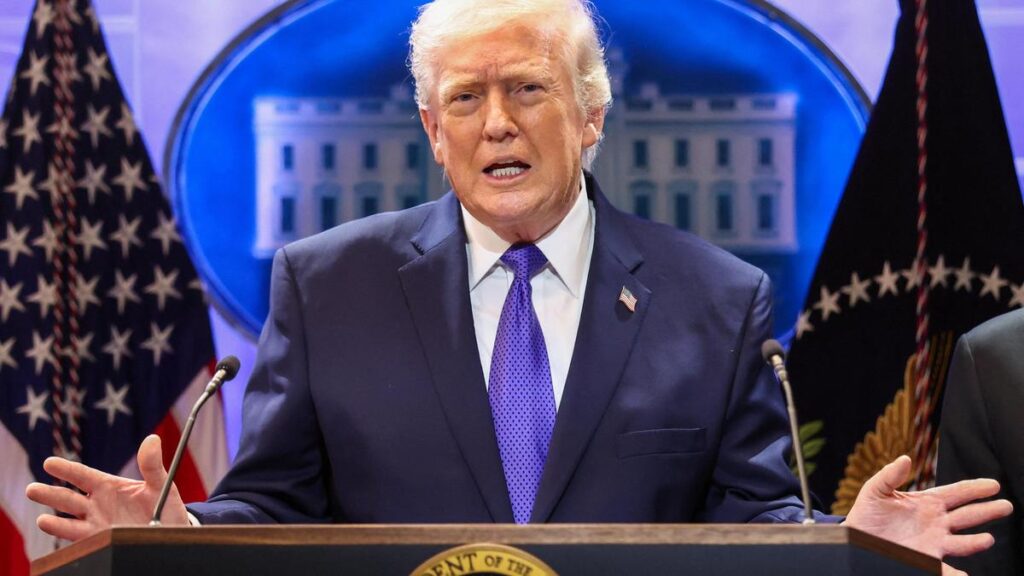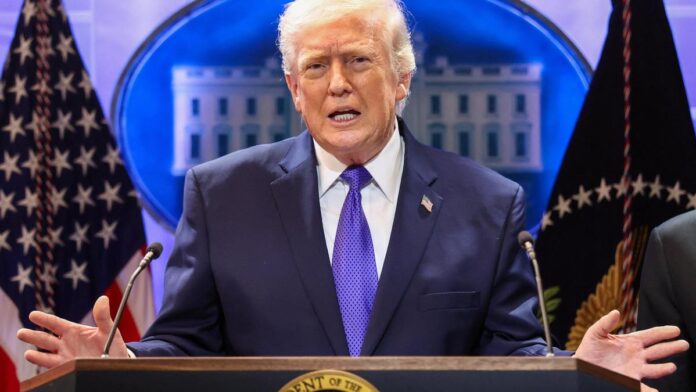
Senior Iranian officials warned President Donald Trump on Friday that any U.S. move to intervene in Iran’s ongoing protests would cross a “red line,” after Trump said Washington could come to the aid of demonstrators if security forces kill them.
In a social media post, Trump said that if Iranian authorities “shoot and kill peaceful protesters,” the United States would “come to their rescue,” adding that the country was “locked and loaded and ready to go.” He did not elaborate on what action the United States might take.
The warning came as protests in Iran entered a sixth day, marking the largest wave of unrest since 2022, when the death of 22-year-old Mahsa Amini in police custody triggered nationwide demonstrations. The current protests erupted after a sharp collapse in Iran’s currency over the weekend, with the rial plunging to roughly 1.4 million to the U.S. dollar, intensifying pressure on an economy already strained by inflation and sanctions.
At least seven people have been killed since the unrest began, including a volunteer member of the Basij paramilitary force, according to Iranian media and rights groups. Videos circulating online have shown security personnel carrying shotguns, with gunfire audible in the background.
Ali Shamkhani, a senior adviser to Supreme Leader Ayatollah Ali Khamenei, said Iran’s national security was not “material for adventurist tweets.” In a post on X, he warned that “any intervening hand nearing Iran’s security on pretexts will be cut off with a regret-inducing response.”
Trump’s comments followed his recent statement that the United States could strike Iran if it were found to be rebuilding its nuclear program, further heightening tensions between the two longtime adversaries.
Ali Larijani, secretary of Iran’s Supreme National Security Council, also responded, accusing the United States and Israel of fueling the demonstrations — a claim Iranian officials have repeatedly made during periods of unrest. In a post on X, Larijani warned that U.S. involvement in Iran’s domestic affairs would destabilize the region and harm American interests, adding that Americans should be mindful of the safety of U.S. troops stationed abroad.
Iran has previously threatened U.S. forces in the Middle East, and in June launched missiles at the Al Udeid Air Base in Qatar after U.S. strikes on Iranian nuclear enrichment facilities.
The protests have centered in Tehran but have spread to cities including Isfahan. Shopkeepers have shuttered businesses in protest, while students have staged demonstrations on university campuses. Although economic grievances are at the core of the unrest, demonstrators have also chanted anti-government slogans and criticized what they describe as corruption and mismanagement.
President Masoud Pezeshkian initially struck a conciliatory tone, inviting protest leaders to talks and saying his government should listen to what he called the protesters’ “legitimate demands.” That approach contrasts with the heavy-handed crackdown during the 2022 demonstrations.
However, recent deaths could signal a tougher response. The Islamic Revolutionary Guard Corps said earlier this week it would act decisively against what it described as foreign interference or “sedition.”
As tensions rise at home, Iranian officials have also sought to counter U.S. claims that Tehran is reviving its nuclear program. Iran has said it is not enriching uranium anywhere in the country and has indicated a willingness to engage in negotiations with Western powers.
Gabonese President Brice Clotaire Oligui Nguema ushered in the New Year with a sweeping cabinet reshuffle, appointing new vice presidents and reconstituting his government as he moves to consolidate the political transition that began with his 2023 seizure of power.
Nguema signed three presidential decrees on Thursday, January 1. One decree appointed Hugues Alexandre Barro Chambrier as Vice President of the Republic, while another elevated former Interior Minister Hermann Immongault to the post of Vice President of the Government, a role comparable to prime minister. A third decree formally established the composition of the new government.
Under the reshuffle, the cabinet expands to 31 ministers from 30 in the previous lineup, with 10 women and 21 men.
Immongault’s promotion has been widely interpreted as recognition for his role in overseeing elections during the transition period. As interior minister, he was central to organizing September’s legislative and parliamentary polls, which delivered a commanding victory for Nguema’s Democratic Union of Builders, securing 101 of the 145 seats in the National Assembly.
The changes come after weeks of political anticipation. Groundnews reported that following about 45 days of uncertainty, Nguema finalized a new government marked both by key promotions and high-profile exits, including the removal of influential former economy and finance chief Henri-Claude Oyima.
Several new figures have been appointed to strategic portfolios. Clotaire Kondja takes charge of the Ministry of Petroleum and Gas, while Thierry Minko assumes leadership of the Ministry of Economy, Finance, Debt and State Holdings. Marie-Edith Tassyla-Ye-Doumbéneny, a former ambassador to France and ex–head of state protocol, was named foreign minister.
At the same time, several close allies of the president retained their positions. Ulrich Manfoumbi Manfoumbi remains a senior figure in government with the rank of minister of state. Defense Minister Gen. Brigitte Onkanowa and Education Minister Carmelia Ntoutoume were also kept on.
Two prominent figures, however, were dropped from the cabinet. In addition to Oyima, former Health Minister Adrien Mougougou exited the government.
Nguema, a former military commander, won a presidential election in April, nearly two years after leading the coup that ended more than five decades of rule by the Bongo family. The latest reshuffle underscores his efforts to stabilize his administration and tighten control as Gabon continues its transition toward a new political order.
President Donald Trump on Friday warned that the United States could intervene if Iranian security forces violently suppress protesters, as days of unrest driven by economic hardship posed the most serious internal challenge to Iran’s leadership in years.
“We are locked and loaded and ready to go,” Trump wrote on social media, issuing his strongest signal yet of potential U.S. involvement as demonstrations over soaring inflation spread across the country. The remarks came months after the United States struck Iranian nuclear facilities in June, joining an Israeli air campaign that targeted Tehran’s atomic program and senior military figures, Reuters reported.
Iranian officials swiftly condemned Trump’s comments. Ali Larijani, a senior figure who heads Iran’s Supreme National Security Council and advises Supreme Leader Ayatollah Ali Khamenei, warned that U.S. interference in Iran’s domestic affairs would destabilize the entire region. Iran backs armed groups across Lebanon, Iraq and Yemen.
State media in Iran cited a local official in the country’s west, where several deaths have been reported, as saying that any unrest or illegal gatherings would be met “decisively and without leniency,” signaling a possible escalation as protests enter their sixth day.
Largest unrest in years
Demonstrations sparked by the collapse of Iran’s rial and rising living costs have spread across multiple provinces, with clashes between protesters and security forces concentrated in western regions. State-linked outlets and rights groups have confirmed at least six deaths since Wednesday, including one man authorities identified as a member of the Basij paramilitary force affiliated with the Revolutionary Guards, according to Reuters.
Iran has faced repeated waves of unrest over recent decades, often responding with mass arrests and heavy security deployments. Analysts say the current economic strain may have left authorities more exposed than during previous crises.
Reuters reported that verified video footage showed crowds gathered outside a burning police station overnight, with gunfire audible and protesters shouting “shameless, shameless” at security forces. In Zahedan, a southern city with a large Baluch minority population, the rights group Hengaw said demonstrators chanted “Death to the dictator.”
Hengaw has documented at least 29 arrests so far, most of them in western Iran and including members of the Kurdish minority. State television separately announced arrests in Kermanshah, where authorities accused suspects of producing petrol bombs and homemade firearms.
Deaths acknowledged by official or semi-official Iranian media have occurred in the western towns of Lordegan and Kuhdasht, Reuters said. Hengaw also reported a fatality in central Fars province, though state outlets denied that account.
The unrest marks Iran’s largest protests since 2022, when the death of 22-year-old Mahsa Amini in police custody triggered nationwide demonstrations that paralyzed the country for weeks and left hundreds dead, according to rights groups.
Demonstrators chant during an anti-Israel protest following an Israeli strike on Lebanon, in Tehran, Iran, September 28, 2024. Majid Asgaripour/WANA (West Asia News Agency) via REUTERS
President strikes conciliatory tone
Amid the turmoil, Iran’s elected President Masoud Pezeshkian has adopted a more conciliatory approach, pledging dialogue with protest leaders even as rights organizations accuse security forces of firing on demonstrators.
Speaking Thursday, before Trump’s warning, Pezeshkian acknowledged government failures as a root cause of the crisis. “We are to blame,” he said, urging officials not to shift responsibility elsewhere and calling for solutions that address public grievances, according to Iran’s state news agency IRNA.
Pezeshkian’s administration has pursued economic liberalization, including easing currency controls, a move that has accelerated the rial’s fall on the unofficial market. Inflation has remained above 36% since March, even by official estimates, in an economy battered by years of Western sanctions.
Pressure has also mounted following Israeli and U.S. strikes last year, the fall of Syrian President Bashar al-Assad, a key Iranian ally, and Israeli attacks on Hezbollah in Lebanon.
Regional tensions and U.S. warning
Larijani accused Washington and Israel of encouraging unrest and warned that intervention would threaten U.S. interests across the Middle East. “The American people should know that Trump started the adventurism. They should take care of their own soldiers,” he said, according to Reuters.
The Daily Mail separately reported that Trump’s warning came just hours after he met with Israeli Prime Minister Benjamin Netanyahu, describing the statement as a threat of war if Tehran violently crushes peaceful protests. Trump reiterated on Truth Social that the United States would “come to their rescue” if protesters were killed.
Iranian officials have repeatedly blamed Western countries for fueling anti-regime demonstrations, while advisers to Khamenei, including Ali Shamkhani, warned that “any interventionist hand that gets too close to the security of Iran will be cut,” invoking past U.S. interventions in the region, the Daily Mail said.
While demonstrations have not yet reached the nationwide scale seen after Amini’s death, analysts say the depth of economic anger and the sharp exchange of threats between Washington and Tehran risk further inflaming tensions in an already volatile region.
A series of construction site accidents in Nairobi has exposed critical safety compliance failures, claiming one life and injuring multiple workers in separate incidents that have raised urgent questions about enforcement of building regulations and workplace safety standards across Kenya’s rapidly expanding urban landscape.
On July 31 last year, a wall collapsed at a construction site located on 147 Rhapta Road, injuring several workers in an incident that investigators attributed to multiple safety violations. The site, allegedly managed by a Chinese construction firm, lacked basic safety compliance measures that Kenyan regulations require for active construction zones, according to reports from the scene.
Unconfirmed sources revealed that the Rhapta Road construction site operated without a visible signboard identifying the project, contractors, or responsible parties—a fundamental requirement under Kenyan building codes designed to establish accountability and enable public reporting of safety concerns. The absence of clearly posted safety compliance information suggested broader failures in regulatory oversight that may have contributed to conditions enabling the wall collapse.
The specific nature and severity of injuries sustained by workers in the Rhapta Road incident were not disclosed in official reports, though multiple workers required medical attention following the structural failure. The lack of detailed injury reporting reflects broader patterns in Kenya’s construction sector where workplace accidents often go underreported or receive minimal official documentation, particularly when involving foreign contractors whose operations may face less scrutiny than domestic firms.
The alleged involvement of a Chinese construction firm in the Rhapta Road incident highlights the complex dynamics surrounding foreign investment in Kenya’s building sector. Chinese companies have become major players in Kenyan infrastructure development through projects funded under China’s Belt and Road Initiative and bilateral development agreements. However, these partnerships have generated persistent concerns about whether foreign contractors adequately comply with Kenyan safety standards or receive preferential treatment from regulatory authorities reluctant to jeopardize diplomatic and economic relationships.
Earlier in February, a more devastating incident claimed a worker’s life when a three-story building under construction collapsed on Third Avenue in Parklands, a middle-class Nairobi neighborhood experiencing rapid residential and commercial development. The building failure occurred at approximately 5:20 p.m. on February 11, after construction activities had concluded for the day and most workers had departed the site.
The deceased worker had remained at the site to monitor closed-circuit television security systems, a common practice at construction zones where valuable equipment and materials require overnight protection against theft. Witnesses indicated that the worker was found trapped in the rubble when a friend returned to check on him, discovering that he had already succumbed to his injuries by the time rescue efforts could begin.
The timing of the Parklands collapse—occurring after working hours when the site was largely vacant—prevented what could have been a mass casualty event had the structural failure happened during active construction when dozens of workers would have been present. The lone fatality, while tragic, represented a fortunate limitation of casualties that could easily have numbered in the double digits had the collapse occurred just hours earlier.
The circumstances surrounding the victim’s death raise troubling questions about whether adequate structural assessments occurred before workers were permitted to occupy the building, even for security monitoring purposes. Construction sites typically require engineering evaluations confirming that partially completed structures can safely bear loads and withstand environmental stresses before allowing personnel to work inside or beneath them. The collapse suggests either that such assessments were not conducted, were inadequate, or that construction practices deviated from approved plans in ways that compromised structural integrity.
The practice of having workers remain on construction sites overnight for security purposes reflects economic pressures in Kenya’s informal labor markets where employment opportunities remain scarce and workers accept dangerous conditions to secure income. The deceased worker’s willingness to stay alone monitoring security systems at a partially completed building demonstrates the desperation that drives many Kenyans to accept risks that workers in developed economies with stronger labor protections would refuse.
Both incidents occurred against a backdrop of Kenya’s construction boom, particularly in Nairobi where population growth and economic expansion have fueled massive building activity across residential, commercial, and infrastructure sectors. The rapid pace of development has strained regulatory capacity, with the National Construction Authority and county building inspectors struggling to adequately monitor compliance across thousands of active sites operating simultaneously throughout the metropolitan area.
Building collapses have become disturbingly common in Kenyan urban centers, with high-profile disasters periodically killing residents and workers when substandard construction techniques, poor materials, inadequate engineering, or corruption in the approval process result in structural failures. The frequency of such incidents has eroded public confidence in regulatory systems supposedly designed to prevent tragedies through mandatory inspections, permits, and compliance certifications.
Corruption in Kenya’s construction sector represents a fundamental obstacle to improving safety outcomes. Developers and contractors frequently bribe building inspectors to overlook violations, approve substandard plans, or certify incomplete work as compliant. This systematic corruption creates perverse incentives where investing in proper safety measures becomes economically disadvantageous compared to cutting corners and purchasing regulatory approval, with workers and eventual building occupants bearing the consequences through injuries, deaths, and property losses.
The alleged Chinese firm’s management of the Rhapta Road site without proper signage suggests either ignorance of Kenyan regulatory requirements or deliberate disregard for compliance obligations. Foreign construction companies operating in Kenya should be subject to the same regulatory scrutiny as domestic firms, yet evidence suggests that enforcement remains inconsistent, particularly for projects connected to government infrastructure initiatives or diplomatic relationships that officials prioritize over worker safety.
The absence of visible safety compliance measures at the Rhapta Road site beyond missing signboards indicates more comprehensive failures. Kenyan construction regulations require sites to maintain protective barriers, post warning signs, provide workers with personal protective equipment, implement fall protection systems, and establish emergency response protocols. The wall collapse suggests multiple simultaneous violations that regulatory inspectors should have identified and corrected before catastrophic failure occurred.
Investigation outcomes for both incidents remain unclear, with no public reporting on whether authorities filed charges against responsible contractors, imposed fines, suspended operating licenses, or implemented corrective measures to prevent similar accidents. The lack of transparent accountability reinforces perceptions that construction safety violations carry minimal consequences, encouraging continued disregard for regulations that protect workers and public safety.
Labor unions representing construction workers have repeatedly called for stronger enforcement of safety regulations and meaningful penalties for violations resulting in injuries or deaths. However, Kenya’s construction sector remains largely informal with many workers employed through casual daily arrangements that provide no benefits, insurance, or legal protections. This informality makes it difficult to organize workers, document violations, or pursue legal remedies when accidents occur.
The families of workers killed or injured in construction accidents often receive minimal compensation, if any, particularly when employment was informal and no written contracts exist. Kenya’s Workers’ Compensation Act theoretically provides benefits for workplace injuries and deaths, but enforcement remains weak and many contractors simply disappear or claim insolvency when faced with compensation demands, leaving victims’ families with no practical recourse.
The incidents highlight the human costs of Kenya’s development trajectory, where rapid urbanization and infrastructure expansion proceed without adequate investment in regulatory capacity, enforcement mechanisms, or worker protection systems. Each preventable death and injury represents not just an individual tragedy but a systemic failure where economic priorities consistently override human welfare considerations.
International construction firms operating in Kenya bear particular responsibility to maintain safety standards meeting or exceeding both Kenyan requirements and international best practices. Companies from China, India, and other nations actively investing in African infrastructure should not exploit weaker enforcement environments to cut costs through safety compromises that would be unacceptable in their home countries. The ethical obligation to protect workers’ lives and wellbeing transcends national borders and regulatory gaps.
Moving forward, preventing similar tragedies requires multifaceted reforms including increased inspection capacity, meaningful penalties for violations, transparency in enforcement actions, protection for whistleblowers who report unsafe conditions, mandatory insurance coverage for construction workers, and cultural shifts that prioritize safety over speed and cost minimization. Without such comprehensive changes, construction site accidents will continue claiming lives in incidents that engineering knowledge and regulatory frameworks already exist to prevent.
Professional violinist Brian King Joseph has filed a lawsuit against actor-musician Will Smith and his management company alleging sexual harassment, wrongful termination, and retaliation following disturbing incidents during Smith’s 2025 world tour that left the musician fearing for his safety.
Joseph filed the complaint Tuesday, December 30, at the Superior Court of California in Los Angeles County, naming both the Bad Boys star, 57, and Treyball Studios Management, Inc. as defendants in a case that alleges Smith “was deliberately grooming and priming Mr. Joseph for further sexual exploitation” after inviting the violinist to join his Based on a True Story: 2025 global tour in November 2024.
The lawsuit details what Joseph characterizes as a “traumatic series of events” that unfolded in March 2025 during the tour when the musician discovered that someone had entered his Las Vegas hotel room without forced entry. According to the complaint, Joseph found disturbing evidence suggesting “a sexual threat of violence,” including a handwritten note reading “Brian, I’ll be back…just us,” accompanied by a drawn heart and signed “Stone F.”
Additional items allegedly discovered in the room included wipes, a beer bottle, a red backpack, a bottle of HIV medication bearing another individual’s name, an earring, and hospital discharge paperwork belonging to someone Joseph did not know. The presence of HIV medication and the threatening note’s intimate tone allegedly led Joseph to fear “that an unknown individual would soon return to his room to engage in sexual acts” with him without his consent, according to the complaint.
PEOPLE has reached out to representatives for Will Smith for comment on the allegations but had not received a response at the time of publication.
Joseph reported the hotel room intrusion to multiple parties including hotel staff, a local non-emergency police line, and Smith’s management team, according to the lawsuit. Rather than receiving support or enhanced security measures following his report, the complaint alleges that a member of the tour management team later “shamed” Joseph for reporting the incident and informed him he was being terminated from the tour.
The lawsuit claims that another violinist was subsequently hired to assume Joseph’s position on the tour, suggesting the termination was retaliatory rather than based on performance concerns. The abrupt dismissal following Joseph’s safety complaints forms the basis for the wrongful termination allegations against Smith’s company.
The incidents and subsequent termination caused Joseph “severe emotional distress, economic loss, reputational harm, and other damages,” according to the complaint. The lawsuit specifically references “PTSD and other mental illness as a result of the termination,” indicating that Joseph has experienced ongoing psychological consequences from what he alleges was a pattern of harassment culminating in retaliation for reporting safety concerns.
Joseph, a Washington, D.C. native, gained national recognition competing on America’s Got Talent season 13 in 2018, where he placed as a top-three finalist. His classical violin performances showcased technical virtuosity that attracted a substantial following and established him as a rising talent in the crossover classical music scene that blends traditional technique with contemporary popular music.
In December 2024, Joseph posted an Instagram video showing him performing violin onstage, indicating in his caption that it was the first night of touring with Will Smith. The post suggested enthusiasm about the professional opportunity to perform with one of entertainment’s biggest stars on a global tour that would expose Joseph’s artistry to massive international audiences.
The tour, titled Based on a True Story, ran from June through September 2025 following the March release of Smith’s album of the same name. The extensive tour schedule took Smith and his supporting musicians through multiple continents, performing in major venues before audiences drawn by Smith’s crossover appeal as both actor and musician.
The lawsuit against Smith arrives amid a broader pattern of legal challenges facing the actor and his family. A $3 million lawsuit filed December 1 from former associate Bilaal Salaam, also known as Brother Bilaal, targets Smith’s wife Jada Pinkett Smith, claiming she verbally threatened him. An entertainment source characterized the couple’s response to PEOPLE, stating they “are really mad and say it’s a lot of crap,” and describing Salaam as “an opportunistic person out to exploit them.”
The timing and nature of multiple legal actions against the Smith family has generated speculation about whether the complaints reflect genuine grievances or opportunistic litigation aimed at wealthy celebrities whose public profiles make them attractive targets for monetary settlements. Defense attorneys for high-profile defendants often characterize such lawsuits as attempts to leverage celebrity status and settlement pressure rather than pursue legitimate legal remedies for actual harm.
Joseph’s allegations join a growing category of entertainment industry lawsuits where touring musicians, crew members, and other personnel claim workplace harassment, unsafe conditions, or retaliatory termination. The power dynamics inherent in entertainment industry employment—where career opportunities often depend on maintaining positive relationships with powerful stars and their management teams—can create environments where reporting misconduct carries professional risks that victims must weigh against personal safety concerns.
The lawsuit’s allegations about hotel room security raise questions about tour management protocols for protecting supporting performers. Professional tours typically maintain security measures including restricted floor access, security personnel monitoring hallways, and protocols for ensuring that only authorized individuals access performers’ rooms. The alleged breach of Joseph’s room security, if substantiated, would suggest failures in tour management’s duty to provide safe accommodations for touring personnel.
The presence of HIV medication belonging to another individual among items allegedly left in Joseph’s room adds a particularly concerning dimension to the claimed threat. Beyond the immediate fear of sexual assault, the medication’s presence could reasonably suggest to the victim that any assault might involve HIV transmission risk, intensifying psychological trauma even if no physical assault occurred.
Legal experts note that sexual harassment litigation in entertainment contexts often hinges on establishing patterns of behavior, documentation of complaints, and evidence of retaliation following reports. Joseph’s lawsuit will need to demonstrate connections between the hotel room incident, his reporting of that incident, and the subsequent termination to establish wrongful termination and retaliation claims under California employment law.
The complaint’s characterization of Smith as “deliberately grooming and priming” Joseph for exploitation represents a serious allegation suggesting premeditated predatory behavior rather than isolated incidents or misunderstandings. Grooming typically describes systematic efforts to build trust and lower boundaries with intended victims before escalating to more explicit exploitation, a pattern that prosecutors and plaintiff attorneys in sexual misconduct cases work to establish through documentary evidence and witness testimony.
Smith’s representatives will likely challenge both the factual allegations and the legal theories connecting Smith personally to the alleged hotel room intrusion and management team’s termination decision. Celebrity defendants typically argue that they cannot be held personally liable for actions by unknown third parties or employment decisions made by management companies, particularly when no evidence directly links the celebrity to the challenged conduct.
The entertainment industry has experienced heightened scrutiny of workplace conduct and power dynamics following the #MeToo movement that exposed systematic sexual harassment and assault across film, television, music, and theater sectors. That cultural shift has encouraged victims to report misconduct they might previously have tolerated to preserve career opportunities, while simultaneously making defendants more vulnerable to allegations that might not have generated lawsuits in earlier eras.
Joseph’s decision to file litigation rather than pursue confidential settlement negotiations or complaints through internal channels suggests either that settlement discussions failed or that Joseph and his attorneys believe public litigation serves interests beyond monetary compensation. Public lawsuits can vindicate victims, establish accountability, and potentially encourage other victims to come forward, though they also subject plaintiffs to intense scrutiny and require willingness to have allegations examined in detail through discovery and potential trial.
The lawsuit arrives just weeks after Tyler Perry faced another sexual assault lawsuit that his attorneys characterized as a “money grab.” Mario Rodriguez, who appeared in Perry’s 2016 film Boo! A Madea Halloween, is seeking $77 million in damages for alleged sexual assault and unwanted advances while Perry promised him roles, according to PEOPLE reports.
Rodriguez’s attorney Jonathan J. Delshad also represents Derek Dixon, another actor who made similar allegations against Perry, 56, earlier in the year. Perry’s attorney Alex Spiro responded December 26, stating “Having recently failed in another matter against Mr. Perry, the very same lawyer has now made yet another demand from more than a decade ago which will also be a failed money grab.” However, Delshad counters that Dixon’s claims “are alive and well, and none of them have failed; they were just moved to a different court,” with the case relocating from California to Georgia.
Rodriguez’s lawsuit obtained by PEOPLE claims he was approached at a Los Angeles gym in 2015 by a trainer who said Perry wanted to meet him. Perry allegedly offered Rodriguez a small role in Madea Halloween over the phone, with Rodriguez ultimately playing “Frat Guy #10” in the film.
The complaint alleges multiple instances where Perry invited Rodriguez to his home under the guise of discussing future projects, only to make sexual advances while drinking. In November 2018, Perry allegedly “grabbed [Rodriguez’s] penis” and Rodriguez “repeatedly told Mr. Perry to stop,” having to “physically struggle to get away,” according to the lawsuit.
Perry allegedly told Rodriguez to “let it happen” and “If you were to just be with me, I would take care of you….” The lawsuit claims that after two incidents Perry apologized and handed Rodriguez $5,000 “and sent him away.” A final alleged encounter in April 2019 saw behavior that made it “clear that Mr. Perry would do whatever he wanted, whenever he wanted, to whomever he wanted no matter how many times he was rejected,” according to the complaint.
Rodriguez’s lawsuit claims Perry “randomly reach out to” him through 2024, and when Perry learned Rodriguez planned to file the lawsuit, Perry allegedly texted him saying he “did so much to help Rodriguez” and felt “betrayed.” In a December 13 Instagram video, Rodriguez spoke about feeling “scared and ashamed,” explaining why he hadn’t previously come forward, without naming Perry specifically but referencing a “powerful” director “that everybody knows.”
“I stayed quiet for much too long. And I just want to say I’m really sorry, man. Because if I would’ve spoken up sooner I could’ve saved somebody that this probably happened to after me,” Rodriguez tells his nearly 1 million Instagram followers in the clip. “I just wanna say sorry for that, whoever that may be. It could’ve stopped with me if I would’ve said something. … But I’m speaking up now.”
Dixon, who starred on Perry’s TV series The Oval, filed a $260 million lawsuit against Perry in June alleging sexual harassment, assault and retaliation, which the filmmaker denies. In September, Perry’s attorney Matthew Boyd characterized Dixon as “an individual who got close to Tyler Perry for what now appears to be nothing more than setting up a scam,” adding “Tyler will not be shaken down and we are confident these fabricated claims of harassment will fail.”
The parallel lawsuits against major entertainment figures like Smith and Perry reflect broader questions about power dynamics, accountability, and legal recourse in industries where career advancement often depends on relationships with influential stars and producers. Whether these cases represent legitimate grievances exposing systematic problems or opportunistic litigation exploiting celebrity wealth and settlement pressure will ultimately be determined through judicial processes that scrutinize evidence, assess credibility, and apply legal standards to contested facts.
Foreign tourists from multiple countries are among at least 47 people confirmed dead following a devastating New Year’s fire that engulfed a crowded nightclub in this elite Swiss Alpine ski resort, authorities confirmed Thursday, as nations across Europe mobilized diplomatic resources to identify citizens who perished in what Switzerland’s president called “one of the worst tragedies our country has experienced.”
“We can expect victims of foreign nationalities,” local police chief Frederic Gisler stated during a Thursday press conference, confirming what had become increasingly apparent as the scope of the disaster emerged: the international character of Crans-Montana as a premier winter destination meant the death toll would span multiple countries, triggering a complex multinational response to identify victims and notify grieving families scattered across Europe and potentially beyond.
Italian Foreign Minister Antonio Tajani provided the first specific death toll of 47 after maintaining regular contact with Swiss authorities throughout the day, though he did not specify how many Italian nationals were among the deceased. The confirmation launched urgent efforts by foreign ministries across Europe to determine which of their citizens celebrating New Year’s at the exclusive resort had survived the inferno that consumed Le Constellation bar shortly after 1:30 a.m. local time.
The presence of numerous foreign tourists among the casualties reflects Crans-Montana’s status as an international playground for wealthy Europeans and global travelers drawn to its high-altitude ski runs, luxury accommodations, and vibrant après-ski scene. The resort attracts visitors from France, Italy, Germany, the United Kingdom, and beyond, creating a cosmopolitan atmosphere where multiple languages fill the streets and establishments cater to international clientele with sophisticated tastes and substantial disposable incomes.
Among the 115 injured, many critically, hospital officials confirmed that treatment centers across Switzerland and neighboring countries were receiving patients from multiple nationalities. French outlet RTS reported that the youngest survivor currently receiving treatment is just 16 years old, underscoring that many victims were teenagers or young adults celebrating New Year’s far from their home countries, having traveled to the Swiss Alps expecting a glamorous and safe holiday experience.
The international dimension has complicated what would already be a challenging victim identification process. Police are analyzing cell phones left behind at the scene, but many foreign tourists may have had their primary identification documents destroyed in the fire or may not have been carrying passports while out for New Year’s celebrations. Swiss authorities must coordinate with multiple foreign governments to cross-reference missing persons reports with casualty lists, a painstaking process that could take days or weeks to complete definitively.
“This was one of the worst tragedies our country has experienced,” Swiss President Guy Parmelin declared during Thursday’s press conference, his statement carrying particular weight for a nation that prides itself on safety, precision, and orderly management. For Switzerland, a country that has largely avoided major peacetime disasters in recent decades, the death of 47 people—many of them foreign guests—in a single preventable incident represents both a humanitarian catastrophe and a profound challenge to the nation’s international reputation as a secure destination.
Parmelin ordered flags throughout Switzerland to fly at half-staff for five days, a designation rarely invoked except for events of exceptional national significance. The president had delayed his scheduled New Year’s Day address to the nation, recognizing that celebratory rhetoric would strike an inappropriate tone as Swiss citizens and international families absorbed news of the tragedy.
The massive emergency response that deployed three disaster trucks, 13 helicopters, 42 ambulances, and 150 emergency responders reflected the scale of the disaster and the international implications. Medical teams airlifted critically injured patients not only to hospitals across Switzerland but also to facilities in neighboring France, Italy, and potentially other countries, with some victims being transferred to medical centers in their home nations where families could more easily maintain vigils and provide support.
European consular officials descended on Crans-Montana and surrounding hospitals throughout Thursday, working to identify their nationals among the dead and injured. The diplomatic response highlighted the multinational character of the tragedy, with embassy staff providing translation services, contacting families, and coordinating repatriation of remains for victims whose families would want burials in home countries rather than Switzerland.
French authorities have been particularly active given France’s geographic proximity to the Swiss Alps and the large number of French tourists who visit Swiss ski resorts during winter holidays. The French Foreign Ministry established a crisis cell to field inquiries from families seeking information about relatives who had traveled to Crans-Montana for New Year’s celebrations and had not been heard from since the fire.
Italian Foreign Minister Tajani’s direct involvement in confirming the death toll and maintaining contact with Swiss authorities throughout the day reflected Italy’s concern that Italian nationals may be among the casualties. The geographic proximity of northern Italy to the Swiss Alps makes Crans-Montana a popular destination for wealthy Italians seeking weekend ski trips or extended holiday stays, increasing the likelihood that Italians were present during New Year’s celebrations at Le Constellation.
German officials have similarly mobilized, with the German Embassy in Bern coordinating with Swiss authorities to determine whether German citizens were among the victims. Germany’s large population and strong economy mean that German tourists represent a significant portion of visitors to premium Swiss ski resorts, making it statistically probable that Germans were present at the venue when the fire erupted.
British consular services have been fielding inquiries from UK families, though the distance between Britain and the Swiss Alps means that British tourists may represent a smaller percentage of New Year’s revelers compared to continental European visitors. However, Crans-Montana’s reputation as an exclusive destination attracts wealthy British visitors, and the timing during school holidays means that British families could have been among those celebrating at the resort.
The investigation into the fire’s cause has focused on champagne sparklers—pyrotechnic devices attached to bottles being carried by staff through the crowded venue. Video footage from Le Constellation in May 2024 shows glamorous waitresses carrying champagne bottles adorned with sparklers through the bar, a practice designed to create dramatic visual effects that appeal to international clientele seeking premium nightlife experiences and social media-worthy moments.
“Dozens of pyrotechnic devices in bottles” lined tables in the basement bar, which had a capacity of approximately 300 people, according to a local police spokesperson. The widespread use of sparklers created multiple potential ignition sources in an environment that investigators now recognize was catastrophically dangerous, particularly given the presence of foreign tourists who may not have been familiar with emergency exit locations or evacuation procedures.
“The current leading theory is that a widespread fire caused an explosion,” regional prosecutor Beatrice Pilloud told the news conference, describing how the sparklers ignited a flashover—a phenomenon where accumulated heat causes all combustible materials to simultaneously reach ignition temperature, creating an explosive conflagration. For foreign tourists unfamiliar with the venue’s layout and potentially impaired by alcohol consumption, the rapid fire progression left virtually no time to identify escape routes.
The fire triggered a panicked stampede as attendees rushed toward what appears to have been a single exit staircase. Authorities are investigating whether the staircase met safety standards requiring adequate width for emergency evacuations, with particular concern about whether international building codes that foreign tourists might reasonably expect were properly implemented in this Swiss establishment.
Witnesses described people crushing against each other in darkness and smoke as they struggled toward the narrow staircase, with some foreign tourists potentially unable to understand shouted instructions in German, French, or Italian during the chaos. The language barriers that make Crans-Montana cosmopolitan during normal circumstances may have contributed to confusion and panic during the emergency evacuation, though investigators have not yet determined whether communication difficulties increased casualty rates.
The international character of the tragedy has profound implications for Crans-Montana’s tourism economy, which depends heavily on its reputation as a safe destination for wealthy international visitors. Foreign tourists pay premium prices for Swiss ski resort experiences precisely because they expect exceptional safety standards and well-managed environments where they can vacation without significant risk. The death of 47 people, many of them foreign nationals, fundamentally challenges those expectations.
Insurance companies representing victims’ families are likely to pursue aggressive litigation against Le Constellation’s owners and potentially Swiss regulatory authorities if investigations reveal that the venue violated international fire safety standards or that Swiss enforcement mechanisms failed to identify dangerous conditions. Cross-border liability claims present complex jurisdictional questions, though Swiss courts will likely serve as the primary venue for litigation given that the incident occurred on Swiss soil.
Foreign governments may pressure Switzerland to implement stricter fire safety regulations for entertainment venues that cater to international tourists, arguing that visitors from abroad deserve protection equivalent to what they would receive in their home countries. The European Union, though Switzerland is not a member, could potentially leverage economic relationships to encourage Swiss adoption of EU safety standards for public venues.
The tragedy occurred less than 5 kilometers from Sierre, site of a 2012 disaster when a bus carrying Belgian schoolchildren crashed inside a Swiss tunnel, killing 28 people including many minors. That earlier tragedy similarly involved foreign nationals and generated sustained international attention, creating unfortunate precedent for how Swiss authorities and resort communities manage multinational disasters and coordinate with multiple foreign governments simultaneously.
The 25th anniversary of a comparable New Year’s Eve inferno in the Dutch fishing town of Volendam that killed 14 people and injured more than 200 adds historical context, demonstrating that crowded entertainment venues across Europe continue experiencing preventable fire disasters despite decades of supposedly improved safety regulations. The recurrence of such tragedies suggests that enforcement gaps or economic pressures to maximize venue capacity and create dramatic ambiance with pyrotechnics continue overriding safety considerations.
For families across Europe now awaiting confirmation about whether their relatives survived, the waiting period represents agonizing uncertainty. Many may have last heard from loved ones via text messages or social media posts documenting New Year’s celebrations at the glamorous Swiss resort, never imagining those would be final communications before disaster struck. The time difference between when the fire occurred and when news spread means some families may have spent hours unaware that their relatives were in danger.
The psychological impact extends beyond immediate families to broader expatriate and tourist communities who regularly visit Swiss ski resorts. The realization that a New Year’s celebration at an upscale venue in one of the world’s safest countries could result in mass casualties challenges fundamental assumptions about where international travelers face genuine risks versus where they can reasonably expect high safety standards.
Crans-Montana’s scheduled hosting of elite Alpine skiing competitions in coming weeks, including World Cup events and eventual world championships, now occurs under shadow of tragedy. International skiing federations and Olympic officials will monitor how the resort and Swiss authorities respond to the disaster, with decisions about whether to relocate events potentially hinging on perceptions about whether the tragedy reflects isolated failures or systemic problems with Swiss safety enforcement.
The economic impact on Switzerland’s broader tourism industry could extend well beyond Crans-Montana if international travelers develop concerns about fire safety at Swiss entertainment venues. Switzerland’s tourism economy depends heavily on foreign visitors, particularly wealthy Europeans and global elites who choose Swiss resorts over competing destinations in France, Austria, and Italy. Any sustained damage to Switzerland’s safety reputation could redirect substantial tourism spending to competing destinations.
Foreign ministries will ultimately issue travel advisories addressing whether their citizens should exercise special caution when visiting Swiss entertainment venues, with language potentially suggesting that travelers verify emergency exit locations and avoid establishments using pyrotechnic presentations. Such advisories, even if carefully worded to avoid alarming travelers unnecessarily, could generate lasting reputational damage for Swiss hospitality industry.
None of the deceased have been publicly identified as authorities work to notify families before releasing names. For foreign nationals, this notification process requires coordinating with embassies and consulates to ensure proper protocols are followed and that families receive information through appropriate diplomatic channels rather than through media reports or social media rumors.
The area surrounding Le Constellation will remain closed during the investigation, though this closure affects not just the immediate crime scene but the resort’s commercial center where international tourists congregate. The visible police presence and cordoned-off area will serve as constant reminder of the tragedy for foreign visitors currently staying at the resort, potentially prompting some to cut vacations short and return home rather than continue skiing under circumstances now associated with death rather than recreation.
Mexican federal authorities arrested Pedro Inzunza Noriega, an alleged senior leader of the Sinaloa cartel wanted by the United States on narco-terrorism charges, during an operation in northwestern Sinaloa state, Mexican government sources confirmed Wednesday.
The capture represents a significant enforcement action against what U.S. authorities characterize as one of the Western Hemisphere’s most powerful criminal organizations, responsible for flooding American communities with synthetic opioids, cocaine, and heroin that have contributed to the deadliest drug overdose crisis in United States history.
According to Alrabiya, U.S. prosecutors accused Inzunza Noriega in May of trafficking massive quantities of fentanyl, cocaine, and heroin into the United States while serving as second-in-command of the Beltran Leyva Organization, a Sinaloa cartel faction that American intelligence agencies believe has been largely dismantled but apparently retained operational capabilities under his leadership.
The indictment marked an unprecedented escalation in how U.S. authorities legally characterize cartel operations. For the first time, federal prosecutors charged an alleged cartel leader with “narco-terrorism and material support of terrorism,” according to the Justice Department, applying statutes typically reserved for violent extremist organizations rather than drug trafficking enterprises.
“The Sinaloa Cartel is a complex, dangerous terrorist organization and dismantling them demands a novel, powerful legal response,” Attorney General Pam Bondi declared when announcing the charges. Her characterization represented a fundamental shift in official rhetoric, equating drug cartels with groups like ISIS or al-Qaeda in legal and rhetorical frameworks that could unlock expanded enforcement authorities and harsher penalties.
“Their days of brutalizing the American people without consequence are over – we will seek life in prison for these terrorists,” Bondi emphasized, signaling the Justice Department’s intent to pursue maximum sentences under terrorism statutes that carry potentially more severe consequences than traditional drug trafficking charges.
The arrest occurs as President Donald Trump has intensified focus on drug trafficking following his return to the White House last year. The administration has implemented aggressive interdiction policies that extend beyond traditional law enforcement cooperation to include military-style operations that have generated controversy over their legal basis and human rights implications.
Trump administration forces have conducted strikes against alleged drug-smuggling vessels in the Pacific Ocean and Caribbean Sea, operations that have resulted in more than 100 deaths according to official accounts. The strikes represent a dramatic departure from previous administrations’ approaches, which typically emphasized vessel seizures and arrests rather than using lethal force against suspected traffickers at sea.
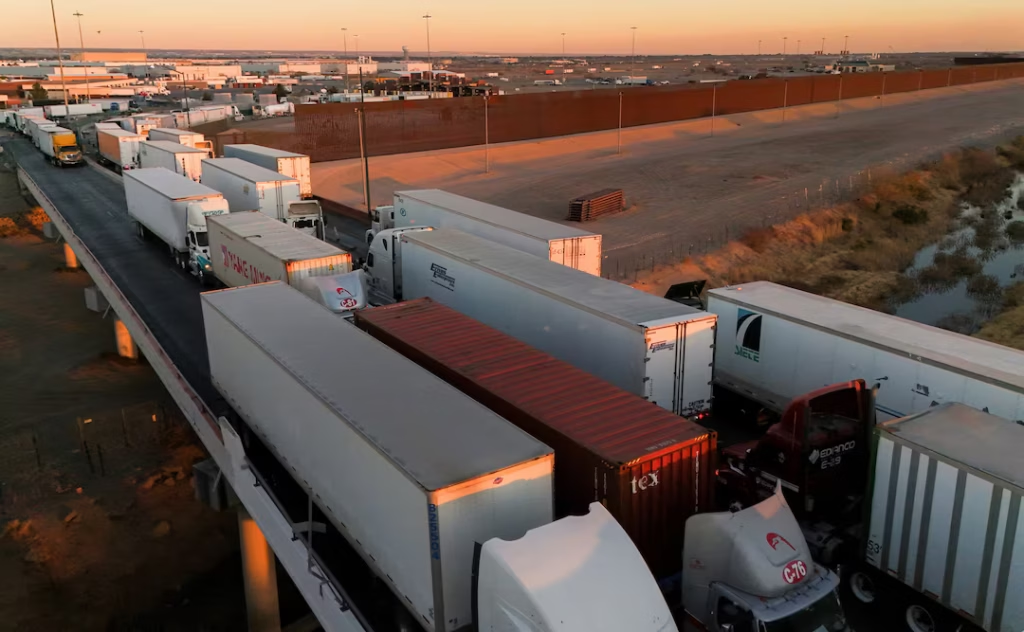
The president has repeatedly demanded Mexico intensify efforts to combat drug cartels, threatening punitive tariffs on Mexican exports if the country fails to demonstrate sufficient commitment to interdiction. The tariff threats inject economic coercion into what has traditionally been framed as bilateral security cooperation, fundamentally altering the diplomatic dynamic between the neighboring nations.
According to Lindaikeji, U.S. authorities specifically identified Inzunza Noriega as second-in-command of the Beltran Leyva Organization, suggesting he maintained significant operational authority despite the faction’s reported decline. The organization originated as part of the broader Sinaloa cartel before splitting into an independent entity following internal conflicts, though its current operational status remains disputed among analysts who debate whether it functions as a coherent organization or has fragmented into smaller cells.
The terrorism charges reflect growing recognition that fentanyl trafficking constitutes a national security threat beyond traditional law enforcement frameworks. Synthetic opioids, primarily fentanyl and its analogues, have driven unprecedented overdose mortality in the United States, with the Centers for Disease Control and Prevention documenting over 100,000 annual overdose deaths in recent years, the majority involving synthetic opioids manufactured in clandestine Mexican laboratories using precursor chemicals sourced primarily from China.
Fentanyl’s extreme potency—approximately 50 times stronger than heroin—means tiny quantities can satisfy enormous demand while remaining easily concealable during smuggling operations. Cartels have increasingly replaced traditional heroin production with fentanyl manufacturing, generating higher profit margins while creating catastrophic public health consequences as users unknowingly consume products far more potent than anticipated.
The Beltran Leyva Organization emerged in the 2000s when the Beltran Leyva brothers broke from the main Sinaloa cartel following internal disputes over leadership succession and allegations of cooperation with law enforcement. The faction gained notoriety for extreme violence including assassinations of high-ranking Mexican officials and innovative smuggling techniques that exploited maritime routes and cross-border tunnels.
Mexican and American authorities have systematically targeted the organization’s leadership over the past two decades, killing or capturing multiple senior figures. U.S. intelligence assessments suggest the faction has been severely degraded but not entirely eliminated, with remaining elements potentially absorbed into other criminal organizations or continuing independent operations under fragmented command structures.
Inzunza Noriega’s son, Pedro Inzunza Coronel, who faced charges alongside his father in the U.S. indictment, was killed by Mexican military personnel during an anti-drug operation in November. The younger Inzunza’s death eliminated one potential successor and demonstrated the physical dangers facing cartel leadership as Mexican security forces have adopted increasingly aggressive tactics under pressure from Washington.
The family connection illustrates how cartel leadership often operates through kinship networks where trust based on blood relationships helps insulate organizations from infiltration by law enforcement informants. However, these family structures also create vulnerabilities when authorities can map organizational hierarchies through genealogical research and target multiple generations simultaneously.
The arrest in Sinaloa state carries symbolic weight as the region serves as the Sinaloa cartel’s historical stronghold and namesake. The Pacific coastal state has long functioned as a center for drug cultivation and trafficking, with mountainous terrain providing ideal conditions for marijuana and opium poppy cultivation while Pacific ports offer access to maritime smuggling routes and precursor chemical shipments from Asia.
Local populations in Sinaloa have complex relationships with cartels that function as shadow governments in areas where state authority remains weak. Cartel organizations provide employment, fund infrastructure projects, and maintain social order through their own justice systems, creating dependencies that complicate enforcement efforts when residents view cartels as more reliable providers of security and services than official government institutions.
The application of terrorism charges to cartel leadership represents more than semantic reframing. Terrorism statutes provide prosecutors with enhanced tools including expanded surveillance authorities, longer prison sentences, and asset forfeiture provisions that extend beyond traditional drug trafficking laws. The legal designation also theoretically enables military action under authorizations for use of military force that Congress has granted for counterterrorism operations, though whether such authorities actually apply to cartel operations remains legally contested.
Critics of the terrorism designation argue that conflating drug trafficking with terrorism dilutes the specific meaning of terrorism as violence intended to achieve political objectives, whereas cartels pursue primarily economic goals. They warn that terrorism framing could justify military interventions in Mexico that would violate sovereignty and potentially destabilize the country further, creating humanitarian crises and refugee flows that would ultimately harm U.S. interests.
Supporters counter that modern cartels have evolved beyond simple profit-seeking criminal enterprises into quasi-governmental entities that use systematic violence to control territory, populations, and commerce. They argue that massacres, public displays of torture victims, and attacks on government officials constitute terrorism regardless of whether cartels articulate explicit political ideologies, making terrorism charges legally and morally appropriate.
The extradition process for Inzunza Noriega will likely prove complex and lengthy. Mexico’s legal system requires extensive documentation and judicial review before approving extraditions, with defendants entitled to appeal through multiple court levels. High-profile cartel figures have historically delayed extradition for years through legal challenges, though Mexican authorities have generally proven willing to eventually transfer defendants to U.S. custody.
If extradited and convicted on terrorism charges, Inzunza Noriega could face life imprisonment without parole under federal sentencing guidelines. Terrorism convictions eliminate possibilities for reduced sentences through cooperation agreements that prosecutors sometimes offer drug trafficking defendants, reflecting the heightened seriousness with which the justice system treats terrorism offenses.
The arrest’s impact on actual fentanyl flows into the United States will likely prove minimal. Cartel organizations have demonstrated remarkable resilience and adaptability, rapidly promoting replacement leaders when senior figures are captured or killed. The decentralized nature of modern trafficking networks means that operational cells can continue functioning largely independently even when high-level leadership faces disruption.
Analysts note that successful cartel prosecution strategies require sustained pressure across organizational levels rather than relying on decapitation strikes against leadership. While high-profile arrests generate publicity and demonstrate political commitment to enforcement, they rarely produce lasting operational damage unless accompanied by systematic efforts to dismantle financial networks, seize assets, prosecute mid-level operators, and address the socioeconomic conditions that make cartel employment attractive to impoverished Mexican youth.
The broader U.S.-Mexico security relationship faces persistent tensions as Trump administration officials demand more aggressive Mexican action while Mexican authorities resist approaches they view as sovereignty violations. Mexican President Claudia Sheinbaum has emphasized domestic security priorities while rejecting what she characterizes as unilateral U.S. military operations in Mexican territory or waters.
The fentanyl crisis has created domestic political pressure on American officials to demonstrate decisive action against sources of synthetic opioids, even when evidence suggests that supply-side enforcement has historically proven ineffective at reducing drug availability or overdose mortality. Public health experts increasingly advocate for harm reduction approaches including expanded access to addiction treatment and overdose reversal medications rather than emphasizing interdiction and prosecution.
The tariff threats that Trump has wielded against Mexico represent economic weapons with potentially severe consequences for both countries’ deeply integrated economies. Mexico serves as America’s largest trading partner, with bilateral commerce exceeding $700 billion annually. Tariffs would raise costs for American consumers and businesses while damaging Mexican industries that employ millions, creating political pressures on both governments that could reshape the bilateral relationship beyond security cooperation.
Whether Inzunza Noriega’s capture marks genuine progress in combating transnational organized crime or simply continues a pattern of high-profile arrests that generate headlines without reducing drug availability remains an open question that will only be answered through sustained monitoring of fentanyl seizures, overdose statistics, and cartel operational capabilities in coming months and years.
Iran ground to a near-complete standstill Wednesday as the government ordered an extraordinary shutdown affecting 21 of the country’s 31 provinces, closing businesses, universities, and government offices in a desperate attempt to contain protests that have erupted over a deepening political and economic crisis threatening the Islamic Republic’s stability.
The unprecedented nationwide closure, ordered by President Masoud Pezeshkian, affected major population centers including the capital Tehran as authorities sought to suppress mounting public fury driven by hyperinflation, currency instability, and collapsing living standards that have pushed millions of Iranians toward economic desperation. The shutdown represents one of the most drastic government responses to civil unrest since the 2022 protests following Mahsa Amini’s death in police custody.
Demonstrations, strikes, and violent clashes between protesters and security forces continued for a fourth consecutive day across multiple cities, with video footage documenting intensifying confrontations between citizens and the Islamic Revolutionary Guard Corps forces deployed to maintain order. The sustained nature of the unrest suggests deeper discontent than periodic protests that Iranian authorities have successfully suppressed in recent years.
Video footage circulating online and disseminated by the People’s Mojahedin Organization of Iran (MEK), an opposition group based outside the country, captured intense confrontations between protesters and security forces in major cities including Shiraz, Isfahan, Kermanshah, and Tehran. The recordings show protesters chanting anti-regime slogans while directly confronting security personnel in crowded streets, demonstrating a level of public defiance that authorities have struggled to contain through traditional intimidation tactics.
The footage includes disturbing scenes of screaming and what appears to be gunfire, with demonstrators hurling objects at security forces while shouting “Death to the dictator” and “Proud Arakis, support, support.” The use of such explicitly anti-government slogans in public spaces reflects eroding fear of repercussions that has historically kept many Iranians from openly challenging the regime, suggesting that economic desperation may have overcome concerns about arrest or violence.
Additional video shared by MEK shows crowds chanting “Death to Khamenei!” and “Shame on you, shame on you!” in direct challenges to Supreme Leader Ayatollah Ali Khamenei’s authority. The anger appears to have spread particularly intensely through bazaar-led protests in Tehran, where traditional merchants have historically played significant roles in Iranian political upheavals. Bazaar communities helped drive both the 1979 Islamic Revolution and subsequent periods of unrest, making their participation in current protests especially concerning for the government.
Some of the most dramatic confrontations occurred in Fasa, a city in south-central Iran where video circulating online captured demonstrators hurling objects at government complex gates and physically shaking the barriers until they opened. The breach of government property represents an escalation beyond street protests into direct assaults on state infrastructure, crossing thresholds that typically trigger severe security responses.
Opposition groups reported that protesters in Fasa stormed the governor’s office, prompting Islamic Revolutionary Guard Corps forces to open fire on crowds, according to Reuters. The use of live ammunition against demonstrators marks a significant escalation in state violence, though casualty figures remain unconfirmed due to government information controls and the challenges opposition groups face verifying reports from inside Iran.
Military helicopters were observed flying over Fasa in what appeared to be deliberate shows of force intended to intimidate residents and prevent unrest from spreading to surrounding communities. The deployment of airborne assets for crowd control suggests authorities view the situation as sufficiently serious to warrant military rather than police responses, blurring lines between civil law enforcement and martial action.
In Kermanshah, located in western Iran near the Iraqi border, bazaar merchants directly confronted security forces while chanting “Dishonorable, dishonorable,” according to video documentation. The willingness of business owners to close shops and engage in street protests despite economic costs reflects how deeply the financial crisis has affected even traditionally conservative merchant classes who might ordinarily prioritize stability over confrontation.
The one-day shutdown affecting 21 provinces represents an acknowledgment by President Pezeshkian that normal governance has become impossible amid the escalating unrest. By closing government offices, universities, and businesses, authorities essentially conceded that attempting to maintain regular operations would expose more citizens to protest participation while providing additional targets for demonstrators to disrupt.
The unrest unfolds against a backdrop of catastrophic economic deterioration. Iran’s currency has plummeted against foreign currencies as international sanctions continue choking oil exports and financial transactions. Inflation has rendered basic necessities increasingly unaffordable for ordinary Iranians, with food prices surging beyond what many families can sustain. The economic collapse has particularly devastated the urban middle class, historically a stabilizing force in Iranian society.
Mounting public anger has forced a series of emergency leadership changes that add uncertainty to an already volatile situation. On Wednesday, Pezeshkian appointed Abdolnaser Hemmati, a former economy minister, as the new central bank chief following Mohammad Reza Farzin’s resignation. The appointment came as authorities scrambled to demonstrate responsiveness to economic concerns while lacking obvious solutions to structural problems rooted in international isolation and domestic mismanagement.
State media quoted Pezeshkian acknowledging that the central bank position is “extremely difficult and complex,” warning that Hemmati would face “intense pressure and criticism amid ongoing economic turmoil,” according to the Islamic Republic News Agency. The unusually candid admission of challenges facing the new appointee suggests recognition that monetary policy interventions alone cannot address the multifaceted crisis driving public anger into the streets.
Separately, Supreme Leader Ayatollah Ali Khamenei announced the appointment of IRGC Brigadier General Ahmad Vahidi as deputy commander in chief of the Revolutionary Guards. The timing of the military leadership change alongside civilian economic appointments suggests coordination between political and security establishments to simultaneously address economic grievances and prepare for potential escalation requiring enhanced security force coordination.
Vahidi’s appointment carries particular significance given his background and the current crisis. As a senior Revolutionary Guard commander, his elevation signals potential hardening of security responses if protests continue expanding. The Revolutionary Guards serve as the regime’s ideological army, distinct from regular military forces, with primary loyalty to the Supreme Leader rather than civilian government institutions.
The economic crisis driving the protests stems from multiple interconnected factors. International sanctions imposed primarily by the United States have severely restricted Iran’s ability to export oil, historically the economy’s foundation. Banking sanctions prevent normal international financial transactions, forcing Iran into creative but inefficient workarounds that increase costs and reduce trade volumes. Domestic mismanagement, corruption, and inefficient state control over major economic sectors compound the damage from external pressure.
Currency instability has created particular hardship for ordinary Iranians. As the rial’s value collapses against dollars and euros, imported goods become prohibitively expensive while inflation erodes purchasing power for domestically produced items. Iranians who held savings in rials have watched their wealth evaporate, creating anger directed at government economic management perceived as incompetent or deliberately sacrificing public welfare for ideological commitments.
The protests reflect a generational shift in Iranian society where younger Iranians, who don’t remember the 1979 revolution or the Iran-Iraq War that helped consolidate the Islamic Republic’s control, increasingly question whether the current system serves their interests. This demographic, facing unemployment, restricted social freedoms, and economic hopelessness, has proven more willing to challenge authority than their parents’ generation.
The bazaar merchants’ participation adds a crucial element given their historical role in Iranian politics. Traditional bazaar communities combine economic power with religious conservatism that historically aligned with the clerical establishment. When bazaaris turn against the government, as occurred before the 1979 revolution, it signals that even constituencies who might philosophically support Islamic governance believe current leadership has failed fundamental responsibilities to maintain economic stability and protect business interests.
The government’s information control efforts face unprecedented challenges in the social media era. Despite sophisticated internet filtering and periodic shutdowns, Iranians continue sharing video documentation of protests and security force responses through virtual private networks and other circumvention tools. International opposition groups like MEK amplify this content, though their materials require careful evaluation given their political agendas and occasional history of exaggerating or misrepresenting events.
The four-day duration of sustained protests across multiple cities suggests this wave of unrest differs from brief eruptions that security forces have successfully suppressed through overwhelming force and mass arrests. Prolonged demonstrations require sustained public commitment despite risks of violence, imprisonment, and torture that Iranian security services have historically employed to break opposition movements.
International reactions to the protests will likely remain muted given limited Western leverage over Iranian domestic affairs and ongoing nuclear negotiations where some governments seek to avoid inflammatory rhetoric that might complicate diplomacy. Human rights organizations will document abuses, but practical international intervention appears unlikely absent dramatically escalating violence that creates unavoidable humanitarian crises.
The shutdown’s economic costs are substantial even for a single day. Closing businesses and government offices in 21 provinces means lost productivity, disrupted supply chains, and forgone commercial activity in an economy already stressed by international isolation. The willingness to accept these costs reflects government calculations that preventing protest expansion justifies immediate economic damage.
Whether the shutdown and security crackdowns can contain the unrest or whether they instead fuel greater anger by demonstrating government desperation remains uncertain. Historical precedents suggest that once protests reach critical mass across multiple cities, suppression often requires sustained brutal violence that can itself generate international pressure and radicalize previously uncommitted citizens who witness or experience state brutality.
The crisis poses fundamental challenges for Iran’s governing system. If economic conditions continue deteriorating without realistic prospects for sanctions relief or successful domestic reforms, public anger may become endemic rather than episodic. The Islamic Republic has survived previous crises through combinations of repression, economic adjustments, and allowing limited dissent within carefully controlled boundaries. Whether those strategies remain viable amid current pressures tests the regime’s adaptability and resilience.
At least six passengers were confirmed dead Tuesday night after a passenger boat crashed along the Nigerdock axis of the Igbologun water channel in Lagos State, authorities said, underscoring persistent safety challenges on Nigeria’s busiest inland waterways.
The accident occurred at about 8:35 p.m. and involved a Savvy Marine passenger boat traveling from Ilashe Beach House when it ran into distress, theleaderng reported. Four passengers were pulled alive from the water as emergency teams rushed to the scene.
The Lagos State Waterways Authority and the National Inland Waterways Authority confirmed the fatalities in a joint statement issued Wednesday and signed by Wuraola Alake, head of the public affairs unit at NIWA, and Omowunmi Yussuff, head of the corporate affairs unit at LASWA.
The agencies said search-and-rescue operations were activated immediately after a distress alert was received, with marine police and other first responders joining the effort. The rescued passengers were taken to a nearby hospital for treatment.
“Sadly, six other passengers were recovered dead at the scene, while search and rescue operations remain ongoing to account for all persons involved,” the statement said.
Preliminary findings suggest the vessel may have struck a submerged object, though officials stressed that investigations are continuing to establish the precise cause of the crash.
Punchng separately reported that the authorities reiterated their condolences to the families of the victims and pledged a thorough inquiry into the incident. The agencies said further updates would be released as more information becomes available.
Beyond the immediate tragedy, the crash has again drawn attention to long-standing safety concerns on Lagos waterways, particularly night travel. LASWA and NIWA restated the need for strict compliance with navigation rules, including adherence to the “no night travel” policy, proper vessel maintenance, passenger manifests, and compulsory use of life jackets.
Officials noted that the accident came just weeks after the two agencies launched a festive-season safety campaign aimed at reducing accidents during peak travel periods, especially in December when water transport surges. The campaign emphasized intensified patrols, joint emergency preparedness, and tougher enforcement against unsafe practices.
Despite repeated warnings, marine safety experts say collisions with submerged objects remain a recurring hazard on Lagos waterways, often linked to poor visibility, speeding, or navigation outside approved hours. Tuesday’s crash adds to growing calls for stronger enforcement, improved channel monitoring, and expanded public awareness to prevent further loss of life on the state’s inland waters.
Authorities urged the public to remain calm and rely only on verified information from LASWA, NIWA and other official sources as rescue and investigative efforts continue.
Gunmen launched coordinated attacks across parts of central and southwestern Nigeria during New Year’s Eve celebrations, killing at least seven people in Plateau State, abducting a traditional ruler and his son in Kwara State, and setting a police station ablaze in Ondo State, deepening fears over worsening insecurity as 2026 began.
In Plateau State, assailants suspected to be armed Fulani militia struck the Bum community in Chugwi, Vwang District of Jos South Local Government Area late Wednesday night, killing at least seven residents, injuring others and burning homes as families marked crossover night.
The attack unfolded at about 11 p.m. on Dec. 31, 2025, as residents gathered to usher in the New Year, throwing the community into chaos and mourning, according to the Berom Youths Moulder-Association.
“While the world welcomed the New Year in celebration, residents of Bum community in Chugwi, Vwang District of Jos South Local Government Area, Plateau State, were plunged into mourning following a deadly attack by suspected armed Fulani militants/bandits,” said Rwang Tengwong, national publicity secretary of the Berom Youths Moulder-Association, in a statement Thursday.
Tengwong said seven bodies had been recovered by morning, adding that search-and-rescue operations were continuing and raising concerns that the death toll could rise. He said the attackers appeared to have exploited the festive atmosphere to carry out the assault, despite earlier security alerts warning that some communities in Jos South had been marked for possible attacks.
“Sadly, the Bum community has now fallen victim to this renewed wave of violence,” Tengwong said, describing the incident as part of a broader pattern of assaults on rural communities in Plateau State, particularly during festive periods.
Plateau has for years been a flashpoint for deadly violence linked to disputes over land, grazing routes and identity, with attacks often intensifying during holidays when communities gather in large numbers. Security analysts say the timing of the assault underscores persistent gaps in preventive deployment and early-response mechanisms despite repeated warnings from local groups.
Elsewhere, residents of Ipele in Owo Local Government Area of Ondo State fled their homes in fear early Thursday after suspected terrorists attacked and burned down a police station, SaharaReporters reported. Video obtained by the outlet showed the station engulfed in flames, with vehicles inside the compound also set ablaze.
The attack occurred in the early hours of Jan. 1, 2026. As of the time of reporting, fatalities or injuries had not been independently confirmed. Some individuals believed to be police officers were later seen inspecting the ruins. Attempts to reach the Ondo State Police Command for comment were unsuccessful, SaharaReporters said.
Ondo State has previously suffered high-profile attacks, including the June 5, 2022, assault on St. Francis Xavier Catholic Church in Owo that killed dozens during a Sunday service, an incident that continues to shape public anxiety in the region.
In a separate New Year’s Eve incident, gunmen abducted a traditional ruler in Kwara State, further highlighting the geographic spread of violent crime. Armed men stormed the palace in Aafin Ile-Ere, Ile-Ire district of Ifelodun Local Government Area, at about 8 p.m. on Dec. 31, 2026, abducting Oba S.Y. Olaonipekun and one of his sons, Olaolu, a serving member of the National Youth Service Corps, according to SaharaReporters.
During the raid, the attackers shot sporadically as they forced their way into the palace. The queen consort, Felicia Olaonipekun, was shot in the arm but was not taken away and was later rushed to hospital for treatment.
A palace eyewitness, who spoke on condition of anonymity, said the attackers overpowered the palace with ease. “I noticed some strange movements outside around 8:00 p.m. and alerted those inside. We locked doors and switched off lights, but once they realized this, they started shooting,” the source said. “They demanded to see the Kabiyesi and later discovered Olaolu in hiding and seized him as well.”
At least 10 family members and visitors were inside the palace at the time, the source said, adding that the community’s vigilante unit, with only two members on night duty, was unable to confront the heavily armed assailants.
The abduction has revived memories of earlier kidnappings in Kwara South. SaharaReporters previously reported that the Ojibara of Bayagan Ile, Kamilu Salami, was released after spending 25 days in captivity, following the payment of a substantial ransom raised by community members.
Community spokesperson Ayinla Lawal said the monarch’s release came only after payments made in two installments, adding that neither local nor state authorities intervened during the ordeal. The kidnappers, he said, initially rejected a N10 million payment and later demanded an additional N15 million.
Security experts warn that the clustering of attacks across multiple states during the same holiday period points to a troubling normalization of violence timed to moments of reduced vigilance. They say the incidents underline the need for coordinated intelligence-sharing, stronger rural policing and sustained federal-state collaboration, particularly during festive seasons when communities are most vulnerable.
For residents of Bum, Ipele and Aafin Ile-Ere, the New Year began not with celebration but with grief, fear and renewed questions about the state’s ability to protect lives, property and traditional institutions.