

A Chicago police officer who was fatally shot inside a hospital during a violent encounter with a suspect in custody has been identified as 38-year-old John Bartholomew, a 10-year veteran of the force, as authorities continue to investigate how the attack unfolded and how the suspect gained access to a weapon.
Bartholomew died Saturday afternoon after being shot while escorting a robbery suspect receiving treatment at Endeavor Health Swedish Hospital on the city’s North Side. The Cook County Medical Examiner’s Office confirmed his identity and said he died from a gunshot wound to the head. A second officer, a 57-year-old veteran with more than two decades of service, remained in critical condition Sunday.
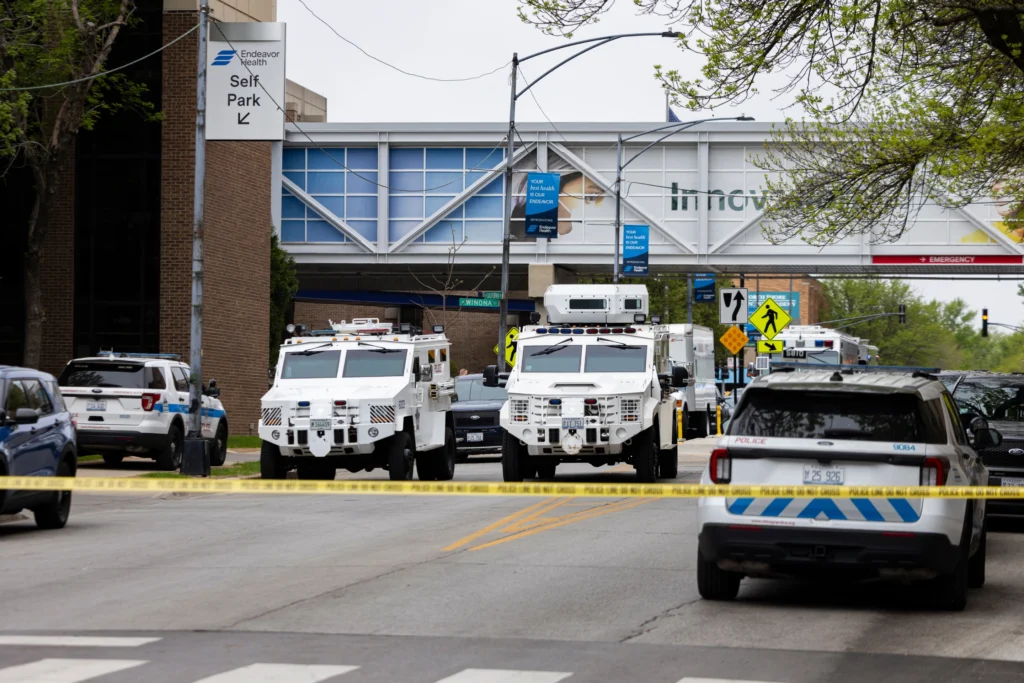
Police Superintendent Larry Snelling described the wounded officer as “fighting for his life,” underscoring the severity of the incident, which has shaken the department and raised urgent questions about security procedures when suspects are transported to medical facilities.
Authorities said the violence erupted shortly before 11 a.m. Saturday after officers brought the suspect, who had been arrested on suspicion of robbery, to the hospital for observation. During treatment, the man suddenly opened fire on the officers, striking both before fleeing the scene.
Law enforcement quickly launched a large-scale response, deploying specialized units and initiating a manhunt in the surrounding neighborhood. The suspect was later taken back into custody near the hospital, and a firearm was recovered. Officials have not disclosed whether the weapon belonged to the suspect or how it entered the hospital environment.
The Associated Press confirmed that Bartholomew was pronounced dead just before 1 p.m. Saturday. Police have not publicly released the suspect’s identity, and no charges had been formally announced as of Sunday morning.
Hospital officials said the suspect had undergone standard screening procedures upon arrival and was under continuous supervision by law enforcement personnel. Despite those measures, the individual managed to fire multiple shots and exit the facility, exposing potential vulnerabilities in protocols designed to protect both officers and the public.
The shooting unfolded in a setting typically considered secure, adding to the sense of alarm surrounding the incident. Medical facilities often operate under different security conditions than detention centers, relying heavily on coordination between hospital staff and police. This case highlights the inherent risks when individuals in custody are moved into less controlled environments.
Bartholomew’s death marks a devastating loss for the Chicago Police Department and the community he served. Colleagues and officials described him as a dedicated officer committed to public service. According to family members who spoke to local media, he was a husband, father, and stepfather known for his devotion to helping others.
Snelling urged the public to keep the officers’ families in their thoughts, emphasizing the dangers officers face daily. He noted that policing remains one of the most hazardous professions, with officers routinely entering unpredictable situations.
“This is an extremely dangerous job,” Snelling said during a briefing. “Our officers understand the risks, yet they continue to serve and protect.”
The incident has also prompted renewed scrutiny of procedures surrounding detainee transport and hospital security. Experts say that while officers are trained to manage individuals in custody, unpredictable behavior and concealed weapons remain persistent threats.
The hospital shooting in Chicago underscores a broader challenge facing law enforcement agencies nationwide: balancing medical care for suspects with officer safety. Incidents involving detainees in hospitals are relatively rare but can be especially volatile due to the open and less secure nature of medical facilities.
Unlike police stations or correctional institutions, hospitals prioritize patient care and accessibility, which can complicate traditional security measures. This creates an environment where even minor lapses can have severe consequences. The fact that a suspect was able to access or use a firearm while under supervision raises critical concerns about search procedures, coordination between hospital security and police, and situational awareness.
In recent years, law enforcement agencies have increased training around custodial transport and hospital monitoring, yet cases like this demonstrate that risks remain high. The presence of multiple weapons recovered at the scene, as mentioned by officials, suggests the possibility of systemic gaps that may need urgent review.
The emotional toll on police departments following such incidents can also be profound. Losing an officer in the line of duty reverberates beyond the immediate tragedy, affecting morale and prompting calls for policy changes. It may also influence how departments approach future interactions involving suspects requiring medical attention.
From a public safety perspective, the shooting highlights the unpredictability of violent encounters and the importance of rapid response. The swift apprehension of the suspect likely prevented further harm, but the incident still raises difficult questions about prevention.
At a national level, the case contributes to ongoing discussions about policing risks, resource allocation, and the need for enhanced protective measures in nontraditional enforcement settings. As investigations continue, findings from this case could shape future protocols not only in Chicago but in departments across the country.
As authorities work to determine how the suspect was able to carry out the attack, the focus remains on supporting the injured officer, honoring the life of John Bartholomew, and ensuring accountability in the investigation. The tragedy serves as a stark reminder of the dangers faced by law enforcement officers and the complexities involved in maintaining safety in dynamic and unpredictable environments.
Further updates are expected as investigators gather evidence, review security procedures, and prepare potential charges against the suspect.
AP/Blockclubchicago





