

A powerful explosion tore through a fireworks factory in central China, killing at least 26 people and injuring dozens more, as rescue crews rushed to search for survivors amid flattened buildings and thick smoke rising into the sky.
The blast struck Monday afternoon at a factory complex in Liuyang, a city widely known for its role in the country’s fireworks industry. Officials said the explosion happened around 4:40 p.m. at the Huasheng Fireworks Manufacturing and Display Company.
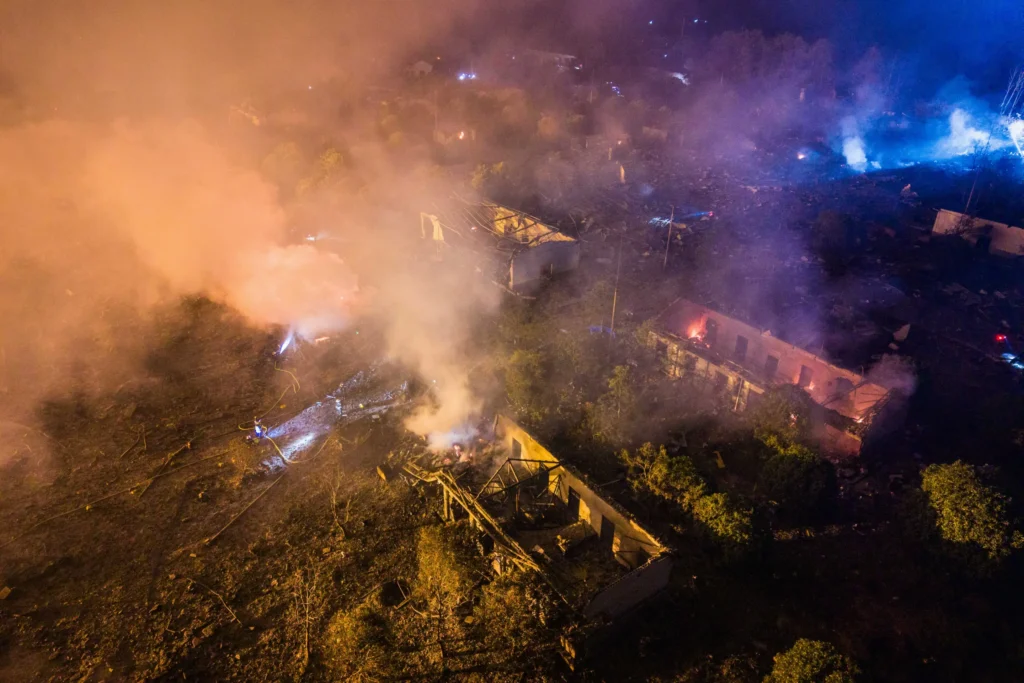
Emergency teams moved in quickly. More than 1,500 firefighters, medical workers, and police officers were deployed, along with drones and robotic equipment, to comb through debris and reduce ongoing risks at the site.
Authorities ordered evacuations in nearby areas due to concerns about highly flammable materials stored in warehouses at the factory. Large quantities of black powder remained a major hazard for rescue crews working through the wreckage.
Images from the scene showed buildings reduced to rubble, with smoke pouring into the air and debris scattered across a wide area. Witnesses described strong shock waves that uprooted trees and left a sharp smell of gunpowder lingering over the site.
A reporter at the scene said much of the area had been leveled, with structures collapsed and access routes blocked by debris, complicating rescue operations.
Officials in Changsha, the provincial capital that oversees Liuyang, said search efforts at the site were largely complete by Tuesday. Authorities confirmed that the person in charge of the company had been detained as investigators work to determine the cause of the explosion.
City officials expressed deep regret over the loss of life.
“We feel extremely sad and extremely guilty,” said Chen Bozhang, a senior official in Changsha’s leadership, offering condolences to victims and their families.
In response to the disaster, authorities ordered all fireworks manufacturers in the city to halt production while safety inspections are carried out. Officials said broader checks would also be launched across industries to identify risks and close gaps in oversight.
Chinese leader Xi Jinping called for a swift investigation and demanded accountability. He also urged stronger safety measures in high-risk industries and renewed efforts to protect lives and property.
The explosion adds to a long list of industrial accidents in China, particularly in sectors that handle flammable or hazardous materials. Just last year, another blast at a fireworks facility in the same province killed nine people and injured dozens.
The Associated Press noted that authorities have detained the factory’s manager and launched an inquiry into what caused the latest explosion, while ordering a shutdown of similar operations for inspection.
Separately, Reuters confirmed the death toll and scale of the injuries, citing officials and footage from the scene showing widespread destruction.
Liuyang sits at the heart of China’s fireworks production. The city’s industry is massive, supplying a large share of both domestic demand and global exports. That scale brings economic benefits, but it also carries serious risks.
Factories in this sector often store large amounts of explosive materials in close proximity. When safety controls fail, the consequences can be catastrophic, as seen in this latest incident.
Despite repeated accidents over the years, enforcement remains uneven. Local governments face pressure to support industries that drive jobs and revenue, which can sometimes clash with strict safety oversight.
This latest explosion may renew scrutiny of how regulations are applied. Shutting down production across the city, even temporarily, signals a serious response. But past patterns suggest that enforcement can weaken once public attention fades.
There is also a broader question about industrial safety in fast-growing economies. As production expands, so does the need for stronger systems to manage risk. Incidents like this one highlight gaps that can have deadly consequences.
For residents, the impact is immediate and personal. Families have lost loved ones. Workers face uncertainty about their jobs as factories close for inspections. Communities near industrial zones are once again reminded of the dangers nearby.
The use of drones and robots in the rescue effort shows how emergency response is evolving. These tools help teams reach dangerous areas and reduce risk to human rescuers. Still, they cannot fully eliminate the hazards posed by unstable structures and explosive materials.
The global dimension also matters. China dominates the fireworks market, exporting billions of dollars’ worth of products each year. Disruptions in production could ripple through supply chains, especially ahead of major celebrations in other countries.
At the same time, international buyers may pay closer attention to safety standards following repeated incidents. Pressure from outside markets can sometimes push for improvements that local enforcement alone struggles to achieve.
For now, the focus remains on understanding what went wrong. Investigators will examine storage conditions, handling procedures, and compliance with safety rules. Their findings could shape future regulations and enforcement efforts.
But for many, the outcome will not change what has already been lost.
As rescue crews clear debris and authorities promise accountability, the explosion stands as another reminder of the risks tied to industries built around explosive materials—and the cost when safety measures fail.
AP/Reuters





