

A drone pierced the air defenses surrounding the Arab world’s only nuclear power plant on Sunday and started a fire on its outer grounds, while Saudi Arabia intercepted three separate drones that crossed from Iraqi airspace, as the diplomatic standoff between the United States and Iran hardened into something that looked increasingly like the prelude to renewed war.
The strike on the Barakah Nuclear Power Plant in the UAE caused no injuries and released no radioactive material, Emirati officials confirmed. The drone hit an electrical generator outside the plant’s inner perimeter. The UAE’s Federal Authority for Nuclear Regulation said all units continued operating normally. The International Atomic Energy Agency said emergency diesel generators were supplying power to one reactor and called for maximum military restraint near any nuclear facility, adding that it was monitoring the situation closely.
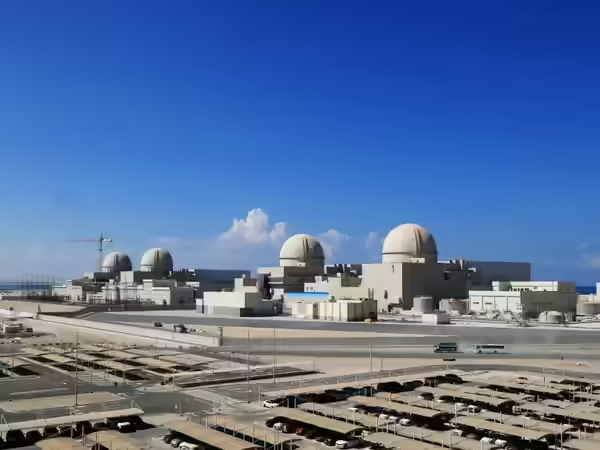
UAE authorities said they were investigating the source of the strike, which the Abu Dhabi Media Office characterized as an unprovoked terrorist attack. Two other drones were intercepted before reaching the plant. The UAE defense ministry said all three had been launched from its western border but did not elaborate on their origin.
Anwar Gargash, a diplomatic adviser to the UAE president, framed the attack in terms that left little ambiguity about where suspicion pointed. The strike, he said on social media, “whether carried out by the principal actor or through one of its proxies, represents a dangerous escalation.”
Saudi Arabia condemned the Barakah strike and separately confirmed its forces had intercepted three drones entering from Iraqi airspace. Iran and allied militia groups based in Iraq have been launching drone attacks on Gulf Arab states throughout the war that began with U.S. and Israeli strikes on Iran on February 28.
Trump’s Warning, Israel’s Preparations
Within hours of the Barakah attack, President Donald Trump posted a blunt threat on Truth Social shortly after a call with Israeli Prime Minister Benjamin Netanyahu. “For Iran, the Clock is Ticking, and they better get moving, FAST, or there won’t be anything left of them. TIME IS OF THE ESSENCE!” Trump wrote.
Trump is expected to meet with senior national security advisers Tuesday to review military options against Iran, Axios reported. He has previously threatened to resume attacks if Iran refuses a deal and has set and then retreated from multiple deadlines throughout the conflict. Whether this one is different is a question his own officials have not answered publicly.
Two people familiar with the situation, including an Israeli military officer, told the Associated Press that Israel was actively coordinating with the United States on a possible resumption of strikes. Both spoke anonymously because they were discussing confidential military planning. Netanyahu, addressing his Cabinet Sunday, said Israel’s eyes were open regarding Iran. “We are prepared for any scenario,” he said.
Iranian state television offered its own image of where the country’s mood stood. On at least two channels, presenters appeared on air while armed. On one, a host named Hossein Hosseini received basic firearms training from a masked member of the Revolutionary Guard during a live broadcast and mimed firing toward a UAE flag. On another channel, host Mobina Nasiri said a weapon had been sent to her from a public gathering in Tehran. “From this platform, I declare that I am ready to sacrifice my life for this country,” she said.
Mohsen Rezaei, a military adviser to Iran’s supreme leader, said on state television: “Our armed forces’ fingers are on the trigger, while diplomacy is also continuing.”
A Deadlock With No Exit
The drone attack landed in a diplomatic environment that has produced no meaningful progress since a ceasefire took effect in April. More than five weeks have passed without the two sides closing the gap between their core positions.
Washington is demanding Iran dismantle its nuclear program and release its grip on the Strait of Hormuz. Tehran is demanding compensation for war damage, termination of the U.S. naval blockade of Iranian ports, and a halt to fighting across all fronts including Lebanon, where Israel continues battling the Iran-backed militant group Hezbollah despite a nominal ceasefire there. Israel and Lebanon agreed Friday to a 45-day extension of that ceasefire, though clashes have continued regardless.
Trump held talks with Chinese President Xi Jinping earlier in the week without securing any commitment from Beijing to help broker a resolution. Iranian Foreign Ministry spokesperson Esmaeil Baqaei said Sunday that the United States and Israel had tried to blame others for destabilizing global energy markets after what he called their unprovoked military aggression against Iran.
Ebrahim Azizi, who chairs the Iranian parliament’s national security committee, said Saturday that Tehran had developed a mechanism to manage traffic through the Strait of Hormuz along a designated corridor and planned to announce the details soon. That statement, if implemented, would further formalize Iranian control over the waterway and deepen the legal and operational conflict with Washington over who holds authority in the strait.
The U.S. naval blockade of Iranian ports remained in effect Sunday. American forces said they had redirected 81 commercial vessels and disabled four since the blockade began.
The Barakah Plant and What It Represents
The $20 billion Barakah Nuclear Power Plant was built with South Korean assistance and went online in 2020. It is the only nuclear power plant in the Arab world and can supply approximately a quarter of the UAE’s total energy needs. The facility sits in the emirate of Abu Dhabi and represents the most significant piece of civilian energy infrastructure in a country that has positioned itself as a model for non-weapons nuclear energy development in the region.
Unlike Iran’s nuclear program, which has enriched uranium close to weapons-grade levels and has long been the subject of international proliferation concerns, the UAE’s program operates under a strict agreement with the United States known as a 123 agreement. Under its terms, the UAE agreed to forgo domestic uranium enrichment and reprocessing of spent fuel entirely. Its uranium comes from abroad. The agreement was designed specifically to preclude the kind of ambiguity that surrounds Iran’s nuclear activities.
The IAEA said the Sunday strike caused a fire in an electrical generator at unit 3, which was subsequently powered by emergency diesel generators. The agency confirmed no radiological release occurred. It was the first confirmed strike on the four-reactor facility during the current war. Yemen’s Houthi rebel movement claimed in 2017 to have targeted the plant while it was under construction, a claim Abu Dhabi denied.
The targeting of nuclear facilities in warfare has become more common in recent years. Russia has repeatedly struck near Ukraine’s nuclear infrastructure since its 2022 invasion. Iran has claimed its own Bushehr nuclear power plant came under attack during the war, though no direct damage to its Russian-operated reactor or any radioactive release was confirmed.
The strike on Barakah crossed a threshold that both military planners and international law have long treated as categorically distinct from other forms of infrastructure targeting. Nuclear power plants present a specific category of risk that conventional military logic does not fully capture. A direct hit on a reactor, a cooling system failure caused by sustained attack on electrical infrastructure, or a radiological release triggered by secondary explosion near nuclear material represents a consequence that cannot be undone and cannot be contained within the borders of the country being targeted.
The IAEA’s call for maximum military restraint was measured in tone but urgent in implication. The agency does not issue that kind of appeal casually. It does so when it calculates that the trajectory of events near nuclear facilities has reached a point where a catastrophic accident becomes a realistic possibility rather than a distant theoretical risk.
The UAE’s 123 agreement with the United States is relevant beyond its nonproliferation purpose. It creates a specific American interest in the security of Barakah that goes beyond the UAE’s sovereignty. If a nuclear facility built under U.S. civilian nuclear cooperation terms is attacked and damaged in ways that cause radiological harm, the legal, reputational, and strategic consequences for American policy across the entire global civilian nuclear enterprise are severe.
Whether Iran directed Sunday’s strike, tolerated it from a proxy, or had no operational knowledge of it in advance will shape what follows. Gargash’s framing — “whether carried out by the principal actor or through one of its proxies” — was careful, but its meaning was clear. The UAE holds Iran responsible regardless of which hand held the controller.
Trump’s Tuesday meeting with national security advisers will be closely watched. He has threatened and retreated before. But the combination of a drone reaching a nuclear power plant, Iranian state television hosts brandishing weapons on live broadcasts, and Israeli military coordination on strike options creates a set of signals that looks different from the diplomatic theater of recent weeks.
The ceasefire is not holding. The diplomacy is stalled. The drones are getting through. And the plant that can power a quarter of the UAE just took a hit.
AP/Reuters





