

Armed young men stormed a hospital treating Ebola patients in eastern Congo on Sunday evening, forcing medical staff to scramble to evacuate infected patients as gunfire rang out outside the building — the third attack on a healthcare facility in a single week as a rapidly growing outbreak pushed the suspected death toll past 119 and potentially as high as 220, depending on which set of official figures one consults.
The assault on Mongbwalu General Hospital began after dark when the men demanded that two bodies of their relatives be released to them, Dr. Richard Lokudu, the hospital’s medical director, told the Associated Press by phone from inside the facility as the chaos unfolded.
“Mongbwalu General Hospital is on general alert,” Lokudu said. He said medics were attempting to evacuate patients and staff under fire and that he had no further details of the evolving situation. It was not immediately known whether anyone was hurt.
Bodies of Ebola victims are highly contagious. Families who prepare them for traditional burial and gather for funeral wakes risk spreading the virus through direct contact with the deceased. Congolese authorities, responding to that transmission vector, have required that burials of suspected victims be managed by official safe burial teams wherever possible — a policy that has generated intense resistance from families who regard it as a violation of their right to mourn and bury their own.
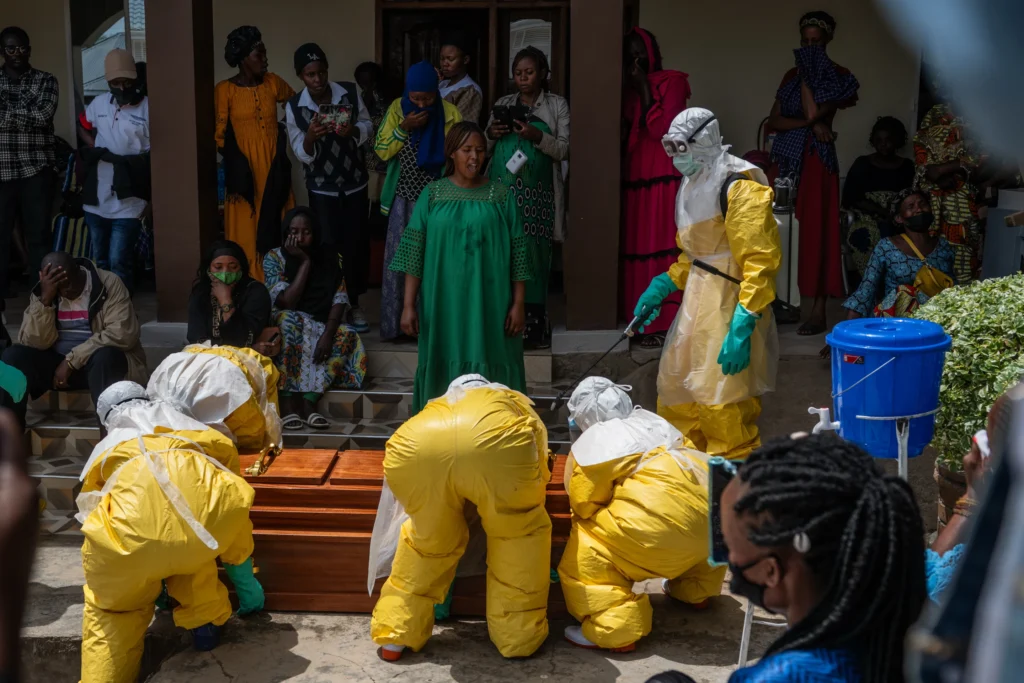
Three Attacks in One Week
Sunday’s hospital siege was the third assault on an Ebola containment facility in Ituri Province within seven days. On Saturday, residents of Mongbwalu attacked and burned a tent established by Doctors Without Borders for suspected and confirmed Ebola cases. During that attack, 18 people with suspected Ebola infections left the facility and have not been accounted for since, Lokudu had said earlier.
On Thursday, a treatment center in the town of Rwampara was burned down after authorities refused to release the body of a local man suspected to have died from Ebola to his family.
The pattern of attacks reflects the collision between two competing urgencies: the public health necessity of controlling how bodies are handled and how large gatherings are managed, and the deeply held cultural and religious practices around death, mourning, and burial that communities in Ituri have observed for generations. The Congolese government sought to address one dimension of that tension Friday, banning funeral wakes and gatherings of more than 50 people in northeastern Congo in an effort to slow transmission.
The Numbers and the Discrepancy
The scale of the outbreak is growing faster than official figures can keep pace with. The Congolese Ministry of Communication posted on X Sunday that 904 suspected Ebola cases had been recorded, mostly in Ituri Province — a significant jump from the more than 700 previously announced. The total suspected death count the ministry cited stood at 119. But figures released separately for each affected region added up to 220 deaths. Officials could not be reached immediately to explain the gap.
As of Monday, confirmed cases had spread beyond Ituri to Goma, the rebel-held capital of neighboring North Kivu Province, as well as to the towns of Butembo and Nyakunde. One death and one suspected case had been confirmed in Uganda.
An American doctor working in Bunia tested positive for Ebola, Congolese officials confirmed Monday. Dr. Peter Stafford had been treating patients at a hospital in the provincial capital when he developed symptoms, according to Serge, the organization he works for. Three other Serge employees, including Stafford’s wife, were at the same hospital but showed no symptoms. Seven Americans, including Stafford, were being transported to Germany for monitoring, Dr. Satish Pillai of the U.S. Centers for Disease Control and Prevention said in a call with reporters.
The CDC issued travel advisories urging Americans in Congo and Uganda to avoid contact with anyone showing symptoms of fever, muscle pain, or rash. The agency announced a 30-day ban on entry to the United States of all foreign nationals who had visited Congo, Uganda, or South Sudan in the past three weeks, along with enhanced symptom screening at ports of entry.
A Response That Started Late
How the outbreak reached this scale without earlier detection is a question that has become as important as the response itself. The first person is believed to have died from the virus on April 24 in Bunia, Congo’s health minister Samuel Roger Kamba confirmed. The body was repatriated to the Mongbwalu health zone, a densely populated mining area. “That caused the Ebola outbreak to escalate,” Kamba said.
When another person fell ill on April 26, samples were sent to Kinshasa for laboratory analysis. They were initially tested for the more common Zaire strain of Ebola. The results came back negative. The WHO was not alerted until May 5, when roughly 50 deaths had already occurred in Mongbwalu, including four healthcare workers. The first Ebola confirmation came May 14. The Bundibugyo strain was confirmed the following day — three weeks after the first known death.
“Because early tests looked for the wrong strain of Ebola, we got false negatives and lost weeks of response time,” said Matthew Kavanagh, director of the Georgetown University Center for Global Health Policy and Politics. “We are playing catch-up against a very dangerous pathogen.”
Esther Sterk of Doctors Without Borders, known by its French acronym MSF, acknowledged the delayed detection but noted it was not unusual given the similarity of early Ebola symptoms to other tropical diseases common in the region. “The situation is quite worrying and is evolving pretty quickly,” she told the AP. “It was detected quite late. But that is often the case with Ebola outbreaks.”
Dr. Craig Spencer, an associate professor at Brown University’s School of Public Health who survived Ebola after contracting it in Guinea more than a decade ago, warned that the true scale of the outbreak is almost certainly larger than current figures reflect. “I suspect that the number of cases is going to go up pretty dramatically in the coming weeks as we do better surveillance and end up finding there were a lot more cases and probably a lot more deaths than we recognized,” Spencer said.
The Bundibugyo Strain and the Vaccine Gap
The Bundibugyo virus is a rare type of Ebola. This is only the third time it has been detected in human beings since Ebola first emerged in Congo and Uganda in 1976. The first detection was during a 2007-2008 outbreak in Uganda’s Bundibugyo district that infected 149 people and killed 37. The second was a 2012 outbreak in Isiro, Congo, where 57 cases and 29 deaths were recorded.
Critically, no approved vaccine exists for the Bundibugyo strain. The vaccines that have proven effective against the Zaire strain, which drove most of Congo’s previous 17 outbreaks, do not cover Bundibugyo. Africa CDC chief Dr. Jean Kaseya told Sky News Sunday that he was in “panic mode” over the lack of available medicines and vaccines, though he said some candidate treatments were expected to arrive in the affected area within weeks.
The International Federation of Red Cross and Red Crescent Societies added a troubling detail Saturday: three of its volunteers had died from the outbreak in Mongbwalu. The organization said it believed the three healthcare workers contracted the virus on March 27 while handling dead bodies during a humanitarian mission unrelated to Ebola. If confirmed, that date would push the outbreak’s true beginning back nearly a month before the April 24 death that Congolese officials have cited as the first known case.
A Region Already at Breaking Point
Mongbwalu sits in a remote section of eastern Congo, more than 1,000 kilometers from the capital Kinshasa, accessible mainly by poor roads that limit rapid deployment of medical supplies, personnel, and equipment. Ituri Province has been living under the shadow of armed group violence for years. Dozens of people have been killed and more than 273,000 displaced within the province in the past year alone, according to the United Nations.
UN staff in Bunia were instructed to work from home and avoid physical contact and crowded spaces, a Bunia-based UN official told the AP on condition of anonymity. Rwanda closed its land border with Congo on Sunday. Ugandan authorities said they had found no evidence of domestic spread and had heightened surveillance along the Congolese border.
In the streets of Bunia, the outbreak’s weight was visible in small acts of individual preparation. Noëla Lumo, who had previously lived through Ebola outbreaks in Beni and knew their human consequences intimately, was hand-sewing protective masks for herself and her neighbors as soon as she heard the news.
“I know the consequences of Ebola, I know what it’s like,” Lumo said.
When Distrust Becomes a Vector
The three attacks on Ebola treatment facilities in one week in Ituri Province represent one of the most dangerous dimensions of this outbreak — and one of the hardest to address through conventional public health tools.
Vaccine campaigns, treatment centers, and safe burial protocols are built on a foundation of community trust. In eastern Congo, where residents have lived through years of state failure, armed group violence, and a history of external interventions that have not consistently prioritized local welfare, that foundation is thin. When a family is told they cannot touch, wash, or bury their own dead — when the body of their mother or brother is taken by people in protective suits and buried by strangers — the policy that is medically necessary can feel, from inside that experience, like another form of dispossession.
Attacking the facilities does not bring back the dead or protect the living from Ebola. But it reflects a desperation and a sense of having no recourse that public health authorities need to understand and address directly if the containment effort is to succeed. Communities that burn treatment centers cannot be contacted, traced, or vaccinated effectively. The 18 people who walked out of the MSF facility during Saturday’s attack are now somewhere in Ituri Province with suspected Ebola infections, outside any monitoring system.
Kavanagh’s criticism of the Trump administration’s withdrawal from the WHO and cuts to foreign aid surveillance capacity adds a structural layer to an already complex picture. The systems that were supposed to detect outbreaks like this one early, test for multiple strains, and mobilize international response quickly were funded in significant part through mechanisms the current administration has reduced or eliminated. Whether that directly contributed to the three-week detection delay in this specific case is a causal question the investigation will need to address. What is not in question is that the world is now playing catch-up against a rare strain of one of history’s deadliest viruses, in one of its most inaccessible and conflict-affected regions, without an approved vaccine.
AP





