

Five members of an Albanian organized crime group have been sentenced to lengthy prison terms after carrying out a series of high-value burglaries across England, stealing goods worth more than £1 million and boasting about their crimes.
Authorities said the group targeted homes across multiple regions, including Derbyshire, Cheshire, Staffordshire and Nottinghamshire, using ladders to access upper floors before stealing cash, jewelry, watches and designer items. Investigators tied the group to at least 59 break-ins, describing the operation as coordinated and deliberate.
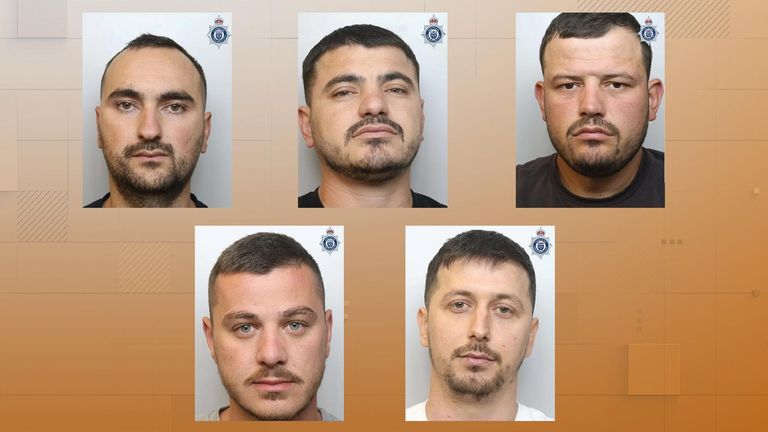
At Chester Crown Court, Kristian Gropcaj, 30, was sentenced to 10 years in prison, while George Pepa, 31, and Krisjian Dedndreaj, 28, each received nine-year terms. Sidorjan Lleshi, 26, was sentenced to 10 years and nine months. Endrit Nikolli, 27, is due to be sentenced at a later date.
A sixth defendant, Jade Tubb, 33, from Britain, admitted involvement in handling stolen goods and was given a 12-month suspended sentence.
Police said the group frequently entered properties through first-floor windows or balconies after using ladders, often striking while residents were inside. Once inside, they removed valuables and quickly sold most of the stolen items for cash.
One victim described the experience as deeply unsettling, recalling how intruders entered the home while occupants were just one floor away. The family barricaded themselves inside a room, uncertain whether the burglars were armed or how many were present.
The investigation began in October 2024 following a spike in burglaries in eastern Cheshire. Detectives later linked incidents across several counties through consistent methods and forensic evidence.
Footwear impressions found at multiple scenes provided an early breakthrough, allowing officers to connect crimes across jurisdictions. Investigators then used automatic number plate recognition technology to track vehicles seen near the burglaries. A red Ford Focus linked to Gropcaj was identified as being present at several locations.
Further analysis of mobile phone data showed frequent communication between members of the group, while surveillance revealed regular meetings at a coffee shop in Birmingham’s Jewelry Quarter. DNA evidence recovered from one burglary scene in Staffordshire was matched to Nikolli, strengthening the case.
Police carried out coordinated raids on properties in Walsall, Sutton Coldfield and Birmingham in July, arresting several suspects. Dedndreaj was later detained in Surrey, and Lleshi was arrested at his home in Sheffield in September.
During the searches, officers recovered designer handbags, watches valued at nearly £17,000, and mobile phones containing location searches linked to burglary sites. Investigators also found images and messages showing stolen goods, which authorities said the group shared among themselves.
Detectives said the suspects openly celebrated their activities, circulating photos of valuables and referring to their criminal lifestyle in personal communications. Letters exchanged between Nikolli and Tubb included references to infamous outlaw partners, highlighting what police described as a lack of remorse.
Detective Sergeant Laura Fox of Macclesfield’s criminal investigation department said the group demonstrated a calculated approach, researching targets in advance and expanding operations across multiple police areas to avoid detection.
She added that the offenders showed little regard for victims, focusing instead on profits and status within their network.
Detective Inspector Ryan McVeigh emphasized the scale and complexity of the investigation, noting that cooperation between multiple police forces was key to dismantling the group.
He said the case illustrates how law enforcement agencies share intelligence across regions to track offenders who attempt to operate beyond local boundaries.
The case highlights a growing trend of highly mobile burglary networks operating across multiple regions, exploiting jurisdictional gaps and targeting affluent households. By moving frequently and coordinating across counties, such groups aim to reduce the risk of detection, but advances in surveillance technology and data sharing are increasingly undermining those tactics.
The use of automatic number plate recognition systems, combined with forensic evidence such as DNA and footwear analysis, played a decisive role in linking the crimes. These tools allow investigators to identify patterns that might otherwise go unnoticed, particularly when offenses span several regions.
The group’s reliance on social messaging and digital mapping also proved to be a critical vulnerability. Authorities say the digital trail left by suspects—ranging from location searches to shared images—has become one of the most valuable sources of evidence in modern criminal investigations.
The psychological impact on victims is another key aspect of the case. Burglaries carried out while residents are present often cause long-term trauma, as victims are left with a sense of vulnerability in their own homes. Law enforcement officials have increasingly emphasized this dimension when assessing the seriousness of such offenses.
From a broader perspective, the case underscores the importance of inter-agency collaboration in tackling organized crime. The successful prosecution relied on coordination between multiple police forces, demonstrating how shared intelligence can overcome the challenges posed by cross-border criminal activity.
While the sentencing brings closure to dozens of victims, authorities caution that similar networks remain active. The combination of high-value targets and relatively low initial risk continues to attract organized groups, making ongoing vigilance and technological investment essential for prevention.
Skynews/Coventry





