

At least 250 people are missing after a crowded migrant boat sank in the Andaman Sea while traveling toward Malaysia, raising fresh concerns about the dangers faced by displaced populations attempting risky sea journeys.
Officials said only nine survivors have been found so far. A spokesperson for the Bangladesh Coast Guard confirmed that the individuals were rescued on April 9 after being spotted floating in open waters. The survivors included three members of a persecuted minority group from Myanmar and six citizens of Bangladesh.
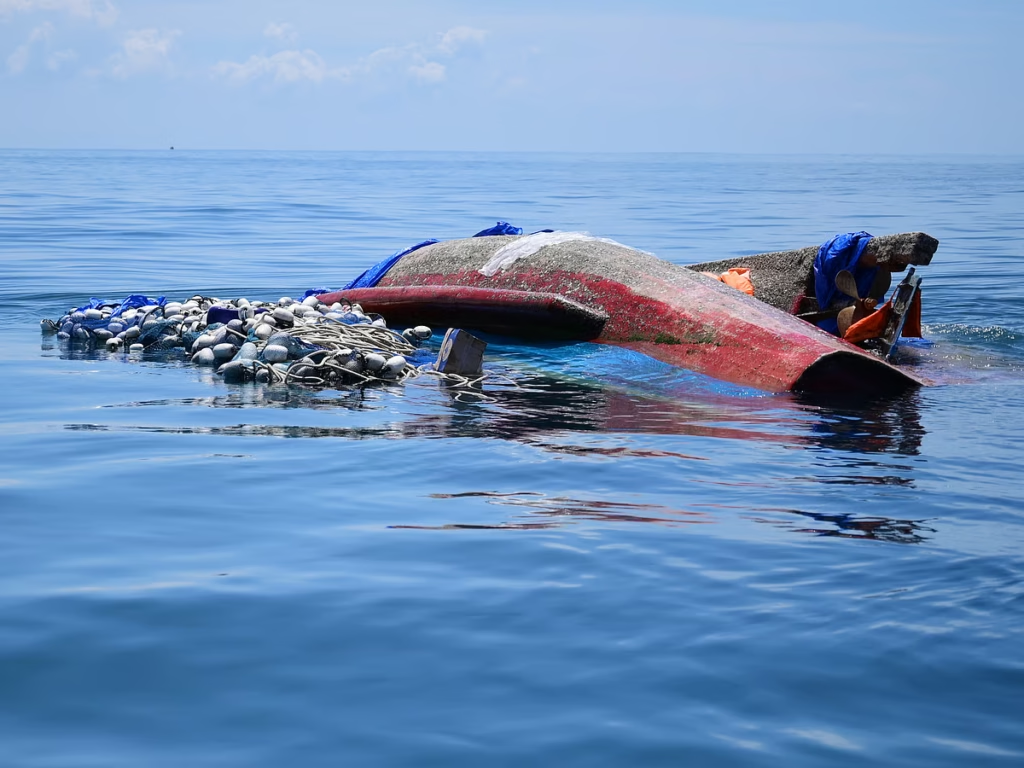
The rescue was carried out by the crew of a commercial vessel, the M.T. Meghna Pride, which encountered the survivors during a voyage from the port city of Chittagong to Indonesia. Authorities indicated the operation was not part of a formal search mission, as the incident occurred outside Bangladesh’s territorial waters.
The exact timing of the sinking remains unclear, and as of Wednesday, there had been no confirmed large-scale search and rescue operation underway. Officials have not provided updated figures on how many people may still be alive or whether additional survivors have been located.
In a joint statement, the United Nations refugee agency and the International Organization for Migration indicated that the vessel departed from Teknaf, a coastal area in southern Bangladesh that serves as a major transit point for migrants. The boat was reportedly carrying a large number of passengers bound for Malaysia, a common destination for those seeking better economic opportunities.
Preliminary findings suggest the vessel capsized due to a combination of overcrowding, strong winds, and rough sea conditions. Such factors have frequently contributed to maritime disasters in the region, where many boats are unregulated and lack basic safety equipment.
A communications officer working with refugee operations in Cox’s Bazar said there were no additional updates available, underscoring the limited information surrounding the incident. Another coast guard official, speaking on condition of anonymity due to policy restrictions, confirmed that all nine survivors were safely transferred to authorities in Teknaf after being brought ashore.
The missing passengers are believed to include both Bangladeshi nationals and members of a stateless minority group who have fled violence in Myanmar. Many individuals from this group have spent years in refugee camps in Bangladesh, facing limited access to employment, education, and long-term stability.
The United Nations agencies emphasized that the incident reflects a broader humanitarian crisis driven by prolonged displacement and lack of viable solutions. Ongoing violence in Myanmar has made it difficult for refugees to return home safely, while conditions in camps continue to push many toward dangerous migration routes.
According to the agencies, many migrants are persuaded to undertake these journeys based on promises of stable jobs and improved living conditions abroad. However, these trips are often organized by smuggling networks that operate with little regard for safety, leading to frequent tragedies at sea.
Bangladesh currently hosts more than one million refugees from Myanmar, placing significant strain on resources and infrastructure in coastal regions such as Cox’s Bazar. International organizations have repeatedly called for increased global support to address both immediate humanitarian needs and long-term solutions.
Despite repeated warnings, maritime crossings in the Andaman Sea and nearby waters remain a persistent route for migrants. The absence of coordinated international rescue frameworks has often resulted in delayed responses to emergencies, increasing the likelihood of mass casualties.
This latest disaster highlights a worsening pattern in maritime migration across South and Southeast Asia. With limited legal pathways for relocation and growing desperation among displaced populations, more individuals are turning to unsafe routes controlled by traffickers. The lack of consistent naval patrols and coordinated rescue mechanisms in international waters further compounds the risk.
The situation also underscores the broader geopolitical challenges tied to refugee crises. Without a political resolution in Myanmar and sustained international funding for refugee-hosting countries like Bangladesh, similar incidents are likely to continue. The economic pull of countries such as Malaysia, combined with misinformation spread by smuggling networks, creates a cycle that is difficult to break.
Additionally, the absence of immediate large-scale search efforts raises concerns about accountability and response readiness. In many cases, delayed action significantly reduces survival chances for those stranded at sea.
The Associated Press





