

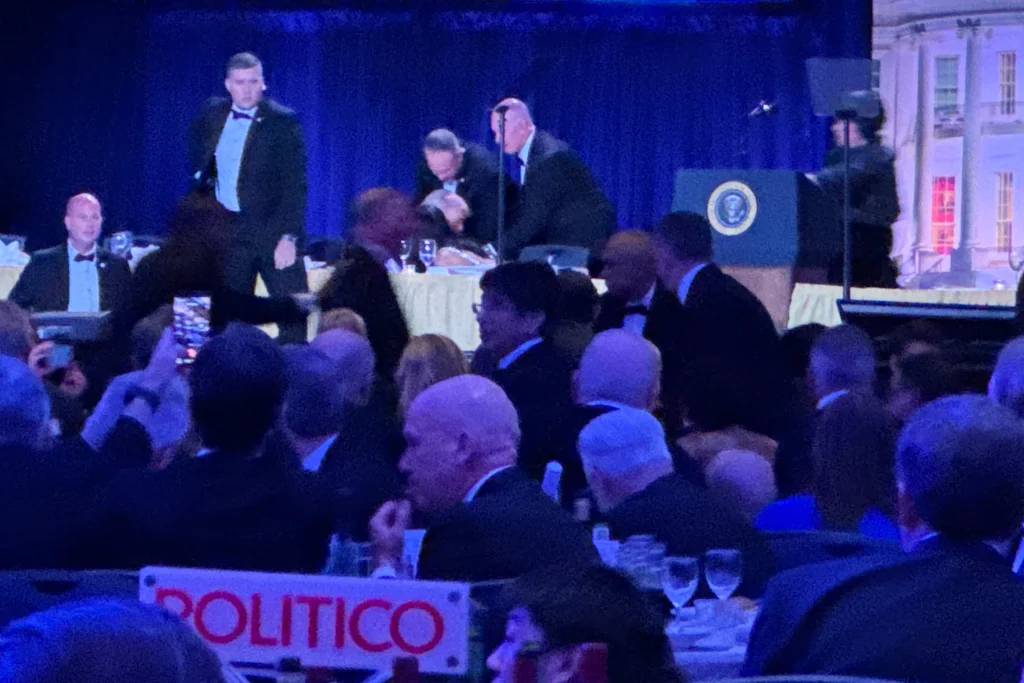
A gunman armed with firearms and knives sparked panic Saturday night at the annual White House Correspondents’ Association dinner, forcing President Donald Trump to be rushed from the stage as shots rang out near the ballroom entrance of the Washington Hilton.
The president was not injured, officials said, but the incident sent hundreds of guests scrambling for cover during one of Washington’s most high-profile gatherings, raising urgent questions about security at an event attended by top government officials, journalists and public figures.
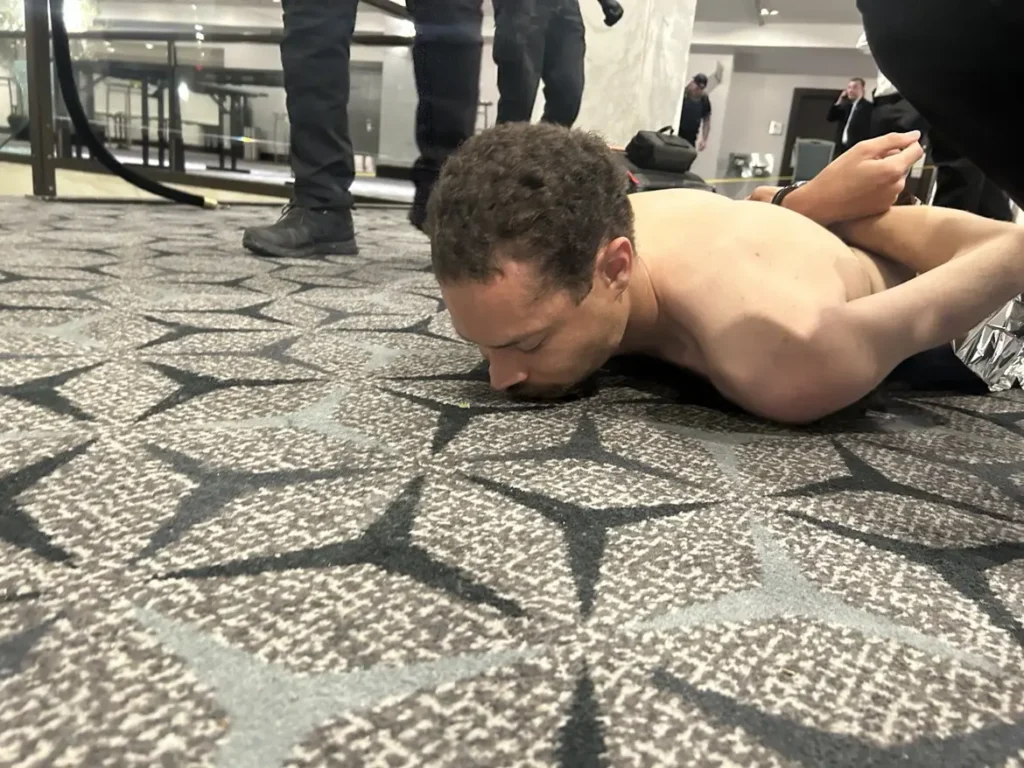
Law enforcement officials identified the suspect as Cole Tomas Allen, 31, of Torrance, California. Authorities said he was taken into custody at the scene and is expected to face multiple charges, including assault on a federal officer. Investigators believe he acted alone, though they have not determined a motive or confirmed his intended target.
The disturbance unfolded just outside the hotel’s main ballroom, where more than 2,000 guests had gathered for the annual black-tie event celebrating journalism and the First Amendment. The evening had only just begun when the sound of gunfire echoed through the venue.
Witnesses described a sudden shift from a routine formal dinner to chaos as guests ducked under tables and security personnel rushed toward the source of the disturbance. Some attendees initially mistook the noise for dropped equipment before realizing shots had been fired.
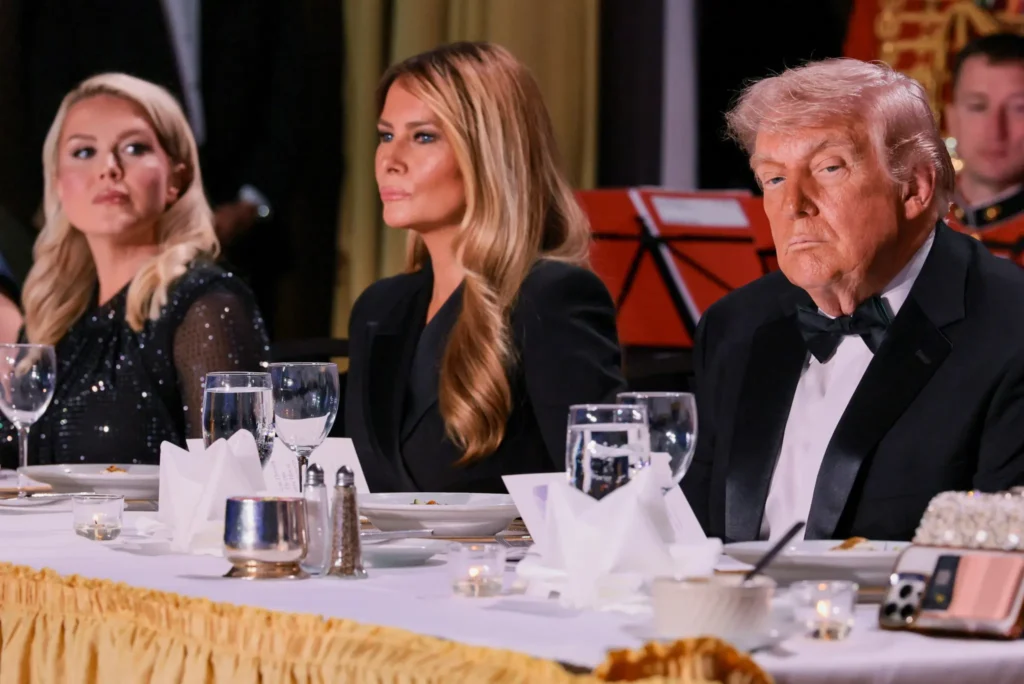
Secret Service agents quickly moved to shield the president. Vice President JD Vance was escorted out first, followed by Trump and first lady Melania Trump. Video footage later released showed agents converging on the suspect after he breached security barriers in the hotel lobby area.
Officials said the suspect fired a weapon at a checkpoint, striking a Secret Service officer in a protective vest. The officer was treated and later released from the hospital. The suspect was subdued and taken for medical evaluation.
Trump, speaking to reporters later at the White House, described the attacker as a “lone wolf” and emphasized that he was unharmed. “When you’re impactful, they go after you,” he said, adding that the incident would not deter him from continuing his work.
The Federal Bureau of Investigation has taken a lead role in the investigation. Director Kash Patel said agents are reviewing physical evidence, including a long gun and shell casings recovered at the scene, while also interviewing witnesses and analyzing surveillance footage.
Inside the ballroom, the response was immediate and intense. Guests, including prominent journalists and political leaders, sought shelter as armed agents entered the room. Some attendees described hearing between five and eight gunshots, followed by shouting and the rapid movement of security personnel.
“It sounded like glass shattering at first,” one attendee told The Associated Press. “Then people started yelling to get down.”
The event was ultimately canceled for the night. Organizers said it would be rescheduled, though no date has been announced.
White House Correspondents’ Association President Weijia Jiang said the group remained committed to holding the event despite the disruption. “We will do this again,” she said.
The incident marks the third time since 2024 that Trump has faced a direct security threat in close proximity. It follows a shooting in Butler, Pennsylvania, that left him injured, as well as another attempted attack later that year.
The Washington Hilton, long the venue for the correspondents’ dinner, has been the site of a previous presidential assassination attempt. In 1981, President Ronald Reagan was shot outside the hotel, prompting significant changes to security protocols at the location.
Despite those measures, Saturday’s events exposed potential vulnerabilities. The hotel typically remains open to the public during the dinner, with security concentrated around the ballroom itself. Investigators are now examining how the suspect was able to enter the premises with weapons and approach restricted areas.
According to Reuters, the gunman carried multiple weapons, including a shotgun, handgun and knives. Interim Police Chief Jeffery Carroll said authorities are working to determine how the weapons were brought into the building and whether any lapses in screening occurred.
The attack also disrupted what had been expected to be a notable moment in Trump’s presidency. The event marked his first attendance at the correspondents’ dinner since taking office again, following years of tension between his administration and the press.
Trump’s relationship with journalists has been marked by legal battles, restricted access and frequent criticism. His appearance at the dinner was widely seen as a potential turning point or, at minimum, a moment of direct engagement with the media.
Instead, the evening became a stark reminder of the heightened security risks facing public officials and large gatherings in an era of deep political division.
Lawmakers from both parties reacted swiftly. House Speaker Mike Johnson said he and his wife were praying for those affected, while House Democratic leader Hakeem Jeffries called for an end to what he described as escalating violence in the country.
Outside the hotel, security presence intensified as National Guard members and local law enforcement secured the area. Helicopters circled overhead while guests were escorted out under tight supervision.
The incident underscores a growing challenge for U.S. security agencies: balancing accessibility at public events with the need for comprehensive protection. The White House Correspondents’ dinner, by design, blends political leadership with media and public figures in a relatively open environment. That openness, however, can create exploitable gaps.
The fact that the suspect was believed to be a registered guest raises further concerns about internal screening procedures. Unlike large outdoor events with strict perimeter controls, hotel venues present unique vulnerabilities, particularly when they remain operational for other guests.
This attack also reflects a broader pattern of increasing threats against political figures in the United States. The repeated targeting of President Donald Trump highlights how political polarization can translate into real-world security risks.
Moreover, the psychological impact of such incidents cannot be overlooked. Events like the correspondents’ dinner are intended to celebrate democratic principles, including freedom of the press. When violence intrudes on those spaces, it sends a chilling message about the state of civic discourse.
The rapid response by Secret Service agents likely prevented a more severe outcome, but the breach itself will prompt a thorough reassessment of security protocols for high-profile gatherings nationwide.
In the coming weeks, investigators will focus not only on the suspect’s motives but also on systemic vulnerabilities. Their findings could influence how future events are organized, potentially leading to stricter access controls and more extensive screening measures.
For now, the incident serves as a stark reminder that even well-established traditions are not immune to disruption in a climate of heightened tension.
AP/Reuters





