

A gang in Haiti released six hostages, among them children and seven women nearly a week after kidnapping more than 50 people during a deadly attack on a community near the capital, UNICEF said late Friday.
The United Nations children’s agency said those released include three children under age 2, a 7-year-old and two teenage girls. UNICEF said it worked with community leaders to help secure their release. It was not immediately clear whether any of them require medical treatment, or whether additional women and children remain in captivity.
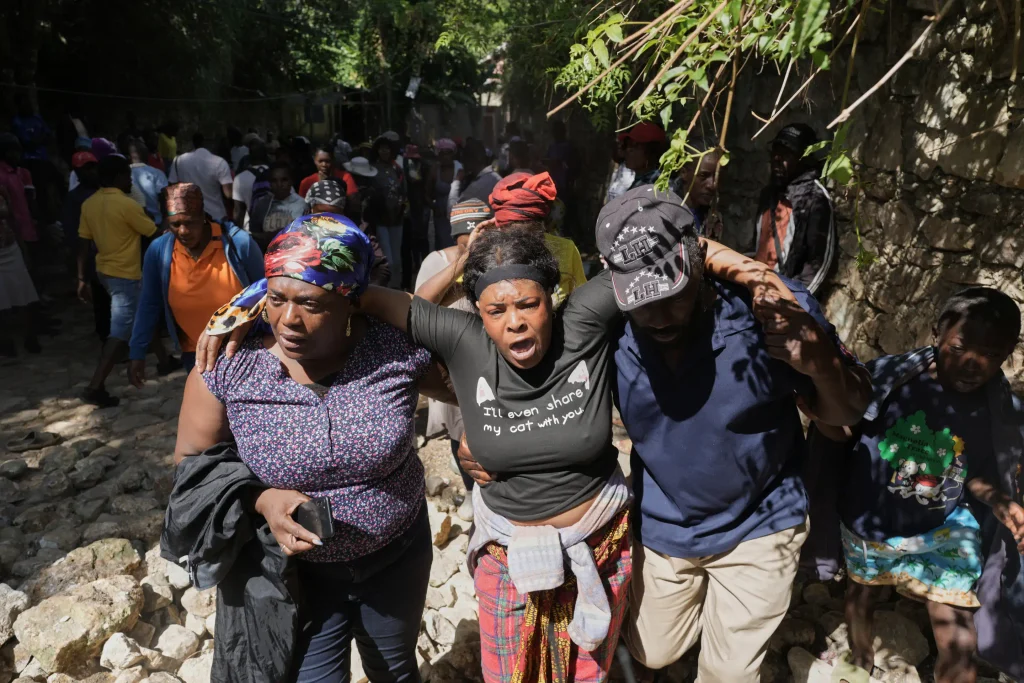
“This release offers a rare moment of hope amid the violence threatening children in Haiti,” said Yannig Dussart, UNICEF’s deputy representative in Haiti. “The Kenscoff abduction was not an isolated incident but another stark reminder of the scale and frequency of attacks on children across the country.”
What We Know So Far
Gang members killed at least 47 people during the attack late Sunday on Kenscoff, a once peaceful farming community in the hills above Port-au-Prince. A gang leader known as Izo 2, who leads an armed group in the area on behalf of and in coordination with other gang leaders including the powerful Izo, had threatened to execute all remaining hostages if police killed any gang members during efforts to secure Kenscoff.
While individual kidnappings remain common in Haiti, mass abductions of this scale are more unusual, and outcomes vary widely. Some hostages are released without a ransom being paid, while others have been killed even after multiple ransom payments were made.
The attack forced more than 2,600 people to flee their homes, many for the second or third time, according to Indrika Ratwatte, the acting United Nations assistant secretary-general for humanitarian affairs. He told the Security Council that displaced residents remain traumatized, are still searching for missing relatives, and face deep uncertainty about their future.
What Authorities Are Saying
The attack prompted an emergency U.N. Security Council meeting Friday, called by the United States, Panama and Colombia, where diplomats expressed horror at the violence and pushed for swift deployment of the new U.N.-backed gang suppression force. Luis Ruiz Massieu, the U.N. special envoy to Haiti, said the attack has generated a new wave of public outrage across Haitian society and among international partners.
Ruiz Massieu welcomed a decision by Haitian authorities to bring together the national police, armed forces and the gang suppression force to coordinate their response, with plans for the suppression force to strengthen its presence in Port-au-Prince and for Haitian forces to reinforce their deployment specifically in Kenscoff. He and several council members nonetheless stressed the urgent need for stronger international security support for Haiti beyond what has already been pledged.
U.S. Deputy Ambassador Jennifer Locetta said the United States remains resolved and committed to supporting Haitian led security efforts to end gang violence, and urged U.N. member states to provide equipment and resources to help the gang suppression force deploy as quickly as possible. She also called for investment in jobs and infrastructure to give young Haitians an alternative to joining gangs, and said gang coalitions have publicly stated their intent to prevent Haitians from voting in future elections. “They cannot terrorize from the ends of rifles and from the comforts of toll stations — as they rob Haiti of their future,” Locetta said, calling for stronger protection of civilians.
Ratwatte told the council that nearly 1.5 million people, or about 12 percent of Haiti’s population, remain internally displaced nationwide, half of them children. He described violence against women, girls and children as shocking, saying humanitarian partners recorded more than 5,500 incidents of gender based violence, or roughly 30 cases per day, during just the first six months of the year.
Why This Matters
The scale of displacement and gender based violence documented by U.N. officials underscores how the Kenscoff attack fits into a much broader humanitarian crisis rather than standing as an isolated incident. Ratwatte’s disclosure that deportations to Haiti continue at scale, including nearly 200,000 people forcibly returned in the first eight months of 2026, a 10 percent increase over the same period last year, adds further strain to a country already struggling to absorb large numbers of internally displaced people, since many of those deported from the Dominican Republic and the United States arrive with nothing and enter a country where gangs control large portions of the capital and surrounding areas.
The partial release of hostages offers a rare positive development, but the continued uncertainty over how many women and children remain in captivity, combined with the gang’s earlier explicit threat to execute hostages under certain conditions, illustrates how fragile any progress remains. The emergency Security Council session and the renewed calls for faster deployment of international security support suggest growing international recognition that Haiti’s own police and armed forces continue to lack the capacity to independently contain gang violence at this scale.
What Happens Next
UNICEF and community leaders are expected to continue working toward the release of any remaining hostages, though the total number still held was not confirmed as of the latest reporting. Haitian security forces, coordinating with the national police, armed forces and the gang suppression force, are expected to reinforce their presence in both Kenscoff and Port-au-Prince in the coming days.
U.N. member states face continued pressure to provide the equipment, resources and broader investment needed to accelerate deployment of the gang suppression force, with officials including Locetta and Ruiz Massieu framing the pace of that international support as central to whether Haiti can make meaningful progress against gang violence in the months ahead.
Report rewritten from original article by The Associated Press




