

Iran declared the Strait of Hormuz closed Saturday, citing what it described as violations of the interim peace agreement by the United States and Israel, as continued Israeli strikes in Lebanon killed at least 16 people and threatened to unravel a fragile diplomatic framework reached just days earlier.
The announcement sent a fresh wave of uncertainty through global energy markets and cast a shadow over technical-level negotiations between U.S. and Iranian delegations set to begin Sunday in Switzerland.
What We Know So Far
Iran’s Islamic Revolutionary Guard Corps Navy warned all ships to stay away from the strait, saying their safety could not be guaranteed, NBC News confirmed. Iran’s top joint military command described the closure as the “first step” in response to what it called breaches of commitments by the United States and Israel, according to Iran’s semi-official Mehr news agency.
The United States disputed the announcement directly. “Iran does not control the Strait of Hormuz. Traffic continues to flow, and U.S. forces are monitoring the situation to ensure this remains the case,” said Captain Tim Hawkins, a spokesperson for U.S. Central Command. The military confirmed that 55 merchant ships transited the waterway Saturday, carrying more than 17 million barrels of oil to global markets.
President Donald Trump responded on social media with a threat of his own, warning that the United States would impose its own tolls on the strait if a final agreement with Iran was not reached within 60 days. Trump said the money would be for “services rendered as the Guardian Angel to the countries of the Middle East.” The current interim agreement calls for toll-free transit through the strait for 60 days.
Trump did not address Iran’s assertion that the waterway was closed.
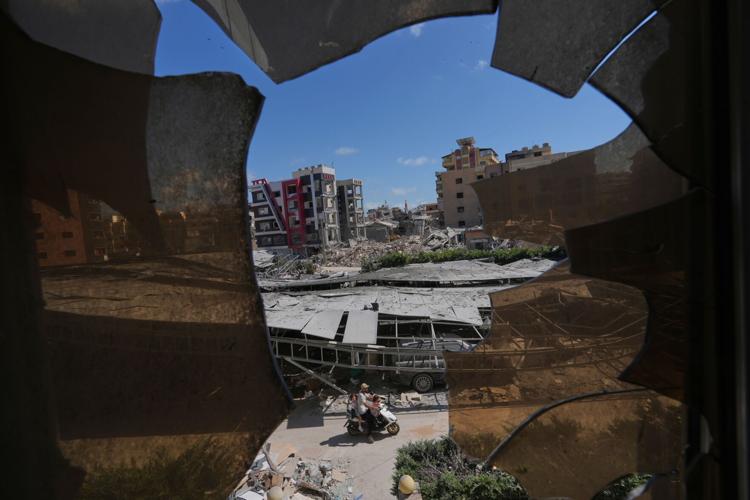
Israeli strikes on southern Lebanon killed at least 16 people, including two children, in the early hours of Saturday, one day after the United States said Israel and Hezbollah had agreed to a fresh ceasefire at Trump’s request, the Associated Press confirmed. Lebanon’s civil defense and media reported that strikes hit a series of towns across the south, with at least seven people trapped under rubble. Lebanon’s army confirmed a soldier was killed between Kfar Rumman and Nabatieh. A previous wave of strikes on Friday had killed 83 people, Lebanon’s Ministry of Health said.
The death toll in the latest Israel-Hezbollah war has surpassed 4,000, Lebanon’s health ministry confirmed Saturday.
The Israeli Defense Forces said Hezbollah had breached the ceasefire by launching more than 50 projectiles at Israeli soldiers operating in southern Lebanon overnight and that Israel struck Hezbollah targets in response. “The IDF remains committed to the ceasefire agreement,” the military’s statement read. An Israeli military official, speaking without authorization to comment publicly, later said the military had received updated political directives to cease fire but was operating defensively, retaining the right to respond to Hezbollah attacks. Five Israeli soldiers were killed in southern Lebanon in the previous 48 hours, the official said.
Hezbollah denied provoking the exchanges. A Hezbollah statement said the group had “adhered to the ceasefire since Friday evening” and accused Israel of fabricating justifications to continue strikes and “sabotage the agreement” between Iran and the United States.
A Hezbollah official told the Associated Press on condition of anonymity that Iran had informed the group it would not reopen the strait until Israel publicly committed to a comprehensive ceasefire in Lebanon and a full halt to military operations there. The official said Hezbollah would honor a ceasefire if Israel did the same.
What Authorities Are Saying
Vice President JD Vance departed for Bürgenstock, Switzerland on Saturday evening to join ongoing negotiations, just as Iranian state television broadcast footage of Iran’s delegation arriving in the country. Iran’s team includes parliamentary speaker Mohammad Bagher Qalibaf, Foreign Minister Abbas Araghchi, and officials from Iran’s central bank and oil sector, the Associated Press confirmed.
Speaking to reporters before boarding his plane, Vance said the situation in Lebanon had calmed down despite news reports to the contrary. “I think we are going to hopefully make progress on the nuclear issue, hopefully make progress on the Lebanon ceasefire issue. Those are the two big things that I think we are going to be focused on,” he said.
Earlier, Vance told Fox News that Trump’s special envoy Steve Witkoff and presidential son-in-law Jared Kushner were already in Switzerland working through technical details of the anticipated negotiations on Iran’s nuclear program.
Pakistan’s Ministry of Foreign Affairs formally announced that technical-level talks would take place Sunday, with U.S. and Iranian representatives joined by mediators from Qatar and Pakistan.
Iranian Foreign Ministry spokesperson Esmail Baghaei said the Iranian delegation’s mission was to “demand the fulfillment of the other side’s obligations,” adding that formal negotiations toward a final agreement would only begin once those obligations were implemented. “If they are not,” Baghaei warned, “the memorandum of understanding as a whole will be jeopardized.”
The talks were originally meant to start Friday but were postponed after Iran initially canceled its participation because of the escalating violence in Lebanon. Negotiators for the United States and Qatar, working with Iranian input, reached a fresh arrangement between Israel and Hezbollah to reduce hostilities and allow the talks to proceed, according to U.S. and regional officials who spoke on condition of anonymity because they were not authorized to discuss the matter publicly, the Associated Press reported.
IDF spokesperson Brigadier General Effie Defrin said Friday that Israeli forces would continue operating in southern Lebanon and would “do whatever is necessary to protect our civilians.” Neither the White House nor the Israeli prime minister’s office responded to questions about Iran’s strait closure declaration.
Why This Matters
The strait’s status sits at the center of the entire diplomatic framework. Iran committed to reopening it as part of the interim agreement signed this week, and ships had begun transiting again following the deal’s announcement, offering the first prospect of eased global energy supply in months. Iran’s closure declaration, whether enforced in practice or not, signals that Tehran is prepared to use the waterway as leverage every time it believes the terms of the agreement are being violated.
The fundamental problem is structural. Israel was not a signatory to the U.S.-Iran agreement and has made clear it does not consider itself bound by its terms, particularly regarding Lebanon. Iran insists that any ceasefire must include Lebanon. Israel’s Prime Minister Benjamin Netanyahu has vowed to keep Israeli forces in southern Lebanon until all threats to Israel are eliminated, a position that appears incompatible with Iran’s core demand.
Netanyahu is also navigating a difficult domestic political landscape, facing a critical election in October and dependent on the support of far-right coalition partners who have publicly criticized the Iran deal as contrary to Israeli interests and pushed for intensified military action in Lebanon. “Netanyahu is in a challenging political spot,” Jonathan Panikoff, a former career intelligence officer now at the Atlantic Council think tank, told NBC News. “When combined with the broad view that Iran has emerged strategically stronger, Netanyahu finds himself trapped.”
U.S. intelligence agencies believe Israel will likely continue striking Hezbollah in Lebanon, a judgment that, if borne out, would keep the current crisis on a slow boil regardless of what is agreed in Switzerland, according to a source with knowledge of the assessments.
For the global economy, the back-and-forth over the strait’s status adds another layer of uncertainty to energy markets that had only just begun pricing in the prospect of resumed Gulf oil flows. Industry experts had already warned that normalizing shipping traffic through the waterway would take weeks even under the most favorable conditions, given that the threat of mines in the area still needs to be cleared.
The broader diplomatic damage is also significant. Vance publicly criticized Israeli officials Thursday, saying Israel did not appreciate American support, a rare and sharp rebuke that reflected the depth of frustration within the Trump administration over Netanyahu’s continued military operations at precisely the moment Washington was trying to consolidate its agreement with Tehran.
What Happens Next
U.S. and Iranian negotiators, joined by Qatari and Pakistani mediators, are expected to meet Sunday in Switzerland to begin technical discussions on the most complex unresolved elements of the interim agreement, including Iran’s nuclear program, the sequencing of sanctions relief, and the status of Lebanon.
The 60-day window established by the interim deal for reaching a final agreement begins from the date of signing. That clock is now running while the foundational question of whether Israel will stop striking Lebanon remains unanswered.
A new round of U.S.-backed talks between Israel and the Lebanese government is expected in Washington the following week, an effort to address the Lebanon dimension through a parallel diplomatic channel that does not require Israel and Iran to negotiate directly.
Residents on both sides of the Lebanon-Israel border expressed weariness and skepticism Saturday. “Our entire lives would change if there is a ceasefire,” said Hussein Khoshman, a resident of the Lebanese coastal city of Tyre. Across the border in northern Israel, Miriam Hod of Metula was less hopeful. “I do not believe in a ceasefire because it does not exist,” she said.
Whether Sunday’s talks in Switzerland can overcome the obstacle that Israel’s strikes in Lebanon now represent, or whether the fighting there will continue to destabilize an agreement that the United States, Iran, Pakistan, and Qatar spent months constructing, is the question on which the entire diplomatic enterprise now turns.





