

Iran launched a fresh wave of missile attacks targeting Israel and several Gulf states on Thursday, signaling that its military capabilities remain intact even as President Donald Trump declared that the threat from Tehran was close to being neutralized.
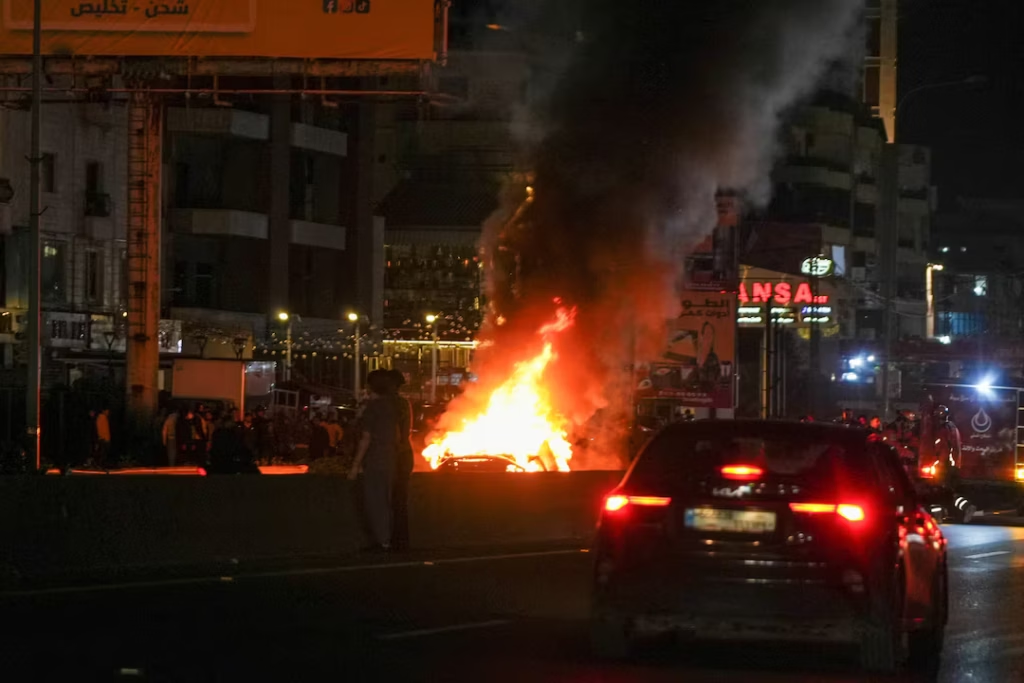
Explosions were heard across parts of the region as air defense systems responded to incoming missiles. In Dubai, blasts echoed shortly before Trump addressed the American public, while sirens sounded in Bahrain, home to the U.S. Navy’s Fifth Fleet, soon after his remarks concluded. Israel also confirmed it was intercepting missiles as alerts spread across multiple areas.
The renewed strikes came as Trump said U.S. military operations had achieved major progress, stating in a national address that “core strategic objectives are nearing completion.” He also argued that Iran was no longer a significant threat, a claim quickly rejected by officials in Tehran.
A spokesperson for Iran’s military, Lt. Col. Ebrahim Zolfaghari, said the country retains undisclosed weapons stockpiles and production sites, adding that facilities hit so far by U.S. strikes were of limited importance. His comments reflected a defiant tone from Iran’s leadership as the conflict continues to escalate.
The fighting has spread across several countries, with Israeli operations in Lebanon intensifying. Health authorities there said at least 27 people were killed in the past 24 hours. Since the war began on Feb. 28, more than 1,900 people have been killed in Iran, compared with 19 reported deaths in Israel. Additional casualties have been recorded in Gulf countries and the West Bank, while the United States has confirmed the deaths of 13 service members.
The conflict has also caused widespread displacement. In Lebanon alone, more than 1 million people have been forced from their homes, with over 1,300 fatalities reported. Israeli forces have also lost 10 soldiers in the fighting there.
Beyond the battlefield, the war is having a major impact on global energy markets. Iran’s actions in the narrow waterway that connects the Gulf to open seas have sharply reduced shipping traffic, disrupting oil supplies worldwide. Before the conflict began, roughly one-fifth of the world’s traded oil passed through the route.
Shipping data cited by Reuters shows traffic through the waterway has dropped by more than 90 percent compared with the same period last year. Attacks on commercial vessels and the threat of further strikes have effectively halted most transit.
Countries that rely heavily on energy shipments have begun seeking alternatives. Saudi Arabia redirected large volumes of oil through pipelines, while Iraq has started transporting crude by land routes to bypass the affected area.
Nearly three dozen nations held talks on Thursday to address the situation, focusing on diplomatic and logistical measures to restore shipping once hostilities subside. The discussions included major industrial economies and several Gulf states, though the United States did not participate.
British Foreign Secretary Yvette Cooper said military planners from several countries are preparing options to secure the route after the conflict ends, including clearing hazards and providing protection for commercial vessels. However, no country has signaled a willingness to use force to reopen the passage while fighting continues.
French President Emmanuel Macron, speaking during a visit to South Korea, described the idea of a military operation to secure the route as unrealistic under current conditions.
Trump, in his address, suggested that nations dependent on energy supplies should take responsibility for reopening the route, urging them to act rather than rely on U.S. intervention. He indicated that while force could be used, it would not necessarily be led by the United States.
Meanwhile, strikes continued inside Iran. State media said an attack hit a major bridge project, with reports of casualties. Trump shared video online that he said showed the structure collapsing, warning that further actions could follow. Iran’s foreign minister criticized the strike, describing it as an attack on civilian infrastructure.
The economic effects of the conflict are becoming increasingly visible. Oil prices have surged sharply, with U.S. crude trading above $111 per barrel, up roughly 50 percent since the start of the war. Rising fuel costs are beginning to affect household budgets and could drive up prices for goods and services worldwide.
Air travel has also been affected, with disruptions to jet fuel supplies adding pressure to an already strained global transportation network.
The latest exchange of strikes underscores a key reality of the conflict: while military operations may degrade certain capabilities, they rarely eliminate them entirely. Iran’s continued ability to launch coordinated attacks suggests that its military infrastructure is more resilient and dispersed than initially assumed.
At the same time, control over critical energy routes has emerged as one of Iran’s strongest strategic tools. By disrupting shipping rather than relying solely on direct military confrontation, Tehran is able to exert pressure on the global economy, affecting countries far beyond the immediate conflict zone.
The sharp reduction in shipping traffic highlights how vulnerable global supply chains remain to geopolitical shocks. Even temporary disruptions can lead to significant price increases, with ripple effects across industries and national economies.
Trump’s stance that other nations should take the lead in securing the route reflects a broader shift in U.S. foreign policy, placing greater responsibility on allies. However, the reluctance of other countries to engage militarily suggests limits to that approach, particularly in a high-risk environment.
If the conflict continues, energy markets are likely to remain volatile, and the risk of further escalation will persist. The situation also raises longer-term questions about energy security and the need for diversified supply routes to reduce dependence on critical chokepoints.
The Associated Press





