

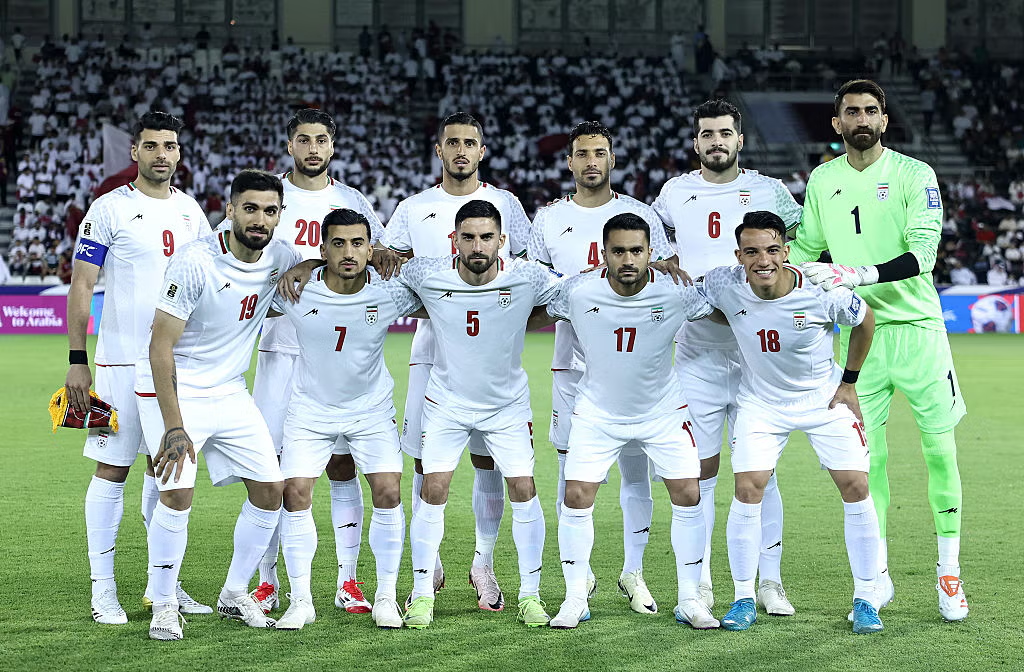
Iran’s national soccer team has received approval to enter the United States for the World Cup, a White House official confirmed Friday, resolving days of uncertainty just ahead of the team’s opening match in Los Angeles.
The decision clears the way for Iran’s players to participate in the tournament despite escalating tensions between Washington and Tehran. The approval came overnight after earlier indications from Iran’s ambassador to Mexico suggested the visas had not yet been issued.
Abolfazl Pasandideh had indicated that the team was still awaiting travel clearance as late as Thursday, but U.S. authorities moved to finalize the process in time for the competition.
Iran is scheduled to face New Zealand on June 15 in Los Angeles, with additional group stage matches against Belgium and Egypt set to follow in Seattle.
While players have secured entry, some uncertainty remains around support staff. Iranian media outlets indicated that visas for portions of the technical and administrative delegation had not yet been granted, though U.S. officials have not publicly addressed those claims.
The visa process unfolded against a backdrop of diplomatic strain and military confrontation between the two countries, raising questions about whether Iran would be able to compete on U.S. soil. The situation prompted Iranian officials to relocate the team’s base from Arizona to Tijuana, Mexico, in an effort to limit time spent inside the United States.
U.S. Secretary of State Marco Rubio had earlier told lawmakers that individuals linked to Iran’s Revolutionary Guard would not be permitted entry as part of the delegation, a restriction that could affect players who completed mandatory service tied to the military organization.
Despite those concerns, U.S. officials have not formally opposed the team’s presence for the tournament.
Iran’s participation marks an unprecedented moment in World Cup history, as it is the first time since the competition began in 1930 that a host nation will stage matches involving a country it is actively in conflict with.
Speaking in Mexico City, Pasandideh framed Iran’s participation as a signal of openness, suggesting that competing even in a rival nation reflects a willingness to pursue stability.
The visa approval highlights the complex intersection of global sports and international politics. While the World Cup is designed as a unifying event, it increasingly serves as a stage where geopolitical tensions play out in subtle but visible ways.
For the United States, allowing Iran’s team to compete reinforces its obligations as a host nation under international sporting agreements, even as broader diplomatic relations remain strained. Denying entry could have triggered backlash from global football authorities and undermined the tournament’s credibility.
For Iran, participation carries symbolic weight. Competing on American soil during a period of conflict offers a rare platform to project a softer national image, even as political tensions persist behind the scenes.
The partial visa uncertainty for staff also signals how security concerns continue to shape policy decisions, suggesting that while athletes may be granted access, broader engagement remains tightly controlled.
As the tournament approaches, the presence of Iran’s team in the United States is likely to draw heightened scrutiny, both on and off the field, reinforcing how deeply global events are now intertwined with international relations.
TheIndependent/Reuters




