Islam is on course to surpass Christianity as the world’s largest religion by 2035, driven chiefly by higher birth rates among Muslims, according to detailed projections released Wednesday by the Pew Research Center.
Both faiths are growing, but Islam is expanding considerably faster, said Pew, which has produced widely cited studies of religious demography for 25 years, Japan Today said, citing The Associated Press.
“It’s the babies,” said Conrad Hackett, a senior demographer at Pew, noting that conversion and other changes in religious identity play a far smaller role than fertility.
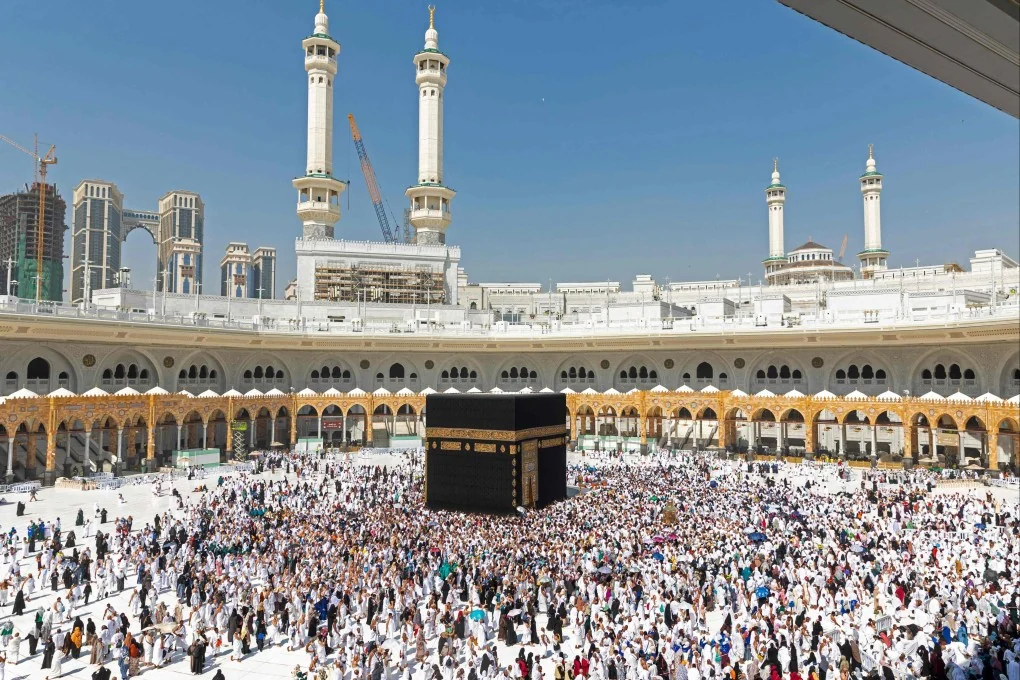
Pew estimated there were 2.27 billion Christians and 2.02 billion Muslims worldwide in 2020. By 2035, it projects 2.57 billion Muslims and 2.52 billion Christians. If current trends hold, Muslims would number about 3.64 billion by 2070, or 36% of the world’s population, up from 26% in 2020, while Christians would total about 2.96 billion and hold roughly steady at 29%, The Washington Times said.
“For centuries, Christianity has been the world’s largest religion. That may soon change,” Pew’s researchers wrote in the report.
Birth rates drive the shift
From 2020 to 2025, Muslim women averaged 3.1 children, compared with 2.5 for Christian women, Pew said. Women of all other groups averaged 1.6, below the 2.1 rate needed for a population to replace itself.
About 252 million babies were born to Muslim mothers during that period, compared with 208 million to Christian mothers. Muslims are the only major religious group expected to see rising numbers of births in coming decades.
Muslims also had the youngest median age of any religious group in 2020, at 24, compared with 33 for non-Muslims and 37 for the religiously unaffiliated, the report noted.
The projections, part of a broader Pew study of how major religious groups may change from 2020 to 2070, factor in age structures, fertility, religious switching and migration.
Africa at the center of growth
The world’s population is projected to rise 29% between 2020 and 2070. Only Christians and Muslims are expected to keep pace, with Christians growing 30% and Muslims 80%, Pew said.
Most of the world’s population growth is expected in sub-Saharan Africa, where most people are Christian or Muslim. By 2070, more than half of the world’s Christians will live in the region, and Congo will overtake the United States as the country with the most Christians, their numbers more than tripling to 299 million.
Pakistan is projected to have the largest Muslim population by 2070, followed by India, Nigeria and Indonesia, which currently ranks first.
In Asia and the Pacific, Muslims are expected to become the largest religious group, overtaking Hindus. Christians will remain dominant in Latin America, though their share is projected to fall from 85% to 77%.
Decline in the West
Europe’s population is projected to shrink 17% by 2070, and its Christian population to fall by a third, from 505 million to 324 million. The share of Europe’s population that is Muslim is expected to rise from 6% to 13%.
“European Christians are projected to experience more deaths than births and to continue to see larger numbers of people leaving the faith than converting to it,” the researchers wrote.
In the United States, Christians now make up 62% of adults, a share Pew projects will fall below half by 2065. Their numbers are expected to decline from about 217 million in 2020 to about 174 million in 2070. In Canada, Christians are projected to drop below 50% by 2030.
In both countries, the main factor is the growth of people with no religious affiliation, often called “nones.” They are projected to make up 41% of the U.S. population by 2070 and to outnumber Christians in Canada.
Globally, however, Pew projects the share of “nones” will fall from 24% to 17% by 2070, largely because of population decline in China, home to most of the world’s unaffiliated. Excluding China, their ranks elsewhere are expected to grow by more than 180 million. “Nones” already form a majority in 10 countries, including Japan, the Czech Republic and the Netherlands, with South Korea, France and the United Kingdom expected to join them.
Hindus and Jews are projected to grow in number but decline as a share of the global population, while Buddhists are expected to shrink on both counts, partly due to falling populations in China, South Korea and Japan.
Warnings against a ‘clash’ narrative
Alan Cooperman, Pew’s director of religion research, stressed that most growth for both faiths is occurring in countries where they are already the majority, with conversion playing a minor role.
“I don’t think this is a situation in which the growth of Muslims is coming at the expense of Christians,” he said. “I do worry about mischief being made with headlines or narratives that take this finding and portray it as sort of a clash where Christians are losing to Muslims.”
Gina Zurlo, a senior researcher at Harvard Divinity School, said relations between the faiths are “extremely important.” She noted that the “clash of civilization” idea remains influential in some communities and that many Christians are uneasy about the findings. “Personal contact is important — when people have personal relationships across religious differences, it ‘humanizes’ the ‘other’ in fruitful ways,” she said.
Others predicted broader cultural effects. Tricia Bruce, a Catholic sociologist, told The Washington Times that Western values could shift. “We could see different understandings of gender roles, norms of governance and the place of religion in public life,” she said.
Democratic strategist James Carville suggested demographic change could influence U.S. policy toward Israel. “Public attitudes are changing, no doubt, and this is not a good time for the state of Israel,” he said.
Skeptics question the forecasts
Some analysts cautioned that the projections could prove wrong. The Rev. Thomas Reese, a Jesuit analyst at Religion News Service, said Muslim birth rates could fall faster than expected. “We know from other research that women who are educated have fewer children,” he said.
Michael New, a professor at the Catholic University of America, said economic growth in Muslim-majority countries could also lower birth rates. He also cited rising religiosity among young people in developed countries. A Gallup survey in April found 42% of men ages 18 to 29 called religion “very important” in 2024 and 2025, up from 28% in 2022 and 2023.
Pew itself cautioned that the projections “are not intended to predict all the ways the world could change,” including wars, disasters, epidemics and economic upheavals. The center noted that in 2015 it underestimated the rise of the religiously unaffiliated.
Demography, not conversion, and a long horizon
The headline finding is likely to draw attention, but the underlying story is primarily about demographics rather than religious competition. Pew’s own researchers emphasize that both faiths are growing mainly through births in places where they already predominate, especially sub-Saharan Africa and South Asia. The crossover point in 2035 reflects differences in fertility and age structure, not large-scale movement between faiths.
That distinction matters because, as Cooperman and Zurlo warned, the numbers can easily be framed as a contest. The range of reactions in this report, from concern about cultural change to calls for interfaith understanding, shows how differently the same data can be read.
Projections spanning half a century carry significant uncertainty. Fertility rates have historically fallen as education and incomes rise, and the skeptics’ points suggest Muslim birth rates may decline faster than the model assumes. Pew’s past underestimate of the rise of “nones” shows that religious behavior can shift in ways demographers do not anticipate, and recent signs of renewed religiosity among young men in some countries point to further unpredictability.
What appears more certain is the geographic shift in global Christianity toward Africa, and the continuing secularization of Europe and North America. Those trends are already well underway and are likely to reshape religious institutions, leadership and priorities regardless of when, or whether, Islam overtakes Christianity in total numbers.
Sources: Pew Research Center; The Associated Press (AP), via Japan Today; The Washington Times