

Gunmen opened fire in a crowded neighborhood in Jos North, killing several residents and prompting authorities in Plateau State, Nigeria, to impose a 48 hour curfew as security forces moved to contain unrest following the attack.
The violence unfolded Sunday night in the Angwa Rukuba area, where witnesses said armed men on motorcycles shot at people in the streets, sending residents fleeing in panic. The area is known for its large population of students and young people.
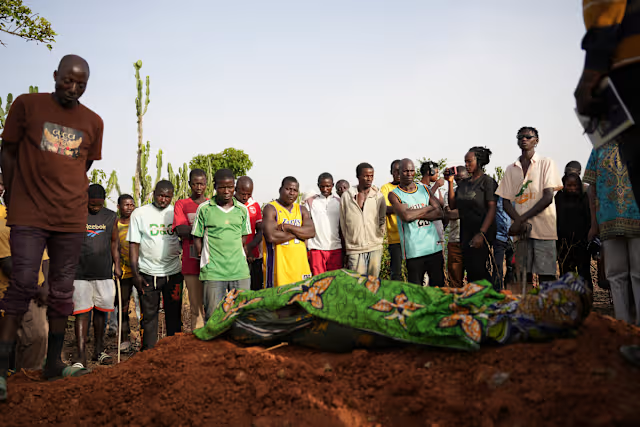
Local accounts cited by Pulse Nigeria indicated that at least 10 people were killed, though officials have not released a confirmed death toll. Some victims were believed to be students living in the community.
“They just rode past and started shooting,” one resident said, describing the sudden outbreak of gunfire and confusion.
Images shared online showed bodies lying in the streets, intensifying anger and fear among residents already on edge after previous incidents of violence in the region.
In the immediate aftermath, groups of young people blocked major roads in protest, accusing nearby security forces of responding too slowly. The demonstrations added to tensions, raising concerns about further unrest.
The Plateau State government responded by announcing a 48 hour curfew across Jos North, effective from midnight March 29 through April 1, in an effort to restore order and allow security personnel to stabilize the situation.
In a statement issued by Commissioner for Information and Communication Joyce Ramnap, the government described the attack as “barbaric and unprovoked” and confirmed that security agencies had been deployed to track down those responsible.
“Following the tragic security incident … resulting in the loss of lives, while several others sustained injuries, the government … wishes to inform the public of the imposition of a 48 hour curfew,” the statement said, as cited by Punch Nigeria.
Governor Caleb Mutfwang condemned the killings and assured residents that efforts were underway to restore calm and protect lives and property. He urged the public to cooperate with authorities and provide information that could assist the investigation.
Accounts from residents provided further detail on the attack. One resident, John Caleb, told Punch Nigeria that multiple people were killed and others injured, with victims taken to a nearby hospital. Another resident, Janet Pam, said she initially mistook the gunfire for a minor disturbance before realizing the scale of the attack.
“They targeted those moving on the road and those selling by the roadside,” she said, adding that one of the victims was her neighbor returning from a church service.
She described the violence as unprecedented in her experience and said the attackers fled before security personnel arrived.
Authorities have not confirmed the motive for the attack or the identities of the victims. Claims circulating online describing the incident as a targeted religious killing have not been verified by officials.
The timing of the attack, which coincided with a major religious observance for many Christians, has contributed to speculation about possible motives. However, officials have urged caution and have not linked the violence to any specific cause.
The attack has also disrupted daily life in the area. The University of Jos announced the postponement of examinations scheduled for March 30 and March 31, citing safety concerns for students and staff living in affected neighborhoods.
The incident adds to a pattern of violence that has troubled Plateau State for years. Communities in the region have experienced repeated attacks, kidnappings and clashes, often fueled by longstanding tensions.
Earlier in March, more than 20 security personnel and local defense volunteers were killed in an ambush in another part of the state. In previous years, coordinated attacks in several communities resulted in large numbers of deaths and displacement, drawing widespread condemnation.
Residents say the recurring violence has created a climate of fear and uncertainty, with many calling for stronger security measures and quicker responses from authorities.
The latest attack in Jos highlights the persistent security challenges facing Plateau State, where cycles of violence have proven difficult to break. While the immediate cause of the shooting remains unclear, the rapid spread of unverified claims online underscores how quickly such incidents can inflame tensions.
The government’s decision to impose a curfew reflects both the seriousness of the situation and the need to prevent retaliatory violence. However, curfews are often short term solutions that do not address underlying issues such as weak law enforcement capacity, economic strain and community mistrust.
The reaction from residents, including road blockades and protests, points to frustration with perceived gaps in security response. Restoring public confidence will likely depend on visible progress in identifying and prosecuting those responsible.
The disruption to academic activities also illustrates the broader impact of insecurity on daily life, particularly in areas with large student populations. Schools and universities often become indirect victims of instability, affecting education and local economies.
Looking ahead, the incident may increase pressure on both state and federal authorities to strengthen security operations in the region. Without sustained efforts, there is a risk that violence could escalate further, deepening divisions and prolonging instability.
Pulseng/Punchng/LindaIkejiblog





