

(AP) — A gunman opened fire on visitors at a major archaeological site north of Mexico City on Monday, killing a Canadian tourist and wounding six others before taking his own life, authorities said.
The shooting unfolded at Teotihuacan, one of the country’s most visited historic landmarks, about an hour’s drive from the capital. Officials said the attacker positioned himself atop Pyramid of the Moon, where dozens of tourists had gathered, and began firing shortly after 11:30 a.m.
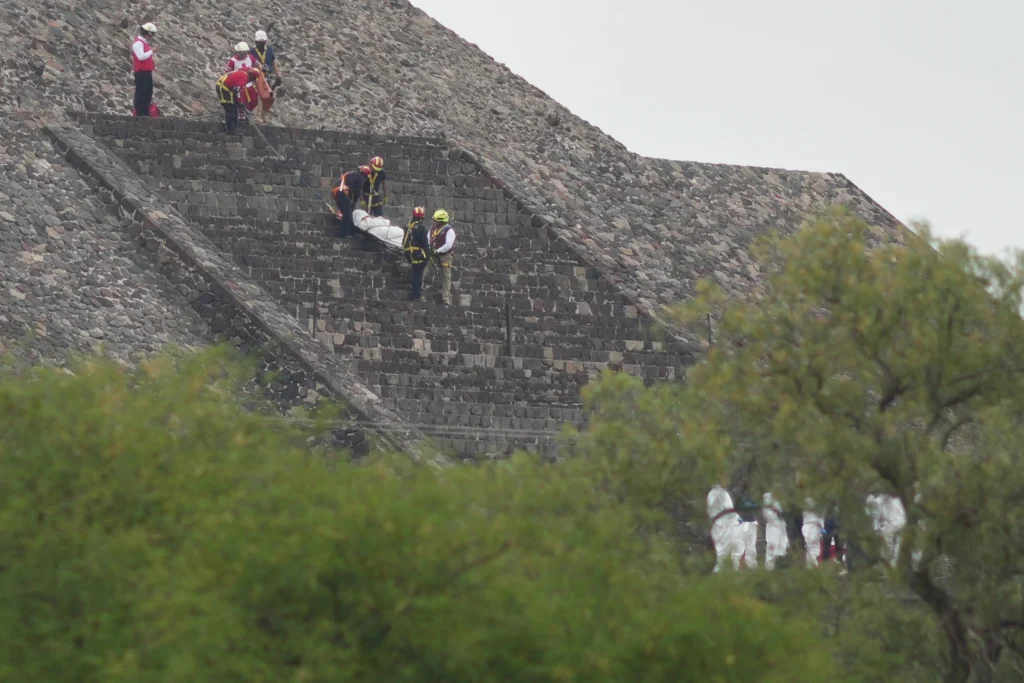
Local authorities said four people were struck by gunfire, while two others were injured after falling during the panic that followed. The victims included visitors from Canada, Colombia and Russia, officials said, adding that all were taken to hospitals for treatment. Details on their conditions were not immediately available.
The suspected gunman later died from a self-inflicted gunshot wound, according to a statement from local officials. Security personnel at the site, along with a responding National Guard unit, secured the area soon after the shooting began.
Witness accounts described a scene of confusion and fear as tourists scrambled for safety. A tour guide who was present at the time told The Associated Press that visitors initially froze or dropped to the ground as shots rang out, while others rushed down the pyramid steps in an attempt to escape.
“Some people lay flat on the ground, and others started moving down as quickly as they could,” the guide said, speaking on condition of anonymity for safety reasons. The guide added that the gunman continued firing as people tried to flee.
Images and video circulating from the scene showed a man standing on the pyramid with a firearm as visitors ducked and ran for cover. Several gunshots could be heard in the recordings, underscoring the chaos that unfolded at the site.
Emergency responders treated victims at the scene before transporting them to medical facilities. Witness footage showed injured individuals receiving aid, including one person with visible wounds to the back and another being treated for an arm injury.
Authorities said security measures at the site are under review. In previous years, visitors were subject to screening before entering the archaeological complex, but those checks had reportedly been discontinued.
Mexican President Claudia Sheinbaum said the incident would be fully investigated and confirmed that officials were coordinating with the Canadian Embassy following the death of one of its citizens.
“What happened today deeply pains us,” Sheinbaum said in a public message. “We stand in solidarity with the victims and their families.”
Canada’s foreign affairs minister, Anita Anand, confirmed that one Canadian national was killed and another injured in what she described as a “horrific act of gun violence.” She expressed condolences to those affected.
The Teotihuacan complex, built by ancient civilizations centuries ago, is one of Mexico’s most important cultural and tourism destinations. Government figures show the site attracts more than 1.8 million international visitors each year, making Monday’s violence particularly shocking for both officials and the tourism industry.
Authorities said a firearm, ammunition and a knife were recovered at the scene as part of the ongoing investigation. Officials have not released further details about the suspect or a possible motive.
The attack at Teotihuacan represents a rare but deeply alarming breach of safety at a globally recognized cultural landmark. Sites of this scale and historical importance are typically seen as secure environments, designed to welcome visitors from around the world. Monday’s shooting challenges that perception and raises urgent questions about how such locations are protected.
The apparent absence of security screening measures may become a central issue as investigators review how the attacker was able to bring weapons into a crowded tourist site. While it remains unclear whether enhanced checks would have prevented the incident, the lapse highlights a broader tension between accessibility and security at major attractions.
The impact of the shooting is likely to extend beyond the immediate tragedy. Tourism plays a significant role in Mexico’s economy, and incidents involving violence at high-profile destinations can have ripple effects on visitor confidence. Officials may now face pressure to reassess security protocols not only at Teotihuacan but at similar sites across the country.
From a broader perspective, the attack underscores the unpredictable nature of public safety threats in open spaces. Unlike controlled environments such as airports or government buildings, cultural landmarks often rely on minimal barriers to preserve accessibility and visitor experience. This balance can create vulnerabilities that are difficult to address without fundamentally altering how such sites operate.
The involvement of international victims also brings diplomatic attention to the incident. Coordination between Mexican authorities and foreign governments will likely continue as the investigation unfolds, particularly in ensuring support for victims and their families.
As officials work to determine the motive behind the attack, attention may also turn to mental health factors and the availability of weapons. While no clear explanation has been provided, such incidents often prompt wider discussions about prevention strategies and early intervention.
For now, the focus remains on the victims and the investigation. The tragedy serves as a stark reminder that even places steeped in history and cultural significance are not immune to modern acts of violence.





