

(AP/Reuters/Punchng) — Six former security officials accused of plotting to overthrow the government of Bola Tinubu entered not guilty pleas on Wednesday as a federal court in Abuja, Nigeria, postponed further proceedings in a case that underscores mounting concerns over national security.
The defendants, including a retired army major general and a serving police inspector, face 13 counts ranging from treason to terrorism and financing unlawful activities. During their arraignment, all six rejected the allegations, setting the stage for what is expected to be one of the most consequential legal battles since Tinubu assumed office in 2023.
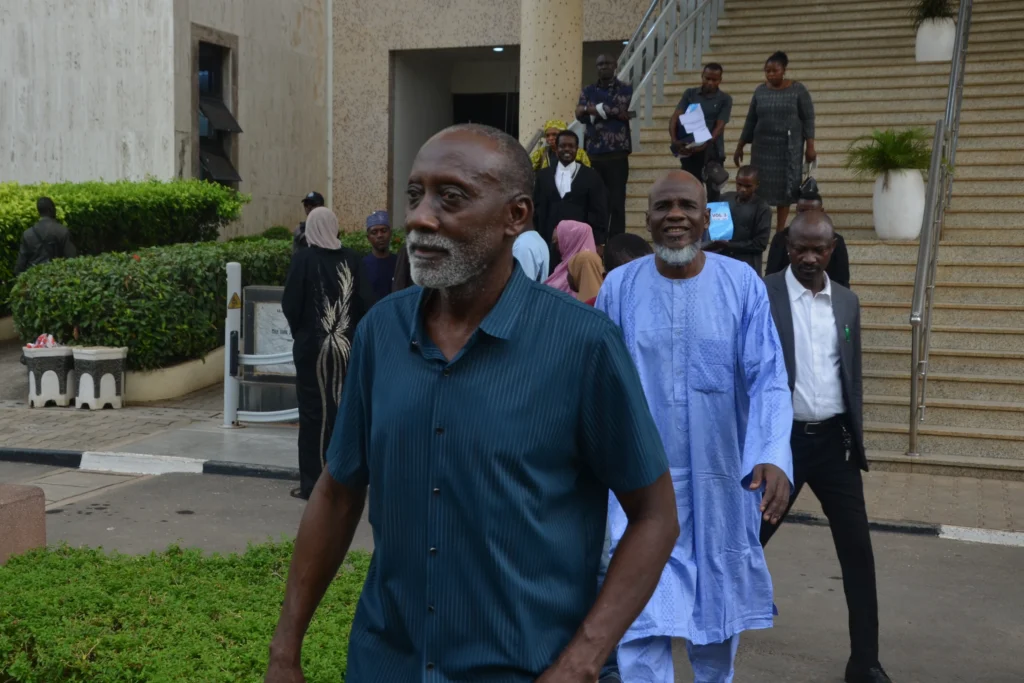
Presiding judge Joyce Abdulmalik scheduled the next hearing for April 27, when the court is expected to consider bail requests and begin substantive arguments. The accused were ordered to remain in custody under the Department of State Services pending further proceedings.
Prosecutors contend that the group worked in concert to undermine the government, alleging in court filings that the suspects “conspired with one another to levy war against the state” in an attempt to intimidate the presidency. The charges reflect what authorities describe as a coordinated effort to destabilize Nigeria’s democratic system.
A seventh suspect, former Bayelsa state governor Timipre Sylva, is also named in the case but remains at large. Investigators allege he played a role in concealing aspects of the purported plot.
Government legal officials have emphasized the seriousness of the case. Attorney General Lateef Fagbemi pressed for an accelerated trial timetable, citing the gravity of the accusations and their potential implications for national stability. The court signaled agreement with the urgency of the matter, setting a swift timeline following the defendants’ pleas.
Defense attorneys sought immediate bail for their clients during the hearing, but the court declined to entertain oral applications, directing counsel to submit formal written motions instead. Until then, the suspects will remain in detention under the supervision of the country’s domestic intelligence service.
The case stems from an alleged coup attempt first disclosed by Nigerian authorities in January. At the time, officials indicated that several individuals, including military personnel, had been detained as part of an investigation into efforts to challenge the government by force. The current proceedings mark the most advanced stage of that investigation.
Nigeria has maintained civilian rule since 1999, following decades of military governance. The allegations now before the court represent a rare and serious challenge to that democratic order, raising concerns about internal divisions within the security apparatus.
The trial unfolds against a backdrop of significant national strain. Nigeria continues to grapple with economic pressures, including inflation and currency instability, alongside persistent security threats in various regions. Armed groups operating in the north have intensified attacks in recent months, stretching military resources and heightening public anxiety.
In October, President Tinubu initiated a sweeping reorganization of the military’s leadership, a move aides described as an effort to strengthen command structures and improve operational effectiveness. Analysts say the leadership changes reflected concerns within the government about both external threats and internal cohesion.
The unfolding trial offers a window into deeper structural challenges facing Nigeria’s political and security institutions. While the charges against the accused remain to be proven in court, the mere existence of such allegations signals potential fractures within elite circles, particularly among those with security backgrounds.
Historically, coup attempts in Nigeria were often driven by dissatisfaction within the military or broader governance concerns. Although the country has experienced more than two decades of uninterrupted democratic rule, analysts caution that economic hardship and security instability can create conditions that test institutional resilience.
The Tinubu administration has emphasized stability and reform, but the convergence of economic strain and ongoing violence in parts of the country has complicated those efforts. Public confidence in governance can be influenced by perceptions of security, and high-profile cases such as this one may further shape political discourse ahead of future elections.
Another critical dimension is the role of the judiciary. The handling of the case will likely be closely watched both domestically and internationally, as it may serve as a benchmark for how Nigeria addresses allegations of threats to its constitutional order. A transparent and credible legal process could reinforce confidence in democratic institutions, while any perceived irregularities could deepen skepticism.
The involvement of a former state governor as a suspect adds a political layer to the case, raising questions about the intersection of security, politics, and accountability. It also underscores the complexity of addressing alleged conspiracies that may span both military and civilian spheres.
At the same time, the government’s decision to pursue the case aggressively reflects a broader strategy to deter any attempts to destabilize the state. By signaling a zero-tolerance approach to alleged coup plotting, authorities aim to reinforce the message that democratic governance remains firmly in place.
However, the broader implications extend beyond the courtroom. The case highlights the importance of addressing underlying issues such as economic inequality, governance challenges, and regional security threats. Without progress on these fronts, experts warn that tensions could persist, potentially creating an environment where instability becomes more likely.
For now, attention remains focused on the upcoming court date, where the next phase of the trial will begin. As proceedings move forward, the case is expected to remain a focal point in Nigeria’s political landscape, reflecting both the resilience and the vulnerabilities of its democratic system.





