

Donald Trump on Thursday directed U.S. naval forces to destroy any small vessels laying mines in the Strait of Hormuz, escalating a confrontation with Iran as tensions over the vital shipping route intensify.
In a message posted on social media, Trump said he had instructed the U.S. Navy to take immediate and lethal action against boats involved in placing explosive devices in the waterway, a key artery for global energy supplies. He added that American minesweeping operations were already underway and would be expanded significantly.
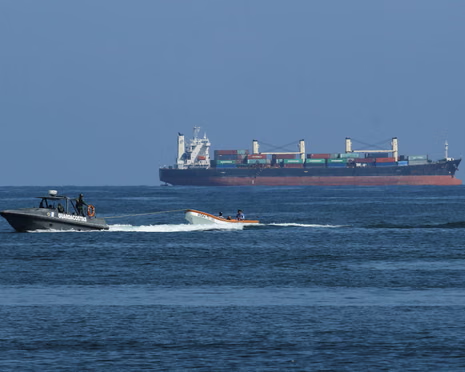
The directive came shortly after U.S. forces intercepted another oil tanker linked to Iranian trade activity, part of a broader campaign aimed at enforcing restrictions on shipments tied to Tehran. Defense officials also released video showing American personnel on board a seized vessel in the Indian Ocean, underscoring the growing scope of maritime operations tied to the dispute.
The escalation follows a series of recent incidents in which commercial ships have come under attack in or near the strait. The waterway handles roughly one-fifth of the world’s oil and natural gas shipments, making it one of the most strategically sensitive maritime corridors in the global economy.
Iranian authorities signaled defiance in response to the rising pressure. Judiciary chief Gholam Hossein Mohseni Ejei praised recent actions by Iranian forces in the region, describing them as a demonstration of national strength. Iranian officials have also insisted that enforcement measures in the strait are justified, while denying wrongdoing in incidents involving commercial vessels.
At the same time, uncertainty continues to surround diplomatic efforts aimed at easing the crisis. Talks expected to take place in Islamabad have yet to materialize, with both Washington and Tehran holding firm on preconditions. Iranian leaders have demanded an end to U.S. restrictions on their ports and shipping, while U.S. officials insist that maritime traffic must resume freely before negotiations can proceed.
Amid the standoff, Pope Leo XIV called for renewed dialogue between the two sides, urging a peaceful resolution to a conflict that has already had far-reaching consequences.
The conflict has strained a fragile ceasefire that Trump recently extended, citing the need to allow Iranian leadership more time to present a unified negotiating position. Despite the extension, both sides have continued actions that have fueled tensions, including seizures of vessels and attacks on shipping.
Ship-tracking data indicates that multiple vessels associated with Iranian oil trade have been intercepted or targeted in recent days. One such tanker, previously sanctioned by the U.S. Treasury, was seized while en route to East Asia. Iranian officials have not issued an immediate response to the latest seizure, though earlier statements suggest a readiness to respond to perceived aggression.
Trump also suggested internal divisions within Iran’s leadership, asserting that competing factions were struggling to coordinate their response to the crisis. Iranian leaders rejected that characterization, emphasizing national unity and dismissing the claim as a distraction from broader issues.
Beyond the immediate confrontation, the crisis has rippled across global markets. The threat to shipping has driven up energy prices, with oil costs climbing sharply since the conflict began. Disruptions in supply chains have also contributed to rising costs for goods and services worldwide, amplifying concerns about economic stability.
Security analysts warn that the use of naval mines represents a particularly dangerous escalation. Mines can remain hidden and pose long-term risks to shipping, even after active hostilities subside. Maritime experts say clearing such threats requires extensive operations and sustained coordination, raising the stakes for any prolonged conflict in the region.
The latest directive from Trump reflects a shift toward more aggressive enforcement measures in one of the world’s most critical waterways. By authorizing direct action against suspected mine-laying vessels, the United States is signaling a willingness to escalate militarily to ensure freedom of navigation.
However, this approach carries significant risks. The Strait of Hormuz is not only a strategic chokepoint but also a flashpoint where miscalculations can quickly spiral into broader conflict. Even limited engagements at sea have the potential to disrupt global energy flows, with immediate consequences for markets and economies.
Iran’s ability to influence traffic through the strait remains a key leverage point. By demonstrating control over the waterway, Tehran can exert pressure not only on the United States but also on countries dependent on energy shipments passing through the region. This dynamic complicates efforts to isolate Iran economically, as disruptions affect a wide range of international stakeholders.
The stalled diplomatic track further underscores the challenges of de-escalation. With both sides insisting on preconditions, the path to negotiations appears uncertain. The longer the standoff continues, the greater the likelihood that incidents at sea could intensify, reducing the chances of a quick resolution.
At the same time, the conflict highlights broader questions about global energy security. Heavy reliance on a single transit route for a significant share of the world’s oil and gas creates vulnerabilities that can be exploited during periods of geopolitical tension. Efforts to diversify supply routes and energy sources may gain renewed urgency as the crisis unfolds.
For now, the situation remains volatile, with military actions and diplomatic signals moving in parallel. As operations continue in and around the Strait of Hormuz, the world is watching closely, aware that developments in this narrow stretch of water can have far-reaching consequences well beyond the region.
AP original story





