

Armed men kidnapped dozens of worshippers from a mosque in Nigeria’s Niger State on Friday, part of a broader spree of attacks across several villages in the remote Borgu Local Government Area, police said.
Police spokesperson Wasiu Abiodun said assailants struck a string of villages before attacking a mosque in Kpenya village during Friday prayers. Borgu area council chairman Abdullahi Mohammed Nasir said gunmen surrounded the mosque and took worshippers away as they prayed. “People were abducted while praying at a Juma’at mosque on Friday,” Nasir said, describing how the attackers encircled the building before seizing those inside.
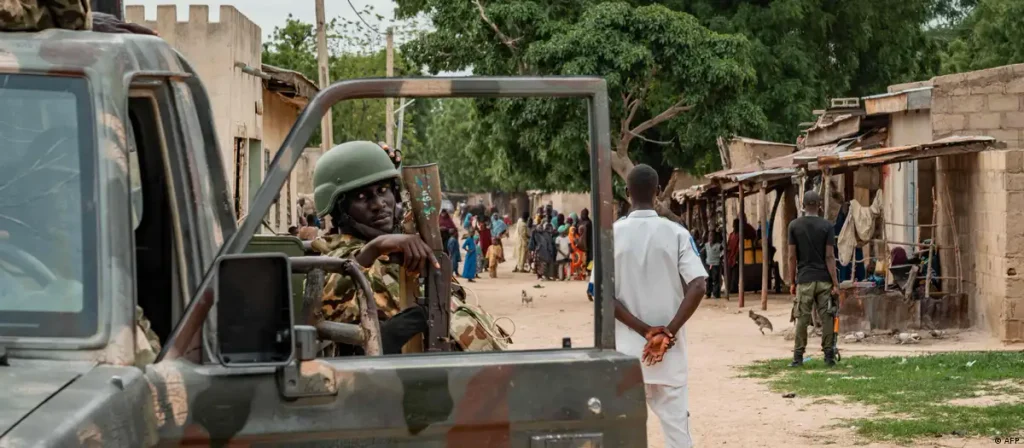
Accounts differed sharply on whether anyone was killed during the attack, a discrepancy that remained unresolved as of the latest reporting. Police said their developing report indicated no lives were lost, and Abiodun reiterated that assessment without providing specific casualty figures.
Multiple witnesses gave a starkly different account, telling AFP that gunmen killed several people during the assault. One survivor described armed men numbering in the hundreds, carrying guns, knives and machetes, who attacked worshippers immediately after Friday prayers concluded. “They slaughtered some of our people, saying we are not practicing the true teachings of Islam,” the survivor told AFP.
What We Know So Far
Estimates of how many people were kidnapped also varied. Nasir said at least 60 people were taken, while Zubairu Umar Talba, a youth leader in the Dekara area of Borgu, said roughly 80 people from his community had been abducted, adding that many residents had fled the area and that no one could provide an exact figure given the scale of displacement. Talba said his own 85 year old father was among those taken. Other local residents cited figures as high as 60 to 80 people kidnapped, consistent with the range described by Nasir and Talba.
Nasir said an unspecified number of people sustained gunshot injuries while attempting to escape the attackers. Abiodun said the Nigerian military had been deployed to the area and that a search for survivors was underway Saturday.
No group has claimed responsibility for the attack, and police have not identified those responsible. Witness accounts pointed to differing possible culprits. One witness told AFP the attackers belonged to Lakurawa, an increasingly radicalized group researchers have linked to the Islamic State Sahel Province.
Another resident told AFP the attackers were members of Ansaru, a group that split from Boko Haram and is now aligned with al-Qaida. Witnesses also described a third, rival group known as Mahmuda clashing with the attackers during the incident, which allowed some abducted worshippers to escape. None of these claims about the attackers’ identity have been officially confirmed by Nigerian authorities.
Why This Matters
While large scale jihadist attacks in Nigeria have declined since the peak of the Boko Haram insurgency roughly a decade ago, the country’s military and police remain stretched thin across multiple, sometimes overlapping conflicts.
Beyond jihadist activity concentrated in northern Nigeria, other regions face separate waves of violence and kidnapping carried out by non-ideological criminal gangs locally known as bandits, meaning security forces must respond to distinct and simultaneous threats with limited resources.
The stark contradiction between police assurances that no one died and witness accounts describing killings underscores a recurring challenge in reporting on attacks in remote parts of Nigeria, where initial official assessments often lag behind or conflict with accounts from residents directly affected.
The competing claims about which armed group carried out the attack, spanning three distinct organizations with different ideological affiliations, further illustrates the complex and fragmented landscape of armed groups operating in the region, complicating both public understanding of the threat and any coordinated security response.
Related: Deadly Attack on Security Forces in Niger
Separately, in the neighboring country of Niger, at least 18 members of Niger’s security forces were killed in an attack on a gendarmerie position in Tessa, a rural commune in the Dosso Region near the border with Nigeria, according to Sahara Reporters, citing local sources.
The attack occurred Friday, August 21, when assailants stormed the position occupied by National Gendarmerie personnel, overran and vandalized the camp, and then withdrew from the area, according to sources cited by Zagazola Makama.
At least three security personnel were reportedly rescued following the assault, though the incident resulted in heavy casualties among the personnel stationed there. Attackers also reportedly vandalized two money transfer agencies in Tessa before fleeing.
Local sources described it as one of the deadliest assaults on Nigerien security forces in the area in recent memory. No group has claimed responsibility, and Niger’s government had not issued an official statement on the incident as of Saturday.
Several planned community and sporting events in the region were canceled following the attack as residents mourned the victims, whose bodies were taken to Tessa and were expected to be buried in Dosso on Saturday afternoon.
Though this attack occurred in the Republic of Niger rather than Nigeria’s Niger State, the two incidents both reflect the intensifying security pressures facing communities along the Niger-Nigeria border, an area increasingly affected by overlapping activity from armed and terrorist groups operating across the wider Sahel region.
What Happens Next
Nigerian authorities are continuing search efforts for the kidnapped worshippers and for anyone who may have escaped or been injured during the mosque attack. Officials have not indicated how negotiations, if any, might proceed for the release of those abducted, and no group has come forward to make ransom demands as of the latest reporting.
In Niger, further details on the identities of the attackers, their motive and the circumstances of the Tessa assault remain unavailable, with the Nigerien government yet to issue a formal statement. Both incidents are likely to draw continued regional and international attention given their scale and their location in an already volatile border region.
Reporting drawn from the Associated Press, Deutsche Welle, AFP, Reuters and SaharaReporters





